Infants and Child Restraints
•
Safety experts recommend that children ride
rearward-facing in the vehicle until they are at least
one year old and weigh at least 20 lbs (9 kg). Two types
of child restraints can be used rearward-facing: infant
carriers and “convertible” child seats.
•The infant carrier is only used rearward-facing in the
vehicle. It is recommended for children who weigh up
to about 20 lbs (9 kg). “Convertible” child seats can be
used either rearward-facing or forward-facing in the
vehicle. Convertible child seats often have a higher
weight limit in the rearward-facing direction than in-
fant carriers do, so they can be used rearward-facing by
children who weigh more than 20 lbs (9 kg) but are less
than one year old. Both types of child restraints are held
in the vehicle by the lap/shoulder belt or the LATCH
anchorage system. (See the LATCH — Child Seat An-
chorage System section for greater explanation.)
•Rearward-facing child seats mustNEVERbe used in
the front seat of a vehicle with a front passenger
airbag. An airbag deployment could cause severe
injury or death to infants in this position.
WARNING!
•A rearward facing infant restraint should only be
used in a rear seat. A rearward facing infant
restraint in the front seat may be struck by a
deploying passenger airbag which may cause se-
vere or fatal injury to the infant.
•Improper installation can lead to failure of an
infant or child restraint. It could come loose in a
collision. The child could be badly injured or
killed. Follow the manufacturer’s directions ex-
actly when installing an infant or child restraint.
Here are some tips on getting the most out of your child
restraint:
•Before buying any restraint system, make sure that it
has a label certifying that it meets all applicable Safety
Standards. We also recommend that you try a child
restraint in the vehicle seats where you will use it
before you buy it.
THINGS TO KNOW BEFORE STARTING YOUR VEHICLE 41
2
•The restraint must be appropriate for your child’s
weight and height. Check the label on the restraint for
weight and height limits.
•Carefully follow the instructions that come with the
restraint. If you install the restraint improperly, it may
not work when you need it.
•Buckle the child into the seat according to the seat
manufacturer’s directions.
•When your child restraint is not in use, secure it in the
vehicle with the seat belt or remove it from the vehicle.
Do not leave it loose in the vehicle. In a sudden stop or
collision, it could strike the occupants or seat backs
and cause serious personal injury.
NOTE:For additional information, refer to
www.seatcheck.org or call 1–866–SEATCHECK.
Older Children and Child Restraints
Children who weigh more than 20 lbs (9 kg) and who are
older than one year can ride forward-facing in the
vehicle. Forward-facing child seats and convertible child
seats used in the forward-facing direction are for children
who weigh 20 to 40 lbs (9 to 18 kg) and who are olderthan one year. These child seats are also held in the
vehicle by the lap/shoulder belt or the LATCH anchor-
age system. (See the LATCH — Child Seat Anchorage
System Section.)
The belt-positioning booster seat is for children weighing
more than 40 lbs (18 kg), but who are still too small to fit
the vehicle’s seat belts properly. If the child cannot sit
with knees bent over the vehicle’s seat cushion while the
child’s back is against the seat back, they should use a
belt-positioning booster seat. The child and belt-
positioning booster seat are held in the vehicle by the
lap/shoulder belt.
Children Too Large For Booster Seats
Children who are large enough to wear the shoulder belt
comfortably, and whose legs are long enough to bend
over the front of the seat when their back is against the
seatback, should use the lap/shoulder belt in the rear
seat.
•Make sure that the child is upright in the seat.
•The lap portion should be low on the hips and as snug
as possible.
42 THINGS TO KNOW BEFORE STARTING YOUR VEHICLE
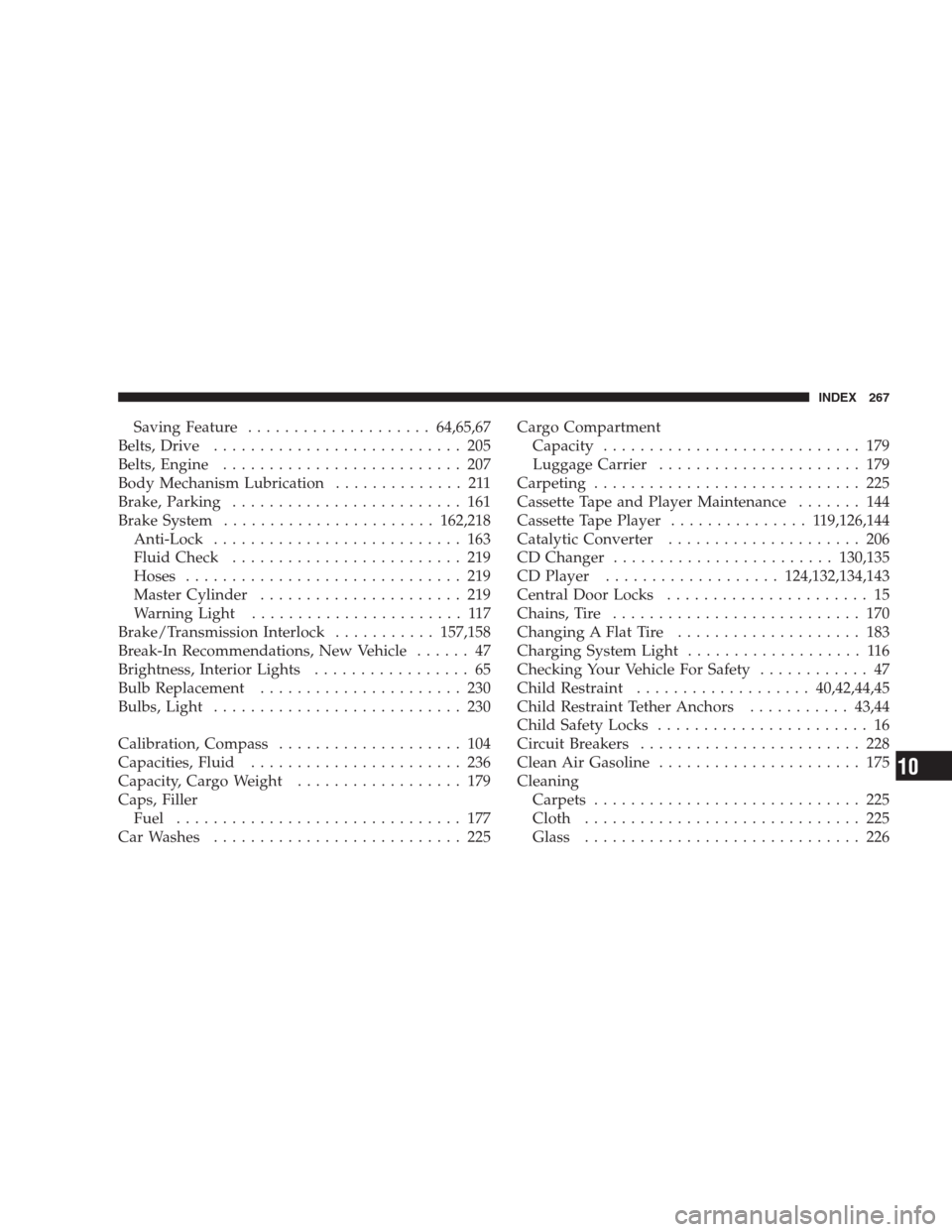
Saving Feature....................64,65,67
Belts, Drive........................... 205
Belts, Engine.......................... 207
Body Mechanism Lubrication.............. 211
Brake, Parking......................... 161
Brake System.......................162,218
Anti-Lock........................... 163
Fluid Check......................... 219
Hoses.............................. 219
Master Cylinder...................... 219
Warning Light....................... 117
Brake/Transmission Interlock...........157,158
Break-In Recommendations, New Vehicle...... 47
Brightness, Interior Lights................. 65
Bulb Replacement...................... 230
Bulbs, Light........................... 230
Calibration, Compass.................... 104
Capacities, Fluid....................... 236
Capacity, Cargo Weight.................. 179
Caps, Filler
Fuel............................... 177
Car Washes........................... 225Cargo Compartment
Capacity............................ 179
Luggage Carrier...................... 179
Carpeting............................. 225
Cassette Tape and Player Maintenance....... 144
Cassette Tape Player............... 119,126,144
Catalytic Converter..................... 206
CD Changer........................130,135
CD Player...................124,132,134,143
Central Door Locks...................... 15
Chains, Tire........................... 170
Changing A Flat Tire.................... 183
Charging System Light................... 116
Checking Your Vehicle For Safety............ 47
Child Restraint...................40,42,44,45
Child Restraint Tether Anchors...........43,44
Child Safety Locks....................... 16
Circuit Breakers........................ 228
Clean Air Gasoline...................... 175
Cleaning
Carpets............................. 225
Cloth.............................. 225
Glass.............................. 226
INDEX 267
10