Page 182 of 277
HAZARD WARNING FLASHER
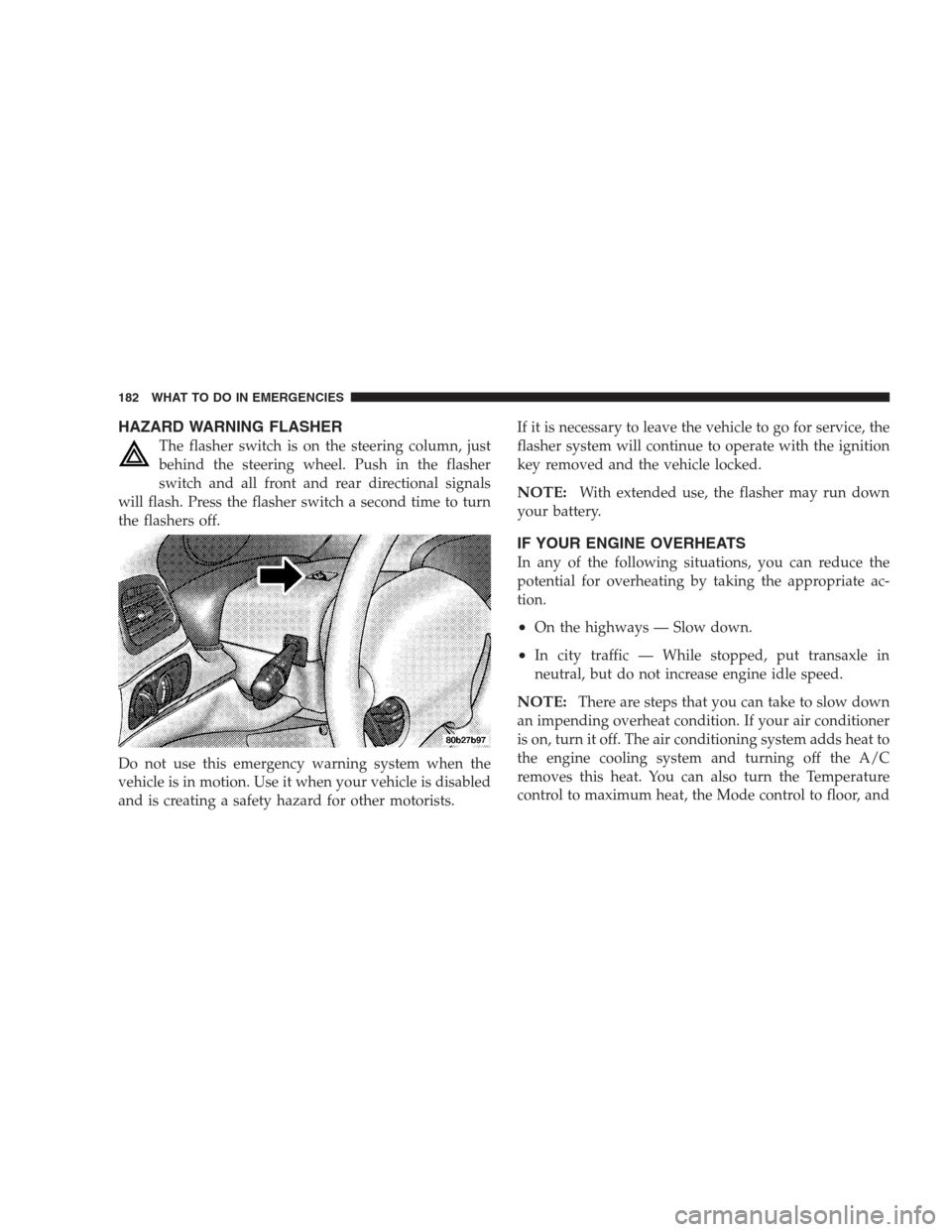
The flasher switch is on the steering column, just
behind the steering wheel. Push in the flasher
switch and all front and rear directional signals
will flash. Press the flasher switch a second time to turn
the flashers off.
Do not use this emergency warning system when the
vehicle is in motion. Use it when your vehicle is disabled
and is creating a safety hazard for other motorists.If it is necessary to leave the vehicle to go for service, the
flasher system will continue to operate with the ignition
key removed and the vehicle locked.
NOTE:With extended use, the flasher may run down
your battery.
IF YOUR ENGINE OVERHEATS
In any of the following situations, you can reduce the
potential for overheating by taking the appropriate ac-
tion.
•On the highways — Slow down.
•In city traffic — While stopped, put transaxle in
neutral, but do not increase engine idle speed.
NOTE:There are steps that you can take to slow down
an impending overheat condition. If your air conditioner
is on, turn it off. The air conditioning system adds heat to
the engine cooling system and turning off the A/C
removes this heat. You can also turn the Temperature
control to maximum heat, the Mode control to floor, and
182 WHAT TO DO IN EMERGENCIES
Page 184 of 277
Preparations For Jacking
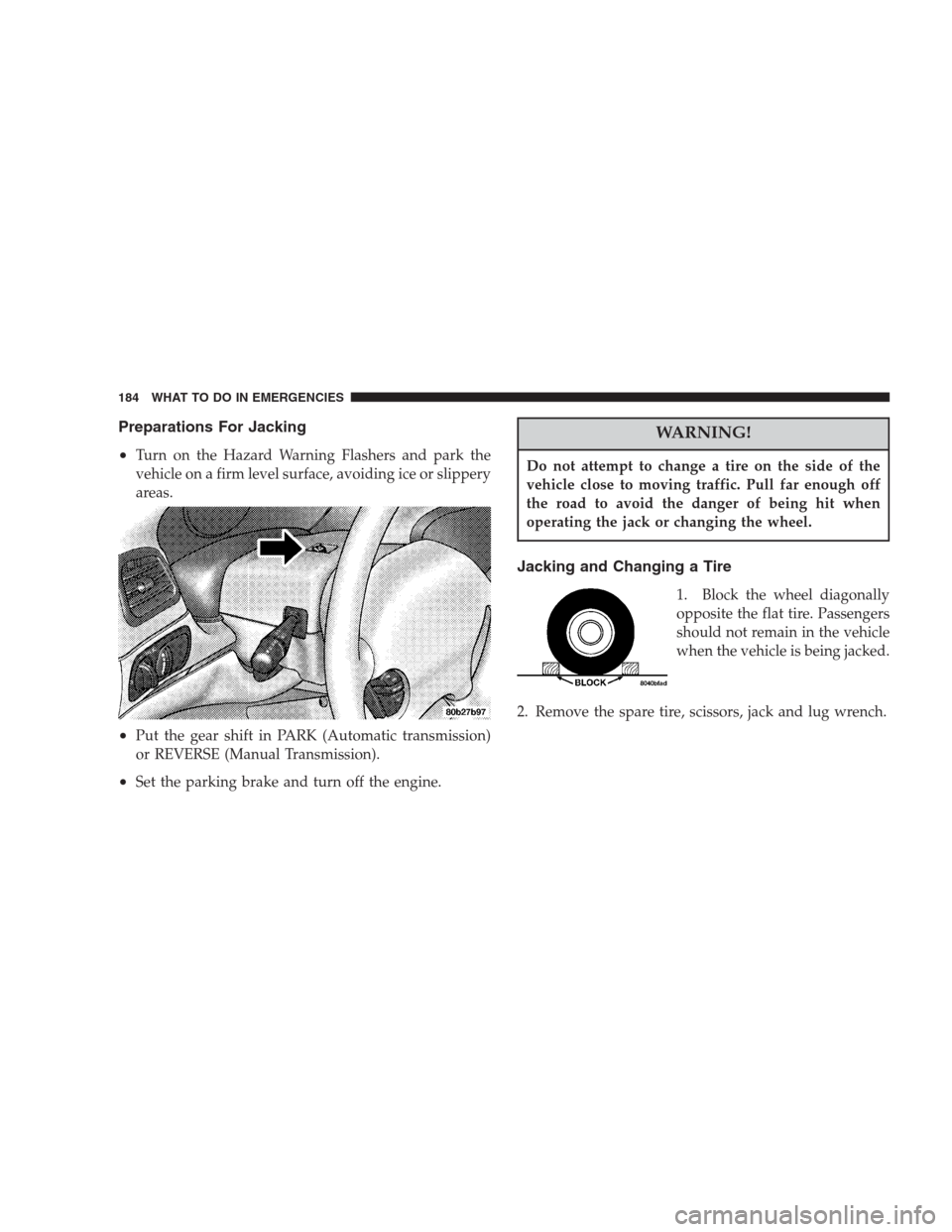
•
Turn on the Hazard Warning Flashers and park the
vehicle on a firm level surface, avoiding ice or slippery
areas.
•Put the gear shift in PARK (Automatic transmission)
or REVERSE (Manual Transmission).
•Set the parking brake and turn off the engine.
WARNING!
Do not attempt to change a tire on the side of the
vehicle close to moving traffic. Pull far enough off
the road to avoid the danger of being hit when
operating the jack or changing the wheel.
Jacking and Changing a Tire
1. Block the wheel diagonally
opposite the flat tire. Passengers
should not remain in the vehicle
when the vehicle is being jacked.
2. Remove the spare tire, scissors, jack and lug wrench.
184 WHAT TO DO IN EMERGENCIES
Page 186 of 277
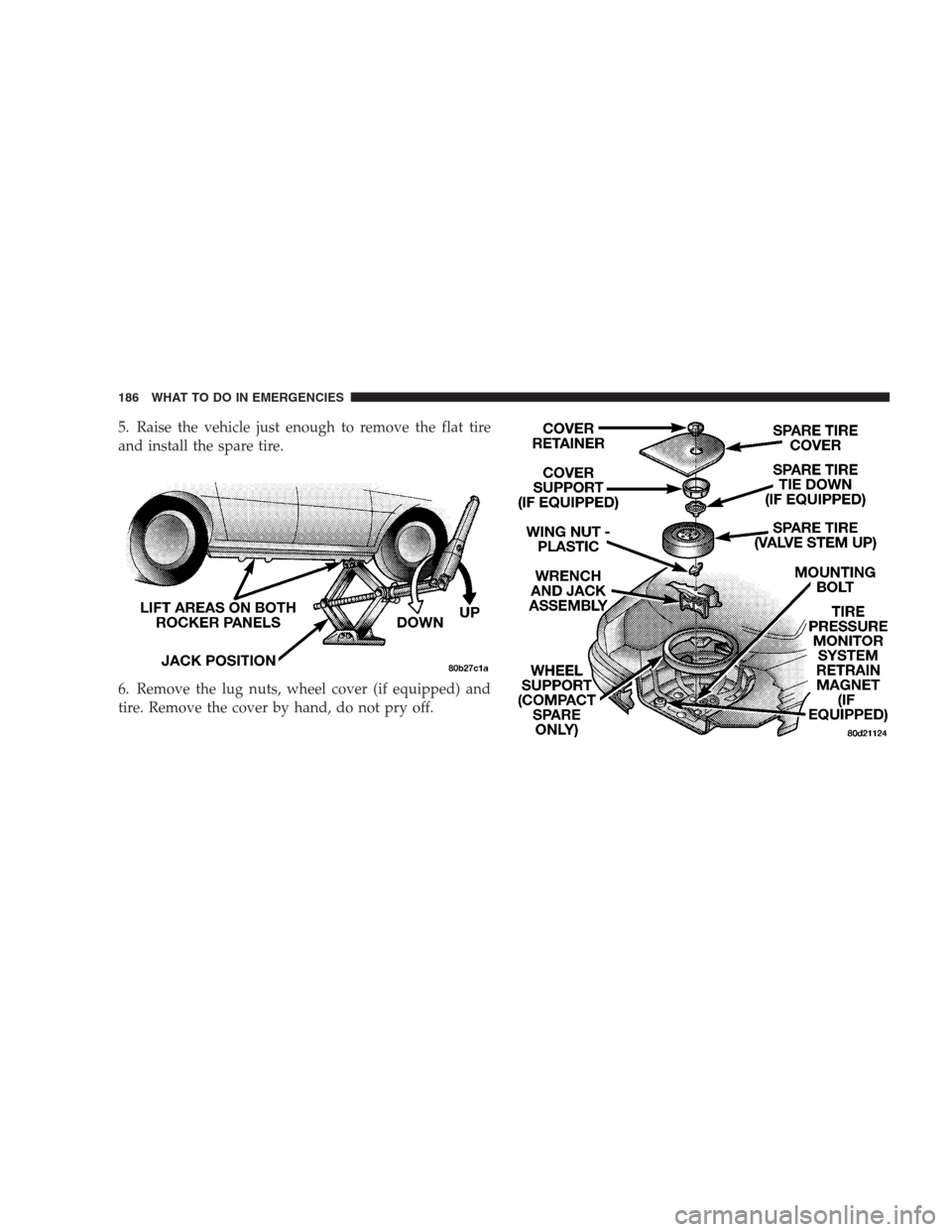
5. Raise the vehicle just enough to remove the flat tire
and install the spare tire.
6. Remove the lug nuts, wheel cover (if equipped) and
tire. Remove the cover by hand, do not pry off.
186 WHAT TO DO IN EMERGENCIES
Page 187 of 277
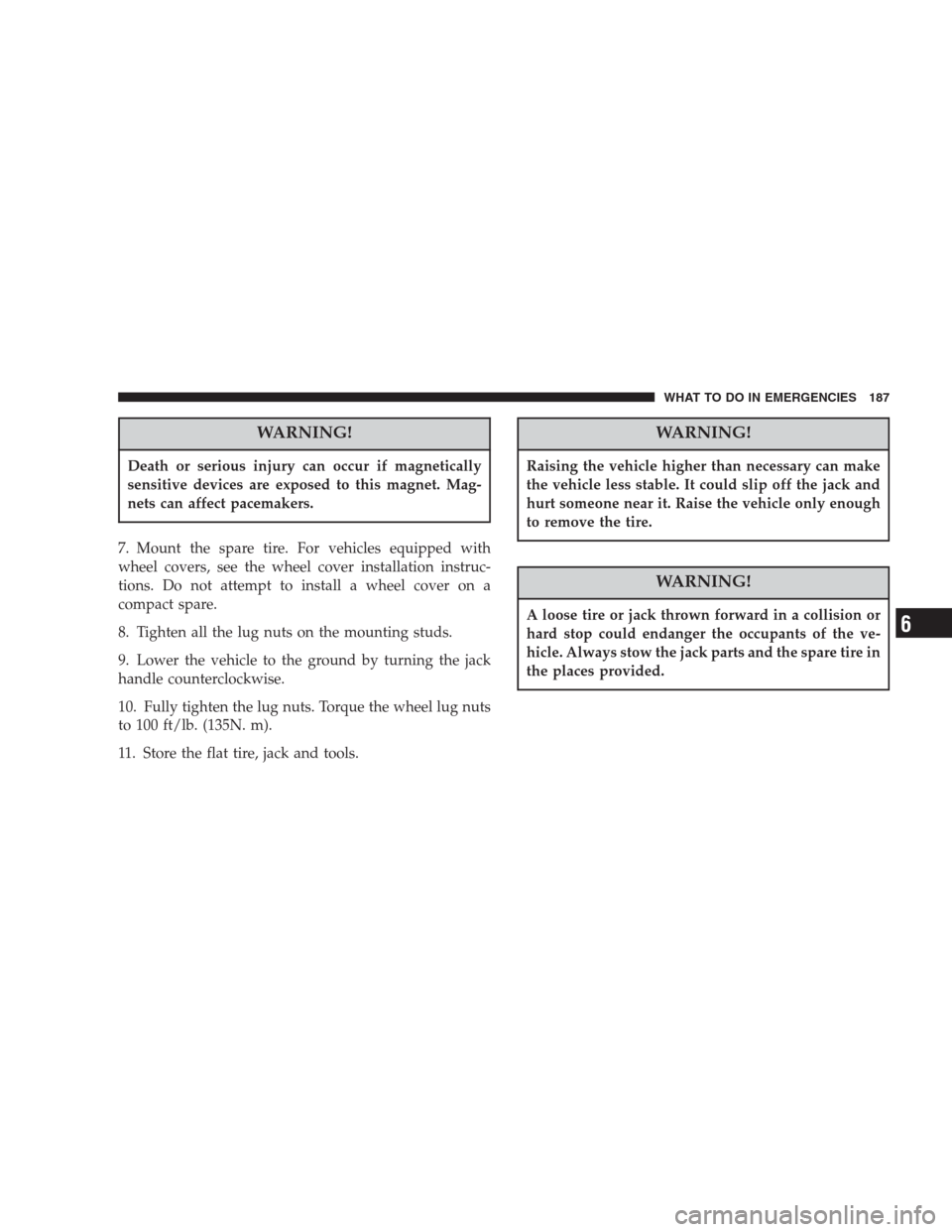
WARNING!
Death or serious injury can occur if magnetically
sensitive devices are exposed to this magnet. Mag-
nets can affect pacemakers.
7. Mount the spare tire. For vehicles equipped with
wheel covers, see the wheel cover installation instruc-
tions. Do not attempt to install a wheel cover on a
compact spare.
8. Tighten all the lug nuts on the mounting studs.
9. Lower the vehicle to the ground by turning the jack
handle counterclockwise.
10. Fully tighten the lug nuts. Torque the wheel lug nuts
to 100 ft/lb. (135N. m).
11. Store the flat tire, jack and tools.
WARNING!
Raising the vehicle higher than necessary can make
the vehicle less stable. It could slip off the jack and
hurt someone near it. Raise the vehicle only enough
to remove the tire.
WARNING!
A loose tire or jack thrown forward in a collision or
hard stop could endanger the occupants of the ve-
hicle. Always stow the jack parts and the spare tire in
the places provided.
WHAT TO DO IN EMERGENCIES 187
6
Page 188 of 277
Compact Spare Tire-For Temporary Emergency
Use Only
•
Keep tire inflated to 60 PSI (414 KPa) Cold Inflation
Pressure.
•Avoid driving more than 50 miles (80 km) before
replacing tire and wheel.
•This tire is designed as an emergency spare only-do
not exceed 50 MPH (80 km/h) speed.
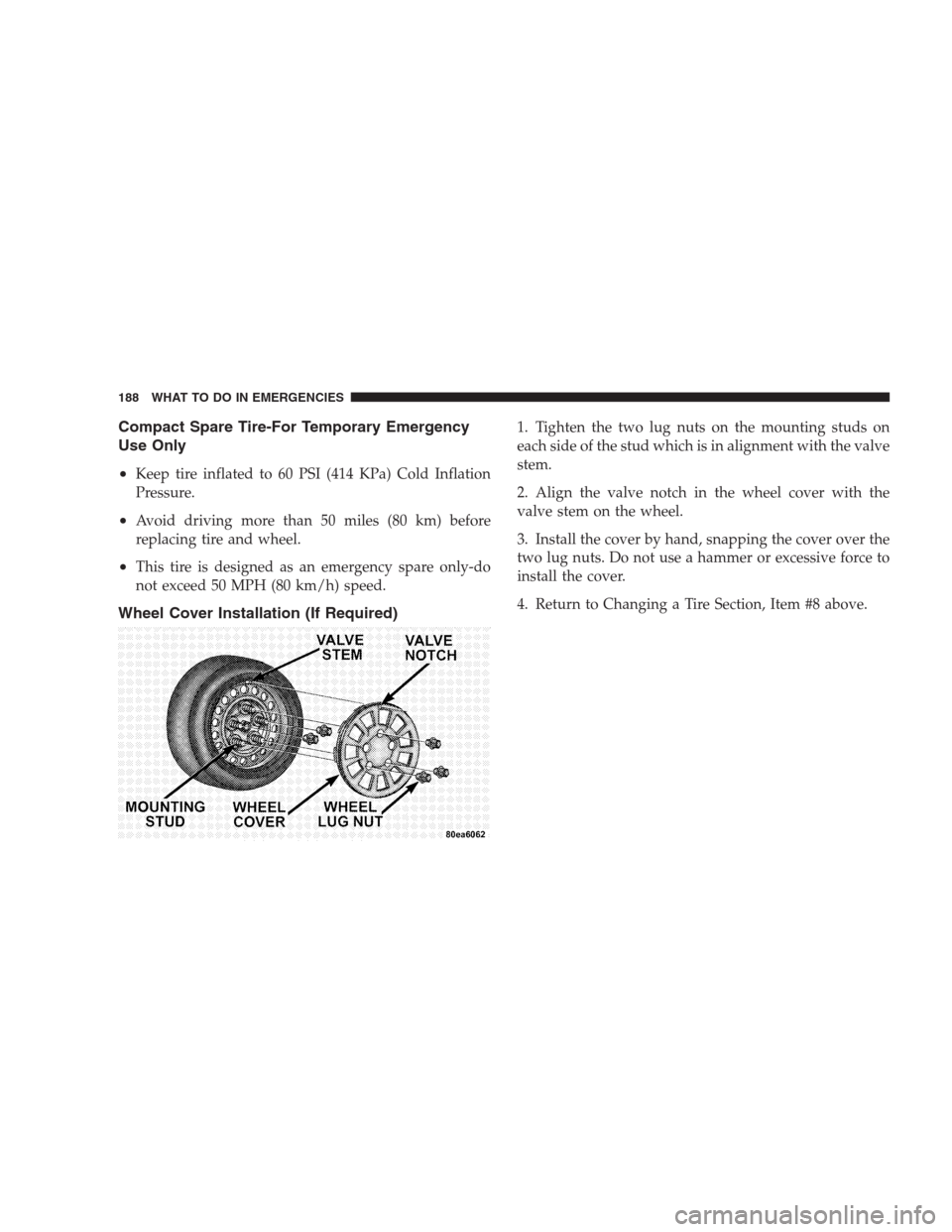
Wheel Cover Installation (If Required)
1. Tighten the two lug nuts on the mounting studs on
each side of the stud which is in alignment with the valve
stem.
2. Align the valve notch in the wheel cover with the
valve stem on the wheel.
3. Install the cover by hand, snapping the cover over the
two lug nuts. Do not use a hammer or excessive force to
install the cover.
4. Return to Changing a Tire Section, Item #8 above.
188 WHAT TO DO IN EMERGENCIES
Page 189 of 277
JUMP-STARTING THE BATTERY
WARNING!
Take care to avoid the radiator cooling fan whenever
the hood is raised. It can start anytime the ignition
switch is on. You can be hurt by the fan.
CAUTION!
Do not try to push or tow your vehicle to get it
started. Your vehicle cannot be started this way.
Pushing with another vehicle may damage the trans-
axle or the rear of your vehicle. If your vehicle has a
discharged (dead) battery, booster cables may be
used to obtain a start from another vehicle. This type
of start can be dangerous if done improperly, so
follow the procedure carefully.
WARNING!
Battery fluid is a corrosive acid solution; do not
allow battery fluid to contact eyes, skin or clothing.
Don’t lean over battery when attaching clamps or
allow the clamps to touch each other. If acid splashes
in eyes or on skin, flush the contaminated area
immediately with large quantities of water.
A battery generates hydrogen gas which is flam-
mable and explosive. Keep flame or spark away
from the vent holes. Do not use a booster battery or
any other booster source with an output that exceeds
12 volts.
NOTE:The battery is stored in a compartment in front
of the tire in the right front fender and is accessible
through the engine compartment. The tire and wheel
need not be removed to gain access to the battery.
WHAT TO DO IN EMERGENCIES 189
6
Page 191 of 277
3. Turn off heater, radio and all unnecessary electrical
loads.
4. Connect one end of a jumper cable to the positive
jump start attachment of the booster battery. Connect the
other end of the same cable to the positive jump start
attachment of the discharged battery.5. Connect the other cable, first to the negative jump start
attachment of the booster battery and then to the engine
of the vehicle with the discharged battery. Make sure you
have a good contact on the engine.
6. Start the engine in the vehicle which has the booster
battery, let the engine idle a few minutes, then start the
engine in the vehicle with the discharged battery.
7. When removing the jumper cables, reverse the above
sequence exactly. Be careful of the moving belts and fan.
DRIVING ON SLIPPERY SURFACES
Acceleration
Rapid acceleration on snow covered, wet, or other slip-
pery surfaces may cause the front wheels to pull errati-
cally to the right or left. This phenomenon occurs when
there is a difference in the surface traction under the front
(driving) wheels.
WHAT TO DO IN EMERGENCIES 191
6
Page 192 of 277
WARNING!
Rapid acceleration on slippery surfaces is danger-
ous. Unequal traction can cause sudden pulling of
the front wheels. You could lose control of the
vehicle and possibly have an accident. Accelerate
slowly and carefully whenever there is likely to be
poor traction (ice, snow, wet, mud, loose sand, etc.).
Traction
When driving on wet or slushy roads, it is possible for a
wedge of water to build up between the tire and road
surface. This is known as hydroplaning and may cause
partial or complete loss of vehicle control and stopping
ability. To reduce this possibility, the following precau-
tions should be observed:
1. Slow down during rainstorms or when roads are
slushy.
2. Slow down if road has standing water or puddles.3. Replace tires when tread wear indicators first become
visible.
4. Keep tires properly inflated.
5. Maintain sufficient distance between your vehicle and
the vehicle in front of you to avoid a collision in a sudden
stop.
NOTE:If so equipped, turn on the Traction Control
System to accelerate on slippery surfaces.
FREEING A STUCK VEHICLE
If your vehicle is equipped with Traction Control, turn
the system off before attempting to “rock” the vehicle.
If your vehicle becomes stuck in mud, sand or snow, it
can often be moved by a rocking motion. Turn your
steering wheel right and left to clear the area around the
front wheels. Then shift back and forth between Reverse
and Drive. Usually the least accelerator pedal pressure to
maintain the rocking motion without spinning the
wheels is most effective.
192 WHAT TO DO IN EMERGENCIES