Page 80 of 277

Security
If you sell your vehicle, be sure to erase the frequencies.
To erase all of the previously trained frequencies, hold
down both outside buttons until the green light begins to
flash.
This device complies with part 15 of FCC rules and with
RS-210 of Industry Canada. Operation is subject to the
following conditions:
1. This device may not cause harmful interference.
2. This device must accept any interference that may be
received including interference that may cause undesired
operation.
NOTE:Changes or modifications not expressly ap-
proved by the party responsible for compliance could
void the user’s authority to operate the equipment.
HomeLink�is a trademark owned by Johnson Controls,
Inc.
GARAGE DOOR OPENER — IF EQUIPPED
Equipped in vehicles that have the optional Electronic
Vehicle Information Center (EVIC)
The HomeLink�Universal Transceiver replaces up to
three remote controls (hand-held transmitters) that oper-
ate devices such as garage door openers, motorized
gates, or home lighting. It triggers these devices at the
push of a button, located on the overhead console. The
universal transceiver operates off your vehicle’s battery
and charging system; no batteries are needed.
80 UNDERSTANDING THE FEATURES OF YOUR VEHICLE
Page 105 of 277
Outside Temperature
Because engine temperature can increase the displayed
temperature, temperature readings are slowly updated
when vehicle speed is below 20 mph (30 km/h).
ELECTRICAL POWER OUTLETS
Your vehicle may be equipped with two power outlets.
The primary power outlet is located in the forward
portion of the center console and in the lower center of
the instrument panel. Accessories powered through this
outlet are protected by a 15 amp fuse. The outlet may be
converted to a cigar lighter by installing the dealer
obtained smoker’s package. The outlet is operated by the
ignition switch, when in the “on/run” or “acc” positions
only. You may convert the outlet from ignition to battery
power by performing the following:
•Remove the fuse cover from the left end of the
instrument panel (see the paragraph on fuses in sec-
tion 7 of this manual.)
•Remove fuse #6 (its on the upper right of the fuse
block) from its “IGN” position.
UNDERSTANDING THE FEATURES OF YOUR VEHICLE 105
3
Page 106 of 277
•Move the fuse slightly right and insert it in the fuse #6
“BAT” location in the fuse block.
•Reinstall the fuse cover.
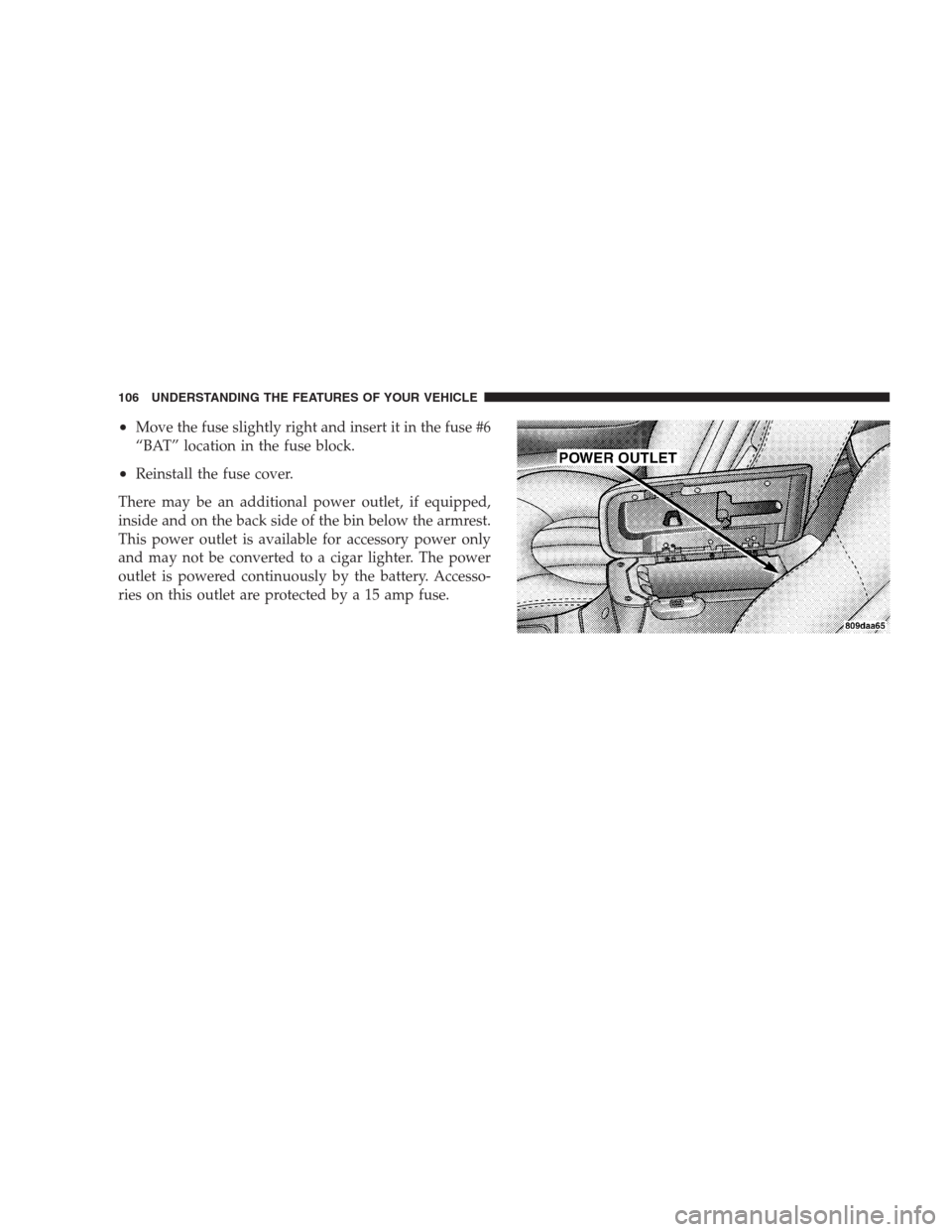
There may be an additional power outlet, if equipped,
inside and on the back side of the bin below the armrest.
This power outlet is available for accessory power only
and may not be converted to a cigar lighter. The power
outlet is powered continuously by the battery. Accesso-
ries on this outlet are protected by a 15 amp fuse.
106 UNDERSTANDING THE FEATURES OF YOUR VEHICLE
Page 155 of 277

STARTING PROCEDURES
WARNING!
Do not leave children or animals inside parked
vehicles in hot weather. Interior heat build up may
cause serious injury or death.
The gear selector must be in the NEUTRAL or PARK
position before you can start the engine. Apply the brakes
before shifting to any driving gear.
Normal Starting
Normal Starting of either a cold or a warm engine does
not require pumping or depressing the accelerator pedal.
Simply turn the key to the “START” position and release
when the engine starts. If the engine has not started
within 3 seconds, slightly depress the accelerator pedal
while continuing to crank. If the engine fails to start
within 15 seconds, turn the key to the “OFF” position,
wait 10 to 15 seconds, then repeat the normal starting
procedure.
Extremely Cold Weather (below -20°F or -29°C)
For reliable starting at these temperatures, use externally
powered battery and electric engine block heaters that
are available from your dealer.
STARTING AND OPERATING 155
5
Page 181 of 277
WHAT TO DO IN EMERGENCIES
CONTENTS
�Hazard Warning Flasher.................182
�If Your Engine Overheats................182
�Jacking And Tire Changing...............183
▫Preparations For Jacking................184
▫Jacking And Changing a Tire.............184
▫Compact Spare Tire-For Temporary Emergency
Use Only...........................188
▫Wheel Cover Installation (If Required)......188
�Jump-Starting The Battery...............189
�Driving On Slippery Surfaces.............191
▫Acceleration.........................191
▫Traction............................192
�Freeing A Stuck Vehicle.................192
�Towing A Disabled Vehicle...............193
6
Page 182 of 277
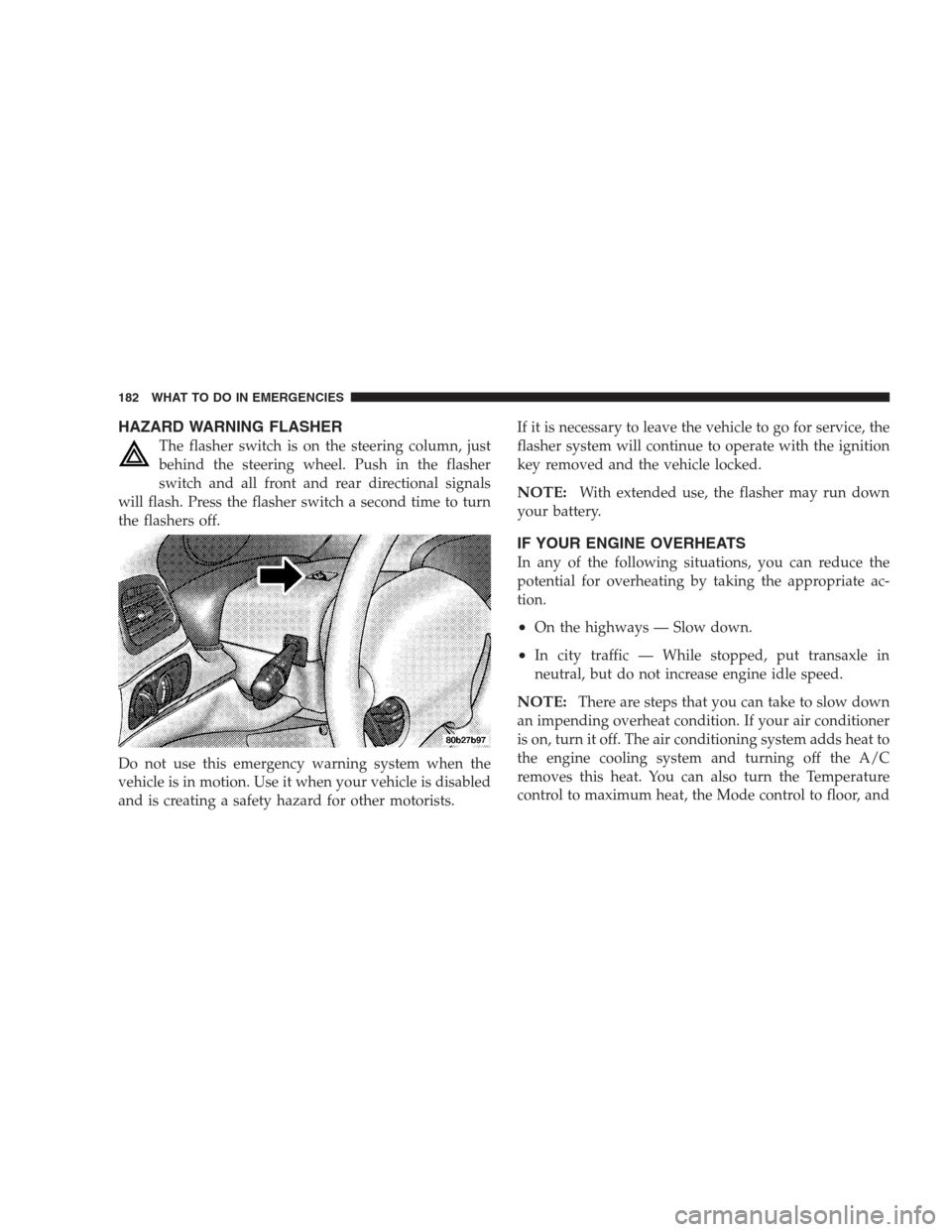
HAZARD WARNING FLASHER
The flasher switch is on the steering column, just
behind the steering wheel. Push in the flasher
switch and all front and rear directional signals
will flash. Press the flasher switch a second time to turn
the flashers off.
Do not use this emergency warning system when the
vehicle is in motion. Use it when your vehicle is disabled
and is creating a safety hazard for other motorists.If it is necessary to leave the vehicle to go for service, the
flasher system will continue to operate with the ignition
key removed and the vehicle locked.
NOTE:With extended use, the flasher may run down
your battery.
IF YOUR ENGINE OVERHEATS
In any of the following situations, you can reduce the
potential for overheating by taking the appropriate ac-
tion.
•On the highways — Slow down.
•In city traffic — While stopped, put transaxle in
neutral, but do not increase engine idle speed.
NOTE:There are steps that you can take to slow down
an impending overheat condition. If your air conditioner
is on, turn it off. The air conditioning system adds heat to
the engine cooling system and turning off the A/C
removes this heat. You can also turn the Temperature
control to maximum heat, the Mode control to floor, and
182 WHAT TO DO IN EMERGENCIES
Page 189 of 277
JUMP-STARTING THE BATTERY
WARNING!
Take care to avoid the radiator cooling fan whenever
the hood is raised. It can start anytime the ignition
switch is on. You can be hurt by the fan.
CAUTION!
Do not try to push or tow your vehicle to get it
started. Your vehicle cannot be started this way.
Pushing with another vehicle may damage the trans-
axle or the rear of your vehicle. If your vehicle has a
discharged (dead) battery, booster cables may be
used to obtain a start from another vehicle. This type
of start can be dangerous if done improperly, so
follow the procedure carefully.
WARNING!
Battery fluid is a corrosive acid solution; do not
allow battery fluid to contact eyes, skin or clothing.
Don’t lean over battery when attaching clamps or
allow the clamps to touch each other. If acid splashes
in eyes or on skin, flush the contaminated area
immediately with large quantities of water.
A battery generates hydrogen gas which is flam-
mable and explosive. Keep flame or spark away
from the vent holes. Do not use a booster battery or
any other booster source with an output that exceeds
12 volts.
NOTE:The battery is stored in a compartment in front
of the tire in the right front fender and is accessible
through the engine compartment. The tire and wheel
need not be removed to gain access to the battery.
WHAT TO DO IN EMERGENCIES 189
6
Page 190 of 277
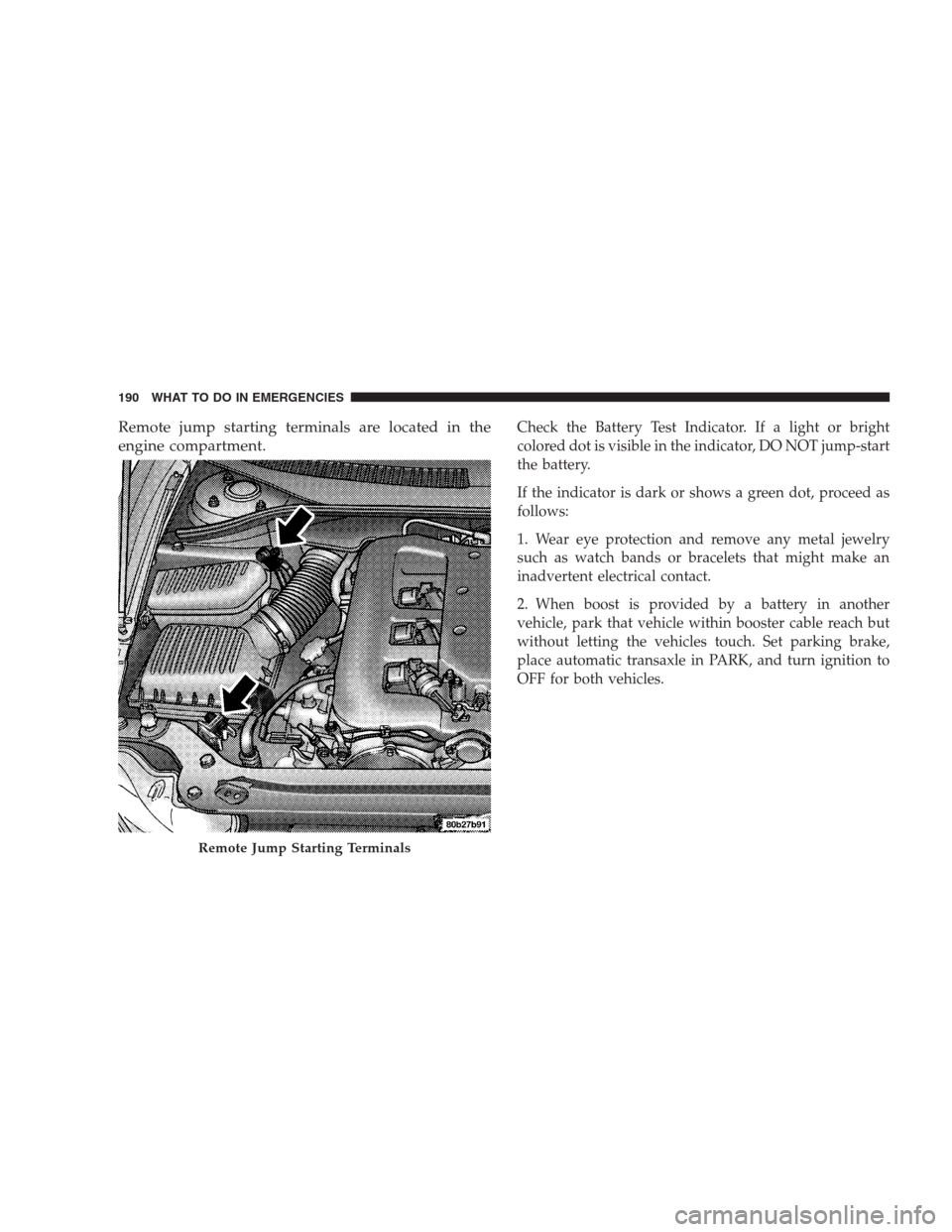
Remote jump starting terminals are located in the
engine compartment.Check the Battery Test Indicator. If a light or bright
colored dot is visible in the indicator, DO NOT jump-start
the battery.
If the indicator is dark or shows a green dot, proceed as
follows:
1. Wear eye protection and remove any metal jewelry
such as watch bands or bracelets that might make an
inadvertent electrical contact.
2. When boost is provided by a battery in another
vehicle, park that vehicle within booster cable reach but
without letting the vehicles touch. Set parking brake,
place automatic transaxle in PARK, and turn ignition to
OFF for both vehicles.
Remote Jump Starting Terminals
190 WHAT TO DO IN EMERGENCIES