Page 38 of 384
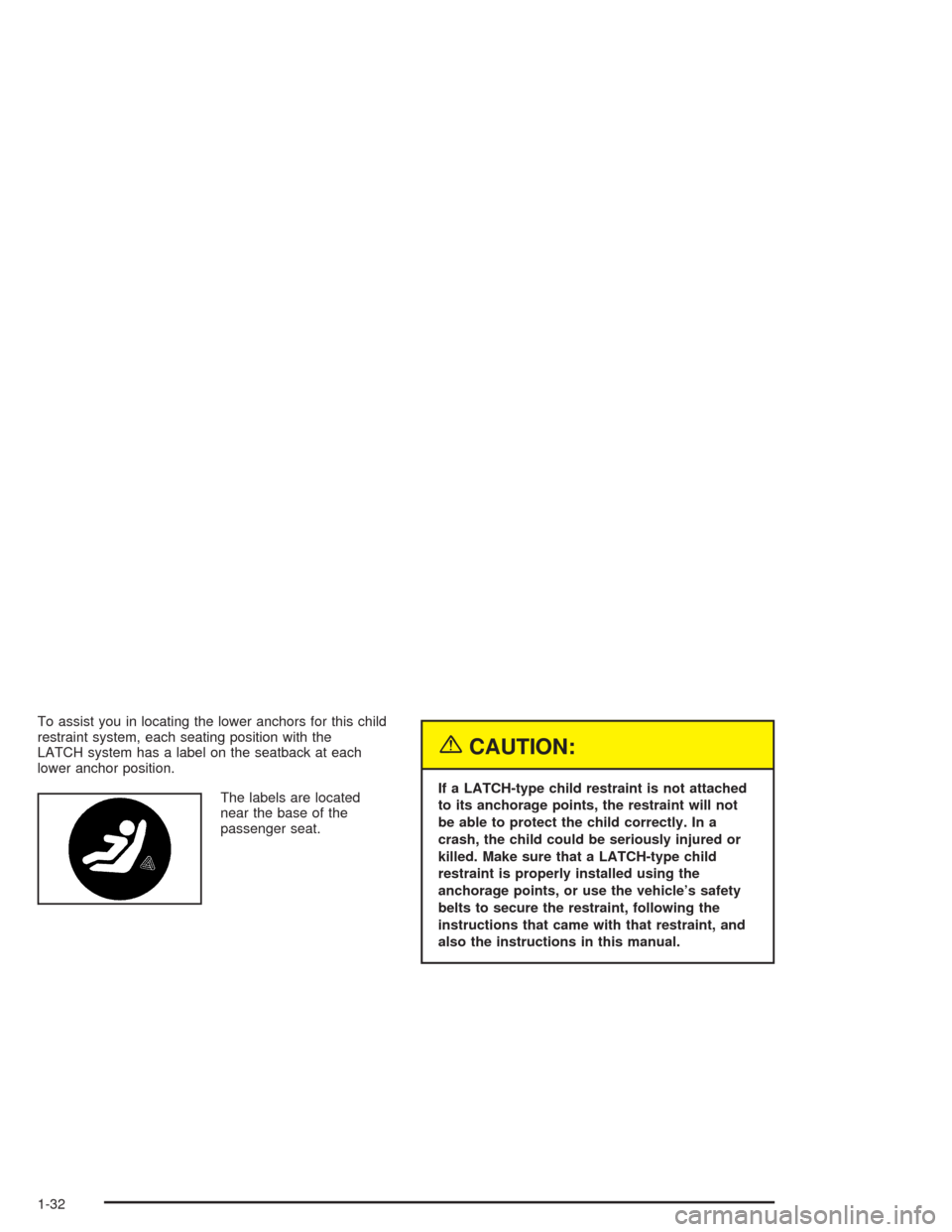
To assist you in locating the lower anchors for this child
restraint system, each seating position with the
LATCH system has a label on the seatback at each
lower anchor position.
The labels are located
near the base of the
passenger seat.
{CAUTION:
If a LATCH-type child restraint is not attached
to its anchorage points, the restraint will not
be able to protect the child correctly. In a
crash, the child could be seriously injured or
killed. Make sure that a LATCH-type child
restraint is properly installed using the
anchorage points, or use the vehicle’s safety
belts to secure the restraint, following the
instructions that came with that restraint, and
also the instructions in this manual.
1-32
Page 44 of 384
If your child restraint is equipped with the LATCH
system, seeLower Anchorages and Top Tethers for
Children (LATCH System) on page 1-30. SeeTop Strap
on page 1-28if the child restraint has one.
If your vehicle is a convertible or has a removable roof
panel, there are no top strap anchors in your vehicle.
Do not secure a child seat in a convertible or a vehicle
with a removable roof panel, if a national or local
law requires that the top strap be anchored, or if the
instructions that come with the restraint say that the top
strap must be anchored.
If your child restraint does not have the LATCH system
you will be using the lap-shoulder belt to secure the
child restraint in this position. Be sure to follow the
instructions that came with the child restraint. Secure
the child in the child restraint when and as the
instructions say.
1. Your vehicle has a passenger’s air bag. SeeAir
Bag Off Switch on page 1-46. If your child restraint
is forward-facing, always move the seat as far
back as it will go before securing it in this seat. See
Manual Seats on page 1-2orPower Seats on
page 1-2. Never use a rear-facing child restraint in
this seat unless the air bag is off.
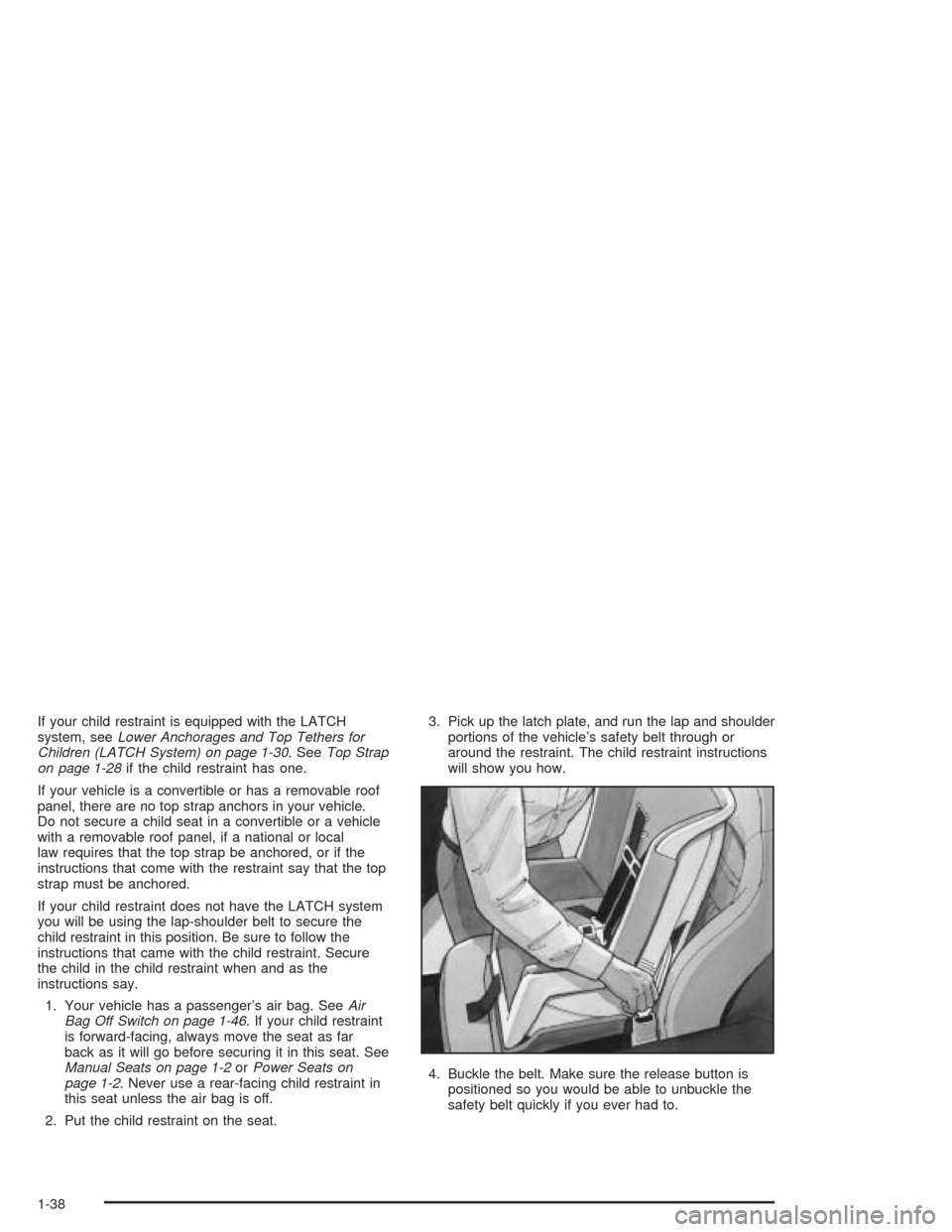
2. Put the child restraint on the seat.3. Pick up the latch plate, and run the lap and shoulder
portions of the vehicle’s safety belt through or
around the restraint. The child restraint instructions
will show you how.
4. Buckle the belt. Make sure the release button is
positioned so you would be able to unbuckle the
safety belt quickly if you ever had to.
1-38
Page 45 of 384
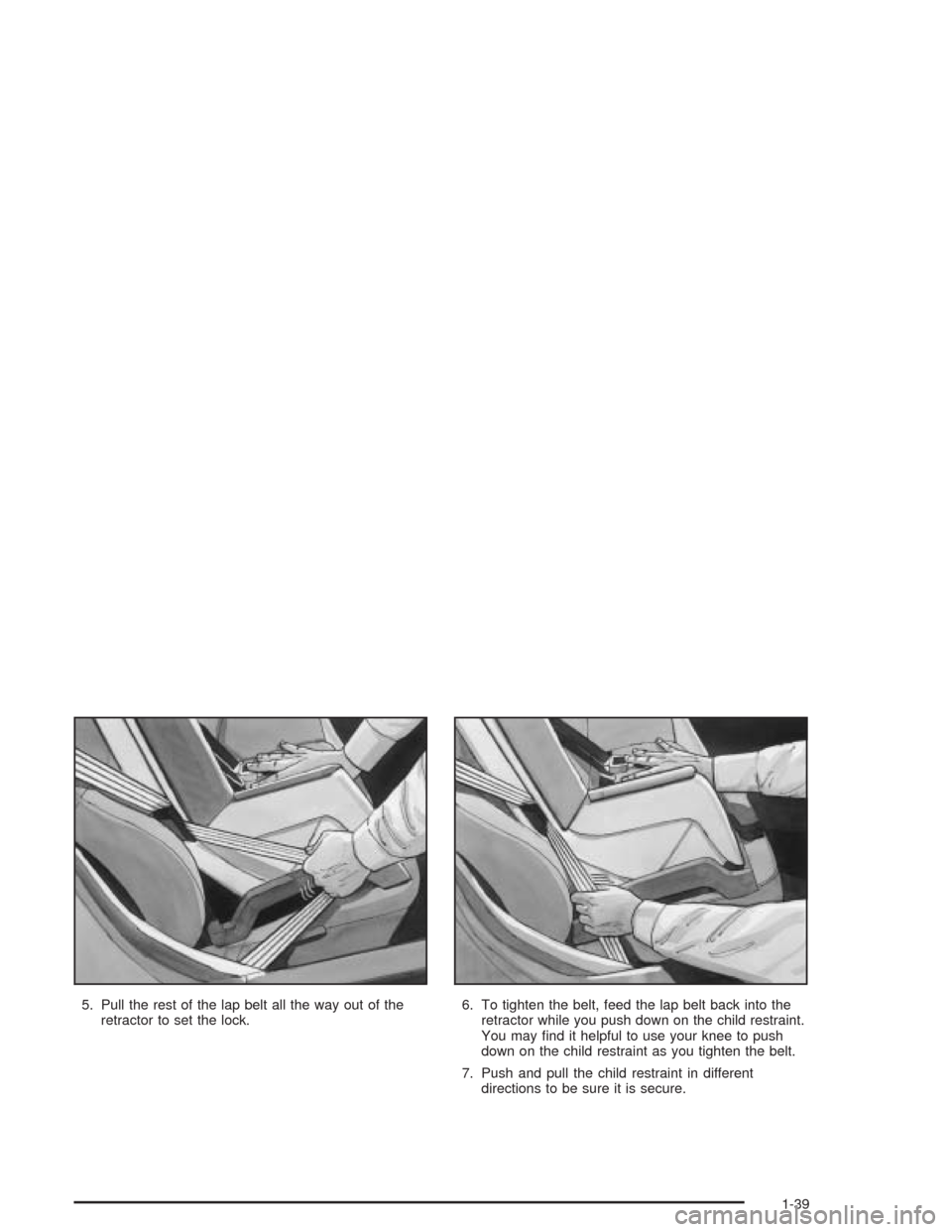
5. Pull the rest of the lap belt all the way out of the
retractor to set the lock.6. To tighten the belt, feed the lap belt back into the
retractor while you push down on the child restraint.
You may find it helpful to use your knee to push
down on the child restraint as you tighten the belt.
7. Push and pull the child restraint in different
directions to be sure it is secure.
1-39
Page 46 of 384
To remove the child restraint, just unbuckle the vehicle’s
safety belt and let it go back all the way. The safety
belt will move freely again and be ready to work for an
adult or larger child passenger.
Turn on the passenger’s air bag when you remove the
child restraint from the vehicle unless the person
who will be sitting there is a member of a passenger air
bag risk group. SeeAir Bag Off Switch on page 1-46.
{CAUTION:
If the passenger’s air bag is turned off for a
person who isn’t in a risk group identied by
the national government, that person won’t
have the extra protection of an air bag. In a
crash, the air bag wouldn’t be able to inate
and help protect the person sitting there. Don’t
turn off the passenger’s air bag unless the
person sitting there is in a risk group. See “Air
Bag Off Switch” in the Index for more on this,
including important safety information.
Air Bag System
This part explains the air bag system.
Your vehicle has air bags – one air bag for the driver
and another air bag for the passenger.
Frontal air bags are designed to help reduce the risk of
injury from the force of an inflating air bag. But these
air bags must inflate very quickly to do their job
and comply with federal regulations.
Here are the most important things to know about the
air bag system:
{CAUTION:
You can be severely injured or killed in a crash
if you are not wearing your safety belt — even
if you have air bags. Wearing your safety belt
during a crash helps reduce your chance of
hitting things inside the vehicle or being
ejected from it. Air bags are designed to work
with safety belts, but do not replace them. Air
bags are designed to deploy only in moderate
to severe frontal and near frontal crashes.
CAUTION: (Continued)
1-40
Page 47 of 384
CAUTION: (Continued)
They are not designed to inate in rollover,
rear or low-speed frontal crashes, or in many
side crashes. And, for some unrestrained
occupants, air bags may provide less
protection in frontal crashes than more
forceful air bags have provided in the past.
Everyone in your vehicle should wear a safety
belt properly — whether or not there is an air
bag for that person.
{CAUTION:
Air bags inate with great force, faster than the
blink of an eye. If you’re too close to an
inating air bag, as you would be if you were
leaning forward, it could seriously injure you.
Safety belts help keep you in position before
and during a crash. Always wear your safety
belt, even with air bags. The driver should sit
as far back as possible while still maintaining
control of the vehicle.
{CAUTION:
Anyone who is up against, or very close to,
any air bag when it inates can be seriously
injured or killed. Air bags plus lap-shoulder
belts offer the best protection for adults, but
not for young children and infants. Neither the
vehicle’s safety belt system nor its air bag
system is designed for them. Young children
and infants need the protection that a child
restraint system can provide. Always secure
children properly in your vehicle. To read how,
seeOlder Children on page 1-19andInfants
and Young Children on page 1-22.
There is a air bag
readiness light on the
instrument panel, which
shows the air bag symbol.
The system checks the air bag electrical system for
malfunctions. The light tells you if there is an electrical
problem. SeeAir Bag Readiness Light on page 3-35
for more information.
1-41
Page 50 of 384
How Does an Air Bag Restrain?
In moderate to severe frontal or near-frontal collisions,
even belted occupants can contact the steering wheel or
the instrument panel. Air bags supplement the
protection provided by safety belts. Air bags distribute
the force of the impact more evenly over the occupant’s
upper body, stopping the occupant more gradually.
But air bags would not help you in many types of
collisions, including rollovers, rear impacts and many
side impacts, primarily because an occupant’s motion is
not toward those air bags. Air bags should never be
regarded as anything more than a supplement to safety
belts, and then only in moderate to severe frontal or
near-frontal collisions.
What Will You See After an Air Bag
Inates?
After the air bag inflates, it quickly deflates, so quickly
that some people may not even realize the air bag
inflated. Some components of the air bag module – the
steering wheel hub for the driver’s air bag, the instrument
panel for the passenger’s bag – will be hot for a short
time. The parts of the bag that come into contact with you
may be warm, but not too hot to touch. There will be
some smoke and dust coming from the vents in the
deflated air bags. Air bag inflation doesn’t prevent the
driver from seeing or being able to steer the vehicle, nor
does it stop people from leaving the vehicle.
{CAUTION:
When an air bag inates, there is dust in the
air. This dust could cause breathing problems
for people with a history of asthma or other
breathing trouble.
CAUTION: (Continued)
1-44
Page 51 of 384
CAUTION: (Continued)
To avoid this, everyone in the vehicle should
get out as soon as it is safe to do so. If you
have breathing problems but can not get out of
the vehicle after an air bag inates, then get
fresh air by opening a window or a door. If you
experience breathing problems following an air
bag deployment, you should seek medical
attention.
In many crashes severe enough to inflate the air bag,
windshields are broken by vehicle deformation.
Additional windshield breakage may also occur from the
passenger air bag.
•Air bags are designed to inflate only once. After an
air bag inflates, you’ll need some new parts for
your air bag system. If you don’t get them, the air
bag system won’t be there to help protect you
in another crash. A new system will include air bag
modules and possibly other parts. The service
manual for your vehicle covers the need to replace
other parts.
•Your vehicle is equipped with a diagnostic module,
which records information about the air bag
system. The module records information about the
readiness of the system, when the system
commands air bag inflation and driver’s safety belt
usage at deployment. The module also records
speed, engine rpm, brake and throttle data.
•Let only qualified technicians work on your air bag
systems. Improper service can mean that an air
bag system won’t work properly. See your dealer for
service.
Notice:If you damage the covering for the driver’s
or the passenger’s air bag, the bag may not work
properly. You may have to replace the air bag
module in the steering wheel or both the air bag
module and the instrument panel for the
passenger’s air bag. Do not open or break the air
bag coverings.
1-45
Page 53 of 384
Medical Condition.A passenger has a
medical condition which, according to his or
her physician:
•
causes the passenger air bag to pose a special risk
for the passenger; and
•makes the potential harm from the passenger air
bag in a crash greater than the potential harm
from turning off the air bag and allowing the
passenger, even if belted, to hit the dashboard or
windshield in a crash.
{CAUTION:
If the passenger’s air bag is turned off for a
person who isn’t in a risk group identied by
the national government, that person won’t
have the extra protection of an air bag. In a
crash, the air bag wouldn’t be able to inate
and help protect the person sitting there. Don’t
turn off the passenger’s air bag unless the
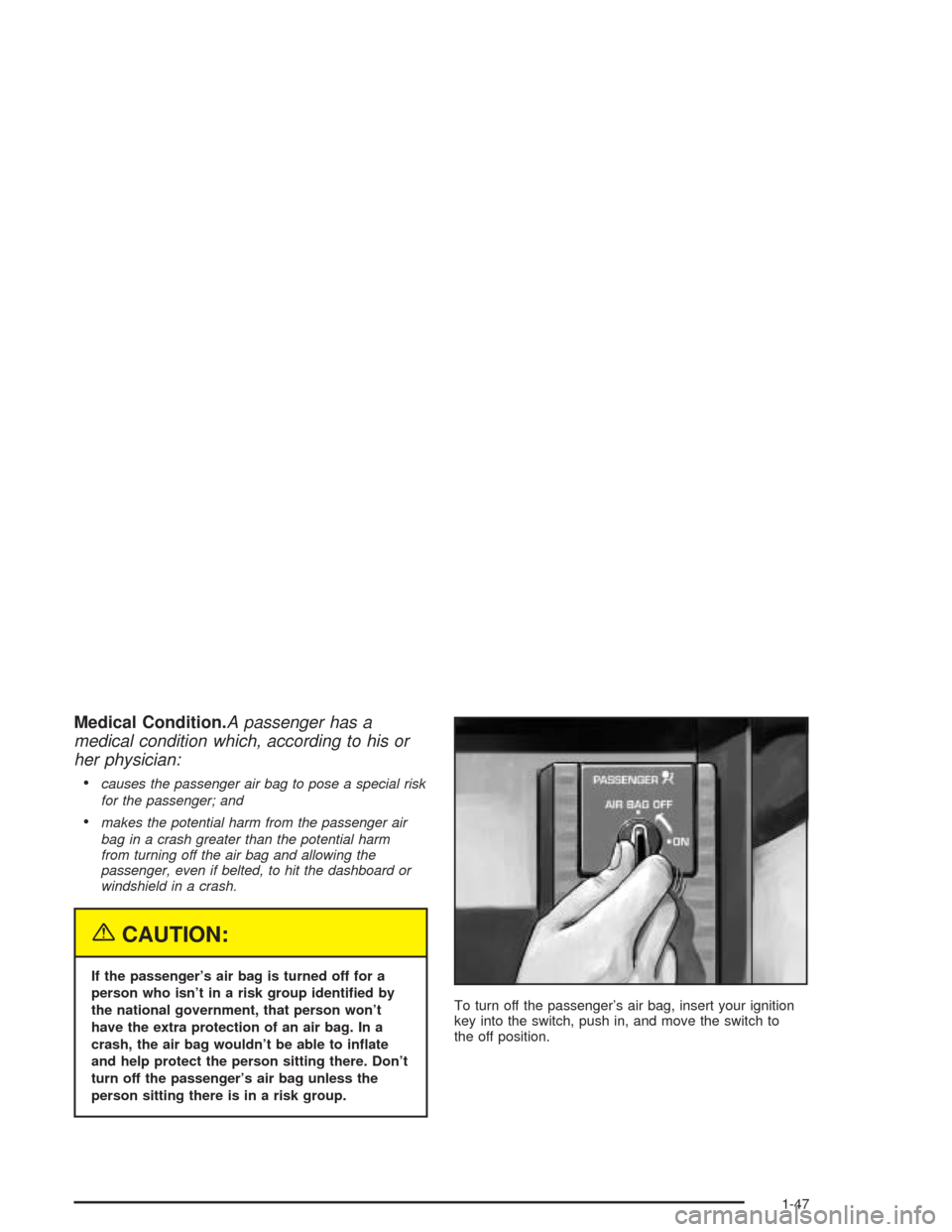
person sitting there is in a risk group.To turn off the passenger’s air bag, insert your ignition
key into the switch, push in, and move the switch to
the off position.
1-47