2003 VOLVO XC90 fuel
[x] Cancel search: fuelPage 107 of 242
2003 VOLVO XC90
pg. 86 Starting and driving
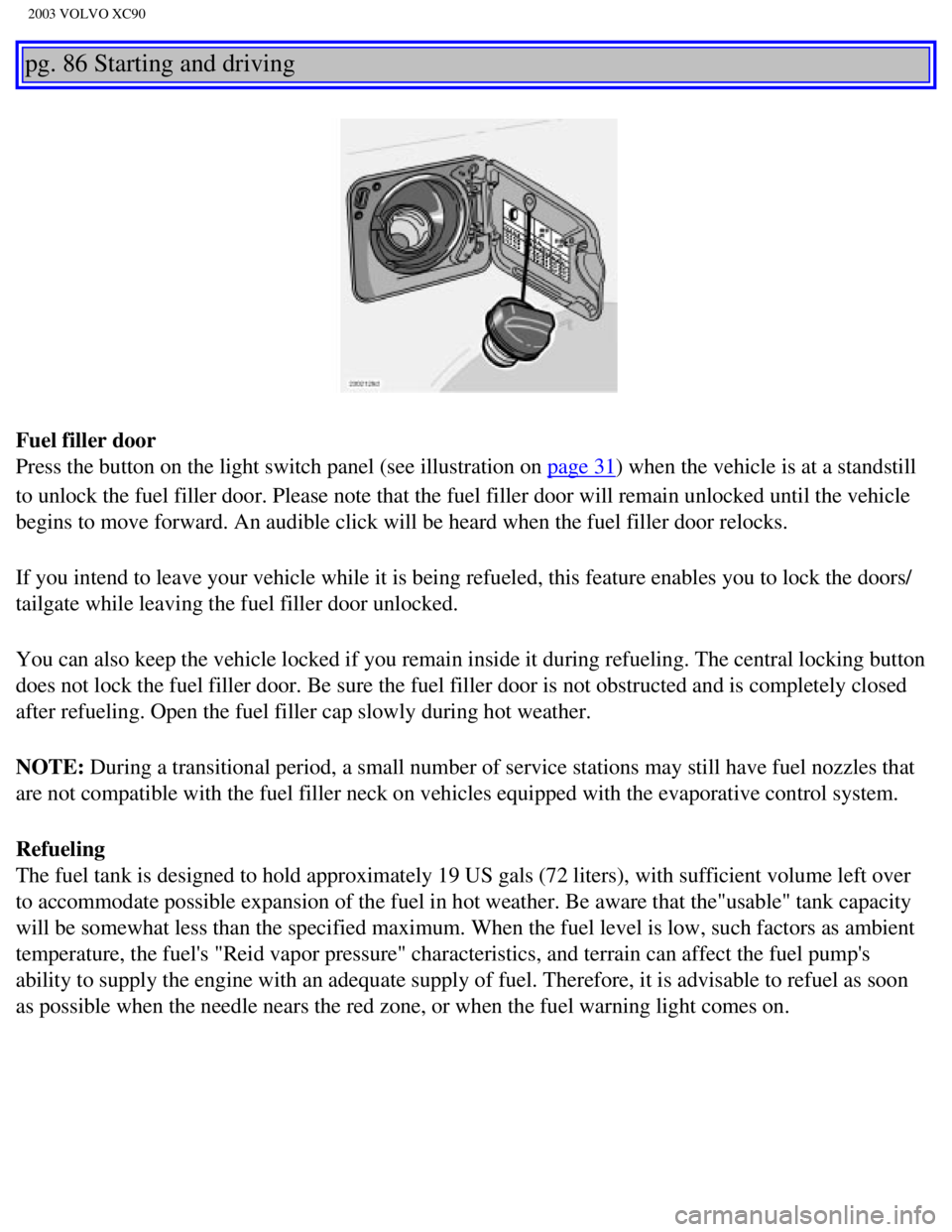
Fuel filler door
Press the button on the light switch panel (see illustration on
page 31) when the vehicle is at a standstill
to unlock the fuel filler door. Please note that the fuel filler door wi\
ll remain unlocked until the vehicle
begins to move forward. An audible click will be heard when the fuel fil\
ler door relocks.
If you intend to leave your vehicle while it is being refueled, this fea\
ture enables you to lock the doors/
tailgate while leaving the fuel filler door unlocked.
You can also keep the vehicle locked if you remain inside it during refu\
eling. The central locking button
does not lock the fuel filler door. Be sure the fuel filler door is not \
obstructed and is completely closed
after refueling. Open the fuel filler cap slowly during hot weather.
NOTE: During a transitional period, a small number of service stations may st\
ill have fuel nozzles that
are not compatible with the fuel filler neck on vehicles equipped with t\
he evaporative control system.
Refueling
The fuel tank is designed to hold approximately 19 US gals (72 liters)\
, with sufficient volume left over
to accommodate possible expansion of the fuel in hot weather. Be aware t\
hat the"usable" tank capacity
will be somewhat less than the specified maximum. When the fuel level is\
low, such factors as ambient
temperature, the fuel's "Reid vapor pressure" characteristics, and terra\
in can affect the fuel pump's
ability to supply the engine with an adequate supply of fuel. Therefore,\
it is advisable to refuel as soon
as possible when the needle nears the red zone, or when the fuel warning\
light comes on.
file:///K|/ownersdocs/2003/2003_XC90/03xc90_06a.htm (4 of 15)12/30/200\
6 4:18:58 PM
Page 108 of 242

2003 VOLVO XC90
CAUTION
- Do not refuel with the engine running *. Turn the ignition off or to p\
osition I. If the ignition is on,
an incorrect reading could occur in the fuel gauge
- After refueling, close the fuel filler cap by turning it clockwise unt\
il it clicks into place*.
- Allow for fuel expansion by not overfilling the tank. Overfilling coul\
d also cause damage to the
emission control systems.
- Avoid spilling gasoline during refueling. In addition to causing damag\
e to the environment,
gasolines containing alcohol can cause damage to painted surfaces, which\
may not be covered under
the New Vehicle Limited Warranty.
- Do not use gasolines containing methanol (methyl alcohol, wood alcoho\
l). This practice can result
in vehicle performance deterioration and can damage critical parts in th\
e fuel system. Such damage
may not be covered under the New Vehicle Limited Warranty.
* If the fuel filler cap is not closed tightly or if the engine is runni\
ng when the vehicle is refueled, the
Check Engine Light (malfunction indicator lamp) may indicate a fault. \
However, your vehicle's
performance will not be affected. Use only Volvo original or approved fu\
el filler caps.
pg. 87 Starting and driving
Starting the engine
1. Fasten the seat belt.
WARNING!
Before starting, check that the seat, steering wheel and mirrors are adj\
usted properly. Make sure the
brake pedal can be depressed completely. Adjust the seat if necessary. S\
ee
pages 54, 56.
2. Apply the parking brake if not already set. The gear selector is lock\
ed in the (P)ark position
(Shiftlock).
Manual transmission: the clutch must be fully depressed.
3. Without touching the accelerator pedal, turn the ignition key* to the\
starting position. Allow the
starter to operate for up to 10 seconds. Release the key as soon as the \
engine starts. If the engine fails to
start, repeat this step.
NOTE:
- On certain models, when the vehicle is started, idle speed may be noti\
ceably higher than normal for a
short period, depending on the temperature of the engine.
This has been done to help bring components in the emission control syst\
em to their normal operating
temperature as quickly as possible, which enables them to function norma\
lly.
file:///K|/ownersdocs/2003/2003_XC90/03xc90_06a.htm (5 of 15)12/30/200\
6 4:18:58 PM
Page 111 of 242
 or\
remove the key from the ignition
switch while the vehicle is in motion. This could cause the steeri")
2003 VOLVO XC90
WARNING!
Never switch off the ignition (turn the ignition key to position 0) or\
remove the key from the ignition
switch while the vehicle is in motion. This could cause the steering whe\
el to lock, which would make
the vehicle impossible to steer.
* The gear selector must be in the (P)ark position (automatic transmission).
** Please be aware that leaving the key in this position will increase b\
attery drain.
pg. 89 Starting and driving
General information
Economical driving conserves natural resources
Better driving economy may be obtained by thinking ahead, avoiding rapid\
starts and stops and
adjusting the speed of your vehicle to immediate traffic conditions. Obs\
erve the following rules:
l Bring the engine to normal operating temperature as soon as possible by \
driving with a light foot on
the accelerator pedal for the first few minutes of operation. A cold eng\
ine uses more fuel and is subject
to increased wear.
l Whenever possible, avoid using the vehicle for driving short distances. \
This does not allow the engine
to reach normal operating temperature.
l Drive carefully and avoid rapid acceleration and hard braking.
l Use the transmission's (D)rive position as often as possible and avoid using "kickdown" to help
improve fuel economy.
l Do not exceed posted speed limits.
l Avoid carrying unnecessary items (extra load) in the vehicle.
l Maintain correct tire pressure. Check tire pressure regularly (when tir\
es are cold).
l Remove snow tires when threat of snow or ice has ended.
l Note that roof racks, ski racks, etc, increase air resistance and also f\
uel consumption.
l At highway driving speeds, fuel consumption will be lower with the air c\
onditioning on and the
windows closed than with the air conditioning off and the windows open. \
l Using the onboard trip computer's fuel consumption modes can help you le\
arn how to drive more
economically.
Other factors that decrease gas mileage are:
l Dirty air cleaner
l Dirty engine oil and clogged oil filter
l Dragging brakes
l Incorrect front end alignment
Some of the above mentioned items and others are checked at the standard\
Maintenance intervals.
file:///K|/ownersdocs/2003/2003_XC90/03xc90_06a.htm (8 of 15)12/30/200\
6 4:18:58 PM
Page 113 of 242

2003 VOLVO XC90
WARNING!
Avoid driving diagonally across steep inclines as this could increase th\
e risk of a roll-over. Try to
drive straight up or down the slope.
If the road is very steep, avoid turning the vehicle around to help avoi\
d the risk of rolling over. Back
the vehicle up or down the incline instead.
NOTE: Avoid driving on steep inclines if the fuel tank is nearly empty. If the\
flow of fuel to the engine
is interrupted due to the vehicle's angle of inclination, this could res\
ult in damage to the three-way
catalytic converter. We recommend keeping the fuel tank at least half fu\
ll when driving on steep inclines.
Driving through water
l The vehicle should not be driven through water that is deeper than 18 in\
ches (48 cm). Driving through
deeper water could result in damage to transmission components or the di\
fferential, or to the engine if
excess water is drawn in through the air intake system.
l Drive slowly and avoid stopping when driving through water.
l After having driven through water, apply the brakes lightly several time\
s to remove water, mud, etc
from the brake discs.
l Never allow the vehicle to stand in water above the door sills. This cou\
ld result in damage to the
electrical system.
Conserving electrical current
Keep the following in mind to help minimize battery drain:
l When the engine is not running, avoid turning the ignition key to positi\
on II (see page 88). Many
electrical systems (the audio system, the optional infotainment/navigat\
ion systems, power windows, etc)
will function with the ignition key in position I. This position reduces\
drain on the battery.
l Please keep in mind that using systems, accessories, etc that consume a \
great deal of current when the
engine is not running could result in the battery being completely drain\
ed.
NOTE: A warning message will be displayed in the text window in the instrument\
panel when the
battery charge is low.
pg. 91 Starting and driving
Automatic transmission with Geartronic
file:///K|/ownersdocs/2003/2003_XC90/03xc90_06a.htm (10 of 15)12/30/20\
06 4:18:58 PM
Page 115 of 242

Never engage")
2003 VOLVO XC90
WARNING!
Never leave the vehicle unattended when the engine is running. If, by mi\
stake, the gear selector is
moved from P, the vehicle may start moving.
R (Reverse)
Never engage R while the vehicle is moving forward.
D (Drive)
D is the normal driving position and should be used as often as possible\
to help improve fuel economy.
The vehicle should not be moving when shifting from R to the D position.
Shiftgate positions
NOTE:
l 5-cylinder turbo engine: 5 forward speeds.
l 6-cylinder turbo engine: 4 forward speeds.
Automatic transmission - shift gate positions
You can move the gear selector freely between the (MAN)ual and (D)rive positions while driving.
Depress the button on the front of the gear selector knob to move betwee\
n the R, N, D, and P positions.
pg. 92 Starting and driving
Automatic transmission with Geartronic (contd)
Manual shifting - Geartronic
You can move the gear selector freely between the (MAN)ual and (D)rive positions while driving.
file:///K|/ownersdocs/2003/2003_XC90/03xc90_06a.htm (12 of 15)12/30/20\
06 4:18:58 PM
Page 116 of 242

2003 VOLVO XC90
l Models equipped with a 5-cylinder turbo engine have five forward speeds.\
Models equipped with a 6-
cylinder turbo engine have four forward speeds
l A "lock-up" feature on gears 3 and 4 (and 5, if equipped) reduces engi\
ne speed and help saves fuel.
The currently selected gear will be displayed in the instrument panel (\
see
page 24).
l To access the (MAN)ual shifting position from (D)rive, move the gear selector to the left to MAN.
l To return to the (D)rive position from MAN, move the gear selector to the right.
While driving
If you select the (MAN)ual position while driving, the gear that was being used in the (D)rive position
will also initially be selected in (MAN)ual position.
l Move the gear selector forward (toward "+") to shift to a higher gear \
or rearward (toward "-") to shift
to a lower gear.
l If you hold the gear selector toward "-", the transmission will downshif\
t one gear and will utilize the
braking power of the engine. If the current speed is too high for using \
a lower gear, the downshift will
not occur until the speed has decreased enough to allow the lower gear t\
o be used.
l If you slow down to a very low speed, the transmission will automaticall\
y shift down.
l When starting in the (MAN)ual position, 3rd gear is the highest gear that may be selected.
Kickdown
Automatic shift to a lower gear (kickdown) is achieved by depressing t\
he accelerator pedal fully and
briskly. An upshift will occur when approaching the top speed for a part\
icular gear or by releasing the
accelerator pedal slightly. Kickdown can be used for maximum acceleratio\
n or when passing at highway
speeds.
NOTE: The gear selector must be in the D (Drive) position for kickdown to fu\
nction.
Automatic transmission - adaptive system
The automatic transmission is controlled by an adaptive control system t\
hat constantly monitors the way
in which the transmission functions. It senses and adapts each gear shif\
t for optimal performance. The
system also monitors your particular driving style and adapts gear shift\
ing accordingly.
pg. 93 Starting and driving
file:///K|/ownersdocs/2003/2003_XC90/03xc90_06a.htm (13 of 15)12/30/20\
06 4:18:58 PM
Page 118 of 242

2003 VOLVO XC90
to spin, an electronically controlled coupling distributes power to the \
wheels that have the best traction.
Tire dimensions
Volvo recommends that you always drive on tires of the same brand, size,\
construction (radial), tread
pattern, load-, speed-, traction-, temperature-, and treadwear rating. N\
ever drive on mixed tires, except
for brief periods when the temporary spare tire is in use. Always use pr\
operly inflated tires of correct
dimensions. Tire size and inflation pressures are shown on the tire pres\
sure label located inside the fuel
filler door.
Tire Rotation
Volvo recommends rotating the tires every 7,500 miles (12,000 km). Tir\
es should be rotated front-to-
back/back-to-front only. Tires must maintain the same direction of rotat\
ion throughout their lifetime, and
should never be rotated from one side of the vehicle to the other.
Temporary Spare
The temporary spare tire is for temporary, lowspeed, short-distance use \
only. Replace it with a full-sized
tire as soon as possible, in accordance with "Tire Rotation" in the prev\
ious paragraph. Do not drive on
the temporary spare at speeds above 50 m.p.h. (80km/h) or for distance\
s greater than 50 miles (80 km).
Never install snow chains on a temporary spare.
Contents | Top of Page
file:///K|/ownersdocs/2003/2003_XC90/03xc90_06a.htm (15 of 15)12/30/20\
06 4:18:58 PM
Page 128 of 242

2003 VOLVO XC90
Follow these instructions to jump start your vehicle's dead battery or t\
o jump start another vehicle's dead
battery using your vehicle. Although your vehicle's battery is located u\
nder the floor of the cargo area,
jumper cables should be connected in the engine compartment, to the points shown in the illustrations.
If the 12-volt auxiliary battery to be used is in another vehicle, check\
that the vehicles are not touching
to prevent premature completion of a circuit. Be sure to follow jump sta\
rting instructions provided for
the other vehicle.
To jump start your vehicle:
l Switch off the ignition.
l First connect the auxiliary battery positive (+) terminal (1) to the\
positive (+) terminal in your
vehicle's engine compartment (2), located under a small black plastic \
cover attached to the fuse box
cover, marked with a "+" sign. Remove the cover on the main fuse box if \
necessary to access this
terminal.Then connect the auxiliary battery's negative (-) terminal (\
3) to the ground point in your
vehicle's engine compartment (4).
l Start the engine in the assisting vehicle, then start the engine in the \
vehicle with dead battery.
l After the engine has started, first remove the negative (-) terminal j\
umper cable. Then remove the
positive (+) terminal jumper cable.
WARNING!
PROPOSITION 65 WARNING!
Battery posts, terminals, and related accessories contain lead and lead \
compounds, chemicals known
to the state of California to cause cancer and reproductive harm. Wash h\
ands after handling
WARNING!
- Do not connect the jumper cable to any part of the fuel system or to a\
ny moving parts. Avoid
touching hot manifolds.
Never expose the battery to open flame or electric spark.
- Do not smoke near the battery.
- Batteries generate hydrogen gas, which is flammable and explosive.
- Battery fluid contains sulphuric acid. Do not allow battery fluid to c\
ontact eyes, skin, fabrics or
painted surfaces. If contact occurs, flush the affected area immediately\
with water. Obtain medical
help immediately if eyes are affected.
- Failure to follow the instructions for jump starting can lead to perso\
nal injury.
file:///K|/ownersdocs/2003/2003_XC90/03xc90_06b.htm (10 of 17)12/30/20\
06 4:18:59 PM