2003 VOLVO XC90 fuel
[x] Cancel search: fuelPage 47 of 242
2003 VOLVO XC90
pg. 32 Instruments and controls
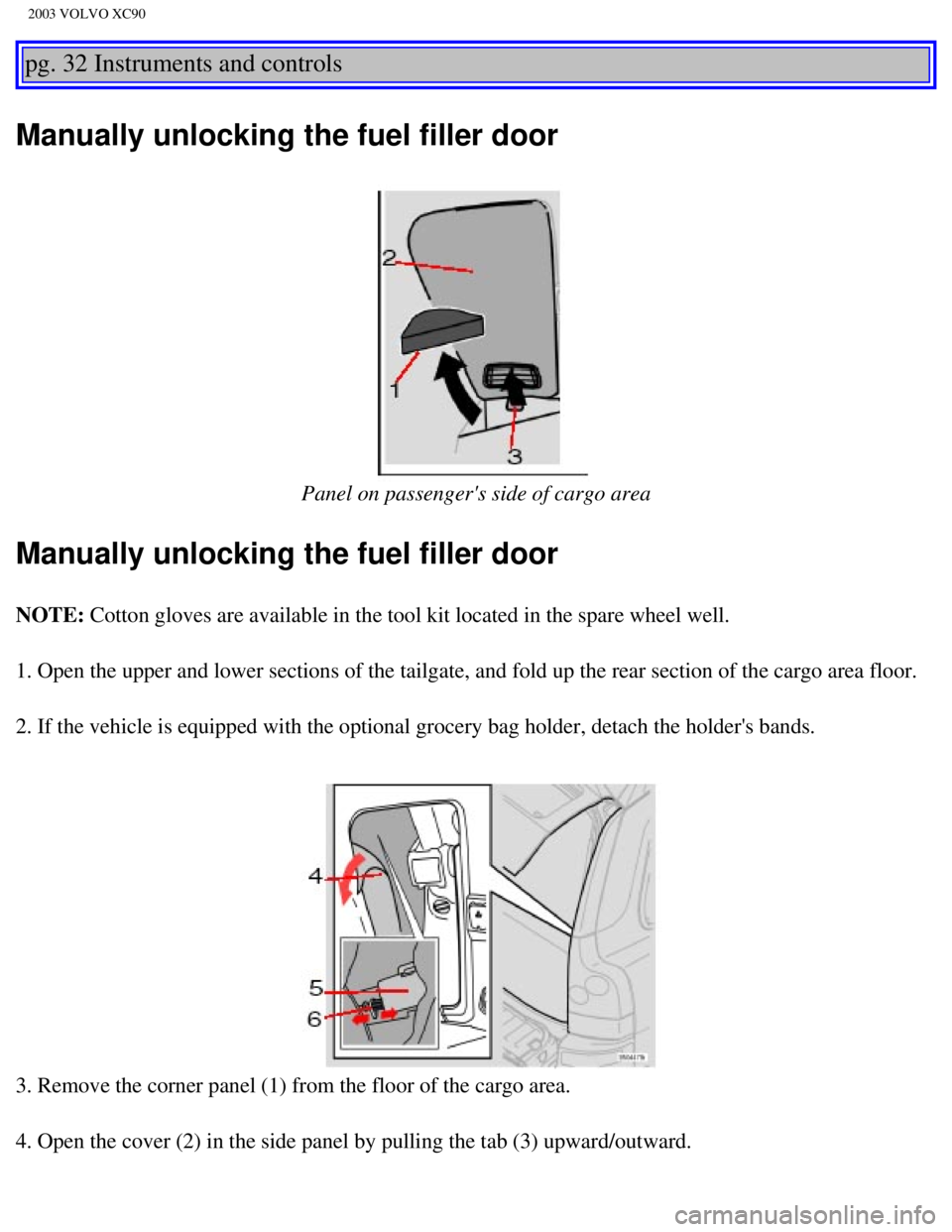
Manually unlocking the fuel filler door
Panel on passenger's side of cargo area
Manually unlocking the fuel filler door
NOTE: Cotton gloves are available in the tool kit located in the spare wheel \
well.
1. Open the upper and lower sections of the tailgate, and fold up the re\
ar section of the cargo area floor.
2. If the vehicle is equipped with the optional grocery bag holder, deta\
ch the holder's bands.
3. Remove the corner panel (1) from the floor of the cargo area.
4. Open the cover (2) in the side panel by pulling the tab (3) upwar\
d/outward.
file:///K|/ownersdocs/2003/2003_XC90/03xc90_02a.htm (13 of 16)12/30/20\
06 4:18:52 PM
Page 48 of 242
 to access the fuel filler doo\
r motor (5).
6. Move the catch (6) rearward to unlock the fuel filler door lock, or\
move it forward to lock t")
2003 VOLVO XC90
5. Pull down the insulating material (4) to access the fuel filler doo\
r motor (5).
6. Move the catch (6) rearward to unlock the fuel filler door lock, or\
move it forward to lock the filler
door.
pg. 33 Instruments and controls
Turn signals
1. Lane change
In maneuvers such as lane changing, the driver can flash the turn signal\
s by moving the turn signal lever
to the first stop and holding it there. The lever will return to the neu\
tral position when released.
2. Signal lever engaged for normal turns
3. High/low beam switch (headlights on).
Move the lever towards the steering wheel and release it.
Headlight flasher (headligts off).
Move the lever towards the steering wheel. The headlight high beam will \
be on until the lever is
released.
NOTE: If the turn signal indicator flashes faster than normal, check for a bur\
ned-out turn signal bulb.
Exterior courtesy lights
Home safe lighting
When you leave your vehicle at night, you can make use of the courtesy l\
ighting function:
l Remove the key from the ignition switch.
l Pull the turn signal lever towards the steering wheel (as when using th\
e headlight flasher function).
l Exit the vehicle and lock the doors.
file:///K|/ownersdocs/2003/2003_XC90/03xc90_02a.htm (14 of 16)12/30/20\
06 4:18:52 PM
Page 52 of 242

l The front seat heating can be switched on and off as required.
l Press the switch once for maximum seat heating. Both LEDs in the switch\
wil")
2003 VOLVO XC90
Heated front seats (option)
l The front seat heating can be switched on and off as required.
l Press the switch once for maximum seat heating. Both LED's in the switch\
will be lit.
l Press the switch a second time for comfort heating. One LED in the switc\
h will be lit.
l Press the switch a third time to turn the heating off completely.
The seat heating for the passenger seat should be switched off when the \
seat is not occupied.
pg. 36 Instruments and controls
Trip computer (option)
The trip computer stores information gathered from several systems in yo\
ur vehicle and has four menus
that can be displayed in the text window.
l Driving distance on current fuel reserve
l Average fuel consumption
l Current fuel consumption
l Average speed
l Current speed in mph (Canadian models only)
NOTE: Warning messages from the vehicle's monitoring systems will override the\
trip computer
function. If a warning message is displayed in the text window while you\
are using the trip computer,
you must acknowledge the message by pressing button A. Press button A ag\
ain to return to the trip
computer function.
file:///K|/ownersdocs/2003/2003_XC90/03xc90_02b.htm (2 of 14)12/30/200\
6 4:18:53 PM
Page 53 of 242

2003 VOLVO XC90
Trip computer controls and functions.
The four* trip computer functions can be accessed by twisting control B \
one step at a time in either
direction. Twisting a fifth** time returns you to the original function.\
The trip computer can be reset (current data will be erased from system\
memory) by pressing RESET
(button C).
1. Driving distance on current fuel reserve
This function shows the approximate distance that can be driven on the f\
uel remaining in the tank. This
calculation is based on average fuel consumption during the last 12 mile\
s (20 km) of driving and the
amount of fuel remaining in the tank when the reading was taken.
When the driving distance on current fuel reserve is less than 12 miles \
(20 km), "----" will be displayed
in the text window.
2. Average fuel consumption
This value indicates fuel consumption since the last time the trip compu\
ter was reset (by pressing
RESET, button C). When the engine is switched off, information on fuel \
consumption is stored and
remains in system memory until the RESET (button C) is pressed again.
3. Current fuel consumption
This value indicates the current fuel consumption, based on readings tak\
en once per second. When the
vehicle is not moving, "----" will be displayed.
4. Average speed
This value indicates average speed since the last time the trip computer\
was reset (by pressing RESET,
button C). When the engine is switched off, information on average spee\
d is stored and remains in
system memory until the RESET (button C) is pressed again.
5. Current speed in miles per hour (Canadian models only)
This function provides the driver with an instantaneous conversion of th\
e vehicle's current speed from
km/h to mph.
* Five functions on Canadian models
** A sixth time on Canadian models
pg. 37 Instruments and controls
Cruise control
file:///K|/ownersdocs/2003/2003_XC90/03xc90_02b.htm (3 of 14)12/30/200\
6 4:18:53 PM
Page 96 of 242

2003 VOLVO XC90
Remote controls
Your vehicle is equipped with a remote control transmitter. This transmi\
tter uses a radio signal to allow
"keyless" entry into the passenger compartment or the tailgate. You will\
be supplied with two coded key
ring transmitters, which will enable you to lock/unlock all doors and th\
e tailgate from a distance of 10-
15 feet (3- 5 meters).
On vehicles equipped with an alarm, the alarm will also be activated/dea\
ctivated by this system.
The vehicle can also be locked/unlocked with the key.
Buttons in remote control:
1-Lock, 2-Unlock, 3-Unlock tailgate,
4-"Panic" function,*, 5-Approach lighting
As an extra security precaution in certain situations (valet parking, e\
tc.), Volvo recommends that the
transmitter not be included when the keys are given to anyone. The servi\
ce key can be used instead. If
one of the transmitters is misplaced, contact the nearest authorized Vol\
vo retailer for assistance.
Using the remote control
l Press the LOCK button once to lock all doors and tailgate.
l Press the UNLOCK button once to unlock the driver's door and fuel filler\
door. Wait for at least 1
second and press this button again (within 10 seconds) to unlock all d\
oors and the tailgate.
l To unlock the tailgate (without unlocking the doors), press the Unlock\
tailgate button twice within 3
seconds.
NOTE:
l Airbag deployment will automatically unlock the doors.
l The keys may also be used to lock and unlock the doors, and to activate \
and deactivate the alarm
system.
l To avoid leaving your keys in the vehicle, make a habit of always lockin\
g the vehicle with the remote
control.
file:///K|/ownersdocs/2003/2003_XC90/03xc90_05.htm (4 of 11)12/30/2006\
4:18:56 PM
Page 104 of 242

2003 VOLVO XC90
2 0 0 3
VOLVO XC90
Starting and driving
pg. 83 Starting and driving
Refueling84
Starting the vehicle87
General information89
Automatic transmission with Geartronic91
All Wheel Drive94
Brake system95
Dynamic Stability Traction Control (DSTC)97
Rear Parking Assistance99
Towing 100
Jump starting 102
Towing a trailer 103
Detachable trailer hitch - installing/
removing 105
Load carriers 106
Cold weather precautions 107
Before a long distance trip108
file:///K|/ownersdocs/2003/2003_XC90/03xc90_06a.htm (1 of 15)12/30/200\
6 4:18:58 PM
Page 105 of 242

2003 VOLVO XC90
pg. 84 Starting and driving
ENGINE OIL
Although some oil consumption occurs during normal engine operation, mor\
e oil is consumed when the
engine is new as the internal parts generate higher friction while weari\
ng-in to each other. From the time
the engine is new until the first maintenance is performed, the oil cons\
umption could be higher than
normal. For this reason, it is especially important to check the oil eve\
ry time you refuel your vehicle
during this period. See
page 130.
Fuel requirements
Octane rating
Volvo engines are designed for optimum performance on unleaded premium g\
asoline with an AKI
octane rating of 91 or above. AKI (ANTI KNOCK INDEX) is an average of \
the Research Octane
Number, RON, and the Motor Octane Number, MON. ((RON + MON)/2). The \
minimum octane
requirement is AKI 87 (RON 91).
Deposit control gasoline (detergent additives)
Volvo recommends the use of detergent gasoline to control engine deposit\
s. Detergent gasoline is
effective in keeping injectors and intake valves clean. Consistent use o\
f deposit control gasolines will
help ensure good driveability and fuel economy. If you are not sure whet\
her the gasoline contains
deposit control additives, check with the service station operator.
NOTE: Volvo does not recommend the use of external fuel injector cleaning syst\
ems.
Unleaded fuel
Each Volvo has a three-way catalytic converter and must use only unleade\
d gasoline. U.S. and Canadian
regulations require that pumps delivering unleaded gasoline be labelled \
"UNLEADED". Only these
pumps have nozzles which fit your vehicle's filler inlet. It is unlawful\
to dispense leaded fuel into a
vehicle labelled "unleaded gasoline only". Leaded gasoline damages the t\
hree-way catalytic converter
and the heated oxygen sensor system. Repeated use of leaded gasoline wil\
l lessen the effectiveness of
the emission control system and could result in loss of emission warrant\
y coverage. State and local
vehicle inspection programs will make detection of misfueling easier, po\
ssibly resulting in emission test
failure for misfueled vehicles.
NOTE: Some U.S. and Canadian gasolines contain an octane enhancing additive ca\
lled methyl-
cyclopentadienyl manganese tricarbonyl (MMT). If such fuels are used, \
your Emission Control System
performance may be affected, and the Check Engine Light (malfunction in\
dicator lamp) located on your
instrument panel may light. If this occurs, please return your vehicle t\
o an authorized Volvo retailer for
maintenance.
Gasoline containing alcohol and ethers
file:///K|/ownersdocs/2003/2003_XC90/03xc90_06a.htm (2 of 15)12/30/200\
6 4:18:58 PM
Page 106 of 242

2003 VOLVO XC90
"Oxygenated fuels"
Some fuel suppliers sell gasoline containing "oxygenates" which are usua\
lly alcohols or ethers. In some
areas, state or local laws require that the service pump be marked indic\
ating use of alcohols or ethers.
However, there are areas in which the pumps are unmarked. If you are not\
sure whether there is alcohol
or ethers in the gasoline you buy, check with the service station operat\
or. To meet seasonal air quality
standards, some areas require the use of "oxygenated" fuel.
Volvo allows the use of the following "oxygenated" fuels; however, the o\
ctane ratings listed on this page
must still be met.
Alcohol - Ethanol: Fuels containing up to 10% ethanol by volume may be u\
sed. Ethanol may also be
referred to as Ethyl alcohol, or "Gasohol".
Ethers - MTBE: Fuels containing up to 15% MTBE may be used.
pg. 85 Starting and driving
Carbon Monoxide - Important Warning
Carbon monoxide is a poisonous, colorless, and odorless gas. It is prese\
nt in all exhaust gases. If you
ever smell exhaust fumes inside the vehicle, make sure the passenger com\
partment is ventilated, and
immediately return the vehicle to your retailer for correction.
Fuel Formulations
Do not use gasoline that contains lead as a knock inhibitor, and do not \
use lead additives. Besides
damaging the exhaust emission control systems on your vehicle, lead has \
been strongly linked to certain
forms of cancer. Many fuels contain benzene as a solvent. Unburned benze\
ne has been strongly linked to
certain forms of cancer. If you live in an area where you must fill your\
own gas tank, take precautions.
These may include:
l standing upwind away from the filler nozzle while refueling
l refueling only at gas stations with vapor recovery systems that fully se\
al the mouth of the filler neck
during refueling
l wearing neoprene gloves while handling a fuel filler nozzle.
Use of Additives
With the exception of gas line antifreeze during winter months, do not a\
dd solvents, thickeners, or other
store-bought additives to your vehicle's fuel, cooling, or lubricating s\
ystems. Overuse may damage your
engine, and some of these additives contain organically volatile chemica\
ls. Do not needlessly expose
yourself to these chemicals.
file:///K|/ownersdocs/2003/2003_XC90/03xc90_06a.htm (3 of 15)12/30/200\
6 4:18:58 PM