2003 SUBARU FORESTER trailer
[x] Cancel search: trailerPage 130 of 420

3-11
Instruments and controls
–CONTINUED –
NOTE
This light also comes on when the fuel filler cap is
not tightened until it clicks.
If you have recently refueled your vehicle, the cause of
the CHECK ENGINE warning light/malfunction indica-
tor lamp coming on could be a loose or missing fuel fill-
er cap. Remove the cap and retighten it until it clicks.
Make sure nothing is interfering with the sealing of the
cap. Tightening the cap will not make the CHECK EN-
GINE warning light turn off immediately. It may take
several driving trips. If the light does not go out, take
your vehicle to your authorized SUBARU dealer im-
mediately. If the light is blinking:
If the light is blinking while driving, an engine misfire
condition has been detected which may damage the
emission control system.
To prevent serious damage to the emission control
system, you should do the following: Reduce vehicle speed.
Avoid hard acceleration.
Avoid steep uphill grades.
Reduce the amount of cargo, if possible.
Stop towing a trailer as soon as possible.
The CHECK ENGINE warning light may stop blinking and come on steadily after several driving trips. You
should have your vehicle checked by an authorized
SUBARU dealer immediately.
Charge warning light
If this light comes on when the engine is run-
ning, it may indicate that the charging system is not
working properly.
If the light comes on while driving or does not go out
after the engine starts, stop the engine at the first safe
opportunity and check the alternator belt. If the belt is
loose, broken or if the belt is in good condition but the
light remains on, contact your nearest SUBARU deal-
er immediately. Oil pressure warning light
If this light comes on when the engine is run-
ning, it may indicate that the engine oil pressure is low
and the lubricating system is not working properly.
If the light comes on while driving or does not go out
after the engine starts, stop the engine at the first safe
opportunity and check the engine oil level. If the oil lev-
el is low, add oil immediately. If the engine oil is at the
proper level but the light remains on, contact your
nearest SUBARU dealer immediately.
Page 267 of 420
7-34
Starting and operating
Self-leveling rear suspension (if
equipped)
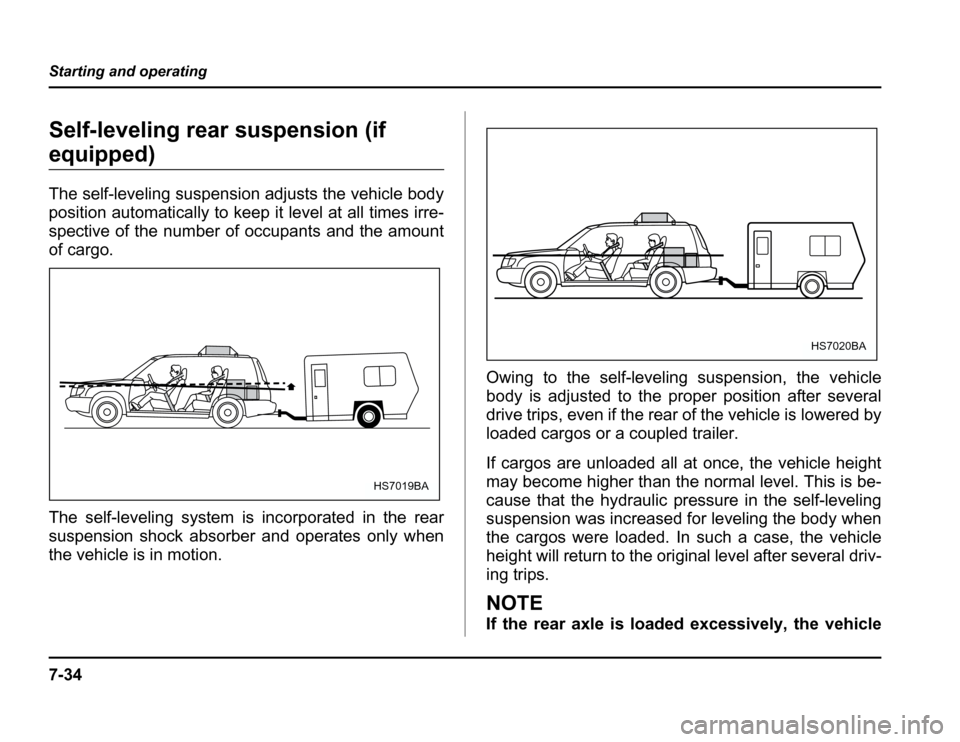
The self-leveling suspension adjusts the vehicle body
position automatically to keep it level at all times irre-
spective of the number of occupants and the amount
of cargo.
The self-leveling system is incorporated in the rear
suspension shock absorber and operates only when
the vehicle is in motion.
Owing to the self-leveling suspension, the vehicle
body is adjusted to the proper position after several
drive trips, even if the rear of the vehicle is lowered by
loaded cargos or a coupled trailer.
If cargos are unloaded all at once, the vehicle height
may become higher than the normal level. This is be-
cause that the hydraulic pressure in the self-leveling
suspension was increased for leveling the body when
the cargos were loaded. In such a case, the vehicle
height will return to the origi
nal level after several driv-
ing trips.
NOTE
If the rear axle is loaded excessively, the vehicle
HS7019BA
HS7020BA
Page 270 of 420

8-1
8
Driving tips
New vehicle break-in driving – the first
1,000 miles (1,600 km) ................................. 8-2
Fuel economy hints ..................................... 8-2
Engine exhaust gas (Carbon monoxide) .. 8-3
Catalytic converter ...................................... 8-4
Periodic inspections ................................... 8-5
Driving in foreign countries ........................ 8-5
Driving tips for AWD vehicles .................... 8-6
Off road driving ........................................... 8-7
Winter driving .............................................. 8-9 Operation during cold weather ...................... 8-9
Driving on snowy and icy roads .................... 8-11
Corrosion protection ...................................... 8-12
Snow tires ........................................................ 8-12
Tire chains ....................................................... 8-13
Rocking the vehicle ........................................ 8-13
Loading your vehicle .................................. 8-14 Vehicle capacity weight .................................. 8-15
GVWR and GAWR (Gross Vehicle Weight
Rating and Gross Axle Weight Rating) ......... 8-16
Roof rail and crossbar (if equipped) ............. 8-17
Trailer hitch (if equipped) ........................... 8-22 Connecting a trailer ........................................ 8-22
When you do not tow a trailer ........................ 8-24
Trailer towing ............................................... 8-25 Warranties and maintenance ......................... 8-25
Maximum load limits ....................................... 8-25
Trailer hitches ................................................. 8-30
Connecting a trailer ........................................ 8-31 Trailer towing tips ........................................... 8-32
Page 285 of 420
8-16
Driving tips
The load capacity of your vehicle is determined by
weight, not by available cargo space. The maximum
load you can carry in your vehicle is shown as the Ve-
hicle Capacity Weight on the tire information label at-
tached to the driver’s side door jamb. It includes the
total weight of driver and all passengers and their be-
longings, any optional equipment such as a trailer
hitch, roof rack or bike carrier, etc., and the tongue
load of a trailer.
The tire information label also shows recommended
tire inflation pressure under full loading and trailer tow-
ing conditions. Adjust tire inflation pressures accord-
ing to the loading conditions. For the tire inflation
pressures, refer to the “Tires and wheels” section in
Chapter 11.
GVWR and GAWR (Gross Vehicle
Weight Rating and Gross Axle Weight
Rating)
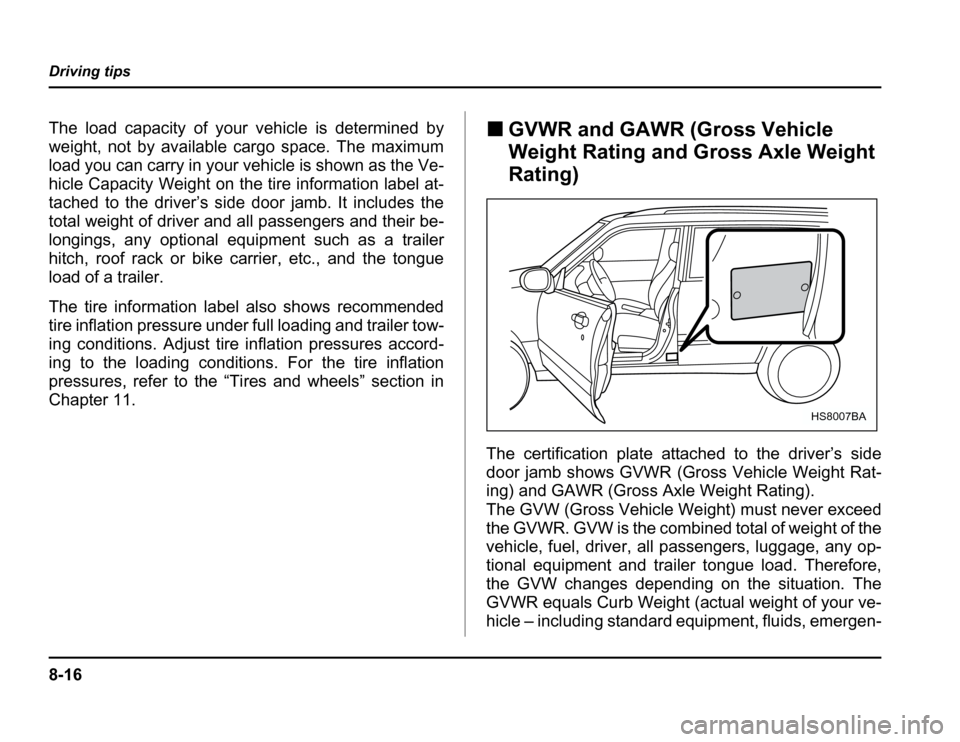
The certification plate attached to the driver’s side
door jamb shows GVWR (Gross Vehicle Weight Rat-
ing) and GAWR (Gross Axle Weight Rating).
The GVW (Gross Vehicle Weight) must never exceed
the GVWR. GVW is the combined total of weight of the
vehicle, fuel, driver, all passengers, luggage, any op-
tional equipment and trailer tongue load. Therefore,
the GVW changes depending on the situation. The
GVWR equals Curb Weight (actual weight of your ve-
hicle – including standard equipment, fluids, emergen-
HS8007BA
Page 291 of 420
8-22
Driving tips
Trailer hitch (if equipped)
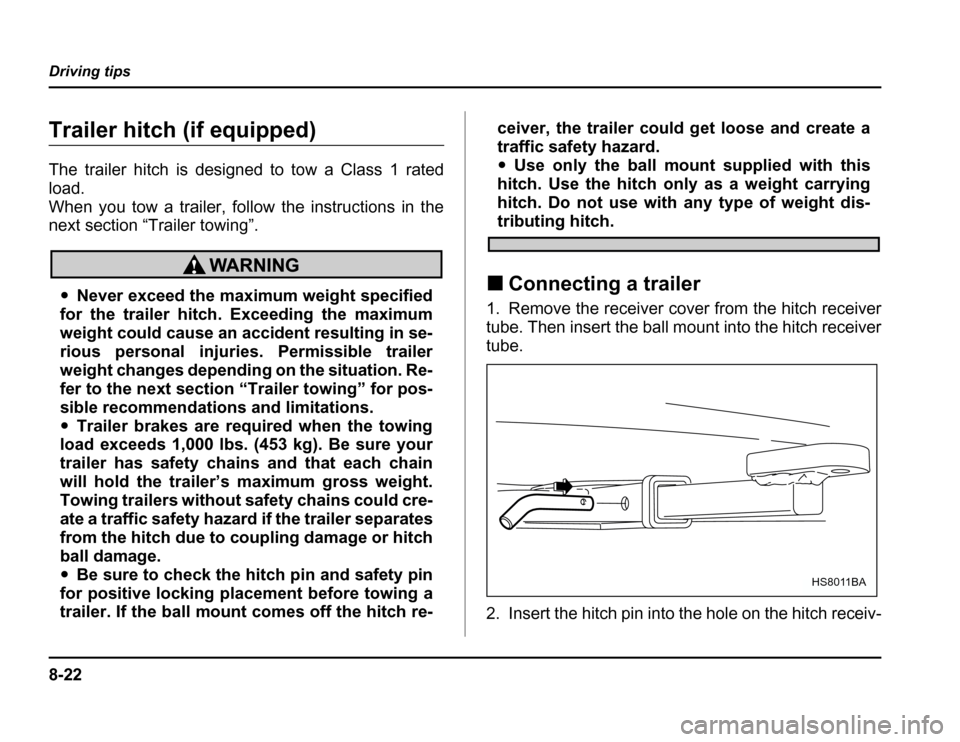
The trailer hitch is designed to tow a Class 1 rated
load.
When you tow a trailer, follow the instructions in the
next section “Trailer towing”.
Never exceed the maximum weight specified
for the trailer hitch. Exceeding the maximum
weight could cause an accident resulting in se-
rious personal injuries. Permissible trailer
weight changes depending on the situation. Re-
fer to the next section “Trailer towing” for pos-
sible recommendations and limitations. Trailer brakes are required when the towing
load exceeds 1,000 lbs. (453 kg). Be sure your
trailer has safety chains and that each chain
will hold the trailer
Page 292 of 420
8-23
Driving tips
– CONTINUED –
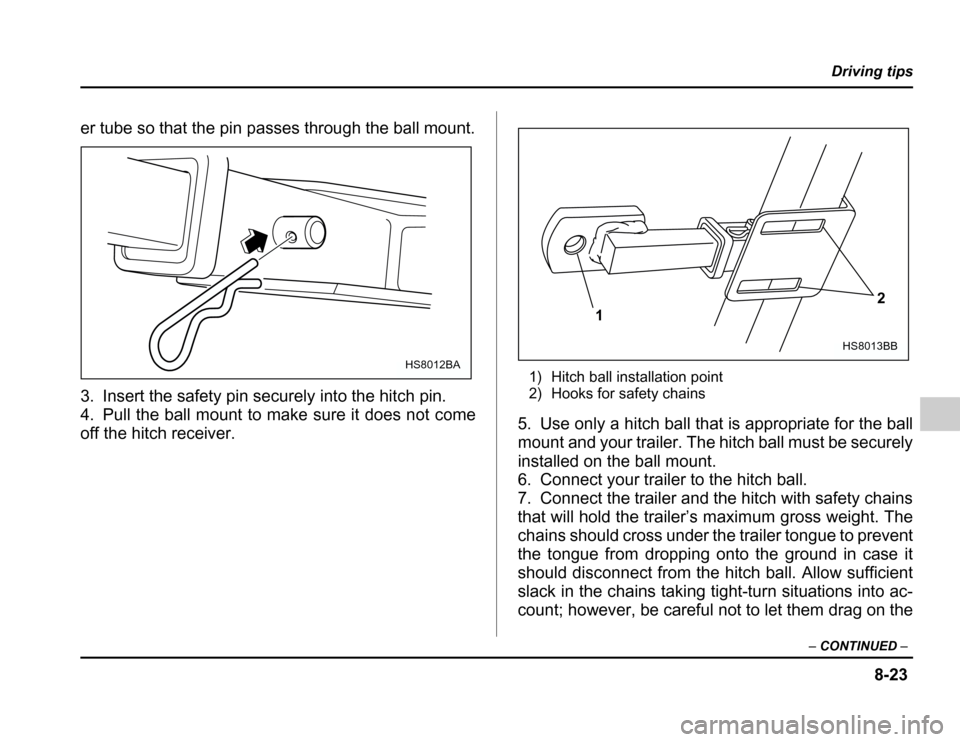
er tube so that the pin passes through the ball mount.
3. Insert the safety pin securely into the hitch pin.
4. Pull the ball mount to make sure it does not come
off the hitch receiver. 1) Hitch ball installation point
2) Hooks for safety chains
5. Use only a hitch ball that is appropriate for the ball
mount and your trailer. The hitch ball must be securely
installed on the ball mount.
6. Connect your trailer to the hitch ball.
7. Connect the trailer and the hitch with safety chains
that will hold the trailer’s maximum gross weight. The
chains should cross under the trailer tongue to prevent
the tongue from dropping onto the ground in case it
should disconnect from the hitch ball. Allow sufficient
slack in the chains taking tight-turn situations into ac-
count; however, be careful not to let them drag on the
HS8012BA
1 2
HS8013BB
Page 293 of 420
8-24
Driving tips
ground.
Do not connect safety chains to part of the ve-
hicle other than the safety chain hooks.
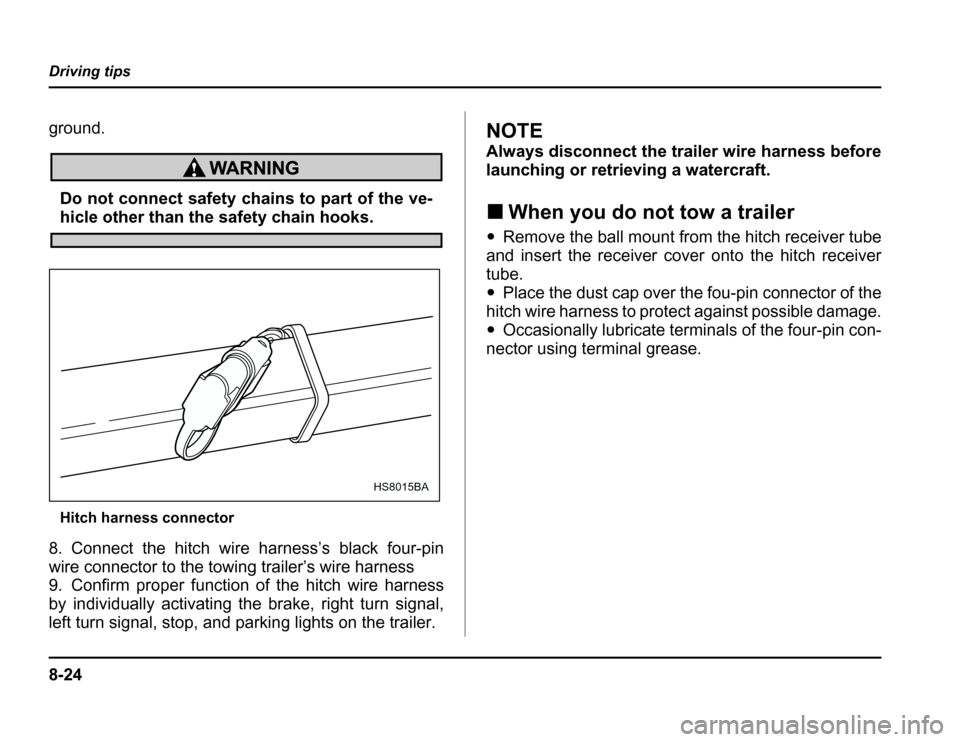
Hitch harness connector
8. Connect the hitch wire harness’s black four-pin
wire connector to the towing trailer’s wire harness
9. Confirm proper function of the hitch wire harness
by individually activating the brake, right turn signal,
left turn signal, stop, and parking lights on the trailer.
NOTE
Always disconnect the trailer wire harness before
launching or retrieving a watercraft. When you do not tow a trailer
Remove the ball mount from the hitch receiver tube
and insert the receiver cover onto the hitch receiver tube. Place the dust cap over the fou-pin connector of the
hitch wire harness to protect against possible damage. Occasionally lubricate terminals of the four-pin con-
nector using terminal grease.
HS8015BA
Page 294 of 420
8-25
Driving tips
– CONTINUED –
Trailer towing
Your car is designed and intended to be used primarily
as a passenger-carrying vehicle. Towing a trailer puts
additional loads on your car’s engine, drivetrain,
brakes, tires and suspension and has an adverse ef-
fect on fuel economy.
If you do decide to tow a trailer, your safety and satis-
faction depend upon proper use of correct equipment
and cautious operation of your vehicle. Seek the ad-
vice of your SUBARU dealer to assist you in purchas-
ing a hitch and other necessary towing equipment
appropriate for your vehicle. In addition, be sure to fol-
low the instructions on correct installation and use pro-
vided by the trailer and other towing equipment manufacturers.
SUBARU assumes no responsibility for injuries or ve-
hicle damage that result from trailer towing equipment,
or from any errors or omissions in the instructions ac-
companying such equipment or for your failure to fol-
low the proper instructions. Warranties and maintenance
SUBARU warranties do not apply to vehicle damage
or malfunction caused by trailer towing. If you use your
vehicle to tow a trailer, more frequent maintenance will
be required due to the additional load. (Refer to “Main- tenance schedule under severe driving conditions” in
the “Warranty and Maintenance Booklet”.)
Under no circumstances should a trailer be towed with
a new vehicle or a vehicle with any new powertrain
component (engine, transmission, differential, wheel
bearings, etc.) for the first 1,000 miles (1,600 km) of
driving.
Maximum load limits
Never exceed the maximum load limits ex-
plained below. Exceeding the maximum load
limits could cause personal injury and/or vehi-
cle damage.
Adequate size trailer brakes are required
when the trailer and its cargo exceed 1,000 lbs
(453 kg) total weight. Before towing a trailer, check the trailer total
weight, GVW, GAWs and tongue load. Make
sure the load and its distribution in your vehicle