2003 SUBARU FORESTER brake
[x] Cancel search: brakePage 266 of 420

7-33
Starting and operating
–CONTINUED –
the desired speed. Then, release the control lever.
The vehicle speed at that moment will be memorized
and treated as the new set speed.
When the difference between the actual vehicle speed
and the set speed is less than 4 mph (6.8 km/h), the
set speed can be increased 1 mph (1.6 km/h) each
time by pressing the control lever upward in the “AC-
CEL, RESUME” direction quickly within 0.5 second. To increase the speed (by accelerator pedal)
1. Depress the accelerator pedal to accelerate the ve-
hicle to the desired speed.
2. Push the control lever downward in the “SET,
COAST” direction once. Now the desired speed is set
and the vehicle will keep running at that speed without
depressing the accelerator pedal.
NOTE
If the difference between the actual vehicle speed
when the control lever is pushed downward and
the speed last time you set is less than 4 mph (6.8
km/h), the vehicle speed will be lowered by 1 mph
(1.6 km/h). This occurs because the cruise control
system unit regards this lever operation as that in-
tended to decrease the vehicle speed.
To decrease the speed (by control lever)
Push the control lever downward in the “SET, COAST”
direction and hold it until the vehicle reaches the de-
sired speed. Then, release the control lever. The vehi-
cle speed at that moment will be memorized and
treated as the new set speed.
When the difference between the actual vehicle speed
and the set speed is less than 4 mph (6.8 km/h), the
set speed can be lowered 1 mph (1.6 km/h) each time
by pressing the control lever downward in the “SET,
COAST” direction quickly within 0.5 second. To decrease the speed (by brake pedal)
1. Depress the brake pedal to release cruise control
temporarily.
2. When the speed decreases to the desired speed,
press the control lever downward in the “SET,
COAST” direction once. Now the desired speed is set
and the vehicle will keep running at that speed without
depressing the accerelator pedal.
Page 271 of 420

8-2
Driving tips
Driving tips
New vehicle break-in driving – the
first 1,000 miles (1,600 km)
The performance and long life of your vehicle are de-
pendent on how you handle and care for your vehicle
while it is new. Follow these instructions during the
first 1,000 miles (1,600 km):
Do not race the engine. And do not allow engine
speed to exceed 4,000 rpm except in an emergency. Do not drive at one constant engine or vehicle
speed for a long time, either fast or slow. Avoid starting suddenly and rapid acceleration, ex-
cept in an emergency. Avoid hard braking, except in an emergency.
The same break-in procedures should be applied to
an overhauled engine, newly mounted engine or when
brake pads or brake linings are replaced with new
ones.
Fuel economy hints
The following suggestions will help to save your fuel. Select the proper gear position for the speed and
road conditions. Avoid sudden acceleration or deceleration. Always
accelerate gently until you reach the desired speed.
Then try to maintain that speed for as long as possible. Do not pump the accelerator and avoid racing the
engine. Avoid unnecessary engine idling.
Keep the engine properly tuned.
Keep the tires inflated to the correct pressure shown
on the tire placard, which is located under the door
latch on the driver’s side. Low pressure will increase
tire wear and fuel consumption. Use the air conditioner only when necessary.
Keep the front and rear wheels in proper alignment.
Avoid carrying unnecessary cargo.
Page 277 of 420

8-8
Driving tips
Do not grip the inside or spokes of the steering
wheel. A bad bump could jerk the wheel and injure
your hands. Instead drive with your fingers and
thumbs on the outside of the rim. If driving through water, such as when crossing
shallow streams, first check the depth of the water and
the bottom of the stream bed for firmness and ensure
that the bed of the stream is flat. Drive slowly and com-
pletely through the stream. The water should be shal-
low enough that it does not reach the vehicle’s
undercarriage. Water entering the engine air intake or
the exhaust pipe or water splashing onto electrical
parts may damage your vehicle and may cause it to
stall. Never attempt to drive through rushing water; re-
gardless of its depth, it can wash away the ground
from under your tires, resulting in possible loss of trac-
tion and even vehicle rollover. Always check your brakes for effectiveness immedi-
ately after driving in sand, mud or water. Do this by
driving slowly and stepping on the brake pedal. Re-
peat that process several times to dry out the brake
discs and brake pads. Do not drive or park over or near flammable materi-
als such as dry grass or fallen leaves, as they may
burn easily. The exhaust system is very hot while the
engine is running and right after the engine stops. This
could create a fire hazard.
After driving through tall grass, mud, rock, sand, riv-
ers, etc., check that there is no grass, bush, paper,
rags, stones, sand, etc. adhering to or trapped on the
underbody. Clear off any such matter from the under-
body. If the vehicle is use d with these materials
trapped or adhering to the underbody, a mechanical
breakdown or fire could occur. Secure all cargo carried inside the vehicle and make
certain that it is not piled higher than the seatbacks.
During sudden stops or jolts, unsecured cargo could
be thrown around in the vehicle and cause injury. Do
not pile heavy loads on the roof. Those loads raise the
vehicle’s center of gravity and make it more prone to
tip over. If you must rock the vehicle to free it from sand or
mud, depress the accelerator pedal slightly and move
the selector lever back and forth between “D” and “R”
repeatedly. Do not race the engine. For the best pos-
sible traction, avoid spinning the wheels when trying to
free the vehicle.
When the road surface is extremely slippery, you can
obtain better traction by starting the vehicle with the
transmission in 2nd than 1st (both for MT and AT). Never equip your vehicle with tires larger than those
specified in this manual. Frequent driving of an AWD vehicle under hard-driv-
ing conditions such as rough roads or off roads will ne-
Page 278 of 420
8-9
Driving tips
– CONTINUED –
cessitate more frequent replacement of engine oil,
brake fluid and transmission oil than that specified in
the maintenance schedule described in the “Warranty
and Maintenance Booklet”.
Remember that damage done to your Subaru while
operating it off-road and not using common sense pre-
cautions such as those listed above is not eligible for
warranty coverage.
Always maintain a safe driving speed accord-
ing to the road and weather conditions in order
to avoid having an accident on a sharp turn,
during sudden braking or under other similar
conditions. Always use the utmost care in driving – over-
confidence because you are driving an all
wheel drive vehicle could easily lead to a seri-
ous accident.
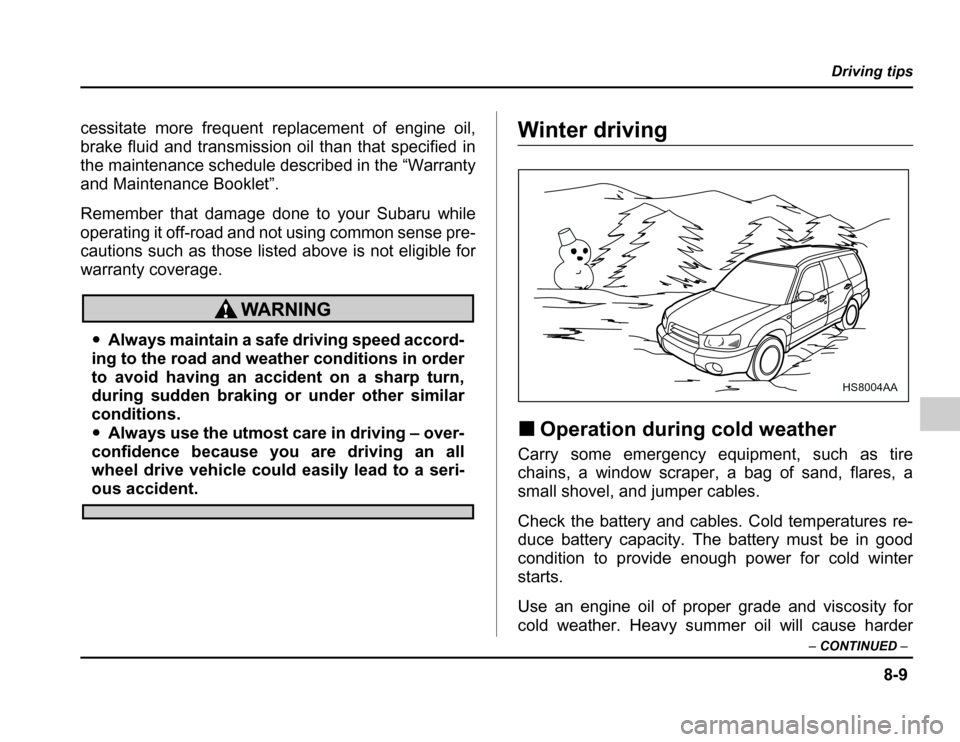
Winter driving Operation during cold weather
Carry some emergency equipment, such as tire
chains, a window scraper, a bag of sand, flares, a
small shovel, and jumper cables.
Check the battery and cables. Cold temperatures re-
duce battery capacity. The battery must be in good
condition to provide enough power for cold winterstarts.
Use an engine oil of proper grade and viscosity for
cold weather. Heavy summer oil will cause harder
HS8004AA
Page 279 of 420

8-10
Driving tips
starting.
Keep the door locks from freezing by squirting them
with deicer or glycerin.
Forcing a frozen door open may damage or separate
the rubber weather strips around the door. If the door
is frozen, use hot water to melt the ice, and afterwards
thoroughly wipe the water away.
Use a windshield washer fluid that contains an anti-
freeze solution. Do not use engine antifreeze or other
substitutes because they may damage the paint of the
vehicle.
Before driving your vehicle
Before entering the vehicle, remove any snow or ice
from your shoes because that could make the pedals
slippery and dangerous.
While warming up the vehicle before driving, check
that the accelerator pedal, brake pedal, and all other
controls operate smoothly.
Clear away ice and snow that has accumulated under
the fenders to avoid making steering difficult. During
severe winter driving, stop when and where it is safe
to do so and check under the fenders periodically.
Parkingincoldweather
Do not use the parking brake when parking for long
periods in cold weather since it could freeze in that po-
sition. Instead, observe the following:
1. Place the shift lever in “1” or “R” for manual trans-
mission vehicles, and in “P” for automatic transmission
vehicles.
2. Use tire stops under the tires to prevent the vehicle
from moving.
When the vehicle is parked in snow or when it snows,
raise the wiper blades off the glass to prevent damage
to them.
When the vehicle has been left parked after use on
roads heavily covered with snow, or has been left
parked during a snowstorm, icing may develop on the
brake system, which could cause poor braking action.
Check for snow or ice buildup on the suspension, disc
brakes and brake hoses underneath the vehicle.
If there is caked snow or ice, remove it, being careful
not to damage the disc brakes and brake hoses and
ABS harness.
Snow can trap dangerous exhaust gases under
your vehicle. Keep snow clear of the exhaust
Page 280 of 420
8-11
Driving tips
– CONTINUED –
pipe and from around your vehicle if you park
the vehicle in snow with the engine running.
Refuelingincoldweather
To help prevent moisture from forming in the fuel sys-
tem and the risk of its freezing, use of an antifreeze ad-
ditive in the fuel tank is recommended during cold
weather.
Use only additives that are specifically designed for
this purpose. When an antifreeze additive is used, its
effect lasts longer if the tank is refilled whenever the
fuel level reaches half empty.
If your SUBARU is not going to be used for an extend-
ed period, it is best to have the fuel tank filled to capac-
ity. Drivingonsnowyandicyroads
To prevent skidding and slipping, avoid sudden brak-
ing, abrupt acceleration, high-speed driving, and
sharp turning when driving on snowy or icy roads.
Always maintain ample distance between your vehicle
and the vehicle ahead of you to avoid the need for sud-
den braking.
To supplement the foot brake, use the engine brake
effectively to control the vehicle speed. (Shift into a lower gear when necessary.)
Avoid shifting down abruptly. Such behavior can
cause the wheels to lock, possibly leading to loss of
vehicle control.
An anti-lock brake system (ABS) enhances your vehi-
cle’s braking performance on snowy and icy roads.
Refer to the “ABS (Anti-lock Brake System)” section in
chapter 7 for information on braking on slippery sur-
faces.
Do not use the cruise control on slippery roads
such as snowy or icy roads. This may cause
loss of vehicle control.
Wiper operation when snowing
Before driving in cold weather, make sure the wiper
blades are not frozen to the windshield or rear window.
If the wiper blades are frozen to the windshield or rear
window, use the defroster with the airflow control but-
ton/dial in the “ ” position and the temperature con-
trol dial set for maximum warmth until the wiper blades
are completely thawed out. If your vehicle is equipped
with a wiper deicer, it is helpful to thaw the windshield
wiper blades. To thaw out the rear wiper blade, use the
Page 291 of 420
8-22
Driving tips
Trailer hitch (if equipped)
The trailer hitch is designed to tow a Class 1 rated
load.
When you tow a trailer, follow the instructions in the
next section “Trailer towing”.
Never exceed the maximum weight specified
for the trailer hitch. Exceeding the maximum
weight could cause an accident resulting in se-
rious personal injuries. Permissible trailer
weight changes depending on the situation. Re-
fer to the next section “Trailer towing” for pos-
sible recommendations and limitations. Trailer brakes are required when the towing
load exceeds 1,000 lbs. (453 kg). Be sure your
trailer has safety chains and that each chain
will hold the trailer
Page 293 of 420
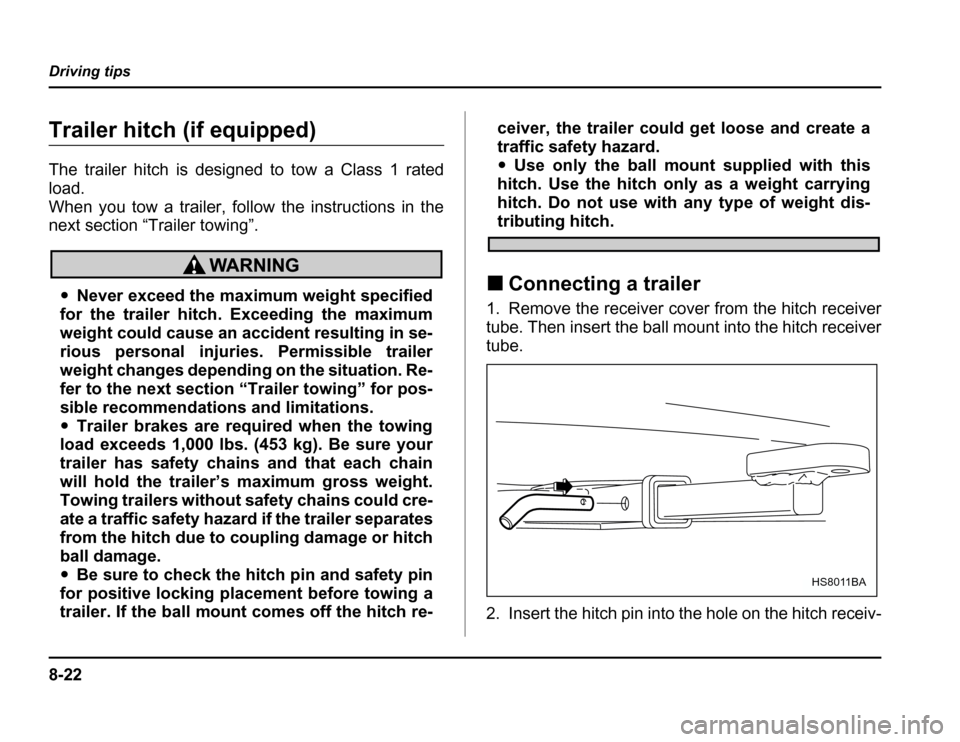
8-24
Driving tips
ground.
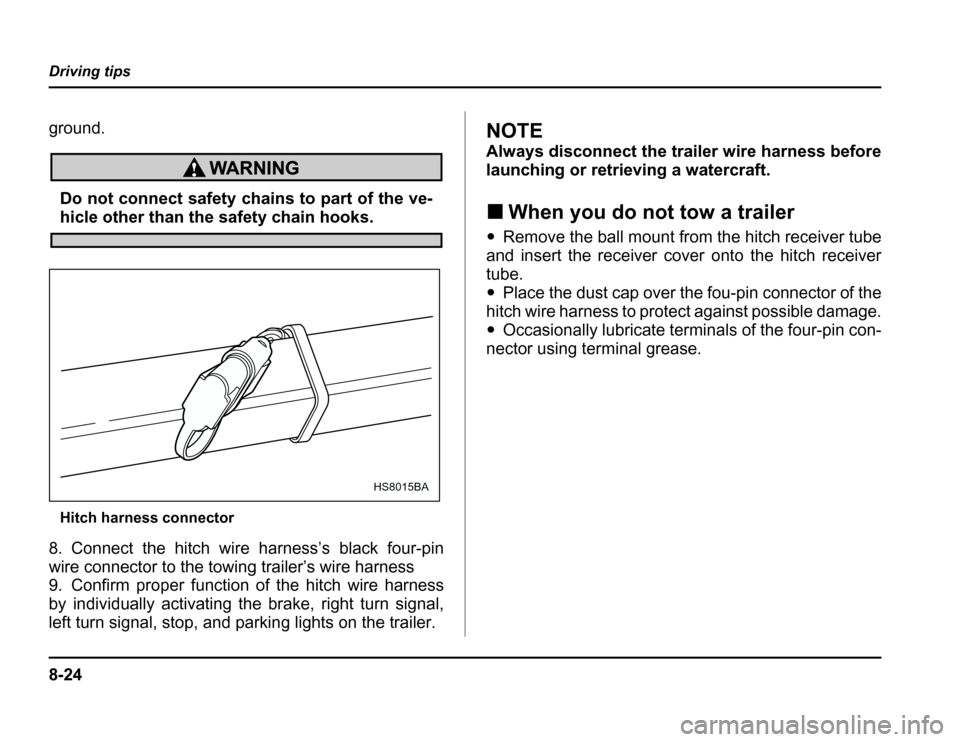
Do not connect safety chains to part of the ve-
hicle other than the safety chain hooks.
Hitch harness connector
8. Connect the hitch wire harness’s black four-pin
wire connector to the towing trailer’s wire harness
9. Confirm proper function of the hitch wire harness
by individually activating the brake, right turn signal,
left turn signal, stop, and parking lights on the trailer.
NOTE
Always disconnect the trailer wire harness before
launching or retrieving a watercraft. When you do not tow a trailer
Remove the ball mount from the hitch receiver tube
and insert the receiver cover onto the hitch receiver tube. Place the dust cap over the fou-pin connector of the
hitch wire harness to protect against possible damage. Occasionally lubricate terminals of the four-pin con-
nector using terminal grease.
HS8015BA