Page 230 of 381
5-19
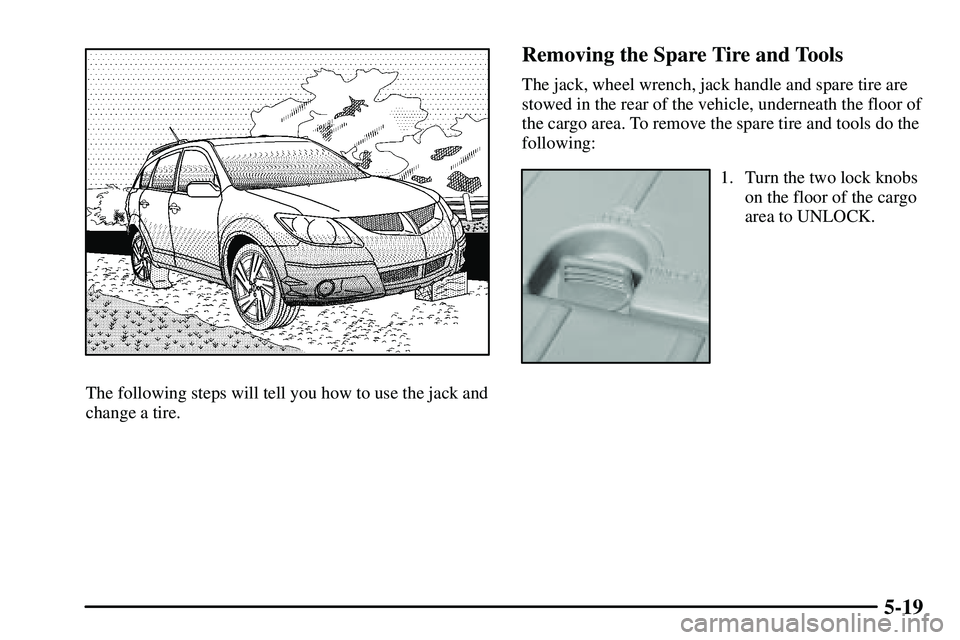
The following steps will tell you how to use the jack and
change a tire.
Removing the Spare Tire and Tools
The jack, wheel wrench, jack handle and spare tire are
stowed in the rear of the vehicle, underneath the floor of
the cargo area. To remove the spare tire and tools do the
following:
1. Turn the two lock knobs
on the floor of the cargo
area to UNLOCK.
Page 236 of 381
5-25
CAUTION:
Rust or dirt on the wheel, or on the parts to
which it is fastened, can make the wheel nuts
become loose after a time. The wheel could come
off and cause an accident. When you change a
wheel, remove any rust or dirt from the places
where the wheel attaches to the vehicle. In an
emergency, you can use a cloth or a paper towel
to do this; but be sure to use a scraper or wire
brush later, if you need to, to get all the rust or
dirt off.
CAUTION:
Never use oil or grease on studs or nuts. If you
do, the nuts might come loose. Your wheel could
fall off, causing a serious accident.
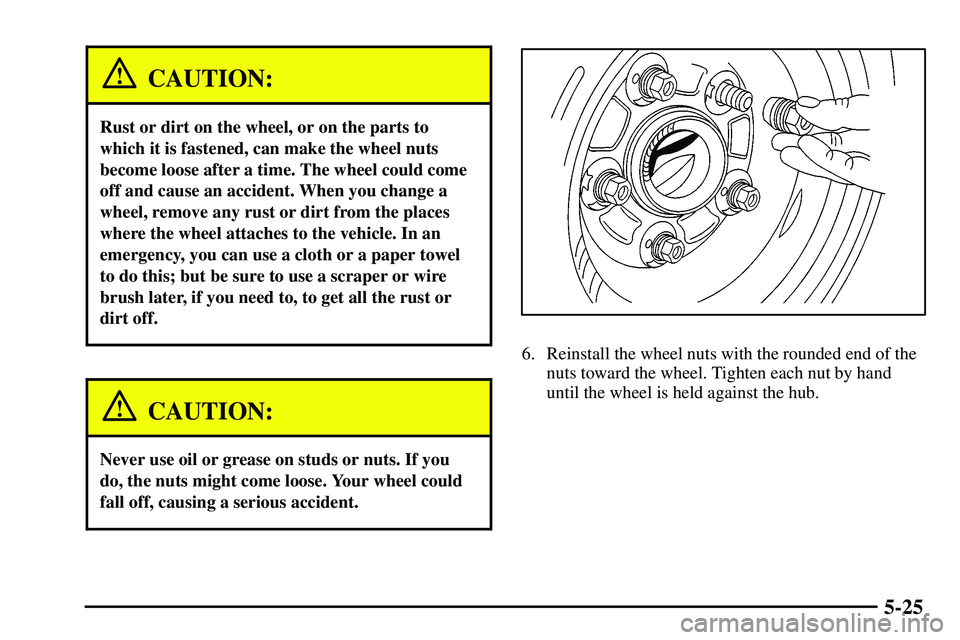
6. Reinstall the wheel nuts with the rounded end of the
nuts toward the wheel. Tighten each nut by hand
until the wheel is held against the hub.
Page 244 of 381
5-33 Rocking Your Vehicle To Get It Out
First, turn your steering wheel left and right. That will
clear the area around your front wheels. Then shift back
and forth between REVERSE (R) and a forward gear
(or with a manual transaxle, between FIRST (1) or
SECOND (2) and REVERSE (R)), spinning the wheels
as little as possible. Release the accelerator pedal while
you shift, and press lightly on the accelerator pedal
when the transaxle is in gear. By slowly spinning your
wheels in the forward and reverse directions, you will
cause a rocking motion that may free your vehicle.
If that doesn't get you out after a few tries, you may
need to be towed out. Or, you can use your recovery
hooks. If you do need to be towed out, see ªTowing
Your Vehicleº in the Index.
Using the Recovery Hook
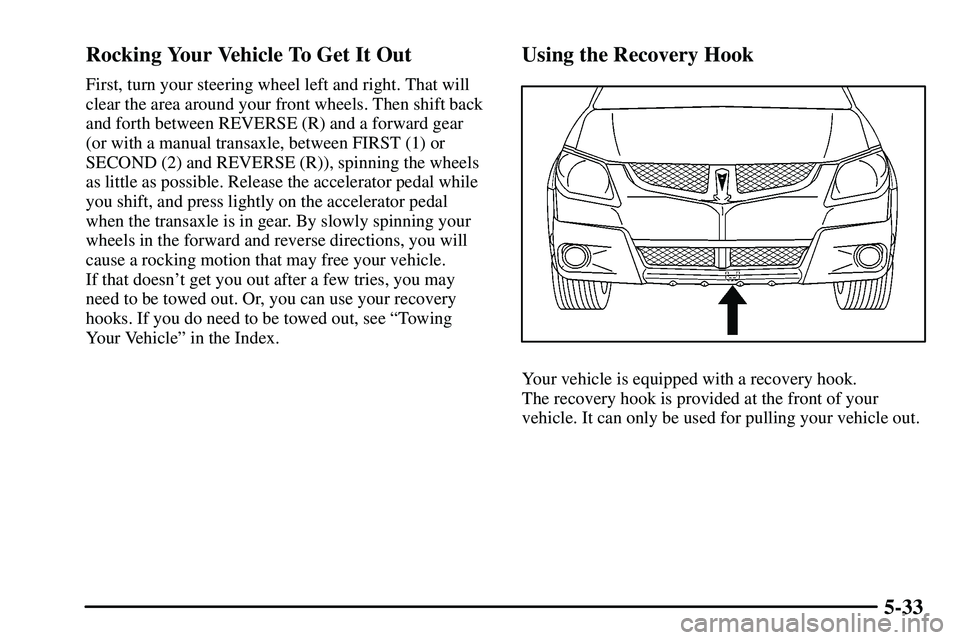
Your vehicle is equipped with a recovery hook.
The recovery hook is provided at the front of your
vehicle. It can only be used for pulling your vehicle out.
Page 245 of 381
5-34
CAUTION:
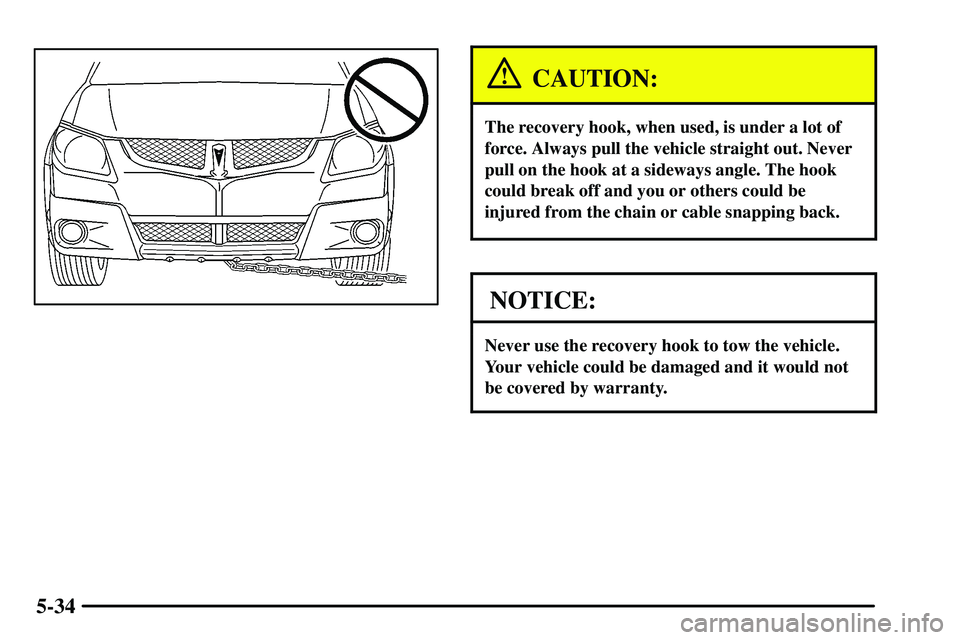
The recovery hook, when used, is under a lot of
force. Always pull the vehicle straight out. Never
pull on the hook at a sideways angle. The hook
could break off and you or others could be
injured from the chain or cable snapping back.
NOTICE:
Never use the recovery hook to tow the vehicle.
Your vehicle could be damaged and it would not
be covered by warranty.
Page 256 of 381
6-11
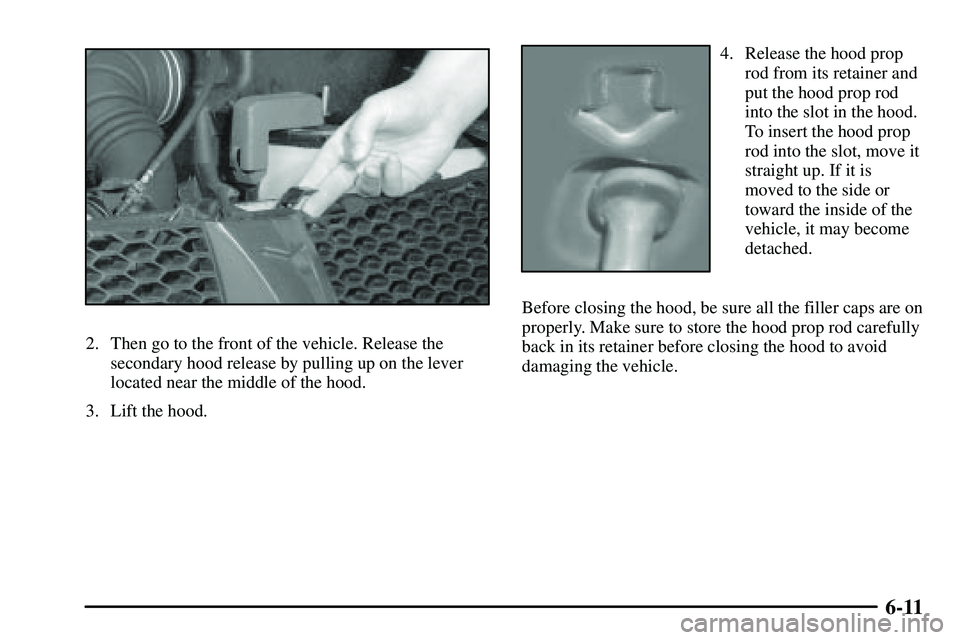
2. Then go to the front of the vehicle. Release the
secondary hood release by pulling up on the lever
located near the middle of the hood.
3. Lift the hood.
4. Release the hood prop
rod from its retainer and
put the hood prop rod
into the slot in the hood.
To insert the hood prop
rod into the slot, move it
straight up. If it is
moved to the side or
toward the inside of the
vehicle, it may become
detached.
Before closing the hood, be sure all the filler caps are on
properly. Make sure to store the hood prop rod carefully
back in its retainer before closing the hood to avoid
damaging the vehicle.
Page 260 of 381
6-15
Turn off the engine and give the oil several minutes to
drain back into the oil pan. If you don't, the oil dipstick
might not show the actual level.
Pull out the dipstick and clean it with a paper towel or
cloth, then push it back in all the way. Remove it again,
keeping the tip down, and check the level.
1.8L (Code 8) Engine
1.8L (Code L) Engine
Page 264 of 381
6-19 When to Change Engine Oil
If any one of these is true for you, use the short trip/city
maintenance schedule:
�Most trips are less than 5 miles (8 km). This is
particularly important when outside temperatures are
below freezing.
�Most trips include extensive idling (such as frequent
driving in stop
-and-go traffic).
�You frequently tow a trailer or use a carrier on top of
your vehicle.
�The vehicle is used for delivery service, police, taxi
or other commercial application.
Driving under these conditions causes engine oil to
break down sooner. If any one of these is true for your
vehicle, then you need to change your oil and filter
every 3,000 miles (5 000 km) or 3 months
-- whichever
occurs first.
If none of them is true, use the long trip/highway
maintenance schedule. Change the oil and filter every
7,500 miles (12 500 km) or 12 months
-- whichever
occurs first. Driving a vehicle with a fully warmed
engine under highway conditions will cause engine oil
to break down slower.
What to Do with Used Oil
Used engine oil contains certain elements that may be
unhealthy for your skin and could even cause cancer.
Don't let used oil stay on your skin for very long. Clean
your skin and nails with soap and water, or a good hand
cleaner. Wash or properly throw away clothing or rags
containing used engine oil. See the manufacturer's
warnings about the use and disposal of oil products.
Used oil can be a threat to the environment. If you
change your own oil, be sure to drain all the oil from the
filter before disposal. Never dispose of oil by putting it
in the trash, pouring it on the ground, into sewers, or
into streams or bodies of water. Instead, recycle it by
taking it to a place that collects used oil. If you have a
problem properly disposing of your used oil, ask your
dealer, a service station or a local recycling center
for help.
Page 267 of 381
6-22
Passenger Compartment Air Filter
Passenger compartment air, both outside and
recirculated air, is routed through a passenger
compartment air filter. The filter removes certain
contaminants from the air, including pollen and dust
particles. Reductions in airflow, which may occur more
quickly in dusty areas, indicate that the filter needs to be
replaced early. An air filter is available through your
dealer. For how often to change the air filter, see
ªMaintenance Scheduleº in the Index.
The access panel for the air filter is behind the glove
box. To replace the filter, follow these steps:
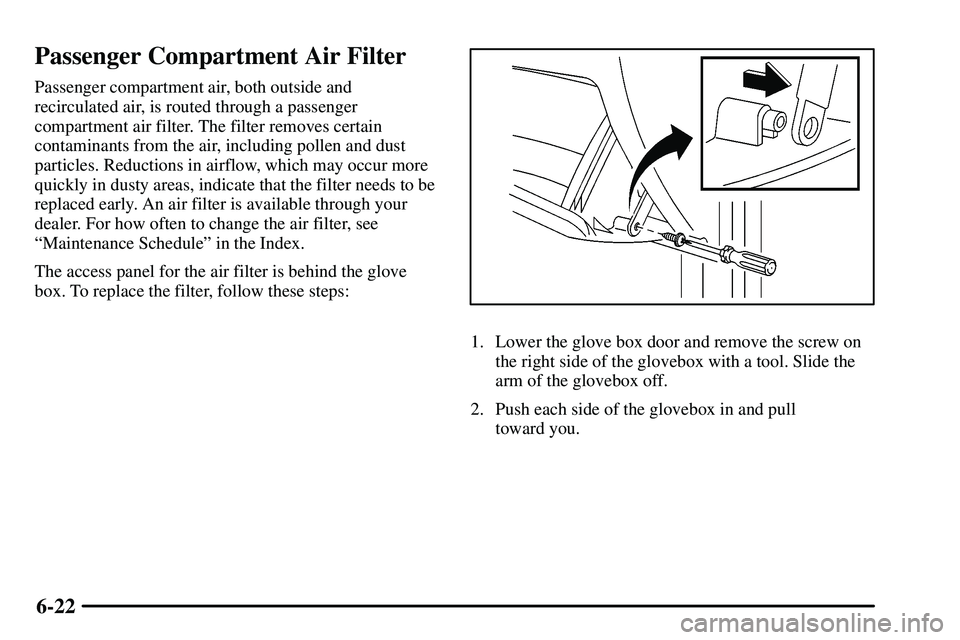
1. Lower the glove box door and remove the screw on
the right side of the glovebox with a tool. Slide the
arm of the glovebox off.
2. Push each side of the glovebox in and pull
toward you.