Page 236 of 381
5-25
CAUTION:
Rust or dirt on the wheel, or on the parts to
which it is fastened, can make the wheel nuts
become loose after a time. The wheel could come
off and cause an accident. When you change a
wheel, remove any rust or dirt from the places
where the wheel attaches to the vehicle. In an
emergency, you can use a cloth or a paper towel
to do this; but be sure to use a scraper or wire
brush later, if you need to, to get all the rust or
dirt off.
CAUTION:
Never use oil or grease on studs or nuts. If you
do, the nuts might come loose. Your wheel could
fall off, causing a serious accident.
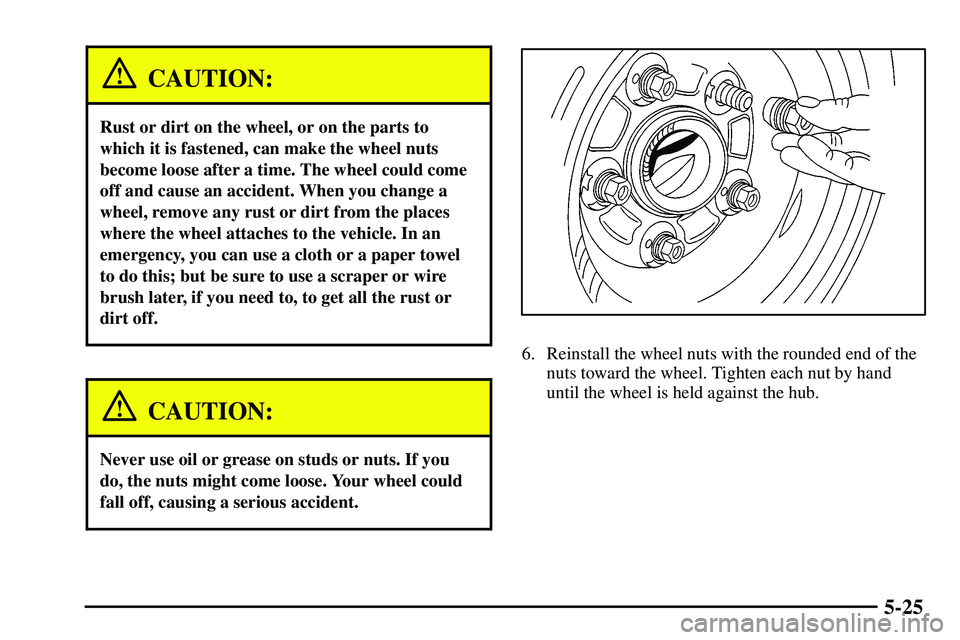
6. Reinstall the wheel nuts with the rounded end of the
nuts toward the wheel. Tighten each nut by hand
until the wheel is held against the hub.
Page 262 of 381
6-17 What Kind of Engine Oil to Use
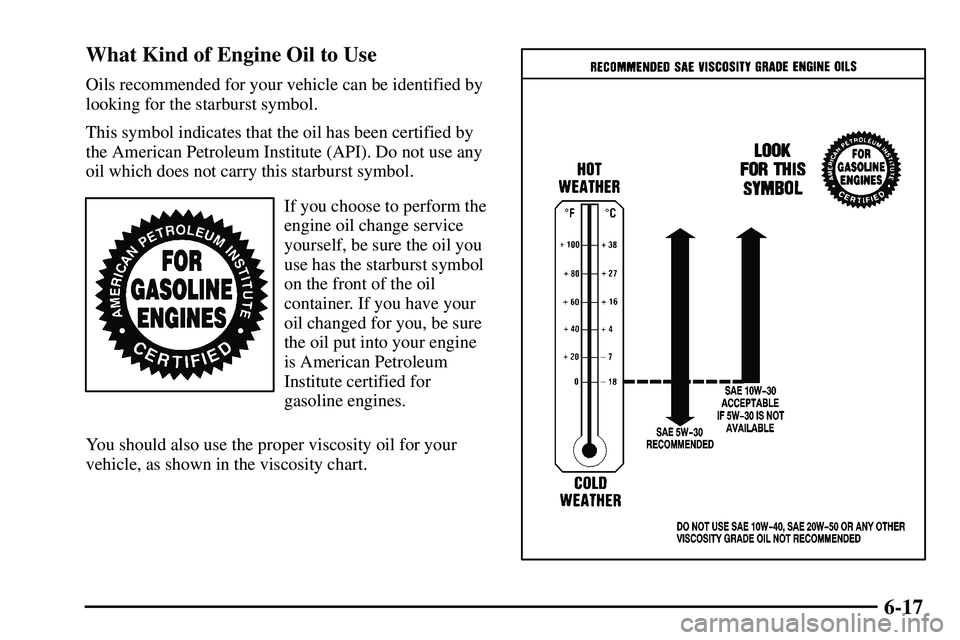
Oils recommended for your vehicle can be identified by
looking for the starburst symbol.
This symbol indicates that the oil has been certified by
the American Petroleum Institute (API). Do not use any
oil which does not carry this starburst symbol.
If you choose to perform the
engine oil change service
yourself, be sure the oil you
use has the starburst symbol
on the front of the oil
container. If you have your
oil changed for you, be sure
the oil put into your engine
is American Petroleum
Institute certified for
gasoline engines.
You should also use the proper viscosity oil for your
vehicle, as shown in the viscosity chart.
Page 264 of 381
6-19 When to Change Engine Oil
If any one of these is true for you, use the short trip/city
maintenance schedule:
�Most trips are less than 5 miles (8 km). This is
particularly important when outside temperatures are
below freezing.
�Most trips include extensive idling (such as frequent
driving in stop
-and-go traffic).
�You frequently tow a trailer or use a carrier on top of
your vehicle.
�The vehicle is used for delivery service, police, taxi
or other commercial application.
Driving under these conditions causes engine oil to
break down sooner. If any one of these is true for your
vehicle, then you need to change your oil and filter
every 3,000 miles (5 000 km) or 3 months
-- whichever
occurs first.
If none of them is true, use the long trip/highway
maintenance schedule. Change the oil and filter every
7,500 miles (12 500 km) or 12 months
-- whichever
occurs first. Driving a vehicle with a fully warmed
engine under highway conditions will cause engine oil
to break down slower.
What to Do with Used Oil
Used engine oil contains certain elements that may be
unhealthy for your skin and could even cause cancer.
Don't let used oil stay on your skin for very long. Clean
your skin and nails with soap and water, or a good hand
cleaner. Wash or properly throw away clothing or rags
containing used engine oil. See the manufacturer's
warnings about the use and disposal of oil products.
Used oil can be a threat to the environment. If you
change your own oil, be sure to drain all the oil from the
filter before disposal. Never dispose of oil by putting it
in the trash, pouring it on the ground, into sewers, or
into streams or bodies of water. Instead, recycle it by
taking it to a place that collects used oil. If you have a
problem properly disposing of your used oil, ask your
dealer, a service station or a local recycling center
for help.
Page 269 of 381

6-24
Automatic Transaxle Fluid
When to Check and Change
A good time to check your automatic transaxle fluid
level is when the engine oil is changed.
Check the fluid in the transaxle and differential every
30,000 miles (50 000 km). Change the fluid every
60,000 miles (100 000 km) if the vehicle is mainly
driven under one or more of these conditions:
�In heavy city traffic where the outside temperature
regularly reaches 90�F (32�C) or higher.
�In hilly or mountainous terrain.
�When doing frequent trailer towing.
�Uses such as found in taxi, police or delivery service.
See ªScheduled Maintenance Servicesº in the Index.
How to Check
Because this operation can be a little difficult, you may
choose to have this done at the dealership service
department.
If you do it yourself, be sure to follow all the
instructions here, or you could get a false reading
on the dipstick.
NOTICE:
Too much or too little fluid can damage your
transaxle. Too much can mean that some of the
fluid could come out and fall on hot engine parts
or exhaust system parts, starting a fire. Too little
fluid could cause the transaxle to overheat. Be
sure to get an accurate reading if you check your
transaxle fluid.
Page 273 of 381

6-28
Manual Transaxle Fluid
When to Check
A good time to have it checked is when the engine oil is
changed. However, the fluid in your manual transaxle
doesn't require changing.
How to Check
Because this operation can be difficult, you may choose
to have this done at your Pontiac dealership service
department.
If you do it yourself, be sure to follow all the
instructions here, or you could get a false reading.
NOTICE:
Too much or too little fluid can damage your
transaxle. Too much can mean that some of the
fluid could come out and fall on hot engine parts
or exhaust system parts, starting a fire. Too little
fluid could cause the transaxle to overheat. Be
sure to get an accurate reading if you check your
transaxle fluid.
Check the fluid level only when your engine is off, the
vehicle is parked on a level place and the transaxle is
cool enough for you to rest your fingers on the
transaxle case.
Then, follow these steps:
1. Remove the filler plug.
2. Check that the lubricant level is up to the bottom of
the filler plug hole.
3. If the fluid level is good, install the plug and be sure
it is fully seated. If the fluid level is low, add more
fluid as described in the next steps.
How to Add Fluid
Here's how to add fluid. Refer to the Maintenance
Schedule to determine what kind of fluid to use. See
ªRecommended Fluids and Lubricantsº in the Index.
1. Remove the filler plug.
2. Add fluid at the filler plug hole. Add only enough
fluid to bring the fluid level up to the bottom of the
filler plug hole.
3. Install the filler plug. Be sure the plug is fully seated.
Page 276 of 381

6-31 Carrier Assembly-Differential
(Rear Drive Module)
When to Check and Change Lubricant
Refer to the Maintenance Schedule to determine how
often to check the lubricant and when to change it. See
ªScheduled Maintenance Servicesº in the Index.
How to Check Lubricant
To get an accurate reading, the vehicle should be on
a level surface.
If the level is below the bottom of the filler plug hole,
you'll need to add some lubricant. Add enough lubricant
to raise the level to the bottom of the filler plug hole. A
fluid loss could indicate a problem; check and have it
repaired, if needed.
What to Use
Refer to the Maintenance Schedule to determine what
kind of lubricant to use. See ªRecommended Fluids
and Lubricantsº in the Index.
Engine Coolant
The following explains your cooling system and how
to add coolant when it is low. If you have a problem
with engine overheating, see ªEngine Overheatingº
in the Index.
A 50/50 mixture of clean, drinkable water and the
proper coolant will:
�Give freezing protection down to
-34�F (-37�C).
�Give boiling protection up to 265�F (129�C).
�Protect against rust and corrosion.
�Help keep the proper engine temperature.
�Let the warning lights and gages work as
they should.
Page 328 of 381

Scheduled Maintenance
7-5
Short Trip/City Definition
Follow the Short Trip/City Scheduled Maintenance if
any one of these conditions is true for your vehicle:
�Most trips are less than 5 miles (8 km). This is
particularly important when outside temperatures are
below freezing.
�Most trips include extensive idling (such as frequent
driving in stop
-and-go traffic).
�You frequently tow a trailer or use a carrier on top of
your vehicle.
�If the vehicle is used for delivery service, police, taxi
or other commercial application.
One of the reasons you should follow this schedule
if you operate your vehicle under any of these conditions
is that these conditions cause engine oil to break
down sooner.
Short Trip/City Intervals
Every 3,000 Miles (5 000 km): Engine Oil and Filter
Change (or 3 months, whichever occurs first).
Every 6,000 Miles (10 000 km): Chassis Lubrication
(or 6 months, whichever occurs first). Tire Rotation.
Engine Air Cleaner Filter Inspection, if driving in
dusty conditions.
Every 15,000 Miles (25 000 km): Passenger
Compartment Air Filter Replacement. Transfer Case
Fluid Change (when trailer towing). Rear Differential
Fluid Change (when trailer towing).
Every 30,000 Miles (50 000 km): Engine Air Cleaner
Filter Replacement. Fuel Tank, Cap, Cap Gasket and
Lines Inspection (or every 24 months, whichever
occurs first). Automatic Transaxle Check. Manual
Transaxle Fluid Change (severe conditions only)
(or every 24 months, whichever occurs first).
Cooling System Service (or every 24 months,
whichever occurs first).
Page 329 of 381
Scheduled Maintenance
7-6
Short Trip/City Intervals
Every 60,000 Miles (100 000 km): Automatic
Transaxle Fluid Change (severe conditions only).
Valve Clearance Inspection, adjust if necessary
(or every 48 months, whichever occurs first).
At 60,000 Miles (100 000 km) (Or 48 Months,
Whichever Occurs First)
-- Then Every
15,000 Miles (25 000 km) (Or 12 Months
Whichever Occurs First): Engine Accessory
Drive Belt Inspection.
Every 120,000 Miles (200 000 km): Spark Plug
Replacement.
These intervals only summarize maintenance services.
Be sure to follow the complete scheduled maintenance
on the following pages.
Long Trip/Highway Definition
Follow this scheduled maintenance only if none of the
conditions from the Short Trip/City Scheduled
Maintenance are true. Do not use this schedule if the
vehicle is used for trailer towing, driven in a dusty area
or used off paved roads. Use the Short Trip/City
schedule for these conditions.
Driving a vehicle with a fully warmed engine under
highway conditions will cause engine oil to break
down slower.