Page 93 of 381
2-29
Parking Brake
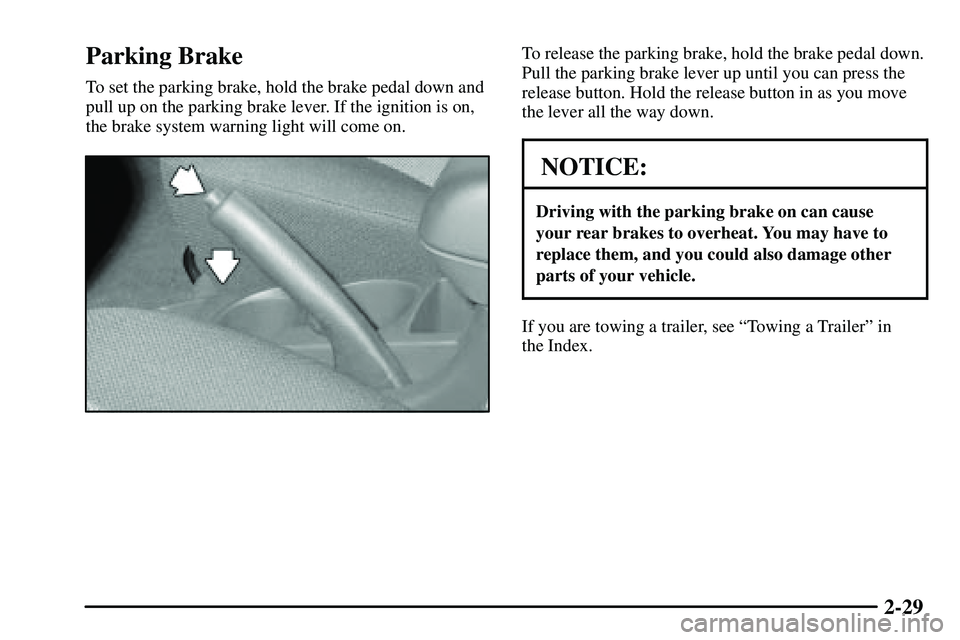
To set the parking brake, hold the brake pedal down and
pull up on the parking brake lever. If the ignition is on,
the brake system warning light will come on.
To release the parking brake, hold the brake pedal down.
Pull the parking brake lever up until you can press the
release button. Hold the release button in as you move
the lever all the way down.
NOTICE:
Driving with the parking brake on can cause
your rear brakes to overheat. You may have to
replace them, and you could also damage other
parts of your vehicle.
If you are towing a trailer, see ªTowing a Trailerº in
the Index.
Page 94 of 381
2-30
Shifting Into PARK (P)
(Automatic Transaxle Only)
CAUTION:
It can be dangerous to get out of your vehicle if
the shift lever is not fully in PARK (P) with the
parking brake firmly set. Your vehicle can roll. If
you have left the engine running, the vehicle can
move suddenly. You or others could be injured.
To be sure your vehicle won't move, even when
you're on fairly level ground, use the steps that
follow. If you're pulling a trailer, see ªTowing a
Trailerº in the Index.
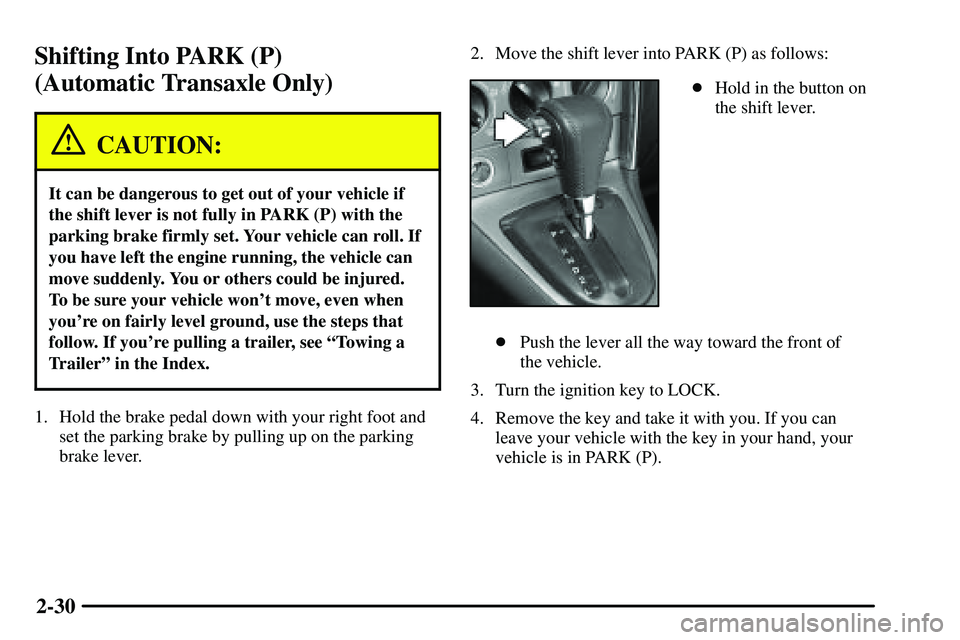
1. Hold the brake pedal down with your right foot and
set the parking brake by pulling up on the parking
brake lever.2. Move the shift lever into PARK (P) as follows:
�Hold in the button on
the shift lever.
�Push the lever all the way toward the front of
the vehicle.
3. Turn the ignition key to LOCK.
4. Remove the key and take it with you. If you can
leave your vehicle with the key in your hand, your
vehicle is in PARK (P).
Page 95 of 381
2-31 Leaving Your Vehicle With the Engine
Running (Automatic Transaxle Only)
CAUTION:
It can be dangerous to leave your vehicle with the
engine running. Your vehicle could move
suddenly if the shift lever is not fully in PARK (P)
with the parking brake firmly set. And, if you
leave the vehicle with the engine running, it could
overheat and even catch fire. You or others could
be injured. Don't leave your vehicle with the
engine running unless you have to.
If you have to leave your vehicle with the engine
running, be sure your vehicle is in PARK (P) and your
parking brake is firmly set before you leave it. After
you've moved the shift lever into PARK (P), hold the
regular brake pedal down. Then, see if you can move the
shift lever away from PARK (P) without first pulling it
toward you. If you can, it means that the shift lever
wasn't fully locked into PARK (P).
Torque Lock (Automatic Transaxle)
If you are parking on a hill and you don't shift your
transaxle into PARK (P) properly, the weight of the
vehicle may put too much force on the parking pawl in
the transaxle. You may find it difficult to pull the shift
lever out of PARK (P). This is called ªtorque lock.º
To prevent torque lock, set the parking brake and then
shift into PARK (P) properly before you leave the
driver's seat. To find out how, see ªShifting Into
PARK (P)º in the Index.
When you are ready to drive, move the shift lever out of
PARK (P) before you release the parking brake.
If torque lock does occur, you may need to have another
vehicle push yours a little uphill to take some of the
pressure from the parking pawl in the transaxle, so you
can pull the shift lever out of PARK (P).
Page 97 of 381
2-33
Parking Your Vehicle
(Manual Transaxle Only)
Before you get out of your vehicle, move the shift lever
into REVERSE (R), and firmly apply the parking brake.
Once the shift lever has been placed into REVERSE (R)
with the clutch pedal pressed in, you can turn the
ignition key to OFF, remove the key and release
the clutch.
If you are towing a trailer, see ªTowing a Trailerº in
the Index.
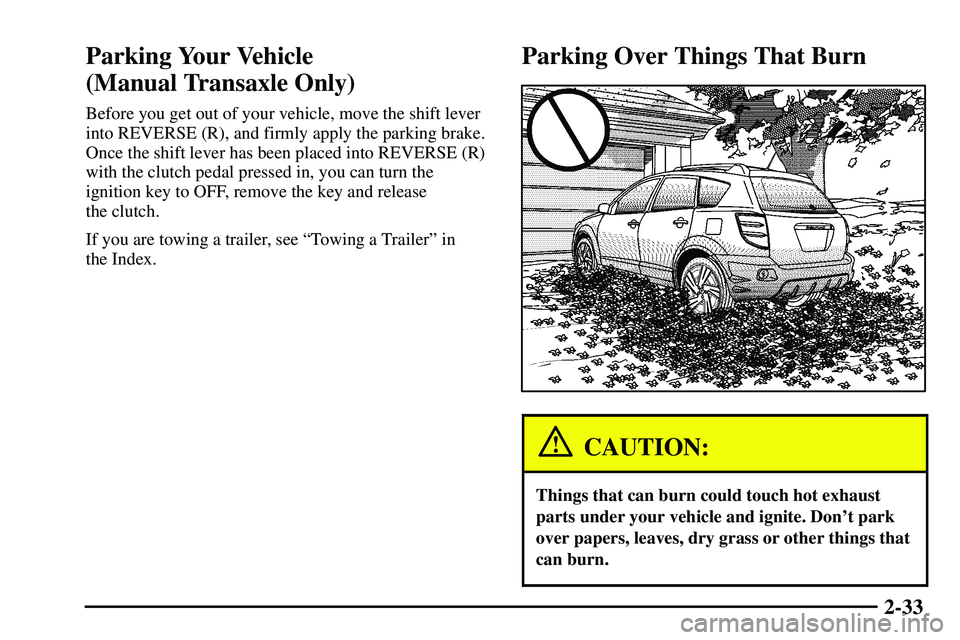
Parking Over Things That Burn
CAUTION:
Things that can burn could touch hot exhaust
parts under your vehicle and ignite. Don't park
over papers, leaves, dry grass or other things that
can burn.
Page 99 of 381
2-35
CAUTION:
It can be dangerous to get out of your vehicle if
the shift lever is not fully in PARK (P) with the
parking brake firmly set. Your vehicle can roll.
Don't leave your vehicle when the engine is
running unless you have to. If you've left the
engine running, the vehicle can move suddenly.
You or others could be injured. To be sure your
vehicle won't move, even when you're on fairly
level ground, always set your parking brake and
move the shift lever to PARK (P).
Follow the proper steps to be sure your vehicle won't
move. See ªShifting Into PARK (P)º in the Index.
If you are parking on a hill and if you're pulling a
trailer, also see ªTowing a Trailerº in the Index.
Horn
To sound the horn, press anywhere on the horn pad on
your steering wheel.
Tilt Wheel
A tilt steering column allows you to adjust the steering
column before you drive. You can also raise it to the
highest level to give your legs more room when you exit
and enter the vehicle.
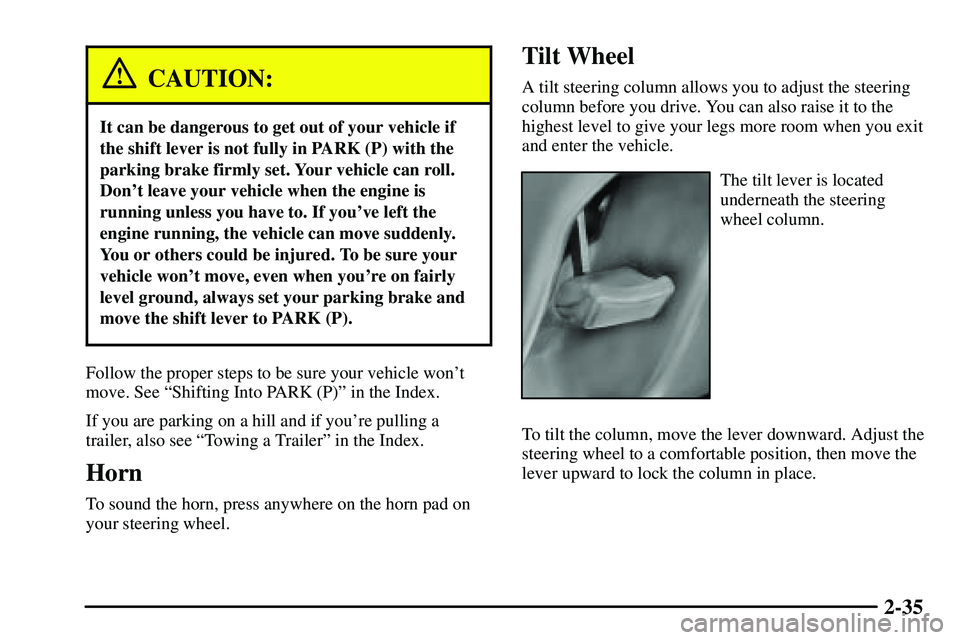
The tilt lever is located
underneath the steering
wheel column.
To tilt the column, move the lever downward. Adjust the
steering wheel to a comfortable position, then move the
lever upward to lock the column in place.
Page 101 of 381

2-37 Headlamp High/Low Beam Changer
The headlamps must be on for this feature to work. For
high beams, push the turn signal lever away from you.
When the high beams
are on, this light on the
instrument panel
cluster also will be on.
It will go off when you switch to the low beams. To
switch back to low beams, pull the lever toward you.
Flash-to-Pass
With the lever in the low-beam position, pull the lever
toward you to momentarily switch to high beams (to
signal that you are going to pass). If you have the
headlamps on when you release the lever, they will
return to the low beams.
Windshield Wipers
The lever on the right side of the steering column
controls the windshield wipers and washer.
The available positions are the following:
OFF: The wipers are off.
INT (Intermittent): Move the lever to INT to choose a
delayed wiping cycle. In light rain or snow, you might
want to use this position rather than continuous wiping.
You can change the time between wipes by turning the
INT TIME band. Turn the band forward or rearward for
longer or shorter delay interval. This position works the
same for the rear wiper.
Page 102 of 381
2-38
LO (Low): Move the lever to LO for steady wiping at
low speed.
HI (High): Move the lever to HI for steady wiping at
high speed.
MIST: For a single wiping cycle, turn the band to
MIST. Hold it there until the wipers start, then let go.
The wipers will stop after one wipe.
REAR: To turn on the rear window wiper, twist the end
of the lever upward. The wiper does not work with the
rear liftglass open.
Be sure to clear ice and snow from the wiper blades
before using them. If they're frozen to the windshield,
carefully loosen or thaw them. If your blades do become
damaged, get new blades or blade inserts.
Heavy snow or ice can overload your wipers. A circuit
breaker will stop them until the motor cools. Clear away
snow or ice to prevent an overload.Windshield Washer
Pull the lever toward you to spray washer fluid on the
windshield. The spray will continue until you release the
lever. The wipers will run a few times. See ªWindshield
Washer Fluidº in the Index.
To squirt washer fluid on the rear window, twist the knob
upward and downward as far as it will go. The knob
automatically returns from these positions after you
release it. You can twist the lever downward to create a
large flow of water on the rear window, then twist the
lever back up to wipe the window. This feature is helpful
to quickly clear the rear liftglass when very dirty.
CAUTION:
In freezing weather, don't use your washer until
the windshield is warmed. Otherwise the washer
fluid can form ice on the windshield, blocking
your vision.
Page 105 of 381
2-41
Reducing Speed While Using Cruise Control
There are two ways to reduce your speed while using
cruise control:
�Push and hold the lever to SET/COAST until you
reach the lower speed you want, then release it.
�To slow down in very small amounts, push the lever
down briefly. Each time you do this, you'll go about
1 mph (1.6 km/h) slower.
Passing Another Vehicle While Using Cruise Control
Use the accelerator pedal to increase your speed. When
you take your foot off the pedal, your vehicle will slow
down to the cruise control speed you set earlier.
Using Cruise Control on Hills
How well your cruise control will work on hills depends
upon your speed, load and the steepness of the hills.
When going up steep hills, you may have to step on the
accelerator pedal to maintain your speed.When going downhill, you may have to brake or shift
to a lower gear to keep your speed down. Of course,
applying the brake or downshifting to SECOND (2) or
LOW (L) takes you out of cruise control. Many drivers
find this to be too much trouble and don't use cruise
control on steep hills.
Ending Cruise Control
There are several ways to turn off the cruise control:
�Step lightly on the brake pedal or push the clutch
pedal, if you have a manual transaxle.
�Press the CRUISE ON
-OFF button again.
�Pull the cruise control lever toward you.
Erasing Speed Memory
When you turn off the cruise control or the ignition,
your cruise control set speed memory is erased.