2003 Oldsmobile Alero Maintenance
[x] Cancel search: MaintenancePage 220 of 354
Fuel
Use of the recommended fuel is an important part of the
proper maintenance of your vehicle.
Gasoline Octane
Use regular unleaded gasoline with a posted octane
of
87 or higher. If the octane is less than 87, you may
get a heavy knocking noise when you drive.
If this
occurs, use a gasoline rated at
87 octane or higher as
soon as possible. Otherwise, you might damage
your engine.
A little pinging noise when you accelerate
or drive uphill is considered normal. This does not
indicate a problem exists or that a higher-octane fuel is
necessary.
If you are using 87 octane or higher-octane
fuel and hear heavy knocking, your engine needs
service.
Gasoline Specifications
It is recommended that gasoline meet specifications
which were developed by the American Automobile
Manufacturers Association and endorsed by the
Canadian Vehicle Manufacturers Association for better
vehicle performance and engine protection. Gasoline
meeting these specifications could provide improved
driveability and emission control system performance
compared to other gasoline.
In Canada, look for the
“Auto Makers’ Choice”
label on the pump.
5-5
Page 236 of 354
Engine Air Cleaner/Filter 3. Check or replace the engine air cleaner/filter.
4. Put the cover back on tightly.
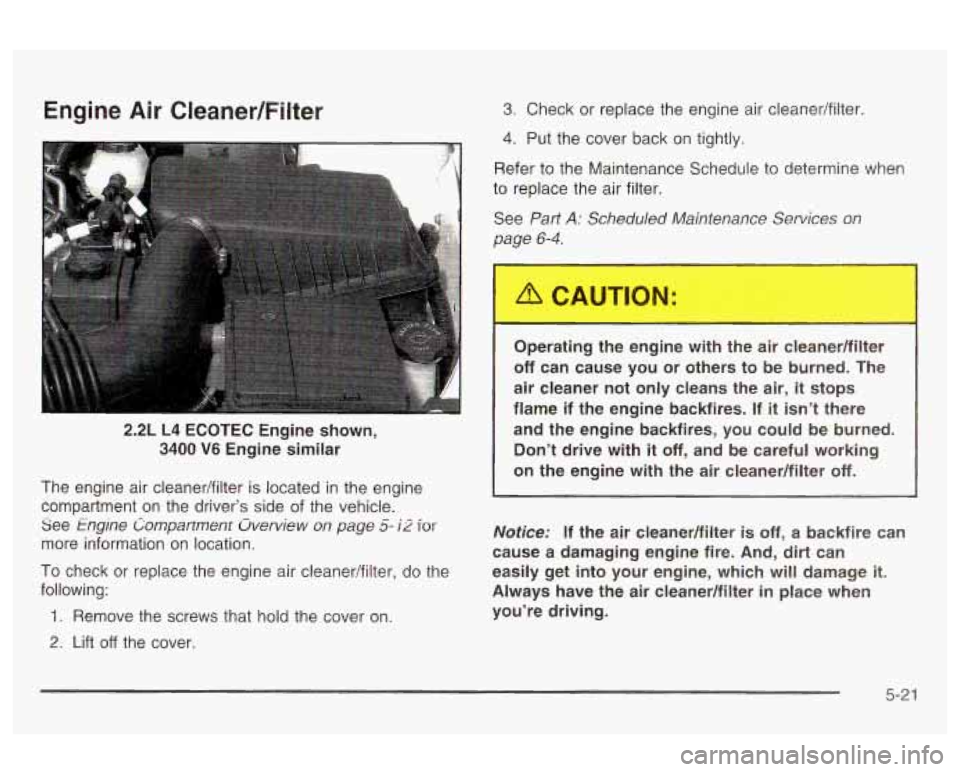
2.2L L4 ECOTEC Engine shown,
3400
V6 Engine similar
The engine air cleanedfilter is located in the engine
compartment on the driver’s side
of the vehicle.
See
Engine Compartment Overview on page 5- i2 ior
more information on location.
To check or replace the engine air cleaner/filter, do the
following:
1. Remove the screws that hold the cover on.
2. Lift off the cover. Refer
to the Maintenance Schedule to determine when
to replace the air filter.
See
Part A: Scheduled Maintenance Services on
page
6-4.
I--
Operating the engine with the air cleaner/filter
off can cause you or others to be burned. The
air cleaner not only cleans the air,
it stops
flame if the engine backfires.
If it isn’t there
and the engine backfires, you could be burned. Don’t drive with
it off, and be careful working
i on the engine with the air cleanerlfilter off.
Notice; If the air cleanerlfilter is off, a backfire can
cause a damaging engine fire. And, dirt can
easily get into your engine, which will damage
it.
Always have the air cleaner/filter in place when
you’re driving.
5-2 1
Page 256 of 354
Replacing Brake System Parts
The braking system on a vehicle is complex. Its many
parts have
to be of top quality and work well together if
the vehicle is to have really good braking. Your
vehicle was designed and tested with top-quality
GM
brake parts. When you replace parts of your braking
system
- for example, when your brake linings
wear down and you need new ones put in
- be sure
you get new approved replacement parts. If you
don’t, your brakes may no longer work properly. For
example,
if someone puts in brake linings that are wrong
for your vehicle, the balance between your front and
rear brakes can change
- for the worse. The braking
performance you’ve come
to expect can change in
replacement brake parts.
many other ways if someone puts in the wrong
Battery
Your new vehicle comes with a maintenance free
ACDelco@ battery. When it’s time for a new battery, get
one that has the replacement number shown on the
original battery’s label. We recommend an ACDelcoC”-‘
battery. See
Engine Compartment Overview on
page
5- 12 for battery location.
Warning; Battery posts, terminals and related
accessories contain lead and lead compounds,
chemicals known to the State of California to cause
cancer and reproductive harm. Wash hands after
handling.
Vehicle Storage
If you’re not going to drive your vehicle for 25 days or
more, remove the black, negative
(-) cable from
the battery. This will help keep your battery from
running down.
Batteries have acic bat can burn you and gas
that can explode. You can be badly hurt
if you
aren’t careful. See “Jump Starting” in the Index
for tips
on working around a battery without
I 3--L ’ =
rrnttjqrr hl Irt.
Contact your dealer to learn how to prepare your
vehicle for longer storage periods.
Also, for your audio system, see
Theft-Deterrent
Feature (Non-RDS Radios) on page
3-64 or
I nefi-Deterrent Feature (RDS RaQiosj on page 3-64. -.
5-41
Page 270 of 354
Tire Inspection and Rotation
Tires should be rotated every 7,500 miles (12 500 km).
Any time you notice unusual wear, rotate your tires
as soon as possible and check wheel alignment. Also
check for damaged tires or wheels. See
When It Is Time
for New Tires on page
5-56 and Wheel Replacement
on page
5-59 for more information.
The purpose of regular rotation is to achieve more
uniform wear for all tires on the vehicle. The first rotation
is the most important. See “Part A: Scheduled
Maintenance Services,” in Section 6, for scheduled
rotation intervals. Don’t include the
compact spare tire in your tire rotation.
After the tires have been rotated, adjust the front and
rear inflation pressures as shown
on the Tire-Loading
Information label.
Make certain that all wheel nuts are properly tightened.
See “Wheel Nut Torque” under
Capacities and
Specifications on page
5-86.
Rust or dirt on a wheel, or or parts to
which
it is fastened, can make wheel nuts
become loose after a time. The wheel could
come
off and cause an accident. When you
change a wheel, remove any rust
or dirt from
places where the wheel attaches to the vehicle.
In an emergency, you can use a cloth or a
paper towel to do
this; but be sure to use a
3cllCapcI VI VVll c; ut U3If IBLGI, II ywu IIG‘CSU LW, LW
get all the rust or dirt off. See “Changing a Flat
Tire”
in the Index.
--_ .------ -_. ... :-- L”..-L I-*-” :+ .--. ~ “...-A 4- 4-
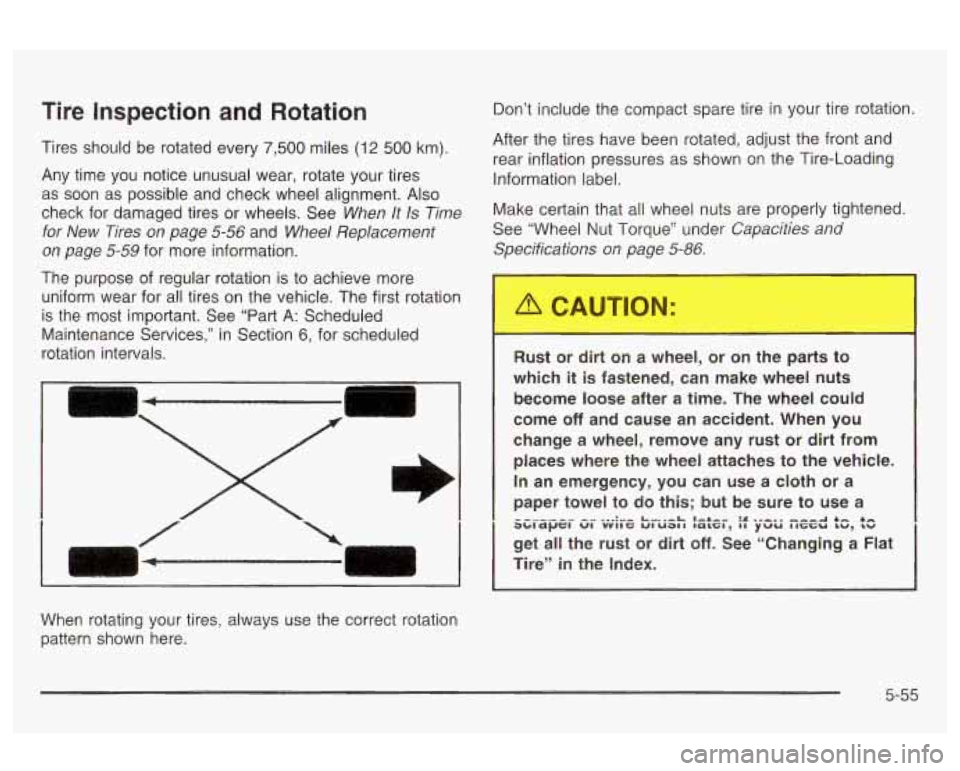
When rotating your tires, always use the correct rotation
pattern shown here.
5-55
Page 293 of 354
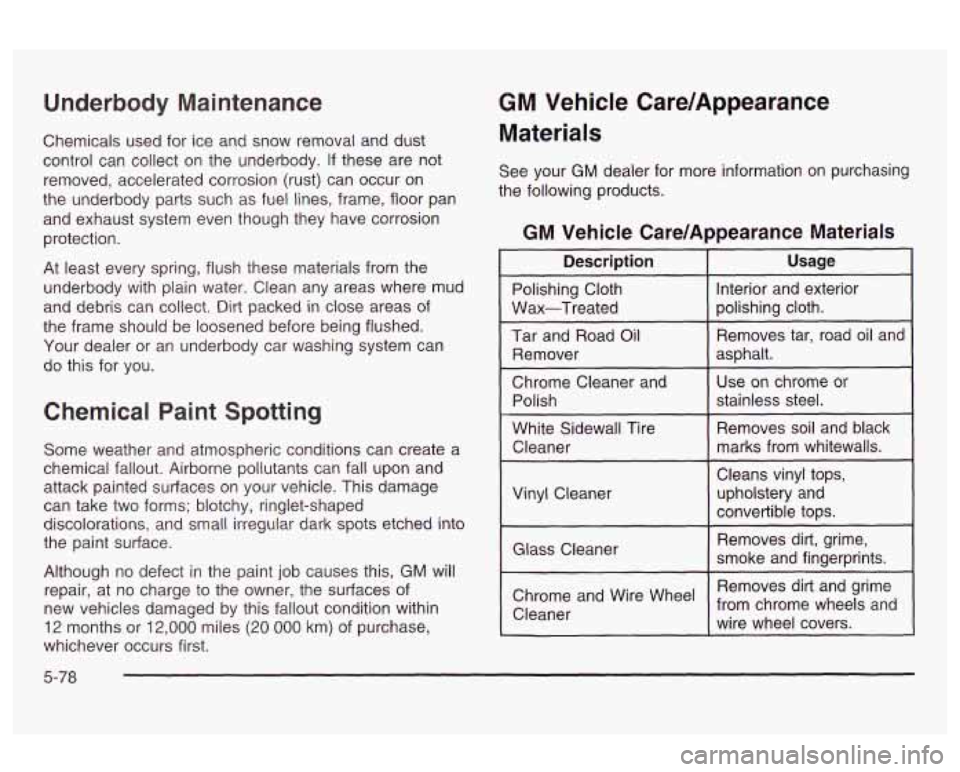
Underbody Maintenance
Chemicals used for ice and snow removal and dust
control can collect on the underbody. If these are not
removed, accelerated corrosion (rust) can occur on
the underbody parts such as fuel lines, frame, floor pan
and exhaust system even though they have corrosion
protection.
At least every spring, flush these materials from the
underbody with plain water. Clean any areas where mud
and debris can collect.
Dirt packed in close areas of
the frame should be loosened before being flushed.
Your dealer or an underbody car washing system can
do this for you.
Chemical Paint Spotting
Some weather and atmospheric conditions can create a
chemical fallout. Airborne pollutants can fall upon and
attack painted surfaces on your vehicle. This damage
can take two forms; blotchy, ringlet-shaped
discolorations, and small irregular dark spots etched into
the paint surface.
Although no defect in the paint job causes this,
GM will
repair, at no charge to the owner, the surfaces of
new vehicles damaged by this fallout condition within
12 months or 12,000 miles (20 000 km) of purchase,
whichever occurs first.
GM Vehicle Care/Appearance
Materials
See your GM dealer for more information on purchasing
the following products.
GM Vehicle Care/Appearance Materials
Description Usage
Polishing Cloth
polishing cloth.
Wax-Treated Interior
and exterior
~ ~ ~ ~~~
Removes tar, road oil and
Chrome Cleaner and Use on
chrome or
Polish stainless steel.
I
White Sidewall Tire Removes soil and black
Cleaner marks from whitewalls.
Vinyl Cleaner Cleans vinyl tops,
upholstery and
convertible tops.
1 Glass Cleaner I
Removes dirt, grime,
smoke and fingerprints.
Chrome and Wire Wheel from chrome wheels and
Cleaner Removes dirt and grime
wire wheel covers.
5-78
Page 303 of 354
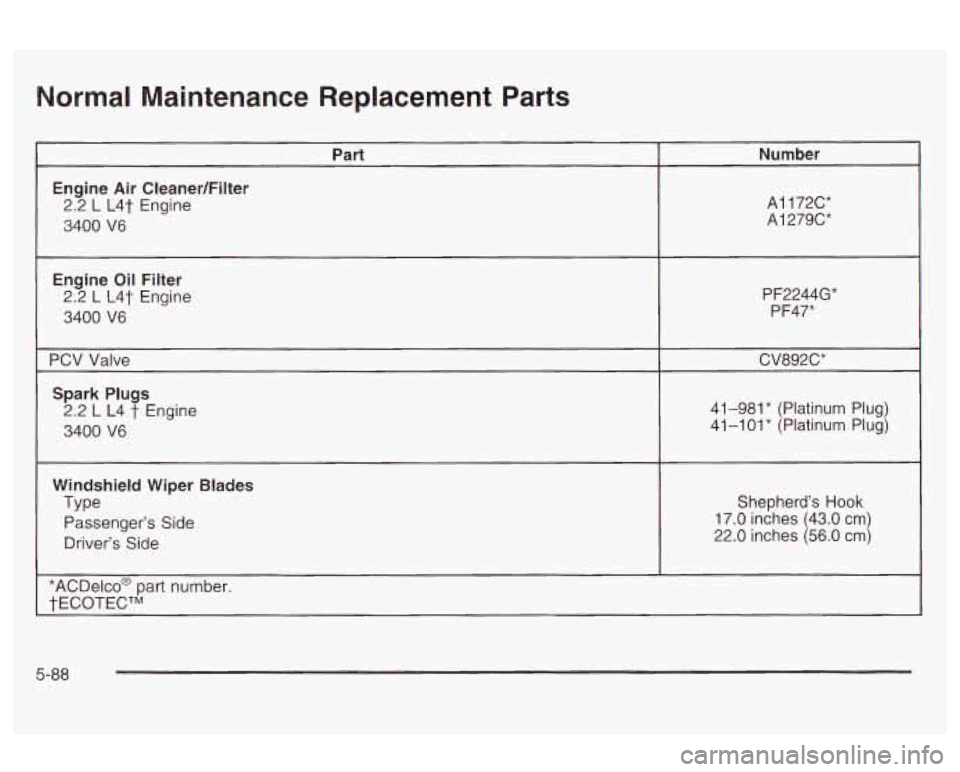
Normal Maintenance Replacement Parts
Part I
Engine Air Cleaner/Filter
2.2 L L4t Engine
3400 V6 Number
AI 172C*
AI 279C"
Engine Oil Filter
2.2
L L4t Engine
3400 V6
PCV Valve Spark Plugs 2.2
L L4 t Engine
3400 V6 PF2244G*
PF47*
CV892C*
41-981
* (Platinum Plug)
41-1
01 * (Platinum Plug)
Windshield Wiper Blades
TY Pe
Passenger's Side
Driver's Side
*ACDelco@
part number.
tECOTECTM Shepherd's
Hook
17.0 inches
(43.0 cm)
22.0 inches (56.0 cm)
5-88
Page 304 of 354
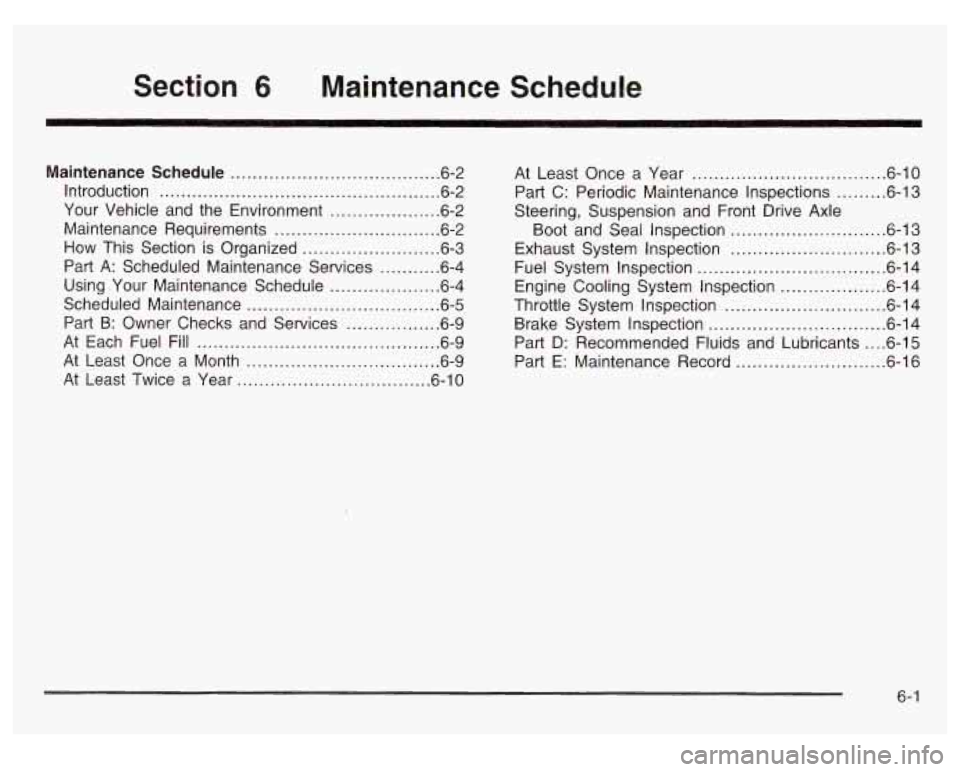
Section 6 Maintenance Schedule
Maintenance Schedule ...................................... 6.2
Introduction
................................................... 6.2
Your Vehicle and the Environment
.................... 6-2
Maintenance Requirements
.............................. 6-2
How This Section
is Organized ......................... 6-3
Part A: Scheduled Maintenance Services
........... 6-4
Using Your Maintenance Schedule
.................... 6-4
Scheduled Maintenance
................................... 6-5
Part B: Owner Checks and Services
................. 6-9
At Each Fuel Fill ............................................ 6-9
At Least Once a Month ................................... 6-9
At Least Twice a Year ................................... 6-10 At
Least Once a Year
................................... 6.10
Part C: Periodic Maintenance inspections
......... 6.13
Steering, Suspension and Front Drive Axle
Boot and Seal inspection
............................ 6.13
Exhaust System Inspection
............................ 6.13
Fuel System Inspection
.................................. 6.14
Engine Cooling System Inspection
................... 6.14
Throttle System Inspection
............................. 6.14
Brake System inspection
................................ 6.14
Part D: Recommended Fluids and Lubricants
.... 6-15
Part E: Maintenance Record
........................... 6.16
6- 1
Page 305 of 354
Maintenance Schedule
Introduction
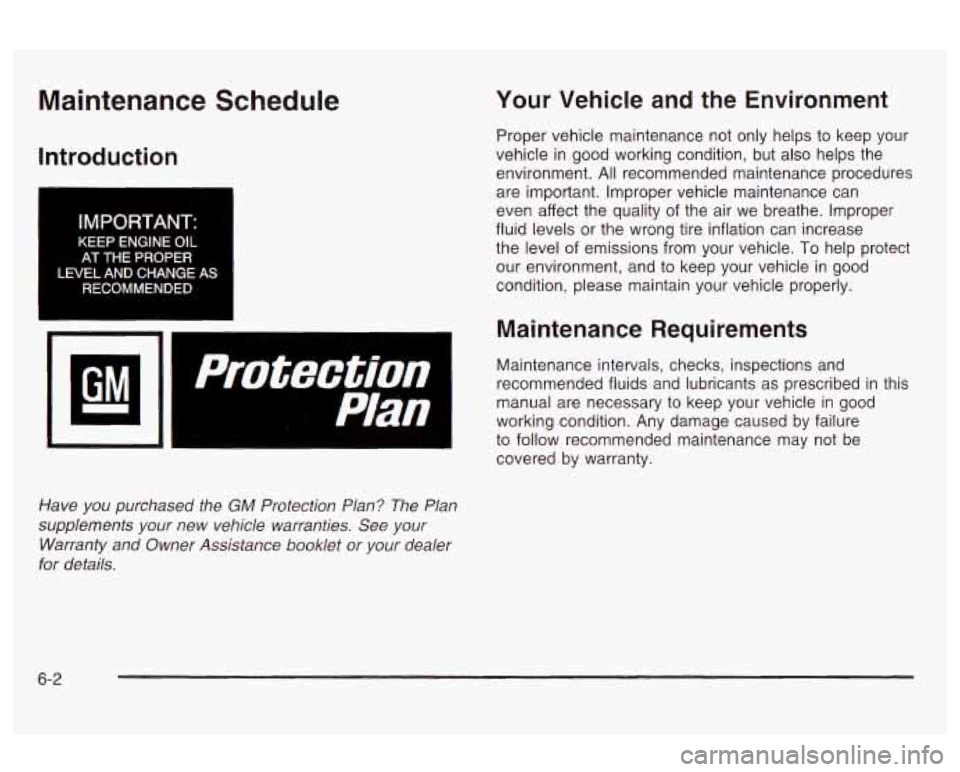
IMPORTANT:
KEEP ENGINE OIL AT THE PROPER
LEVEL AND CHANGE AS RECOMMENDED
14
r
Have you purchased the GM Protection Plan? The Plan
supplements your new vehicle warranties. See your
Warranty and Owner Assistance booklet or your dealer
for details.
Your Vehicle and the Environment
Proper vehicle maintenance not only helps to keep your
vehicle in good working condition, but also helps the
environment. All recommended maintenance procedures
are important. Improper vehicle maintenance can
even affect the quality
of the air we breathe. Improper
fluid levels or the wrong tire inflation can increase
the level of emissions from your vehicle.
To help protect
our environment, and to keep your vehicle in good
condition, please maintain your vehicle properly.
Maintenance Requirements
Maintenance intervals, checks, inspections and
recommended fluids and lubricants as prescribed in this
manual are necessary to keep your vehicle in good
working condition. Any damage caused by failure
to follow recommended maintenance may not be
covered by warranty.
6-2