2003 NISSAN X-TRAIL clock
[x] Cancel search: clockPage 841 of 3066
BRAKE PEDAL
BR-7
C
D
E
G
H
I
J
K
L
MA
B
BR
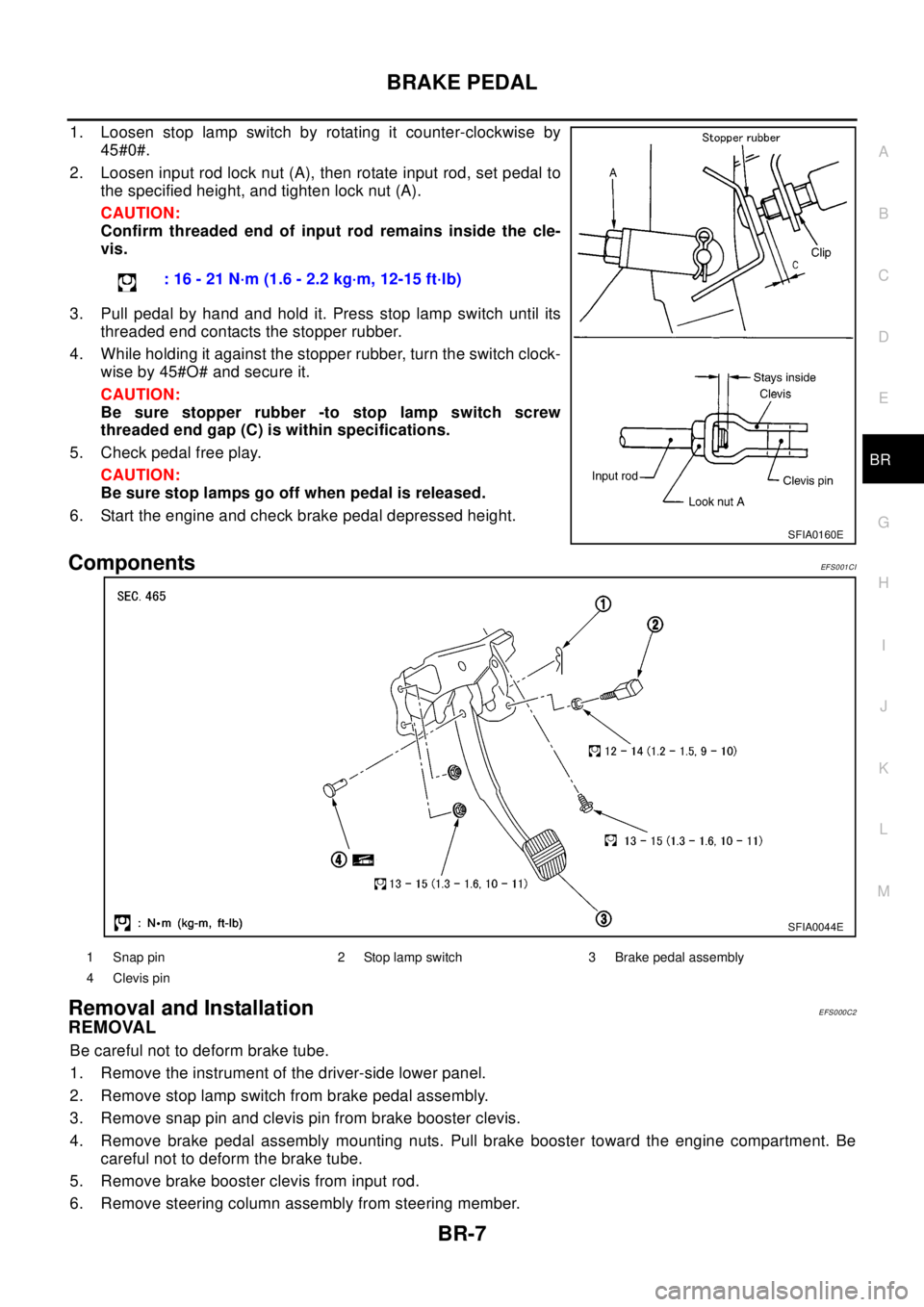
1. Loosen stop lamp switch by rotating it counter-clockwise by
45#0#.
2. Loosen input rod lock nut (A), then rotate input rod, set pedal to
the specified height, and tighten lock nut (A).
CAUTION:
Confirm threaded end of input rod remains inside the cle-
vis.
3. Pull pedal by hand and hold it. Press stop lamp switch until its
threaded end contacts the stopper rubber.
4. While holding it against the stopper rubber, turn the switch clock-
wise by 45#O# and secure it.
CAUTION:
Be sure stopper rubber -to stop lamp switch screw
threaded end gap (C) is within specifications.
5. Check pedal free play.
CAUTION:
Be sure stop lamps go off when pedal is released.
6. Start the engine and check brake pedal depressed height.
ComponentsEF S0 01 CI
Removal and InstallationEFS000C2
REMOVAL
Be careful not to deform brake tube.
1. Remove the instrument of the driver-side lower panel.
2. Remove stop lamp switch from brake pedal assembly.
3. Remove snap pin and clevis pin from brake booster clevis.
4. Remove brake pedal assembly mounting nuts. Pull brake booster toward the engine compartment. Be
careful not to deform the brake tube.
5. Remove brake booster clevis from input rod.
6. Remove steering column assembly from steering member.: 16 - 21 N·m (1.6 - 2.2 kg·m, 12-15 ft·lb)
SFIA0160E
SFIA0044E
1 Snap pin 2 Stop lamp switch 3 Brake pedal assembly
4 Clevis pin
Page 924 of 3066
![NISSAN X-TRAIL 2003 Electronic Repair Manual BRC-56
[ESP/TCS/ABS]
GENERAL INFORMATION
GENERAL INFORMATION
PFP:00000
Fail-SafeEFS0019S
ABS SYSTEM
If a malfunction occurs in the electrical system, the ABS warning lamp, ESP OFF indicator lamp, and](/manual-img/5/57402/w960_57402-923.png "NISSAN X-TRAIL 2003 Electronic Repair Manual BRC-56
[ESP/TCS/ABS]
GENERAL INFORMATION
GENERAL INFORMATION
PFP:00000
Fail-SafeEFS0019S
ABS SYSTEM
If a malfunction occurs in the electrical system, the ABS warning lamp, ESP OFF indicator lamp, and")
BRC-56
[ESP/TCS/ABS]
GENERAL INFORMATION
GENERAL INFORMATION
PFP:00000
Fail-SafeEFS0019S
ABS SYSTEM
If a malfunction occurs in the electrical system, the ABS warning lamp, ESP OFF indicator lamp, and SLIP
indicator lamp in the meter will turn ON. In this condition, the ESP/TCS/ABS and EBD become one of the fol-
lowing conditions by the fail-safe function.
1. Only EBD operates. The same condition as that of models without ESP/TCS/ABS
2. ESP/TCS/ABS and EBD do not operate. Only normal brake operates on 4 wheels.
NOTE:
In the step 1 shown above, the self-diagnosis is carried out at the ignition switch is turned ON and when the
vehicle initial starts. ABS self-diagnosis noise may be heard as usual.
ESP/TCS SYSTEM
If a malfunction occurs in the electrical system, the ESP OFF indicator lamp and SLIP indicator lamp in the
meter turn on. In this condition, ESP/TCS will be deactivated and it becomes equal to that of models without
ESP/TCS. However, ABS is controlled normally.
If a malfunction occurs in the throttle control system, ESP/TCS control does not operate. Only ABS control
operates normally.
CAUTION:
If the fail-safe function operates, carry out the self-diagnosis for ESP/TCS/ABS control system.
Hydraulic CircuitEFS0019T
CAUTION:
lWhen installing, check for twist and fracture.
lMake sure that there is no interference with other parts when turning the steering clockwise or
counter clockwise.
lThe brake piping is an important safety part. If a brake fluid leak is detected, always disassemble
and replace with a new one, if necessary.
ABS FunctionsEFS0019U
1. In cases of braking suddenly or braking on slippery road (ice road), ABS functions prevent wheels from
lock, improve the stability in sudden braking, and make efficient avoidance of obstacles with steering
manipulation by detecting 4-wheel speed and controlling 4-wheel brake fluid pressure.
2. EBD is integrated in ESP/TCS/ABS system.
CAUTION:
lDuring ABS operation, the brake pedal lightly vibrates and its mechanical noise may be heard.
This is a normal condition.
SFIA0346E
Page 1056 of 3066

DI-2
Engine Models) ....................................................... 31
Inspection/Vehicle speed signal ............................. 32
Inspection/Fuel Level Sensor Unit .......................... 33
FUEL LEVEL SENSOR UNIT .............................. 33
LOW-FUEL WARNING LAMP ............................. 33
The Fuel Gauge Pointer Fluctuates·Indicator
Wrong Value·or Varies. ........................................... 35
The Fuel Gauge Does Not Move to F-position. ...... 36
The Fuel Gauge Does Not Work. ........................... 36
Low Fuel Warning Lamp Illuminate or Not Illuminate... 37
Electrical Components Inspection .......................... 37
FUEL LEVEL SENSOR UNIT CHECK / GASO-
LINE ENGINE MODELS ...................................... 37
FUEL LEVEL SENSOR UNIT CHECK / DIESEL
ENGINE MODELS ............................................... 37
THERMAL TRANSMITTER CHECK ................... 38
Removal and Installation for Combination Meter .... 38
Disassembly and Assembly for Combination Meter... 38
WARNING LAMPS .................................................... 39
Schematic ............................................................... 39
Wiring Diagram — WARN —/ LHD Models ............ 40Wiring Diagram — WARN — / RHD Models ...........45
Electrical Components Inspection ...........................50
FUEL WARNING LAMP OPERATION CHECK ... 50
OIL PRESSURE SWITCH CHECK ......................50
DIODE CHECK ....................................................50
A/T INDICATOR .........................................................51
Wiring Diagram — AT/IND — .................................51
WARNING CHIME .....................................................52
System Description .................................................52
POWER SUPPLY AND GROUND CIRCUIT .......52
IGNITION KEY WARNING CHIME ......................52
LIGHT WARNING CHIME ...................................52
Component Parts and Harness Connector Location... 53
Wiring Diagram — CHIME — .................................54
Symptom Chart .......................................................56
Power Supply and Ground Circuit Check ...............56
Lighting Switch Input Signal Check .........................57
Key Switch Insert Signal Check ..............................57
Door Unlock Sensor Check .....................................58
Front Door Switch (driver side) Check ....................59
CLOCK ......................................................................60
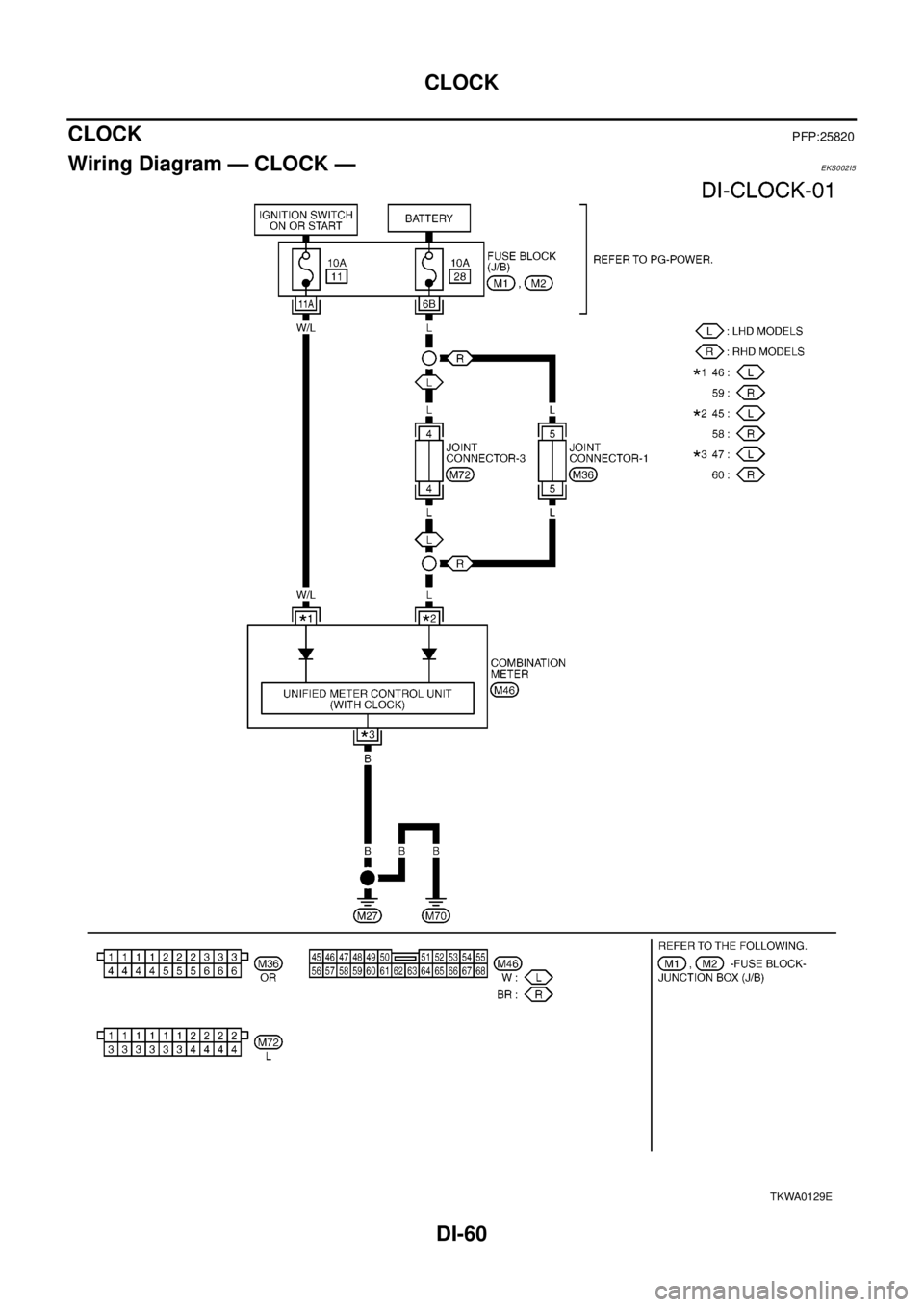
Wiring Diagram — CLOCK — .................................60
Page 1114 of 3066
DI-60
CLOCK
CLOCK
PFP:25820
Wiring Diagram — CLOCK —EKS002I5
TKWA0129E
Page 1147 of 3066
![NISSAN X-TRAIL 2003 Electronic Repair Manual BASIC SERVICE PROCEDURE
EC-33
[QR (WITH EURO-OBD)]
C
D
E
F
G
H
I
J
K
L
MA
EC
7. Make sure that “CMPLT” is displayed on CONSULT-II screen. If
“INCMP” is displayed, “Idle Air Volume Learningâ€](/manual-img/5/57402/w960_57402-1146.png "NISSAN X-TRAIL 2003 Electronic Repair Manual BASIC SERVICE PROCEDURE
EC-33
[QR (WITH EURO-OBD)]
C
D
E
F
G
H
I
J
K
L
MA
EC
7. Make sure that “CMPLT” is displayed on CONSULT-II screen. If
“INCMP” is displayed, “Idle Air Volume Learningâ€")
BASIC SERVICE PROCEDURE
EC-33
[QR (WITH EURO-OBD)]
C
D
E
F
G
H
I
J
K
L
MA
EC
7. Make sure that “CMPLT” is displayed on CONSULT-II screen. If
“INCMP” is displayed, “Idle Air Volume Learning” will not be car-
ried out successfully. In this case, find the cause of the problem
by referring to the “Diagnostic Procedure” below.
8. Rev up the engine two or three times and make sure that idle
speed and ignition timing are within the specifications.
Without CONSULT-II
NOTE:
lIt is better to count the time accurately with a clock.
lIt is impossible to switch the diagnostic mode when an accelerator pedal position sensor circuit
has a malfunction.
1. PerformEC-31, "
Accelerator Pedal Released Position Learning".
2. PerformEC-31, "
Throttle Valve Closed Position Learning".
3. Start engine and warm it up to normal operating temperature.
4. Check that all items listed under the topic “PRE-CONDITIONING” (previously mentioned) are in good
order.
5. Turn ignition switch “OFF” and wait at least 10 seconds.
6. Confirm that accelerator pedal is fully released, turn ignition switch “ON” and wait 3 seconds.
7. Repeat the following procedure quickly five times within 5 seconds.
a. Fully depress the accelerator pedal.
b. Fully release the accelerator pedal.
8. Wait 7 seconds, fully depress the accelerator pedal and keep it for approx. 20 seconds until the MI stops
blinking and turned ON.
9. Fully release the accelerator pedal within 3 seconds after the MI goes off.
10. Start engine and let it idle.
11. Wait 20 seconds.
12. Rev up the engine two or three times and make sure that idle speed and ignition timing are within the
specifications.
13. If idle speed and ignition timing are not within the specification, the result will be incomplete. In this case,
find the cause of the problem by referring to the “Diagnostic Procedure” below.
ITEM SPECIFICATION
Idle speed M/T: 650±50 rpm
A/T: 700±50 rpm (in “P” or “N” position)
Ignition timing M/T: 14±5°BTDC
A/T: 16±5°BTDC (in “P” or “N” position)
SEF455Y
ITEM SPECIFICATION
Idle speed M/T: 650±50 rpm
A/T: 700±50 rpm (in “P” or “N” position)
Ignition timing M/T: 14±5°BTDC
A/T: 16±5°BTDC (in “P” or “N” position)
PBIB0665E
Page 1163 of 3066
![NISSAN X-TRAIL 2003 Electronic Repair Manual ON BOARD DIAGNOSTIC (OBD) SYSTEM
EC-49
[QR (WITH EURO-OBD)]
C
D
E
F
G
H
I
J
K
L
MA
EC
MI Flashing without DTC
If the ECM is in Diagnostic Test Mode II, MI may flash when engine is running. In this cas](/manual-img/5/57402/w960_57402-1162.png "NISSAN X-TRAIL 2003 Electronic Repair Manual ON BOARD DIAGNOSTIC (OBD) SYSTEM
EC-49
[QR (WITH EURO-OBD)]
C
D
E
F
G
H
I
J
K
L
MA
EC
MI Flashing without DTC
If the ECM is in Diagnostic Test Mode II, MI may flash when engine is running. In this cas")
ON BOARD DIAGNOSTIC (OBD) SYSTEM
EC-49
[QR (WITH EURO-OBD)]
C
D
E
F
G
H
I
J
K
L
MA
EC
MI Flashing without DTC
If the ECM is in Diagnostic Test Mode II, MI may flash when engine is running. In this case, check ECM diag-
nostic test mode.EC-49, "
HOW TO SWITCH DIAGNOSTIC TEST MODE".
How to switch the diagnostic test (function) modes, and details of the above functions are described later,EC-
49.
The following emission-related diagnostic information is cleared when the ECM memory is erased.
1. Diagnostic trouble codes
2. 1st trip diagnostic trouble codes
3. Freeze frame data
4. 1st trip freeze frame data
5. System readiness test (SRT) codes
6. Test values
7. Others
HOW TO SWITCH DIAGNOSTIC TEST MODE
NOTE:
lIt is better to count the time accurately with a clock.
lIt is impossible to switch the diagnostic mode when an accelerator pedal position sensor circuit
has a malfunction.
lAlways ECM returns to Diagnostic Test Mode I after ignition switch is turned “OFF”.
How to Set Diagnostic Test Mode II (Self-diagnostic Results)
1. Confirm that accelerator pedal is fully released, turn ignition switch “ON” and wait 3 seconds.
2. Repeat the following procedure quickly five times within 5 seconds.
a. Fully depress the accelerator pedal.
b. Fully release the accelerator pedal.
3. Wait 7 seconds, fully depress the accelerator pedal and keep it for approx. 10 seconds until the MI starts
blinking.
4. Fully release the accelerator pedal.
Mode II Ignition switch in
“ON” position
Engine stoppedSELF-DIAGNOSTIC
RESULTSThis function allows DTCs and 1st trip DTCs to be read.
Engine running HEATED OXYGEN SENSOR 1
MONITORThis function allows the fuel mixture condition (lean or
rich), monitored by heated oxygen sensor 1, to be read. Diagnostic Test
ModeKEY and ENG.
Statu sFunction Explanation of Function
Page 1512 of 3066
![NISSAN X-TRAIL 2003 Electronic Repair Manual EC-398
[QR (WITHOUT EURO-OBD)]
BASIC SERVICE PROCEDURE
7. Make sure that “CMPLT” is displayed on CONSULT-II screen. If
“INCMP” is displayed, “Idle Air Volume Learning” will not be car-
rie](/manual-img/5/57402/w960_57402-1511.png "NISSAN X-TRAIL 2003 Electronic Repair Manual EC-398
[QR (WITHOUT EURO-OBD)]
BASIC SERVICE PROCEDURE
7. Make sure that “CMPLT” is displayed on CONSULT-II screen. If
“INCMP” is displayed, “Idle Air Volume Learning” will not be car-
rie")
EC-398
[QR (WITHOUT EURO-OBD)]
BASIC SERVICE PROCEDURE
7. Make sure that “CMPLT” is displayed on CONSULT-II screen. If
“INCMP” is displayed, “Idle Air Volume Learning” will not be car-
ried out successfully. In this case, find the cause of the problem
by referring to the “Diagnostic Procedure” below.
8. Rev up the engine two or three times and make sure that idle
speed and ignition timing are within the specifications.
Without CONSULT-II
NOTE:
lIt is better to count the time accurately with a clock.
lIt is impossible to switch the diagnostic mode when an accelerator pedal position sensor circuit
has a malfunction.
1. PerformEC-396, "
Accelerator Pedal Released Position Learning".
2. PerformEC-396, "
Throttle Valve Closed Position Learning".
3. Start engine and warm it up to normal operating temperature.
4. Check that all items listed under the topic “PRE-CONDITIONING” (previously mentioned) are in good
order.
5. Turn ignition switch “OFF” and wait at least 10 seconds.
6. Confirm that accelerator pedal is fully released, turn ignition switch “ON” and wait 3 seconds.
7. Repeat the following procedure quickly five times within 5 seconds.
a. Fully depress the accelerator pedal.
b. Fully release the accelerator pedal.
8. Wait 7 seconds, fully depress the accelerator pedal and keep it for approx. 20 seconds until the MI stops
blinking and turned ON.
9. Fully release the accelerator pedal within 3 seconds after the MI goes off.
10. Start engine and let it idle.
11. Wait 20 seconds.
12. Rev up the engine two or three times and make sure that idle speed and ignition timing are within the
specifications.
13. If idle speed and ignition timing are not within the specification, the result will be incomplete. In this case,
find the cause of the problem by referring to the “Diagnostic Procedure” below.
ITEM SPECIFICATION
Idle speed M/T: 650±50 rpm
A/T: 700±50 rpm (in “P” or “N” position)
Ignition timing M/T: 14±5°BTDC
A/T: 16±5°BTDC (in “P” or “N” position)
SEF455Y
ITEM SPECIFICATION
Idle speed M/T: 650±50 rpm
A/T: 700±50 rpm (in “P” or “N” position)
Ignition timing M/T: 14±5°BTDC
A/T: 16±5°BTDC (in “P” or “N” position)
PBIB0665E
Page 1519 of 3066
![NISSAN X-TRAIL 2003 Electronic Repair Manual ON BOARD DIAGNOSTIC (OBD) SYSTEM
EC-405
[QR (WITHOUT EURO-OBD)]
C
D
E
F
G
H
I
J
K
L
MA
EC
4. 1st trip freeze frame data
5. Others
HOW TO SWITCH DIAGNOSTIC TEST MODE
NOTE:
lIt is better to count the ti](/manual-img/5/57402/w960_57402-1518.png "NISSAN X-TRAIL 2003 Electronic Repair Manual ON BOARD DIAGNOSTIC (OBD) SYSTEM
EC-405
[QR (WITHOUT EURO-OBD)]
C
D
E
F
G
H
I
J
K
L
MA
EC
4. 1st trip freeze frame data
5. Others
HOW TO SWITCH DIAGNOSTIC TEST MODE
NOTE:
lIt is better to count the ti")
ON BOARD DIAGNOSTIC (OBD) SYSTEM
EC-405
[QR (WITHOUT EURO-OBD)]
C
D
E
F
G
H
I
J
K
L
MA
EC
4. 1st trip freeze frame data
5. Others
HOW TO SWITCH DIAGNOSTIC TEST MODE
NOTE:
lIt is better to count the time accurately with a clock.
lIt is impossible to switch the diagnostic mode when an accelerator pedal position sensor circuit
has a malfunction.
lAlways ECM returns to Diagnostic Test Mode I after ignition switch is turned “OFF”.
How to Set Diagnostic Test Mode II (Self-diagnostic Results)
1. Confirm that accelerator pedal is fully released, turn ignition switch “ON” and wait 3 seconds.
2. Repeat the following procedure quickly five times within 5 seconds.
a. Fully depress the accelerator pedal.
b. Fully release the accelerator pedal.
3. Wait 7 seconds, fully depress the accelerator pedal and keep it for approx. 10 seconds until the MI starts
blinking.
4. Fully release the accelerator pedal.
ECM has entered to Diagnostic Test Mode II (Self-diagnostic results).
How to Set Diagnostic Test Mode II (Heated Oxygen Sensor 1 Monitor)
1. Set the ECM in Diagnostic Test Mode II (Self-diagnostic results). Refer toEC-405, "How to Set Diagnostic
Test Mode II (Self-diagnostic Results)".
2. Start Engine.
ECM has entered to Diagnostic Test Mode II (Heated oxygen sensor 1 monitor).
How to Erase Diagnostic Test Mode II (Self-diagnostic Results)
1. Set ECM in Diagnostic Test Mode II (Self-diagnostic results). Refer toEC-405, "How to Set Diagnostic
Test Mode II (Self-diagnostic Results)".
2. Fully depress the accelerator pedal and keep it for more than 10 seconds.
The emission-related diagnostic information has been erased from the backup memory in the ECM.
3. Fully release the accelerator pedal, and confirm the DTC 0000 is displayed.
DIAGNOSTIC TEST MODE I — BULB CHECK
In this mode, the MI on the instrument panel should stay ON. If it remains OFF, check the bulb. Refer toDI-39,
"WA RN ING LA MPS"or seeEC-526.
DIAGNOSTIC TEST MODE I — MALFUNCTION WARNING
lThese DTC numbers are clarified in Diagnostic Test Mode II (SELF-DIAGNOSTIC RESULTS)
DIAGNOSTIC TEST MODE II — SELF-DIAGNOSTIC RESULTS
In this mode, the DTC and 1st trip DTC are indicated by the number of blinks of the MI as shown below.
PBIB0092E
MI Condition
ON When the malfunction is detected or the ECM's CPU is malfunctioning.
OFF No malfunction.