Page 509 of 3502
REFRIGERANT LINES
ATC-131
C
D
E
F
G
H
I
K
L
MA
B
AT C
REFRIGERANT LINESPFP:92600
HFC-134a (R-134a) Service ProcedureBJS000HN
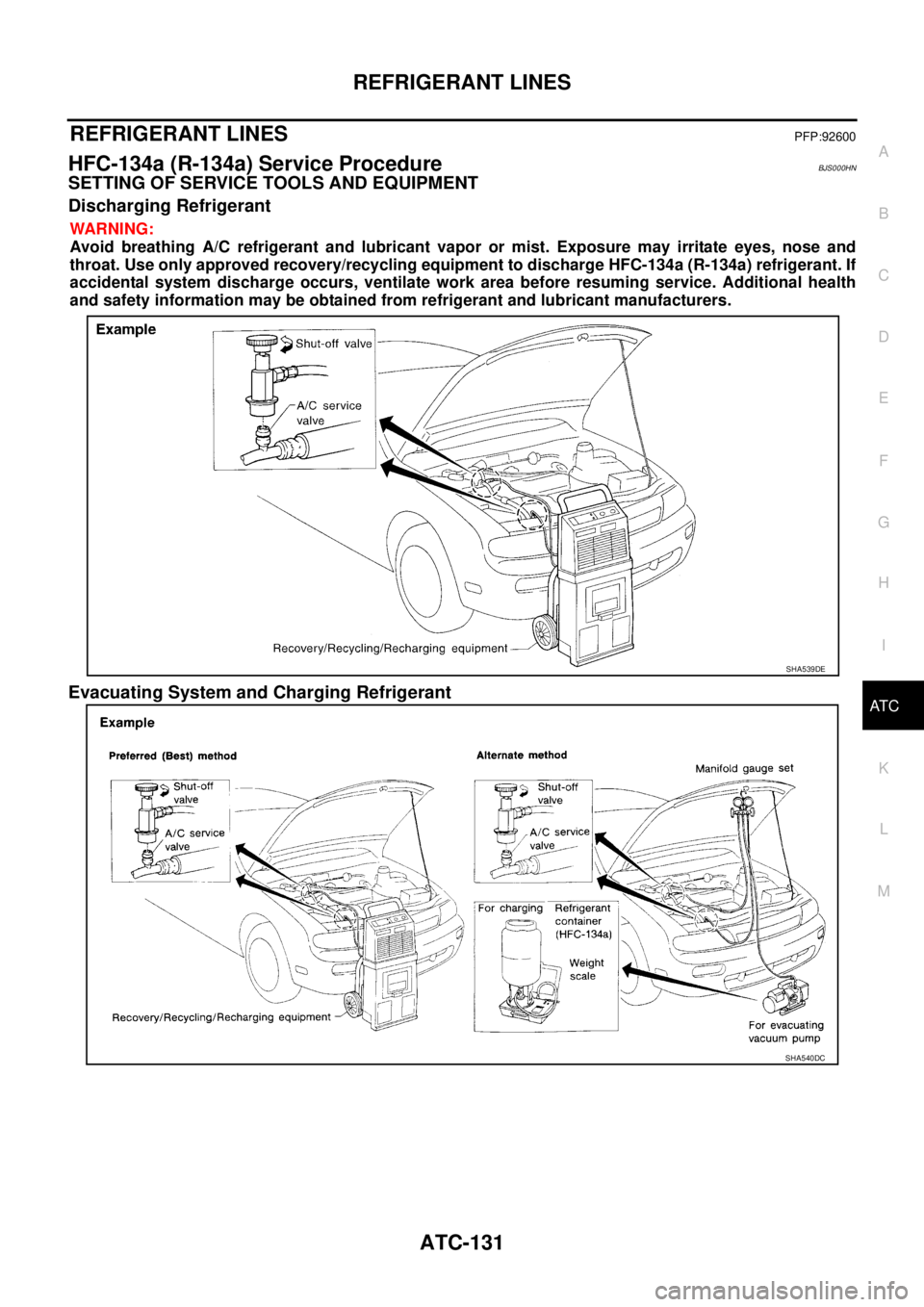
SETTING OF SERVICE TOOLS AND EQUIPMENT
Discharging Refrigerant
WARNING:
Avoid breathing A/C refrigerant and lubricant vapor or mist. Exposure may irritate eyes, nose and
throat. Use only approved recovery/recycling equipment to discharge HFC-134a (R-134a) refrigerant. If
accidental system discharge occurs, ventilate work area before resuming service. Additional health
and safety information may be obtained from refrigerant and lubricant manufacturers.
Evacuating System and Charging Refrigerant
SHA539DE
SHA540DC
Page 514 of 3502
ATC-136
REFRIGERANT LINES
9. Remove mounting bolts and nut from compressor, using power tools.
10. Remove compressor from right side of the vehicle.
INSTALLATION
Installation is basically the reverse order of removal.
CAUTION:
�Replace O-rings of low-pressure flexible hose and high-pressure flexible hose with new ones, and
then apply compressor oil to it when installing it.
�When recharging refrigerant, check for leaks.
Check Disc to Pulley ClearanceBJS000JE
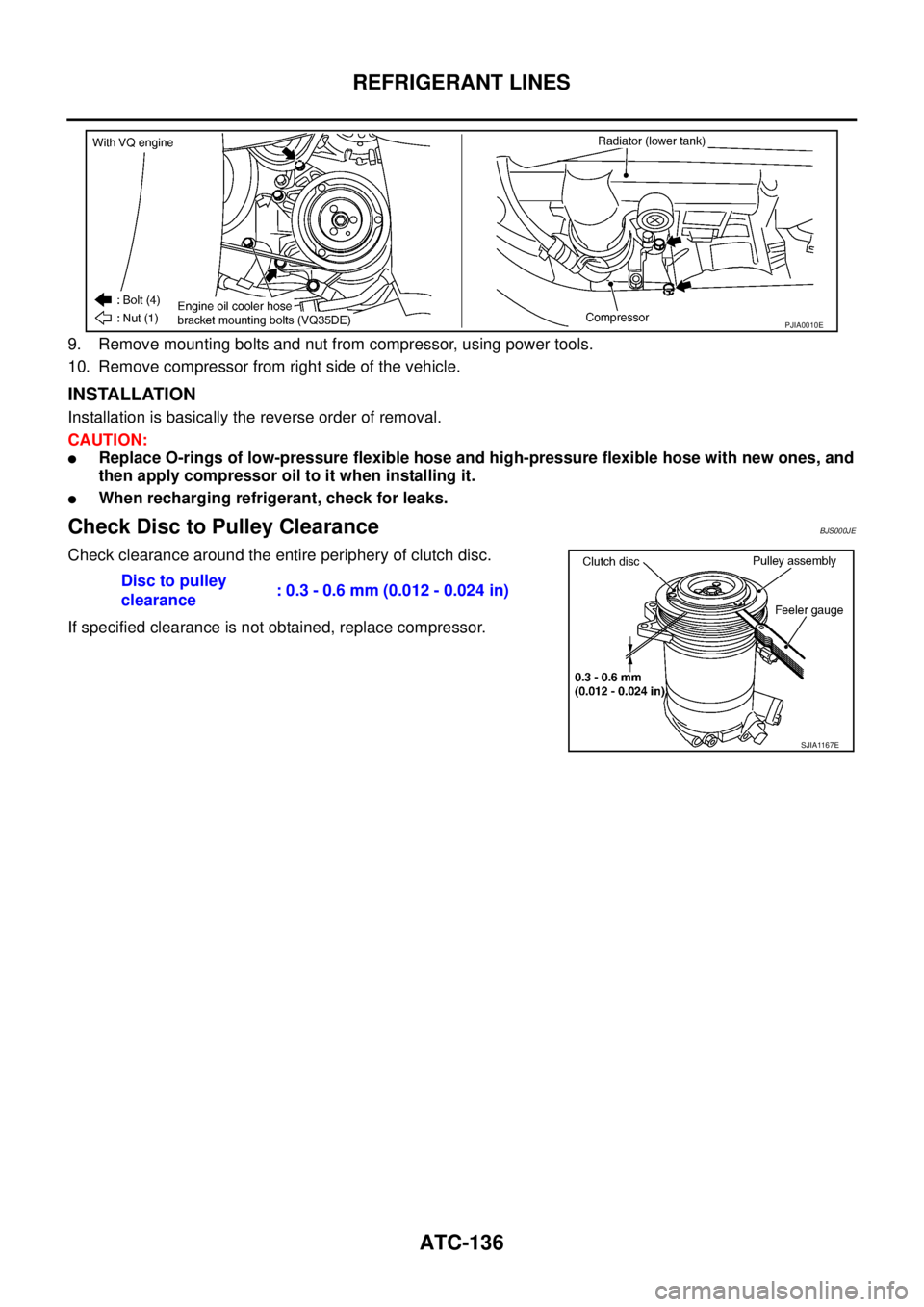
Check clearance around the entire periphery of clutch disc.
If specified clearance is not obtained, replace compressor.
PJIA0010E
Disc to pulley
clearance: 0.3 - 0.6 mm (0.012 - 0.024 in)
SJIA1167E
Page 515 of 3502
REFRIGERANT LINES
ATC-137
C
D
E
F
G
H
I
K
L
MA
B
AT C
Removal and Installation of Low-pressure Flexible Hose and Low-pressure Pipe
1
BJS000HR
REMOVAL
1. Use a refrigerant collecting equipment (for HFC-134a) to discharge the refrigerant.
2. Remove extension cowl top lower panel. Refer to EI-21, "
COWL TOP" .
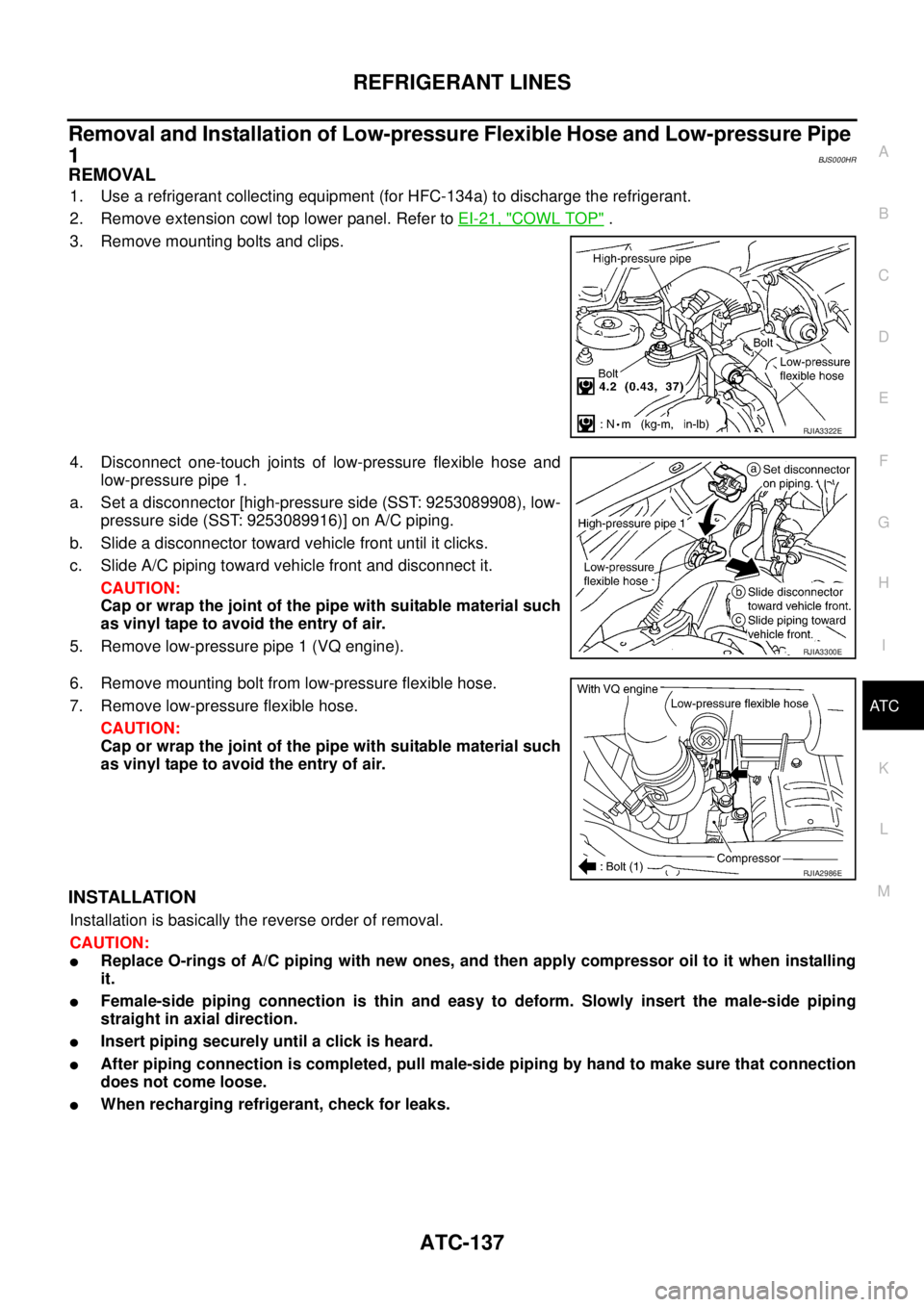
3. Remove mounting bolts and clips.
4. Disconnect one-touch joints of low-pressure flexible hose and
low-pressure pipe 1.
a. Set a disconnector [high-pressure side (SST: 9253089908), low-
pressure side (SST: 9253089916)] on A/C piping.
b. Slide a disconnector toward vehicle front until it clicks.
c. Slide A/C piping toward vehicle front and disconnect it.
CAUTION:
Cap or wrap the joint of the pipe with suitable material such
as vinyl tape to avoid the entry of air.
5. Remove low-pressure pipe 1 (VQ engine).
6. Remove mounting bolt from low-pressure flexible hose.
7. Remove low-pressure flexible hose.
CAUTION:
Cap or wrap the joint of the pipe with suitable material such
as vinyl tape to avoid the entry of air.
INSTALLATION
Installation is basically the reverse order of removal.
CAUTION:
�Replace O-rings of A/C piping with new ones, and then apply compressor oil to it when installing
it.
�Female-side piping connection is thin and easy to deform. Slowly insert the male-side piping
straight in axial direction.
�Insert piping securely until a click is heard.
�After piping connection is completed, pull male-side piping by hand to make sure that connection
does not come loose.
�When recharging refrigerant, check for leaks.
RJIA3322E
RJIA3300E
RJIA2986E
Page 516 of 3502
ATC-138
REFRIGERANT LINES
Removal and Installation of High-pressure Flexible HoseBJS000HS
REMOVAL
1. Use a refrigerant collecting equipment (for HFC-134a) to discharge the refrigerant.
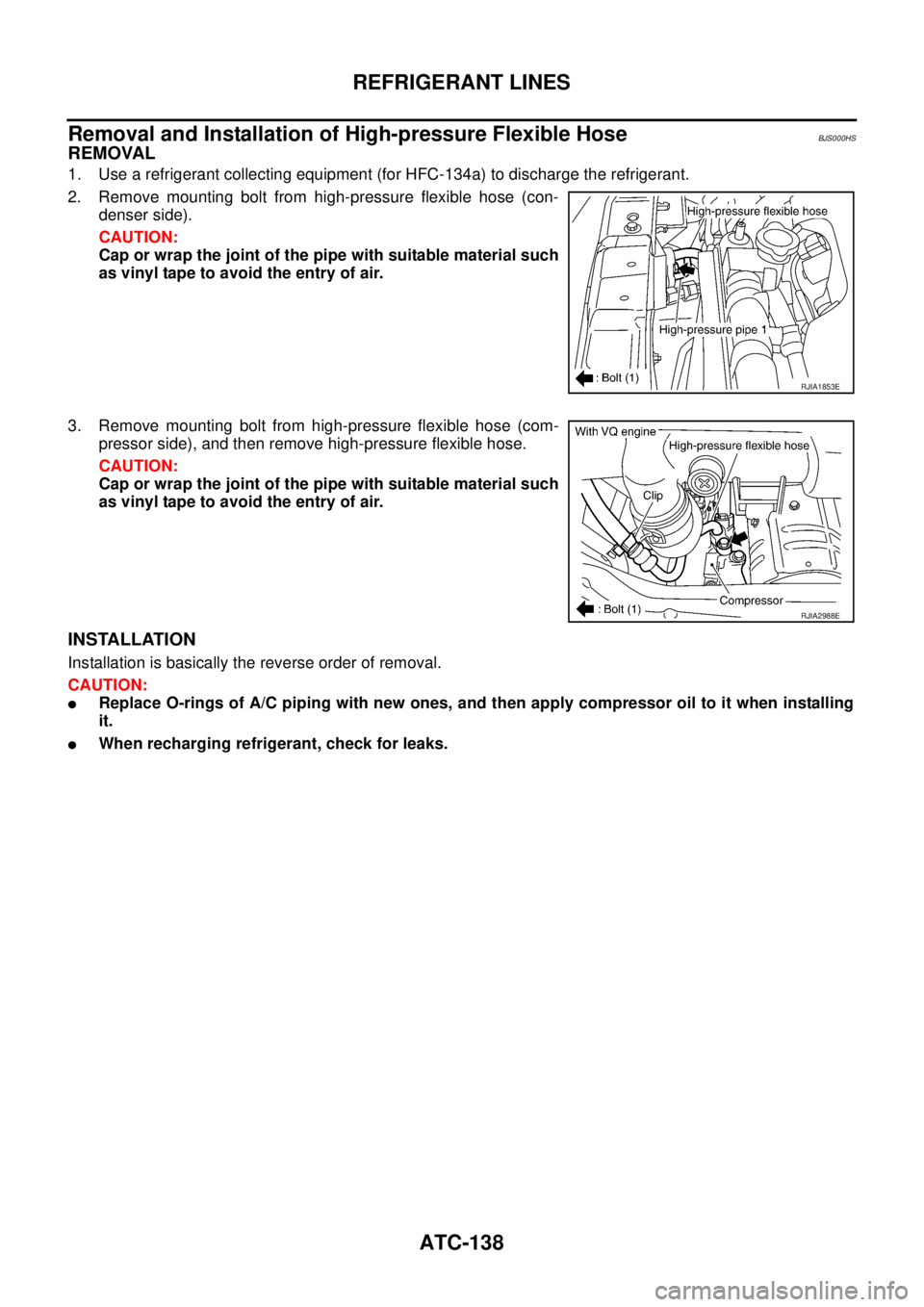
2. Remove mounting bolt from high-pressure flexible hose (con-
denser side).
CAUTION:
Cap or wrap the joint of the pipe with suitable material such
as vinyl tape to avoid the entry of air.
3. Remove mounting bolt from high-pressure flexible hose (com-
pressor side), and then remove high-pressure flexible hose.
CAUTION:
Cap or wrap the joint of the pipe with suitable material such
as vinyl tape to avoid the entry of air.
INSTALLATION
Installation is basically the reverse order of removal.
CAUTION:
�Replace O-rings of A/C piping with new ones, and then apply compressor oil to it when installing
it.
�When recharging refrigerant, check for leaks.
RJIA1853E
RJIA2988E
Page 517 of 3502
REFRIGERANT LINES
ATC-139
C
D
E
F
G
H
I
K
L
MA
B
AT C
Removal and Installation of High-pressure Pipe 1 (Engine Compartment)BJS000HT
REMOVAL
1. Use a refrigerant collecting equipment (for HFC-134a) to discharge the refrigerant.
2. Remove extension cowl top lower panel. Refer to EI-21, "
COWL TOP" .
3. Remove low-pressure flexible hose and low-pressure pipe 1 (VQ engine). Refer to ATC-137, "
Removal
and Installation of Low-pressure Flexible Hose and Low-pressure Pipe 1" .
4. Remove radiator reservoir tank. Refer to CO-13, "
RADIATOR" (QR engine) or CO-37, "RADIATOR" (VQ
engine).
5. Remove IPDM E/R. Refer to PG-28, "
Removal and Installation of IPDM E/R" .
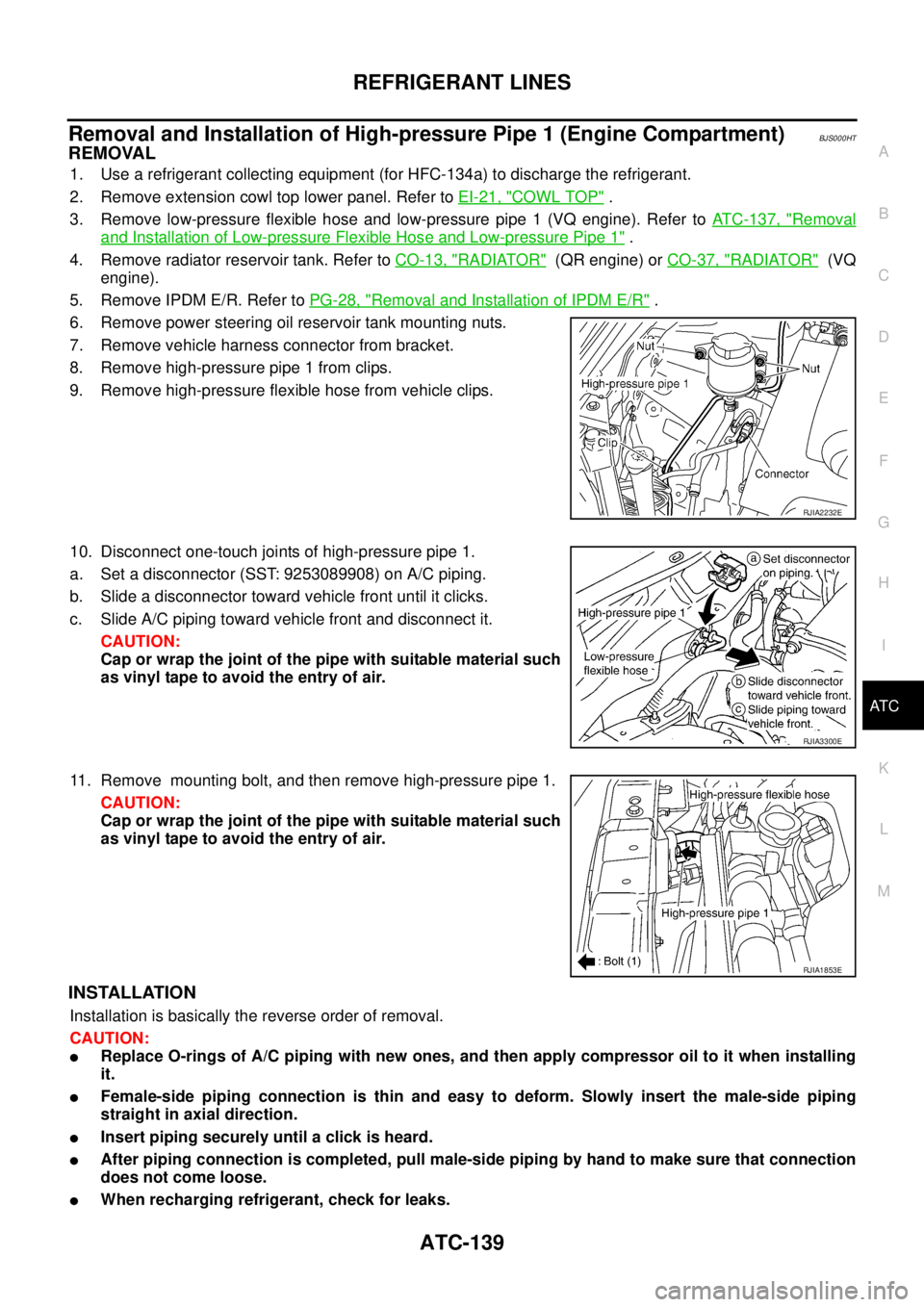
6. Remove power steering oil reservoir tank mounting nuts.
7. Remove vehicle harness connector from bracket.
8. Remove high-pressure pipe 1 from clips.
9. Remove high-pressure flexible hose from vehicle clips.
10. Disconnect one-touch joints of high-pressure pipe 1.
a. Set a disconnector (SST: 9253089908) on A/C piping.
b. Slide a disconnector toward vehicle front until it clicks.
c. Slide A/C piping toward vehicle front and disconnect it.
CAUTION:
Cap or wrap the joint of the pipe with suitable material such
as vinyl tape to avoid the entry of air.
11. Remove mounting bolt, and then remove high-pressure pipe 1.
CAUTION:
Cap or wrap the joint of the pipe with suitable material such
as vinyl tape to avoid the entry of air.
INSTALLATION
Installation is basically the reverse order of removal.
CAUTION:
�Replace O-rings of A/C piping with new ones, and then apply compressor oil to it when installing
it.
�Female-side piping connection is thin and easy to deform. Slowly insert the male-side piping
straight in axial direction.
�Insert piping securely until a click is heard.
�After piping connection is completed, pull male-side piping by hand to make sure that connection
does not come loose.
�When recharging refrigerant, check for leaks.
RJIA2232E
RJIA3300E
RJIA1853E
Page 519 of 3502
REFRIGERANT LINES
ATC-141
C
D
E
F
G
H
I
K
L
MA
B
AT C
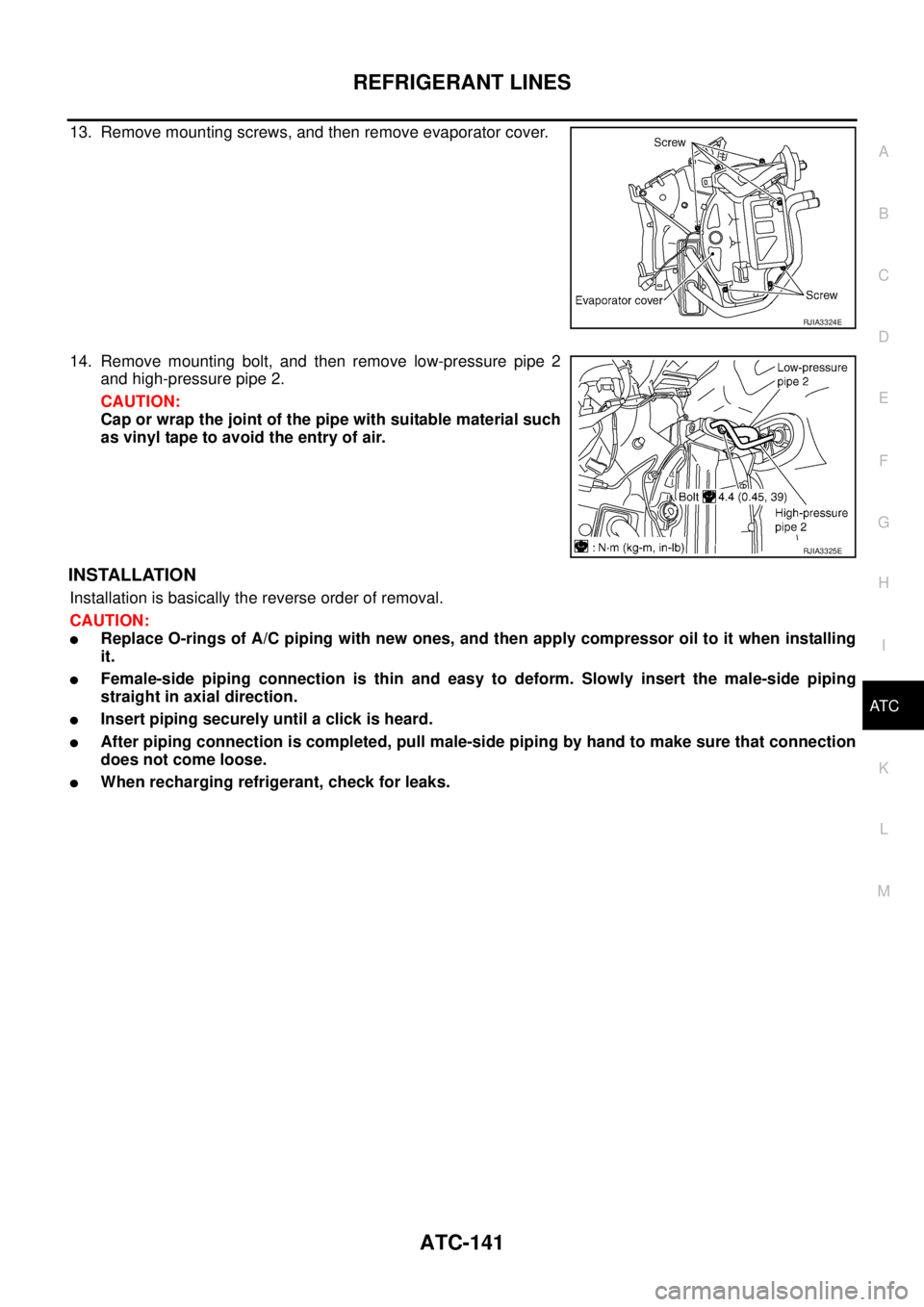
13. Remove mounting screws, and then remove evaporator cover.
14. Remove mounting bolt, and then remove low-pressure pipe 2
and high-pressure pipe 2.
CAUTION:
Cap or wrap the joint of the pipe with suitable material such
as vinyl tape to avoid the entry of air.
INSTALLATION
Installation is basically the reverse order of removal.
CAUTION:
�Replace O-rings of A/C piping with new ones, and then apply compressor oil to it when installing
it.
�Female-side piping connection is thin and easy to deform. Slowly insert the male-side piping
straight in axial direction.
�Insert piping securely until a click is heard.
�After piping connection is completed, pull male-side piping by hand to make sure that connection
does not come loose.
�When recharging refrigerant, check for leaks.
RJIA3324E
RJIA3325E
Page 521 of 3502
REFRIGERANT LINES
ATC-143
C
D
E
F
G
H
I
K
L
MA
B
AT C
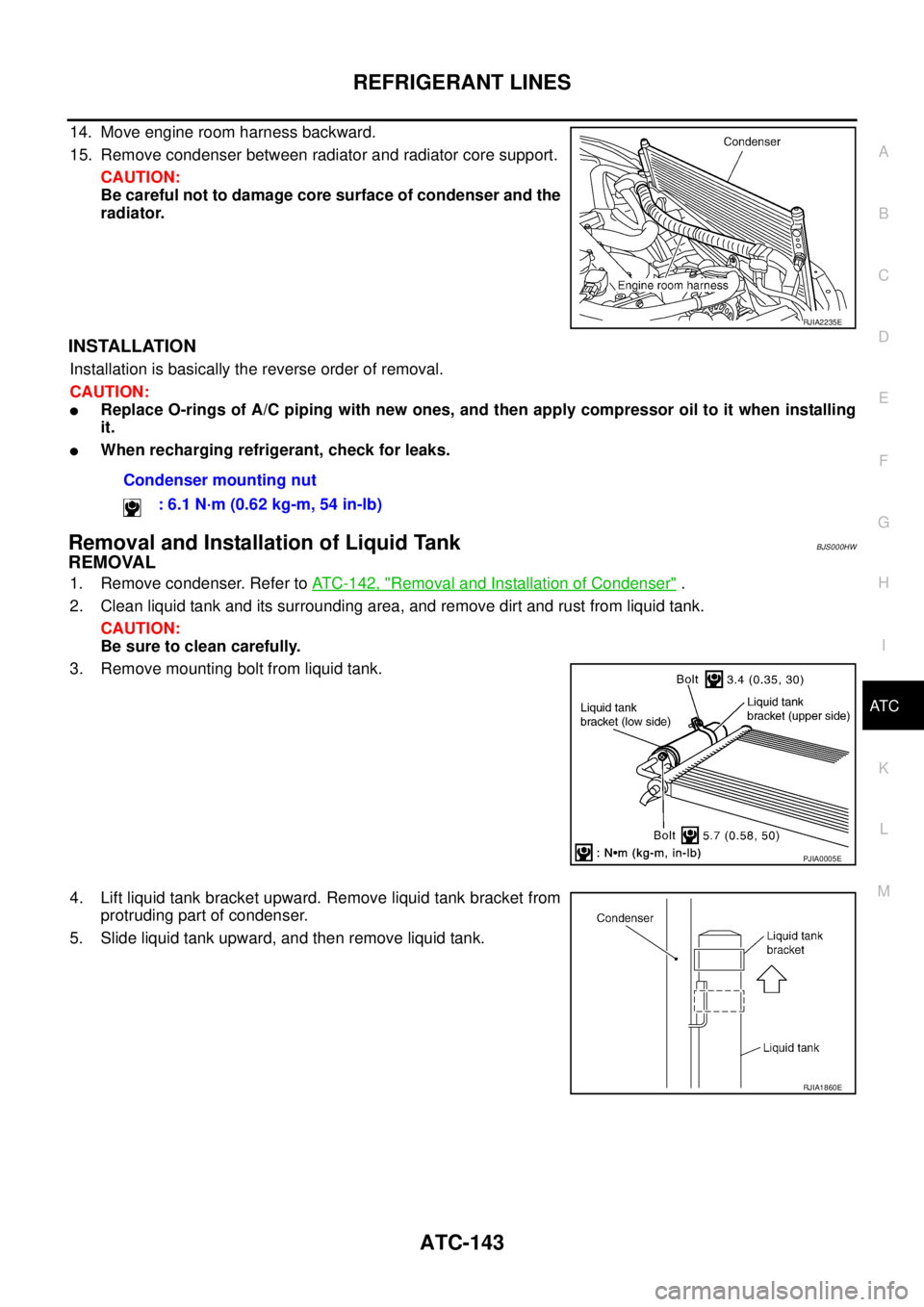
14. Move engine room harness backward.
15. Remove condenser between radiator and radiator core support.
CAUTION:
Be careful not to damage core surface of condenser and the
radiator.
INSTALLATION
Installation is basically the reverse order of removal.
CAUTION:
�Replace O-rings of A/C piping with new ones, and then apply compressor oil to it when installing
it.
�When recharging refrigerant, check for leaks.
Removal and Installation of Liquid TankBJS000HW
REMOVAL
1. Remove condenser. Refer to ATC-142, "Removal and Installation of Condenser" .
2. Clean liquid tank and its surrounding area, and remove dirt and rust from liquid tank.
CAUTION:
Be sure to clean carefully.
3. Remove mounting bolt from liquid tank.
4. Lift liquid tank bracket upward. Remove liquid tank bracket from
protruding part of condenser.
5. Slide liquid tank upward, and then remove liquid tank.
RJIA2235E
Condenser mounting nut
: 6.1 N·m (0.62 kg-m, 54 in-lb)
PJIA0005E
RJIA1860E
Page 522 of 3502

ATC-144
REFRIGERANT LINES
INSTALLATION
Install liquid tank, and then install liquid tank bracket on condenser.
CAUTION:
�Make sure liquid tank bracket is securely installed at protru-
sion of condenser. (Make sure liquid tank bracket does not
move to a position below center of liquid tank.)
�Replace O-rings of A/C piping with new ones, and then
apply compressor oil to it when installing it.
�When recharging refrigerant, check for leaks.
Removal and Installation of Refrigerant Pressure SensorBJS000HX
REMOVAL
1. Remove condenser. Refer to ATC-142, "Removal and Installation of Condenser" .
2. Remove refrigerant pressure sensor from condenser.
CAUTION:
When working, be careful not to damage the condenser
fins.
INSTALLATION
Installation is basically the reverse order of removal.
CAUTION:
Apply compressor oil to O-ring of refrigerant pressure sensor when installing it.
Removal and Installation of EvaporatorBJS000HY
REMOVAL
1. Remove low-pressure pipe 2 and high-pressure pipe 2. Refer to ATC-140, "Removal and Installation of
Low-pressure Pipe 2 and High-pressure Pipe 2" .
CAUTION:
Cap or wrap the joint of the pipe with suitable material such as vinyl tape to avoid the entry of air.
2. Slide evaporator, and then remove it from heater & cooling unit
assembly.
3. Remove intake sensor from evaporator, and then remove evap-
orator.
RJIA1861E
RJIA2237E
RJIA3281E