2003 INFINITI G35 tow
[x] Cancel search: towPage 107 of 256
SECONDARY TRUNK LID
RELEASE
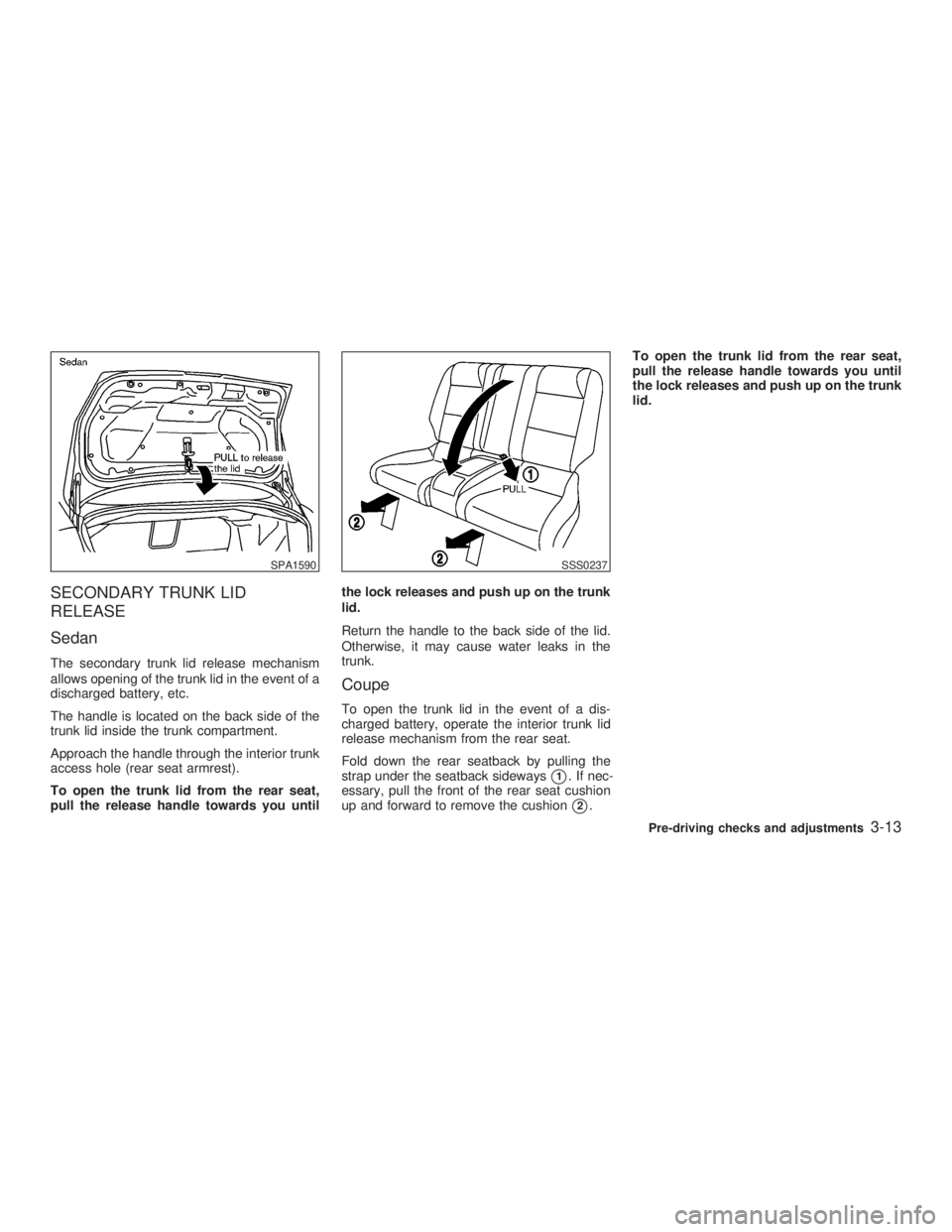
Sedan The secondary trunk lid release mechanism
allows opening of the trunk lid in the event of a
discharged battery, etc.
The handle is located on the back side of the
trunk lid inside the trunk compartment.
Approach the handle through the interior trunk
access hole (rear seat armrest).
To open the trunk lid from the rear seat,
pull the release handle towards you until the lock releases and push up on the trunk
lid.
Return the handle to the back side of the lid.
Otherwise, it may cause water leaks in the
trunk.
Coupe To open the trunk lid in the event of a dis-
charged battery, operate the interior trunk lid
release mechanism from the rear seat.
Fold down the rear seatback by pulling the
strap under the seatback sideways
j 1
. If nec-
essary, pull the front of the rear seat cushion
up and forward to remove the cushion
j 2
. To open the trunk lid from the rear seat,
pull the release handle towards you until
the lock releases and push up on the trunk
lid.
SPA1590 SSS0237
Pre-driving checks and adjustments
3-13
Z 02.7.29/V35-D/V5.0
X
Page 137 of 256

d. You have had an accident involv-
ing damage to the exhaust system,
underbody, or rear of the vehicle.
THREE WAY CATALYST The three way catalyst is an emission control
device installed in the exhaust system. Ex-
haust gases in the converter are burned at
high temperatures to help reduce pollutants.
WARNINGO The exhaust gas and the exhaust sys-
tem are very hot. Keep people, ani-
mals or flammable materials away
from the exhaust system compo-
nents.
O Do not stop or park the vehicle over
flammable materials such as dry
grass, waste paper or rags. They may
ignite and cause a fire. CAUTION O Do not use leaded gasoline. Deposits
from leaded gasoline seriously re-
duce the three way catalyst's ability
to help reduce exhaust pollutants.
O Keep your engine tuned up. Malfunc-
tions in the ignition, fuel injection, or
electrical systems can cause over-
rich fuel flow into the three way cata-
lyst, causing it to overheat. Do not
keep driving if the engine misfires, or
if noticeable loss of performance or
other unusual operating conditions
are detected. Have the vehicle in-
spected promptly by an authorized
INFINITI retailer.
O Avoid driving with an extremely low
fuel level. Running out of fuel could
cause the engine to misfire, damag-
ing the three way catalyst.
O Do not race the engine while warming
it up.
O Do not push or tow your vehicle to
start the engine. AVOIDING COLLISION AND
ROLLOVER
WARNING Failure to operate this vehicle in a safe
and prudent manner may result in loss
of control or an accident.
Be alert and drive defensively at all times.
Obey all traffic regulations. Avoid excessive
speed, high speed cornering, or sudden steer-
ing maneuvers, because these driving prac-
tices could cause you to lose control of your
vehicle. As with any vehicle, a loss of con-
trol could result in a collision with other
vehicles or objects, or cause the vehicle to
rollover, particularly if the loss of control
causes the vehicle to slide sideways. Be
attentive at all times, and avoid driving when
tired. Never drive when under the influence of
alcohol or drugs (including prescription or
over-the-counter drugs which may cause
drowsiness). Always wear your seat belt. See
ªSeat Beltsº in the ª1. Seats, restraints and
supplemental air bag systemsº section. Also
instruct your passengers to do so.
Starting and driving
5-3
Z 02.7.29/V35-D/V5.0
X
Page 138 of 256
DRINKING ALCOHOL/DRUGS AND
DRIVING
WARNINGNever drive under the influence of alco-
hol or drugs. Alcohol in the bloodstream
reduces coordination, delays reaction
time and impairs judgment. Driving after
drinking alcohol increases the likeli-
hood of being involved in an accident
injuring yourself and others. Addition-
ally, if you are injured in the accident,
alcohol can increase the severity of the
injury.
INFINITI is committed to safe driving. You
must not drive under the influence of alcohol.
Every year thousands of people are injured or
killed in alcohol related accidents. Although
the local laws vary on what is considered to be
legally intoxicated, the fact is that alcohol
affects all people differently and most people
underestimate the effects of alcohol.
Remember, drinking and driving don't mix!
And that's true for drugs too (over the counter,
prescription, and illegal drugs). Don't drive if your ability to operate your vehicle is impaired
by alcohol, drugs, or some other physical
condition.
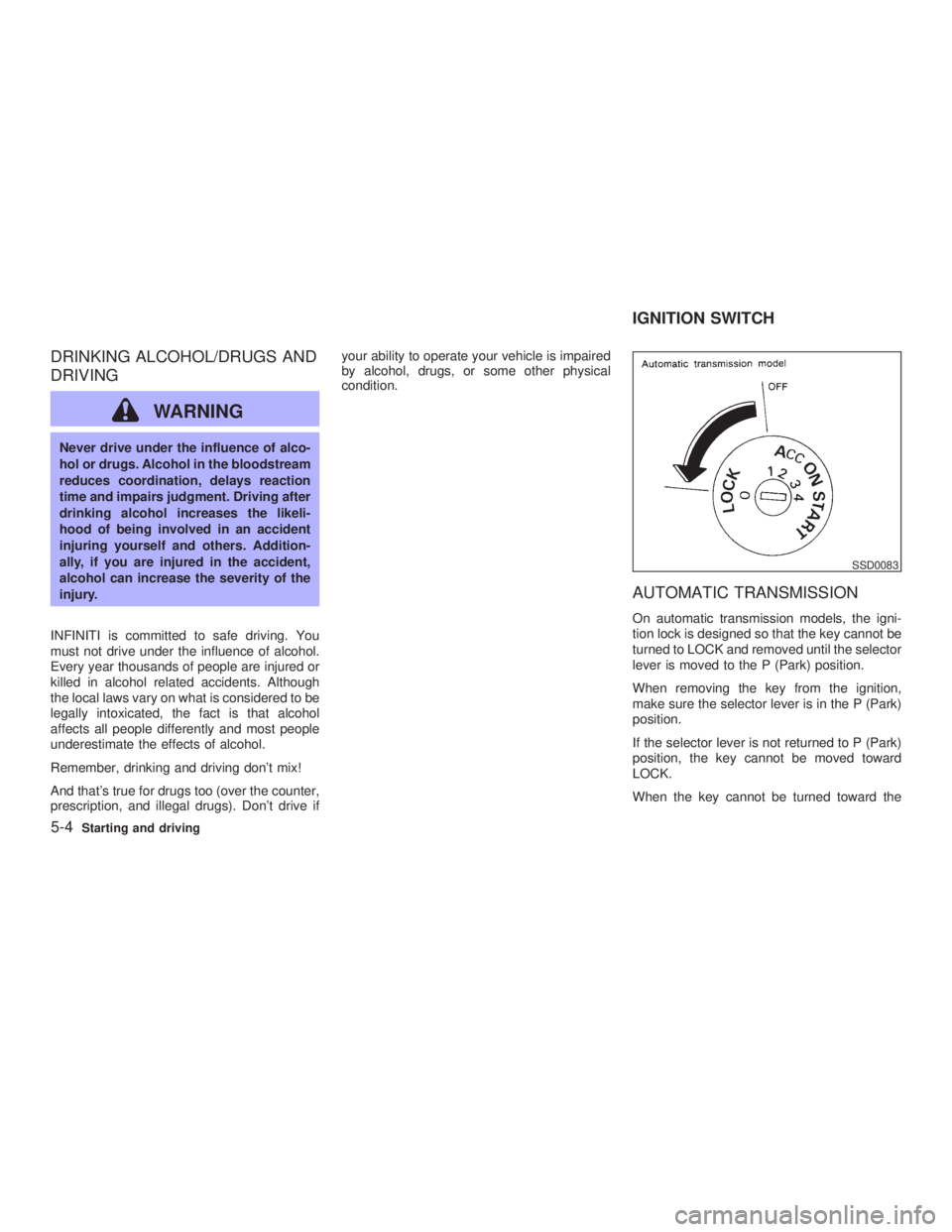
AUTOMATIC TRANSMISSION On automatic transmission models, the igni-
tion lock is designed so that the key cannot be
turned to LOCK and removed until the selector
lever is moved to the P (Park) position.
When removing the key from the ignition,
make sure the selector lever is in the P (Park)
position.
If the selector lever is not returned to P (Park)
position, the key cannot be moved toward
LOCK.
When the key cannot be turned toward the SSD0083
IGNITION SWITCH
5-4 Starting and driving
Z 02.7.29/V35-D/V5.0
X
Page 139 of 256
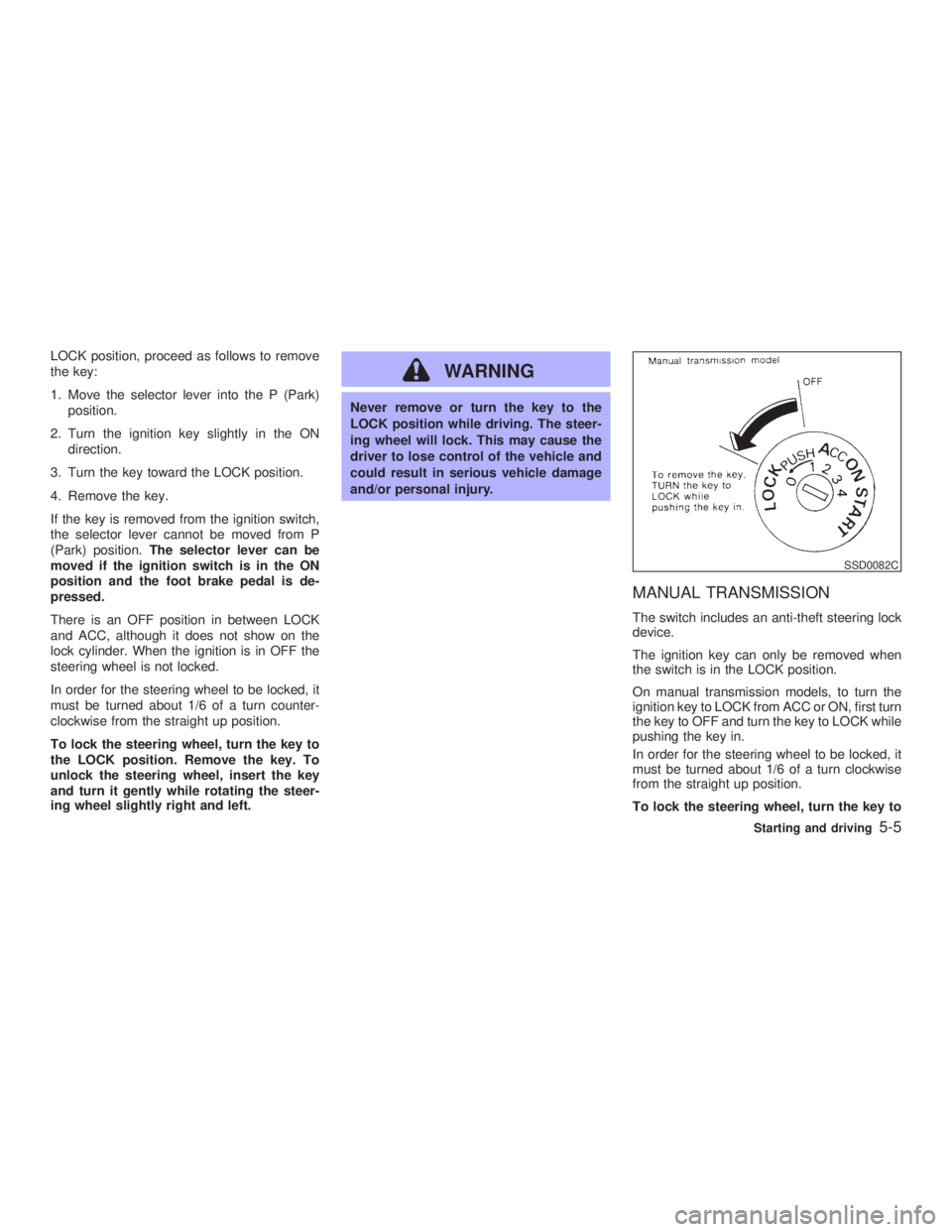
LOCK position, proceed as follows to remove
the key:
1. Move the selector lever into the P (Park)
position.
2. Turn the ignition key slightly in the ON
direction.
3. Turn the key toward the LOCK position.
4. Remove the key.
If the key is removed from the ignition switch,
the selector lever cannot be moved from P
(Park) position. The selector lever can be
moved if the ignition switch is in the ON
position and the foot brake pedal is de-
pressed.
There is an OFF position in between LOCK
and ACC, although it does not show on the
lock cylinder. When the ignition is in OFF the
steering wheel is not locked.
In order for the steering wheel to be locked, it
must be turned about 1/6 of a turn counter-
clockwise from the straight up position.
To lock the steering wheel, turn the key to
the LOCK position. Remove the key. To
unlock the steering wheel, insert the key
and turn it gently while rotating the steer-
ing wheel slightly right and left. WARNING Never remove or turn the key to the
LOCK position while driving. The steer-
ing wheel will lock. This may cause the
driver to lose control of the vehicle and
could result in serious vehicle damage
and/or personal injury.
MANUAL TRANSMISSION The switch includes an anti-theft steering lock
device.
The ignition key can only be removed when
the switch is in the LOCK position.
On manual transmission models, to turn the
ignition key to LOCK from ACC or ON, first turn
the key to OFF and turn the key to LOCK while
pushing the key in.
In order for the steering wheel to be locked, it
must be turned about 1/6 of a turn clockwise
from the straight up position.
To lock the steering wheel, turn the key to SSD0082C
Starting and driving
5-5
Z 02.7.29/V35-D/V5.0
X
Page 151 of 256

During the first 1,200 miles (2,000 km), follow
these recommendations to obtain maximum
engine performance and ensure the future
reliability and economy of your new vehicle.
Failure to follow these recommendations may
result in shortened engine life and reduced
engine performance.
O Avoid driving for long periods at constant
speed, either fast or slow. Do not run the
engine over 4,000 rpm.
O Do not accelerate at full throttle in any gear.
O Avoid quick starts.
O Avoid hard braking as much as possible.
O Do not tow a trailer for the first 500 miles
(800 km). O Accelerate slowly and smoothly. Maintain
cruising speeds with a constant accelerator
position.
O Drive at moderate speeds on the highway.
Driving at high speed will lower fuel
economy.
O Avoid unnecessary stopping and braking.
Maintain a safe distance behind other ve-
hicles.
O Use a proper gear range which suits road
conditions. On level roads, shift into high
gear as soon as possible.
O Avoid unnecessary engine idling. O Keep your engine tuned up.
O Follow the recommended periodic mainte-
nance schedule.
O Keep the tires inflated at the correct pres-
sure. Low pressure will increase tire wear
and waste fuel.
O Keep the front wheels in correct alignment.
Improper alignment will cause not only tire
wear but also lower fuel economy.
O Air conditioner operation lowers fuel
economy. Use the air conditioner only when
necessary.
O When cruising at highway speeds, it is
more economical to use the air conditioner
and leave the windows closed to reduce
drag. SD1001M
BREAK-IN SCHEDULE INCREASING FUEL ECONOMY
Starting and driving
5-17
Z 02.7.29/V35-D/V5.0
X
Page 153 of 256

O HEADED UPHILL WITH CURB:
j 2
Turn the wheels away from the curb and
move the vehicle back until the curb side
wheel gently touches the curb.
O HEADED UPHILL OR DOWNHILL, NO
CURB:
j 3
Turn the wheels toward the side of the road
so the vehicle will move away from the
center of the road if it moves.
4. Turn the ignition key to the LOCK position
and remove the key. The power assisted steering is designed to
use a hydraulic pump, driven by the engine, to
assist steering.
If the engine stops or the drive belt breaks, you
will still have control of the vehicle. However,
much greater steering effort is needed, espe-
cially in sharp turns or at low speeds.
WARNING If the engine is not running or is turned
off while driving, the power assist for the
steering will not work. Steering will be
much harder to operate. BRAKING PRECAUTIONS The brake system has two separate hydraulic
circuits. If one circuit malfunctions, you will still
have braking at two wheels.
Vacuum assisted brake
The brake booster aids braking by using en-
gine vacuum. If the engine stops, you can stop
the vehicle by depressing the brake pedal.
However, greater foot pressure on the brake
pedal will be required to stop the vehicle and
the stopping distance will be longer.
Wet brakes
When the vehicle is washed or driven through
water, the brakes may get wet. As a result,
your braking distance will be longer and the
vehicle may pull to one side during braking.
To dry brakes, drive the vehicle at a safe
speed while lightly pressing the brake pedal to
heat-up the brakes. Do this until the brakes
return to normal. Avoid driving the vehicle at
high speeds until the brakes function correctly.
Using the brakes
Avoid resting your foot on the brake pedal
while driving. This overheats the brakes, in-
creases wear on the brake linings and pads,
and reduces gas mileage.POWER STEERING BRAKE SYSTEM
Starting and driving
5-19
Z 02.7.29/V35-D/V5.0
X
Page 159 of 256
6 In case of emergency Roadside assistance program................................... 6-2
Flat tire ...................................................................... 6-2
Changing a flat tire ............................................... 6-2
Jump starting............................................................. 6-7
Push starting ............................................................. 6-9 If your vehicle overheats ......................................... 6-10
Towing your vehicle ................................................ 6-11
Towing recommended by INFINITI .................... 6-11
Vehicle recovery (Freeing a stuck vehicle) ........ 6-13
Z 02.7.29/V35-D/V5.0
X
Page 165 of 256

Stowing the damaged tire and tools Securely store the spare tire and jacking
equipment in the vehicle.
WARNINGO Always make sure that the spare tire
and jacking equipment are properly
secured after use. Such items can
become dangerous projectiles in an
accident or sudden stop.
O The T-type spare tire and small size spare tire are designed for emer-
gency use. See ªWheels and tiresº in
the ª8. Do-it-yourselfº section.
If needed Roadside Assistance is available.
Please see your Warranty Information Booklet
or Roadside Assistance I.D. Card for the toll-
free number to call (U.S.) or Warranty & Road-
side assistance information booklet (Canada). To start your engine with a booster battery, the
instructions and precautions below must be
followed.
WARNING O If done incorrectly, jump starting can
lead to a battery explosion, resulting
in severe injury or death. It could also
damage your vehicle.
O Explosive hydrogen gas is always
present in the vicinity of the battery.
Keep all sparks and flames away from
the battery.
O Do not allow battery fluid to come
into contact with eyes, skin, cloth or
painted surfaces. Battery fluid is a
corrosive sulphuric acid solution
which can cause severe burns. If the
fluid should come into contact with
anything, immediately flush the con-
tacted area with water.
O Keep battery out of the reach of
children.SCE0384A SCE0425
JUMP STARTING
In case of emergency
6-7
Z 02.7.29/V35-D/V5.0
X