Page 240 of 392

�µ�µ
If you exceed the maximum speed
f or the gear you are in, the engine
speed will enter into the tachometer’s
red zone. If this occurs, you may f eel
the engine cut in and out. This is
caused by a limiter in the engine’s
computer controls. The engine will
run normally when you reduce the
RPM below the red zone.
When driving down hill with a trailer,
use the Second position. To shif t f rom Second
to First, pull the shift lever
towards you, then shift to the
lower gear. With the lever in this
position, the transmission locks in
First gear. By upshif ting and
downshif ting through 1, 2, D and
D, you can operate this
transmission much like a manual
transmission without a clutch
pedal. This allows you to move the shif t
lever out of Park if the normal
method of pushing on the brake
pedal and pulling the shif t lever does
not work.
Set the Parking brake.
Make sure the key is in the
ignition switch LOCK (0) position.
To shif t to Second,
pull the shif t lever towards you, then
shif t to the lower gear. This position
locks the transmission in second
gear. It does not downshif t to f irst
gear when you come to a stop.
Second gives you more power when
climbing, and increased engine
braking when going down steep hills.
Usesecondgearwhenstartingout
on a slippery surf ace or in deep snow.
It will help reduce wheelspin. 1.
2.
3
Engine Speed Limiter
Shift Lock Release
First (1) Second (2)
Automatic Transmission
Driving236
Page 243 of 392

To engage the VTM-4 Lock:To disengage the VTM-4 Lock, do
one of the f ollowing:
The VTM-4 Lock will temporarily
disengage when the vehicle speed
exceeds 18 mph (30 km/h). It will
automatically engage again as the
speed slows below 18 mph (30
km/h). The light in the VTM-4 Lock
button will remain on the whole time.
The vehicle must be stopped with
the engine running.
Move the shift lever to first (1),
second (2) or reverse (R) gear.
Press the VTM-4 Lock button.
The light in the button will come
on.
To get unstuck, apply light pressure
to the accelerator pedal. Do not spin
the f ront tires f or more than a f ew
seconds. Because of the amount of
torque applied to the rear tires, they
should not spin. This is normal. If
you are not able to get the vehicle to
move, apply the brakes to stop the
wheels, then reverse direction. Press the VTM-4 Lock button.
Move the shift lever to D, or D .
Turn the ignition to OFF (0).
When you restart your Pilot, the
VTM-4 Lock f eature will be of f .
1.
2.
3.
3
Variable Torque Management 4WD System
Driving239
Do not continuously spin the f ront tires
of your PILOT. Continuously spinning
the f ront tires can cause transmission
or rear dif f erential damage.
Page 263 of 392

When purchasing a tow bar, make
sure you select a reputable
manuf acturer and installer. Follow
the manufacturer’s attachment
instructions caref ully.If you tow more than 8 hours in one
day, you should repeat the above
procedure at least every 8 hours.
(when you stop f or f uel, etc.)
Check the transmission f luid level
(see page ). Maintaining the correct f luid level
is very important.
Start the engine.
Leave the ignition switch in
ACCESSORY (I) so the steering
wheel does not lock. Make sure
the radio and any items plugged
into the accessory power sockets
are turned of f so you do not run
down the battery. Release the parking brake.
Your Pilot can be towed behind a
motorhome at legal highway speeds
up to 65 mph (100 km/h). Do not
exceed 65 mph (100 km/h).
Otherwise, severe transmission
damage will occur. To avoid damage
to the 4WD system, it must be towed
with all f our wheels on the ground
(f lat towing).
Press on the brake pedal. Shif t the
lever through all the positions (P,
R, N, D, D , 2, 1)
ShifttoD,thentoN.Letthe
engine run f or three minutes, then
turn of f the engine.
Do the f ollowing to prepare your
Pilot f or ‘‘f lat towing.’’ Perf orm this
procedure every day immediately
bef ore you begin towing, and f ollow
this procedure exactly; otherwise,
severe automatic transmission
damage will occur. 293
Do not overf ill.
CONT INUED
3
Ext ended T owing
Towing Your Vehicle Behind a Motorhome
Driving259
Page 264 of 392
Replace the transmission fluid every
two years or 30,000 miles (48,000
km), whichever comes f irst.
Towing Your Vehicle Behind a Motorhome
Driving260
The steering system can be damaged if
the steering wheel is locked. Leave the
ignition switch in Accessory (I), and
make sure the steering wheel turns
f reely bef ore you begin towing.
Improper towing preparation will
damage the transmission. Follow the
above procedure exactly. If you cannot
shif t the transmission or start the
engine, your vehicle must be
transported on a f lat-bed or trailer.
Page 293 of 392
CONT INUED
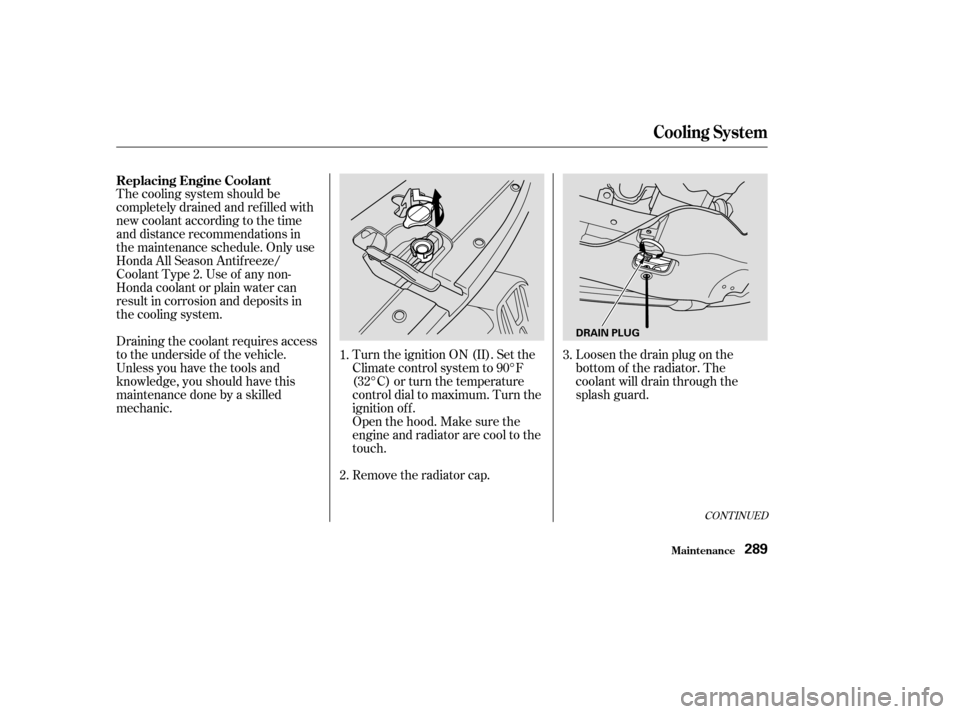
Loosen the drain plug on the
bottom of the radiator. The
coolant will drain through the
splash guard.
Thecoolingsystemshouldbe
completely drained and ref illed with
new coolant according to the time
and distance recommendations in
the maintenance schedule. Only use
Honda All Season Antif reeze/
Coolant Type 2. Use of any non-
Honda coolant or plain water can
result in corrosion and deposits in
the cooling system.
Draining the coolant requires access
to the underside of the vehicle.
Unless you have the tools and
knowledge, you should have this
maintenance done by a skilled
mechanic.
Turn the ignition ON (II). Set the
Climate control system to 90°F
(32°C) or turn the temperature
control dial to maximum. Turn the
ignition of f .
Openthehood.Makesurethe
engine and radiator are cool to the
touch.
Remove the radiator cap.
1.
3.
2.
Replacing Engine Coolant
Cooling Syst em
Maint enance289
DRAIN PLUG
Page 303 of 392
Loosen the two holding clips by
turning the heads one-quarter turn
counterclockwise with a f lat-tipped
screwdriver. Remove the cover on
the f ront cylinder bank by pulling
it straight up.
Clean off any dirt and oil that have
collected around the ignition coils.
The spark plugs in your vehicle are a
special platinum-tipped design f or
longer lif e. The spark plugs should
be replaced according to the time
and distance recommendations in
the maintenance schedule.
Remove the f our bolts using a
hexagon socket wrench, then
remove the engine cover.
1.
2.
3.
CONT INUED
Replacement
Maint enance
Spark Plugs
299
HOLDING CLIP
Page 304 of 392
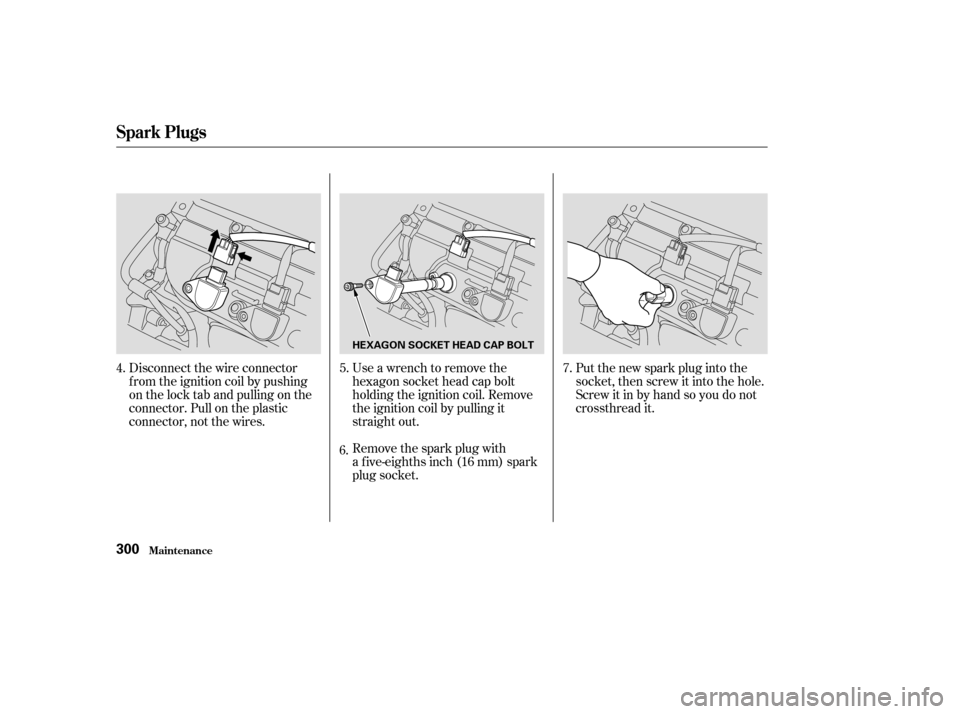
Disconnect the wire connector
f rom the ignition coil by pushing
on the lock tab and pulling on the
connector. Pull on the plastic
connector, not the wires.Remove the spark plug with
a f ive-eighths inch (16 mm) spark
plug socket. Use a wrench to remove the
hexagonsocketheadcapbolt
holding the ignition coil. Remove
the ignition coil by pulling it
straight out.Put the new spark plug into the
socket, then screw it into the hole.
Screw it in by hand so you do not
crossthread it.
4.
5.
6. 7.
Maint enance
Spark Plugs
300
HEXAGON SOCKET HEAD CAP BOLT
Page 305 of 392
�´
�µ
Torque the spark plug. (If you do
not have a torque wrench, tighten
the spark plug two-thirds of a turn
af ter it contacts the cylinder head.)
Tightening torque:Spark Plug Gap:
Install the ignition coil. Reinstall
the hexagon socket head cap bolt.
Push the wire connector onto the
ignition coil. Make sure it locks in
place.
Repeat this procedure f or the
other f ive spark plugs.
Reinstall the cover on the front
cylinder bank while putting its
mounting clip in the hole on the
passenger’s side. Secure the cover
by turning the heads of the two
holding clips one-quarter turn
clockwise with a f lat-tipped
screwdriver. NGK:
DENSO:
8. 9.
10.
11. 12. Specif ications:
Spark Plugs
Maint enance301
13 lbf·ft (18 N·m , 1.8 kgf·m)
0.04 in (1.1 mm)
PKJ16CR-L11 PZFR5F-11
0
0.1 mm
Tighten the spark plugs caref ully. A
spark plug that is too loose can
overheat and damage the engine.
Overtightening can cause damage to
the threads in the cylinder head.