Page 262 of 392

When climbing hills, closely watch
your temperature gauge. If it nears
the red (Hot) mark, turn the air
conditioning of f , reduce speed and, if
necessary, pull to the side of the
road to let the engine cool.
If the transmission shif ts f requently
while going up a hill, shif t down one
gear.
If you must stop when f acing uphill,
use the f oot brake or parking brake.
Do not try to hold the vehicle in
placebypressingontheaccelerator,
as this can cause the automatic
transmission to overheat.
When driving down hills, reduce
your speed and shif t down to D . Do
not ‘‘ride’’ the brakes, and remember
it will take longer to slow down and
stop when towing a trailer.Crosswinds and air turbulence
caused by passing trucks can disrupt
your steering and cause your trailer
to sway. When being passed by a
truck or other large vehicle, keep a
constant speed and steer straight
ahead. Do not try to make quick
steering or braking corrections.
Always drive slowly and have
someone guide you when backing up.
Grip the of the steering
wheel; then turn the wheel to the lef t
to get the trailer to move to the lef t,
andturnthewheelrighttomovethe
trailer to the right.
Follow all normal precautions when
parking, including putting the
transmission in PARK and f irmly
setting the parking brake when you
have f inished parking.
Donotparkonaninclineunlessitis
unavoidable. If you must park on an
incline, turn the vehicle wheels
toward the curb on a downhill and
awayfromthecurbonanuphill.
After parking, place wheel chocks at
each trailer tire, on the downhill side.
If the vehicle wheels slip when
retrieving a boat f rom the water,
shifttofirstgearandturnonVTM-4
Lock (see page ).
Disengage VTM-4 Lock as soon as
the boat is out of the water to
prevent damage to the VTM-4
system.
238
3
bottom
Driving on Hills
Handling Crosswinds and
T urbulence
Backing Up Parking
Ret rieving a Boat
Towing a Trailer
Driving258
Page 266 of 392

The route presents limits (some
roads are too steep and bumpy f or
example). You have limits (in driving
skills and comf ort). And your vehicle
also has limits (traction, stability, and
power, f or instance).
Driving of f -highway can be
hazardous if you f ail to recognize
limits and take proper precautions.
For example, you can have an
accident or rollover during
maneuvers such as turning, driving
on hills, or over large obstacles.
On many unpaved roads, you won’t
f ind lane markers, traf f ic signals, or
signs to warn you of possible trouble
ahead. It’s up to you to continually
assess the situation and drive within
limits.
Remember that your Pilot has higher
ground clearance and a higher
center of gravity than passenger
vehicles designed f or use only on
pavement. This means your vehicle
can more easily tip or roll over if you
make abrupt turns or drive on slopes.
Be sure to store cargo properly, and
do not exceed your Pilot cargo load
limits (see pages and ).
Utility vehicles have a signif icantly
higher rollover rate than other types
of vehicles. To avoid loss of control
or rollover, be sure to f ollow all
recommendations and precautions
on page and in this section.
Seat belts are just as important of f -
road as on paved roads. Wherever
you drive, make sure you and your
passengers always wear seat belts. If
children or inf ants are along f or the
ride, see that they are properly
secured. In a rollover crash, an
unbelted person is more likely to die
than a person wearing a seat belt. 230
226 247
Important Saf ety Precautions
Off-Highway Guidelines
Driving262
Improperly operating this
vehicle on or off-pavement can
cause an accident or rollover in
which you and your passengers
could be seriously injured or
killed.
Follow all instructions and
guidelines in the owner’s
manual.
Keep your speed low and
don’t drive faster than
conditions permit.
Page 268 of 392

Test your brakes from time to time
to make sure they are operating
properly. This will also give you a
f eel f or how much traction you have
on a given surf ace.
Off-highway, the basic turning
technique is to drive at low speed
and gradually adjust the amount of
steering to suit the surf ace.
You should have no problem making
sharp turns at low speed on level
ground. But never make an abrupt
turn at higher speeds, on or of f
pavement. With a higher center of
gravity, your vehicle can more easily
tip or roll over.Bef ore driving up or down a hill, stop
and assess the situation. If you can’t
clearly see all road conditions (good
traction, no bumps, holes or other
obstacles, a safe way out, etc.) walk
the slope bef ore you drive on it. If
you have any doubt about whether
you can saf ely drive on the slope,
. Find another route.
If you are driving up a hill and f ind
that you cannot continue (because of
the steepness, a large obstacle, etc.), . Your vehicle
could roll over. Slowly back down the
hill, f ollowing the same route you
took up the hill. Bumps, holes, rocks, and other
obstacles can be hazardous. Debris
in the road can damage your
suspension or other components.
Even small rocks can cut your tires.
More important, because your
vehicle has a high center of gravity,
driving over a large obstacle, or
allowing a wheel to drop into a deep
hole, can cause your vehicle to tip or
roll over.
Drive slow enough to observe
obstacles ahead and maneuver
around them. If you can’t avoid a
serious obstacle, turn around and
look f or a better route.
don’t do it
do not try to turn around
T urning
Avoiding Obstacles
Driving on Slopes
Off-Highway Guidelines
Driving264
Page 273 of 392

This section explains the importance
of keeping your vehicle well
maintained and why you should
f ollow basic maintenance saf ety
precautions.
This section also includes
Maintenance Schedules f or normal
driving and severe driving conditions,
a Maintenance Record, and instruc-
tions f or simple maintenance tasks
you may want to take care of
yourself .
If you have the skills and tools to per-
f orm more complex maintenance
tasks on your Honda, you may want
to purchase the Service Manual. See
page f or inf ormation on how to
obtain a copy, or see your Honda
dealer.......................
Maintenance Saf ety .270
.
Important Safety Precautions . 271
.................
Maintenance Schedule . 272
...
Required Maintenance Record . 279
.......
Owner Maintenance Checks . 281
..............................
Fluid Locations .282
......................................
Engine Oil .283
..................................
Adding Oil .283
....................
Recommended Oil .283
..............................
Synthetic Oil .284
....................................
Additives .284
.....
Changing the Oil and Filter . 285
.............................
Cooling System .287
............
Adding Engine Coolant . 287
.......
Replacing Engine Coolant . 289
....................
Windshield Washers .292
....
Automatic Transmission Fluid . 293
..........................
Dif f erential Fluid .294
....................................
Brake Fluid .295
............................
Brake System .295
..............................
Power Steering .296
.....................
Air Cleaner Element .297
....................................
Hood Latch .298
....................................
Spark Plugs .299
..............................
Replacement .299
............................
Specif ications .301 ...........................................
Battery .302
.................................
Wiper Blades .304
..............
Air Conditioning System . 306
..................
Dust and Pollen Filter . 307
.....................................
Drive Belts .307
....................................
Timing Belt .308
...............................................
Tires .308
......................................
Inf lation .308
..................................
Inspection .310
..............................
Maintenance .311
.............................
Tire Rotation .311
...
Replacing Tires and Wheels . 312
......................
Wheels and Tires .313
..........................
Winter Driving .313
.............................
Snow Tires .314
............................
Tire Chains .314
.............................................
Lights .315
.....................
Headlight Aiming .317
........................
Replacing Bulbs .317
....................
Storing Your Vehicle .324
377
Maintenance
Maint enance269
Page 285 of 392
�µ�µ �µ
�µ
�µ �µ
Youshouldcheckthefollowing
items at the specif ied intervals. If
you are unsure of how to perf orm
any check, turn to the page given.
Engine oil level Check every
time you fill the fuel tank. See
page .
Engine coolant level Check the
radiator reserve tank every time
you f ill the f uel tank. See page .Tires Check the tire pressure
monthly. Examine the tread f or
wear and foreign objects. See page
.
Automatic transmission Check
the f luid level monthly. See page .
Brakes Check the f luid level
monthly. See page . Lights Check the operation of
the headlights, parking lights,
taillights, high-mount brake light,
turn signals, brake lights, and
license plate lights monthly. See
page .
220
221
293 295 308
315
Owner Maintenance Checks
Maint enance281
Page 301 of 392
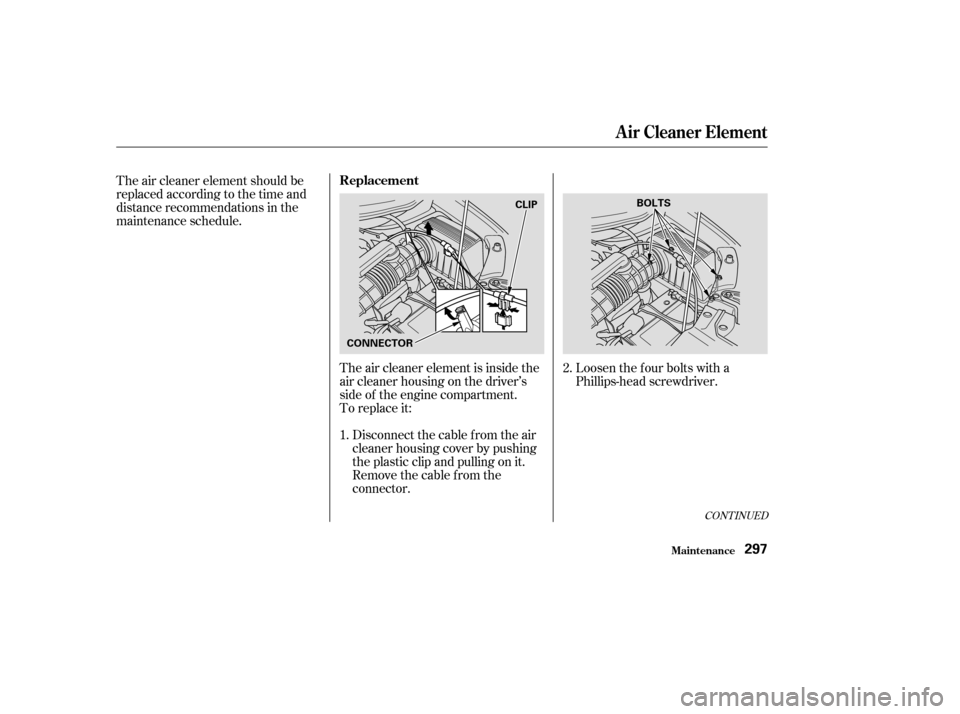
To replace it: The air cleaner element is inside the
air cleaner housing on the driver’s
side of the engine compartment.Disconnect the cable from the air
cleaner housing cover by pushing
the plastic clip and pulling on it.
Remove the cable from the
connector.
The air cleaner element should be
replaced according to the time and
distance recommendations in the
maintenance schedule.
Loosen the f our bolts with a
Phillips-head screwdriver.
1. 2.
CONT INUED
Replacement
A ir Cleaner Element
Maint enance297
CONNECTOR BOLTS
CLIP
Page 303 of 392
Loosen the two holding clips by
turning the heads one-quarter turn
counterclockwise with a f lat-tipped
screwdriver. Remove the cover on
the f ront cylinder bank by pulling
it straight up.
Clean off any dirt and oil that have
collected around the ignition coils.
The spark plugs in your vehicle are a
special platinum-tipped design f or
longer lif e. The spark plugs should
be replaced according to the time
and distance recommendations in
the maintenance schedule.
Remove the f our bolts using a
hexagon socket wrench, then
remove the engine cover.
1.
2.
3.
CONT INUED
Replacement
Maint enance
Spark Plugs
299
HOLDING CLIP
Page 304 of 392
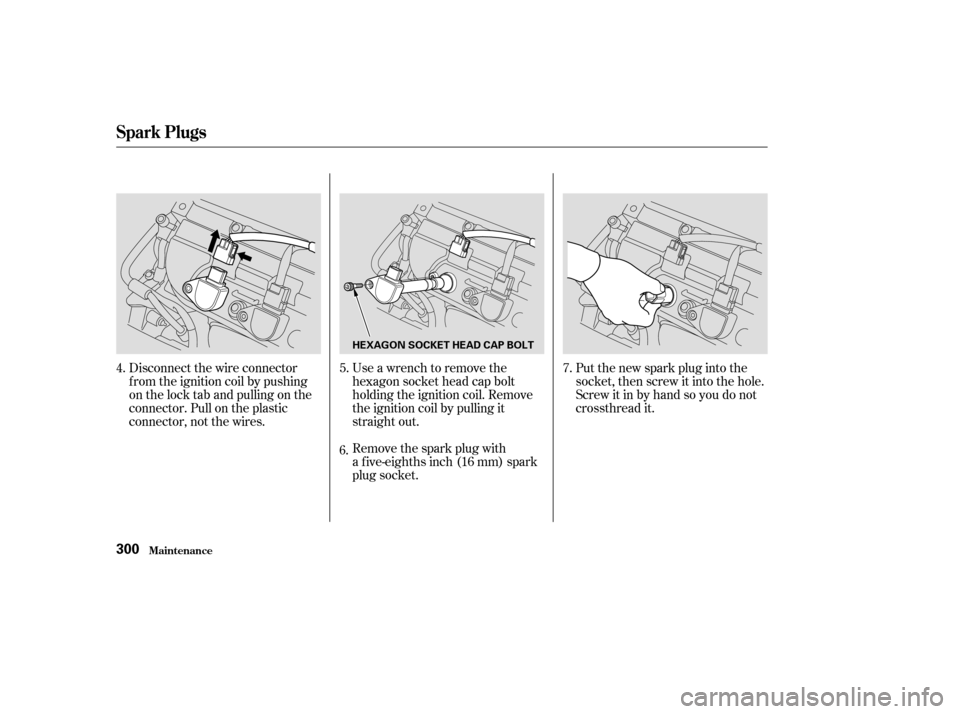
Disconnect the wire connector
f rom the ignition coil by pushing
on the lock tab and pulling on the
connector. Pull on the plastic
connector, not the wires.Remove the spark plug with
a f ive-eighths inch (16 mm) spark
plug socket. Use a wrench to remove the
hexagonsocketheadcapbolt
holding the ignition coil. Remove
the ignition coil by pulling it
straight out.Put the new spark plug into the
socket, then screw it into the hole.
Screw it in by hand so you do not
crossthread it.
4.
5.
6. 7.
Maint enance
Spark Plugs
300
HEXAGON SOCKET HEAD CAP BOLT