Page 19 of 392
CONT INUED
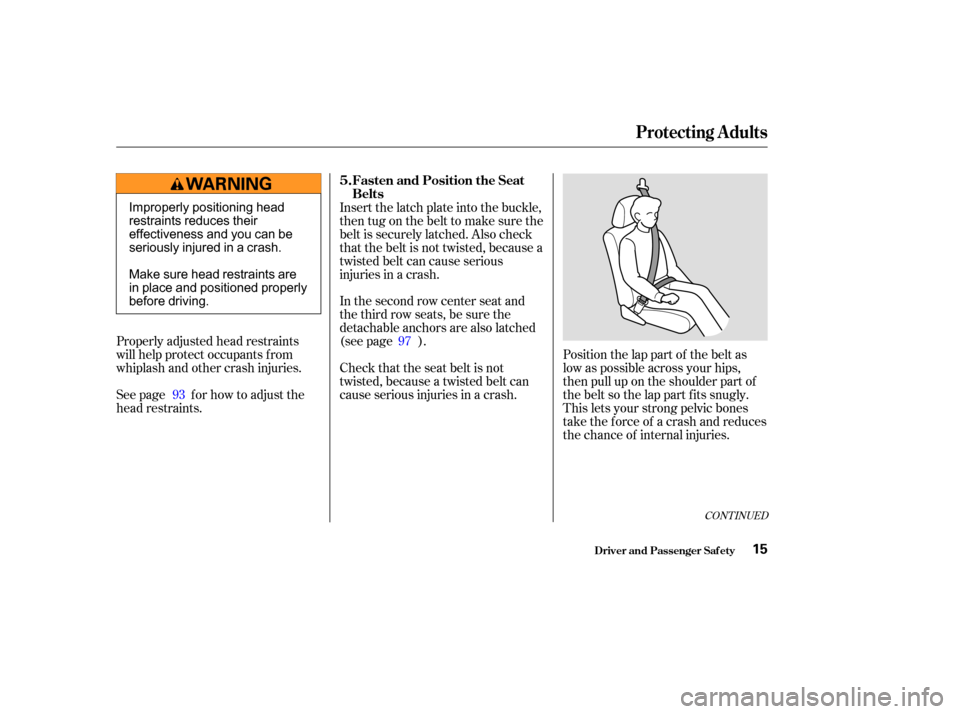
Position the lap part of the belt as
low as possible across your hips,
then pull up on the shoulder part of
thebeltsothelappartfitssnugly.
This lets your strong pelvic bones
take the force of a crash and reduces
the chance of internal injuries.
Properly adjusted head restraints
will help protect occupants f rom
whiplash and other crash injuries.
See page f or how to adjust the
head restraints. Insert the latch plate into the buckle,
then tug on the belt to make sure the
belt is securely latched. Also check
that the belt is not twisted, because a
twisted belt can cause serious
injuries in a crash.
In the second row center seat and
thethirdrowseats,besurethe
detachable anchors are also latched
(see page ).
Check that the seat belt is not
twisted, because a twisted belt can
cause serious injuries in a crash.
97
93
Driver and Passenger Saf ety
Protecting Adults
Fasten and Position the Seat
Belts
5.
15
Improperly positioning head
restraints reduces their
effectiveness and you can be
seriously injured in a crash.
Make sure head restraints are
in place and positioned properly
before driving.
Page 27 of 392

Front airbags have been designed to
help protect adults in a moderate to
severe f rontal collision. To do this,
the passenger’s f ront airbag is quite
large, and it inf lates with tremendous
speed.If
the airbag inf lates, it can hit the back
of the child seat with enough force
to kill or very seriously injure an
inf ant. If the vehicle seat is
too far forward, or the child’s head is
thrown f orward during a collision, an
inflating front airbag can strike the
child with enough f orce to kill or
very seriously injure a small child.
Whenever possible,
larger children should sit in the back
seat, in a booster seat if needed, and
be properly restrained with a seat
belt. (See page f or important
inf ormation about protecting larger
children.) 38
The Passenger’s Front Airbag
Poses Serious Risks to Children
Never put a rear-f acing child seat in
t he f ront seat of a vehicle equippedwit h a passenger’s f ront airbag.
Inf ant s Small Children
Placing a f orward-f acing child seat int he f ront seat of a vehicle equippedwit h a passenger’s f ront airbag canbe hazardous.
Larger ChildrenChildren who have outgrown childseat s are also at risk of being injuredor killed by an inf lat ing passenger’sfront airbag.
Protecting Children
Driver and Passenger Saf ety23
Page 30 of 392
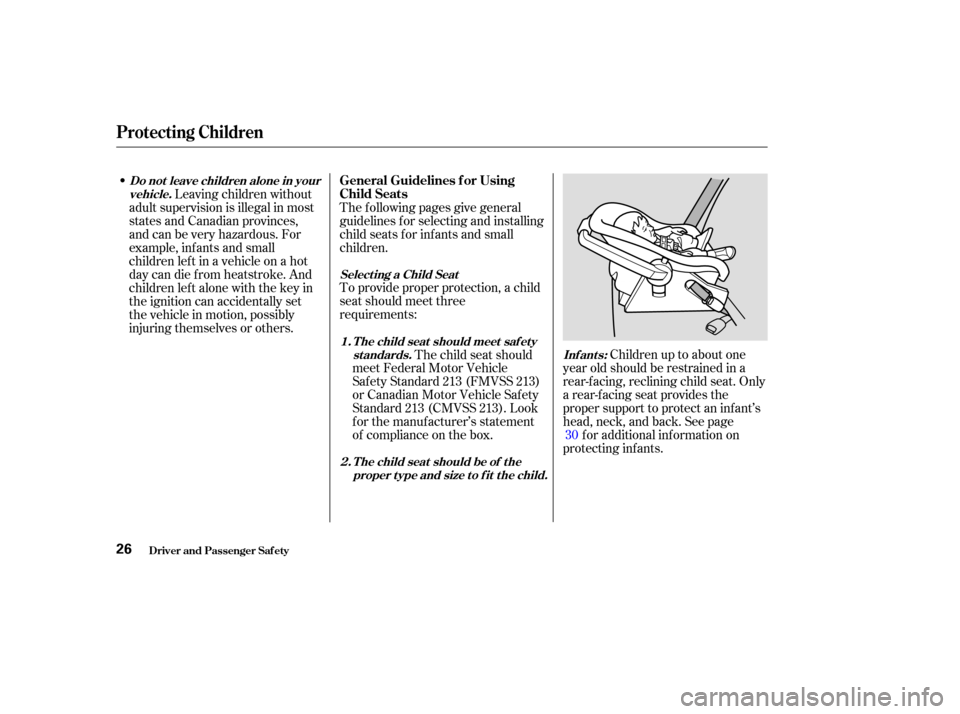
Childrenuptoaboutone
year old should be restrained in a
rear-f acing, reclining child seat. Only
a rear-f acing seat provides the
proper support to protect an inf ant’s
head, neck, and back. See page for additional information on
protecting inf ants.
The f ollowing pages give general
guidelines f or selecting and installing
child seats f or inf ants and small
children.
To provide proper protection, a child
seat should meet three
requirements:
Leaving children without
adult supervision is illegal in most
states and Canadian provinces,
and can be very hazardous. For
example, inf ants and small
childrenleftinavehicleonahot
day can die f rom heatstroke. And
children lef t alone with the key in
the ignition can accidentally set
the vehicle in motion, possibly
injuring themselves or others.
The child seat should
meet Federal Motor Vehicle
Saf ety Standard 213 (FMVSS 213)
or Canadian Motor Vehicle Saf ety
Standard 213 (CMVSS 213). Look
for the manufacturer’s statement
of compliance on the box. 30Inf ant s:
Select ing a Child Seat
T he child seat should be of theproper t ype and size t o f it t he child.
Do not leave children alone in your
vehicle.
T he child seat should meet saf et yst andards.
1.
2.
General Guidelines f or Using
Child Seats
Protecting Children
Driver and Passenger Saf ety26
Page 32 of 392

A small child in a f orward-f acing
child seat is also at risk. If the
vehicle seat is too f ar f orward,
or the child’s head is thrown
f orward during a collision, an
inf lating airbag can kill or
seriously injure the child.
If a small child must ride in the
f ront, f ollow the instructions
provided in this section. The passenger’s f ront airbag
inf lates with enough f orce to kill
or seriously injure an inf ant in a
rear-facing child seat.Recommended positions.
Properlysecurearear-facingchild
seat (see page ).
Recommended
positions. Properly secure a f ront-
f acing child seat (see page ). Never in the f ront seat, due
to the f ront airbag hazard.
Not recommended,
due to the f ront airbag hazard. If a
small child must ride in f ront,
move the vehicle seat to the rear-
most position and secure a f ront-
f acing child seat with the seat belt
(see page ).
This page brief ly summarizes
Honda’s recommendations on where
to place rear-facing and forward-
f acing child seats in your vehicle.
36
31
36
Placing a Child Seat
Front Passenger’s Seat
Back Seat sInf ant s:
Small children:
Inf ant s:
Small children:
Airbags Pose SeriousRisks to Children
Protecting Children
Driver and Passenger Saf ety28
Page 34 of 392
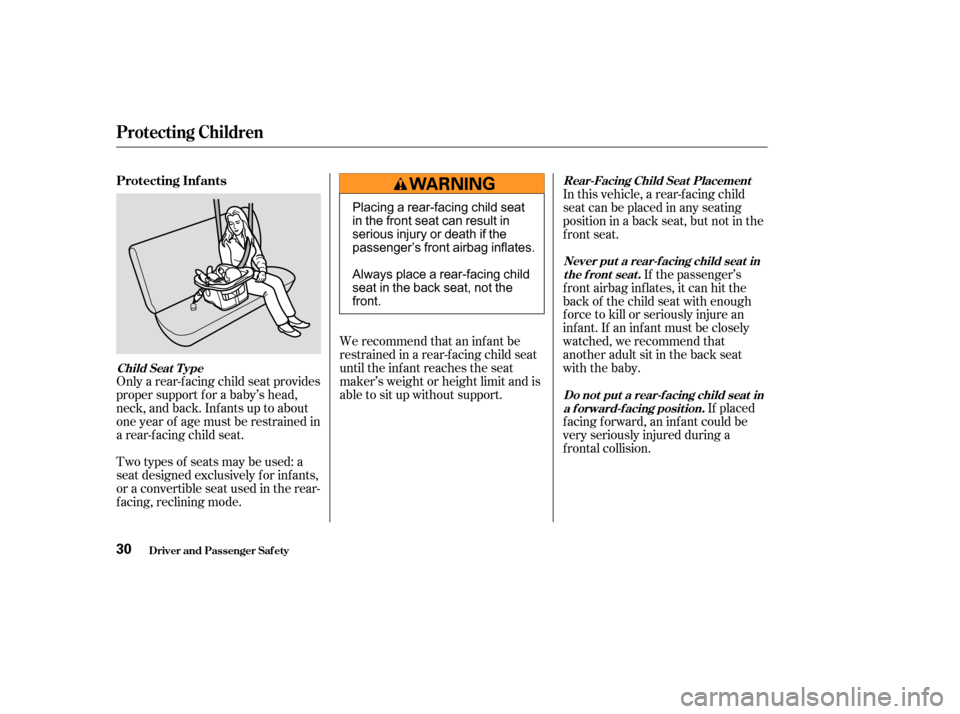
Only a rear-f acing child seat provides
proper support f or a baby’s head,
neck, and back. Inf ants up to about
one year of age must be restrained in
a rear-f acing child seat.We recommend that an inf ant be
restrained in a rear-f acing child seat
until the inf ant reaches the seat
maker’s weight or height limit and is
able to sit up without support.
Two types of seats may be used: a
seat designed exclusively f or inf ants,
or a convertible seat used in the rear-
f acing, reclining mode. In this vehicle, a rear-f acing child
seatcanbeplacedinanyseating
positioninabackseat,butnotinthe
front seat.
If the passenger’s
f ront airbag inf lates, it can hit the
back of the child seat with enough
f orce to kill or seriously injure an
inf ant. If an inf ant must be closely
watched, we recommend that
another adult sit in the back seat
with the baby.
If placed
f acing f orward, an inf ant could be
very seriously injured during a
f rontal collision.
Protecting Inf ants
Child Seat T ype
Rear-Facing Child Seat Placement
Never put a rear-f acing child seat inthe front seat.
Do not put a rear-f acing child seat ina f orward-f acing position.
Protecting Children
Driver and Passenger Saf ety30
Placing a rear-facing child seat
in the front seat can result in
serious injury or death if the
passenger’s front airbag inflates.
Always place a rear-facing child
seat in the back seat, not the
front.
Page 39 of 392
In this vehicle, the best place to
install a f orward-f acing child seat is
in one of the seating positions in a
back seat.
We also recommend that a small
child stay in the child seat as long as
possible, until the child reaches the
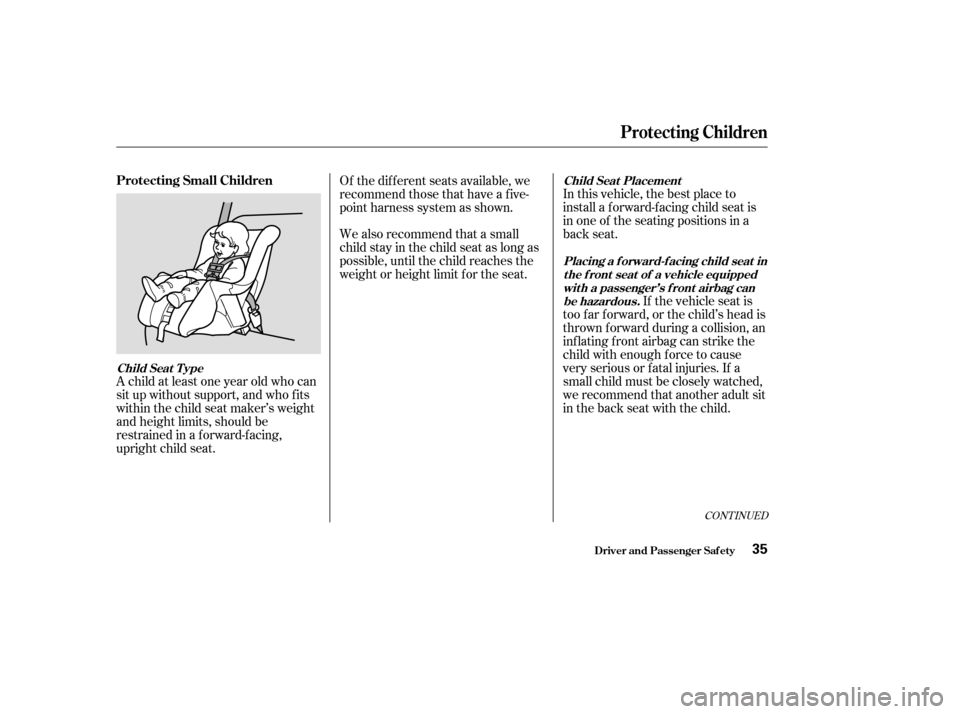
weight or height limit f or the seat. Of the different seats available, we
recommend those that have a f ive-
point harness system as shown.
If the vehicle seat is
too far forward, or the child’s head is
thrown f orward during a collision, an
inflating front airbag can strike the
child with enough f orce to cause
very serious or f atal injuries. If a
small child must be closely watched,
we recommend that another adult sit
in the back seat with the child.
A child at least one year old who can
sit up without support, and who f its
within the child seat maker’s weight
and height limits, should be
restrained in a f orward-f acing,
upright child seat.
CONT INUED
Protecting Small Children
Child Seat T ype Child Seat Placement
Placing a f orward-f acing child seat int he f ront seat of a vehicle equippedwit h a passenger’s f ront airbag canbe hazardous.
Protecting Children
Driver and Passenger Saf ety35
Page 44 of 392
Of course, children vary widely. And
while age may be one indicator of
when a child can saf ely ride in the
f ront, there are other important
f actors you should consider.
Whichever style you select, f ollow
the booster seat maker’s instructions. The back seat is the safest place for
a child of any age or size.
In addition, the passenger’s f ront
airbag poses serious risks to children.
If the seat is too f ar f orward, or the
child’s head is thrown f orward
during a collision, or the child is
unrestrained or out of position, an
inf lating f ront airbag can kill or
seriously injure the child.
The side airbag also poses risks. If
any part of a larger child’s body is in
the path of a deploying airbag, the
child could receive possibly serious
injuries.
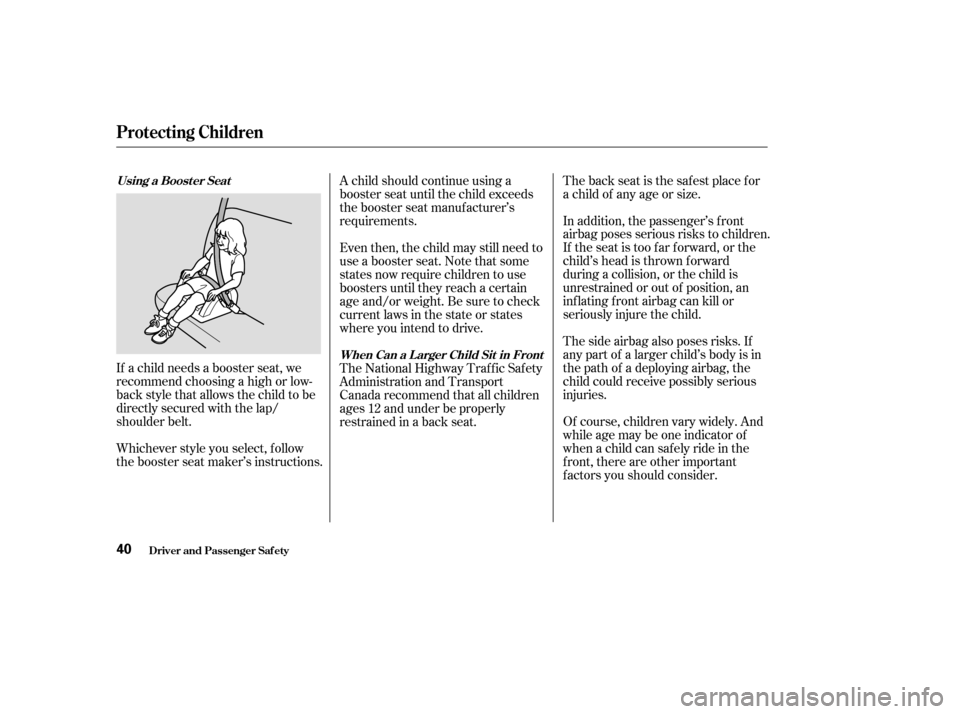
If a child needs a booster seat, we
recommend choosing a high or low-
back style that allows the child to be
directly secured with the lap/
shoulder belt. A child should continue using a
booster seat until the child exceeds
the booster seat manufacturer’s
requirements.
Even then, the child may still need to
use a booster seat. Note that some
states now require children to use
boosters until they reach a certain
ageand/orweight.Besuretocheck
current laws in the state or states
where you intend to drive.
The National Highway Traffic Safety
Administration and Transport
Canada recommend that all children
ages 12 and under be properly
restrained in a back seat.
Using a Boost er Seat
When Can a Larger Child Sit in Front
Protecting Children
Driver and Passenger Saf ety40
Page 47 of 392
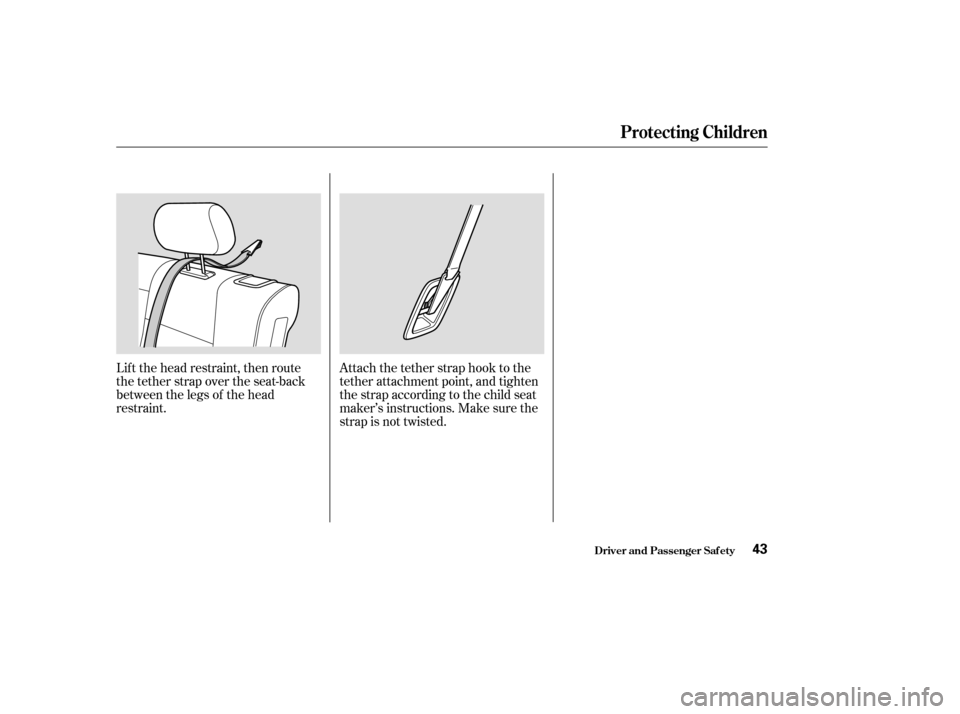
Lift the head restraint, then route
the tether strap over the seat-back
between the legs of the head
restraint.Attach the tether strap hook to the
tether attachment point, and tighten
the strap according to the child seat
maker’s instructions. Make sure the
strap is not twisted.
Protecting Children
Driver and Passenger Saf ety43