Page 311 of 428
Brake Pedal Travel Battery
See your dealer if the brake pedal does not return to
normal height, or
if there is a rapid increase in
pedal travel. This could be a sign of brake trouble.
Brake Adjustment
Every time you make a brake stop, your disc brakes
adjust for wear.
Replacing Brake System Parts
The braking system on a vehicle is complex. Its many
parts have to be of top quality and work well together
if
the vehicle is to have really good braking. Your vehicle
was designed and tested with top-quality
GM brake parts.
When you replace parts of your braking system -for
example, when your brake linings wear down and you
need new ones put in
- be sure you get new approved
GM replacement parts. If you don’t, your brakes may no
longer work properly. For example, if someone puts in
brake linings that are wrong for your vehicle, the balance
between your front and rear brakes can change
- for the
worse. The braking performance you’ve come to expect
can change in many other ways
if someone puts in the
wrong replacement brake parts. Your new
vehicle comes with a maintenance free
ACDelco@ battery. When it’s time for a new battery, get
one that has the replacement number shown on the
original battery’s label. We recommend an ACDelco@
battery. See
Engine Compartment Overview on
page
5-12 for battery location.
Warning: Battery posts, terminals and related
accessories contain lead and lead compounds,
chemicals known to the State of California to cause
cancer and reproductive harm. Wash hands after
handling.
5-42
Page 313 of 428
Notice: If the other system isn’t a 12-volt system
with a negative ground, both vehicles can be
damaged.
2. Get the vehicles close enough so the jumper cables
can reach, but be sure the vehicles aren’t touching
each other. If they are, it could cause a ground
connection you don’t want. You wouldn’t be able to
start your vehicle, and the bad grounding could
damage the electrical systems.
To avoid the possibility of the vehicles rolling, set
the parking brake firmly on both vehicles involved
in the jump start procedure. Put the automatic
transmission in PARK
(P) before setting the parking
brake.
If you have a four-wheel-drive vehicle, be
sure the transfer case is in a drive gear not in
NEUTRAL.
Notice: If you leave your radio on, it could be badly
damaged. The repairs wouldn’t be covered by
your warranty.
3.
4.
Turn off the ignition on both vehicles. Unplug
unnecessary accessories plugged into the cigarette
lighter or in the accessory power outlets. Turn
off
the radio and all the lamps that aren’t needed.
This will avoid sparks and help save both batteries.
And it could save your radio!
Open the hoods and locate the positive
(+) and
negative
(-) terminal locations of the other vehicle.
Your vehicle has a remote positive
(+) jump starting
terminal and a remote negative
(-) jump starting
terminal. You should always use these remote
terminals instead of the terminals on the battery.
The remote positive
(+) terminal is located behind
a red plastic cover near the engine accessory
drive bracket.
To uncover the remote positive (+)
terminal, open the red plastic cover.
The remote negative
(-) terminal is located on the
engine drive bracket on all
V8 and diesel
engines, and on the thermostat housing on the
8.1L engine. On
V8 engines it is marked ”GND.”
See
Engine Compartment Overview on page 5-12
for more information on location.
5-44
Page 314 of 428
Using a match near a battery can cause battery
gas to explode. People have been hurt doing
this, and some have been blinded. Use a
flashlight if you need more light.
Be sure the battery has enough water.
You don’t need to add water to the ACDelco@
battery installed in your new vehicle. But
if
a battery has filler caps, be sure the right
amount of fluid is there. If
it is low, add water
to take care of that first. If you don’t, explosive
gas could be present.
Battery fluid contains acid that can burn you.
Don’t get
it on you. If you accidentally get it in
your eyes or on your skin, flush the place with
water and get medical help immediately.
I
Fans or other moving engine parts can injure
you badly. Keep your hands away from moving
parts once the engine is running.
I
5. Check that the jumper cables don’t have loose or
missing insulation. If they do, you could get a
shock. The vehicles could be damaged too.
Before you connect the cables, here are some
basic things you should know. Positive
(+) will go to
positive
(+) or a remote positive (+) terminal if the
vehicle has one. Negative
(-) will go to a heavy,
unpainted metal engine part or a remote
negative
(-) terminal if the vehicle has one.
Don’t connect positive
(+) to negative (-) or you’ll
get a short that would damage the battery and
maybe other parts too. And don’t connect the
negative
(-) cable to the negative (-) terminal on
the dead battery because this can cause sparks.
5-45
Page 316 of 428
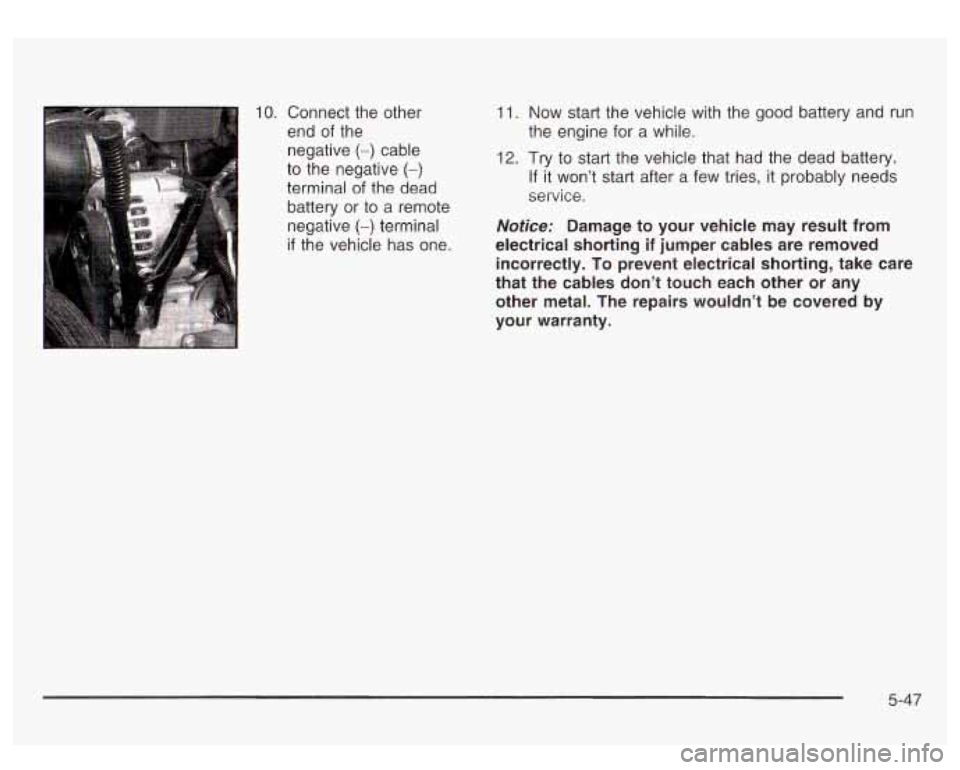
I 10. Connect the other
end of the
negative
(-) cable
to the negative
(-)
terminal of the dead
battery or to a remote
negative
(-) terminal
if the vehicle has one.
11. Now start the vehicle with the good battery and run
the engine for a while.
12. Try to start the vehicle that had the dead battery.
If it won’t start after a few tries, it probably needs
service.
Notice: Damage to your vehicle may result from
electrical shorting if jumper cables are removed
incorrectly.
To prevent electrical shorting, take care
that the cables don’t touch each other or any
other metal. The repairs wouldn’t be covered by
your warranty.
5-47
Page 317 of 428
A 8
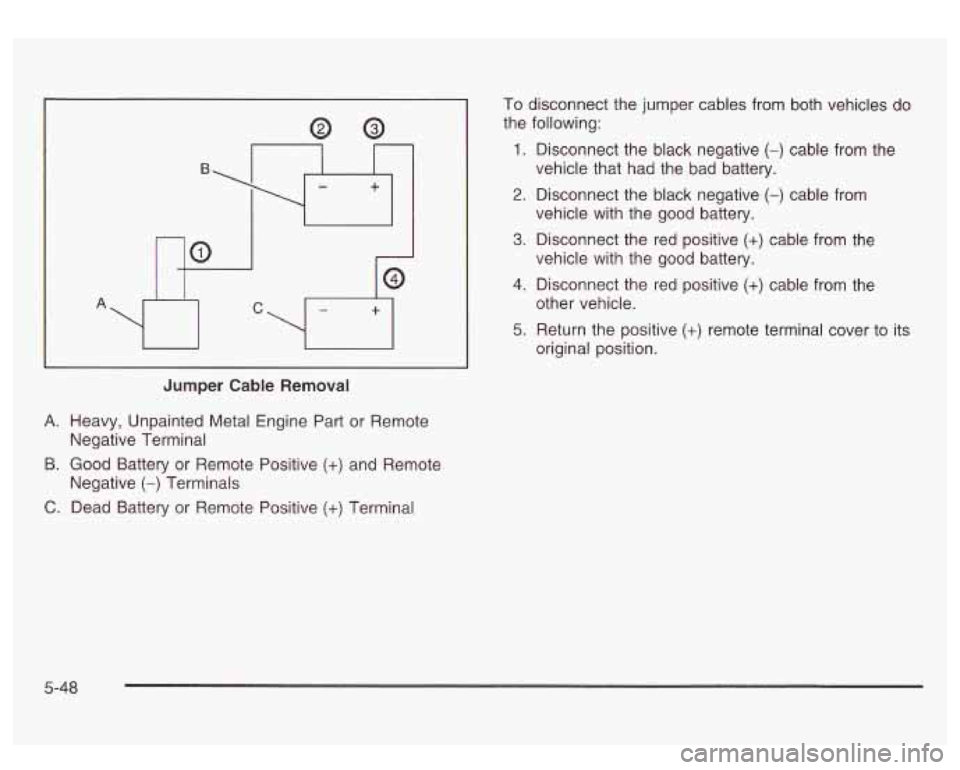
Jumper Cable Removal
A. Heavy, Unpainted Metal Engine Part or Remote
9. Good Battery or Remote Positive (+) and Remote
C. Dead Battery or Remote Positive (+) Terminal
Negative Terminal
Negative
(-) Terminals To
disconnect the jumper cables from both vehicles do
the following:
1. Disconnect the black negative (-) cable from the
2. Disconnect the black negative (-) cable from
3. Disconnect the red positive (+) cable from the
vehicle that
had the bad battery.
vehicle with the good battery.
vehicle with the good battery.
4. Disconnect the red positive (+) cable from the
other vehicle.
5. Return the positive (+) remote terminal cover to its
original position.
5-48
Page 338 of 428
A rear blowout, particularly on a curve, acts much like a Changing a Flat Tire
skid and may require the same correction you’d use
in a skid. In any rear blowout, remove your foot from the
If a tire goes flat, avoid further tire and wheel damage
accelerator pedal. Get the vehicle under control by by driving slowly
to a level place. Turn on your
steering
the way you want the vehicle to go. it may be hazard warning flashers.
very bumpy and noisy, but you can still steer. Gently
brake
to a stop - well off the road if possible.
If a tire goes flat, the next part shows how
to use your
jacking equipment to change a flat tire safely.
C..-nging a tire can cause
an injury. The
vehicle can slip
off the jack and roll over you
or other people. You and they could be badly
injured. Find a level place to change your tire.
To help prevent the vehicle from moving:
1. Set the parking brake firmly.
2. Put the shift lever in PARK (P).
3. Turn off the engine.
4. Put the wheel blocks at the front and rear
of the tire farthest away from the one
being changed. That
would be the tire on
the other side of the vehicle, at the
opposite end.
5-69
Page 363 of 428
Vehicle Identification
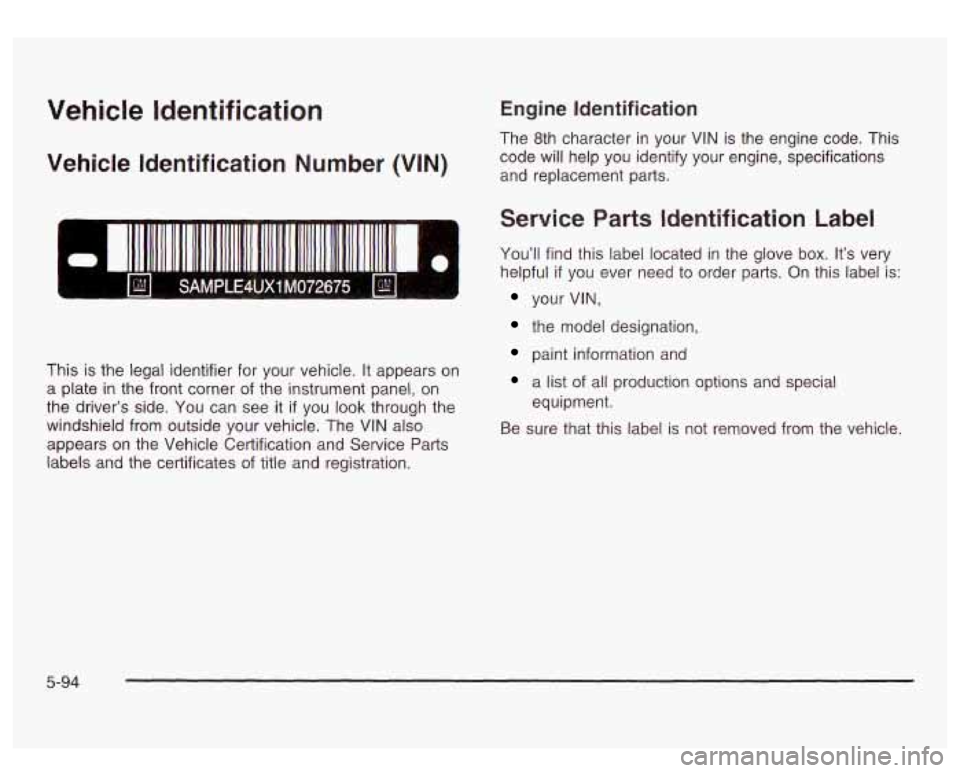
Vehicle Identification Number (VIN)
SAMPLE4UX1 M072675
This is the legal identifier for your vehicle. It appears on
a plate in the front corner of the instrument panel, on
the driver’s side. You can see it
if you look through the
windshield from outside your vehicle. The VIN also
appears on the Vehicle Certification and Service Parts
labels and the certificates of title and registration.
Engine Identification
The 8th character in your VIN is the engine code. This
code will help you identify your engine, specifications
and replacement parts.
Service Parts Identification Label
You’ll find this label located in the glove box. It’s very
helpful
if you ever need to order parts. On this label is:
your VIN,
the model designation,
paint information and
a list of all production options and special
equipment.
Be sure that this label is not removed from the vehicle.
5-94
Page 368 of 428
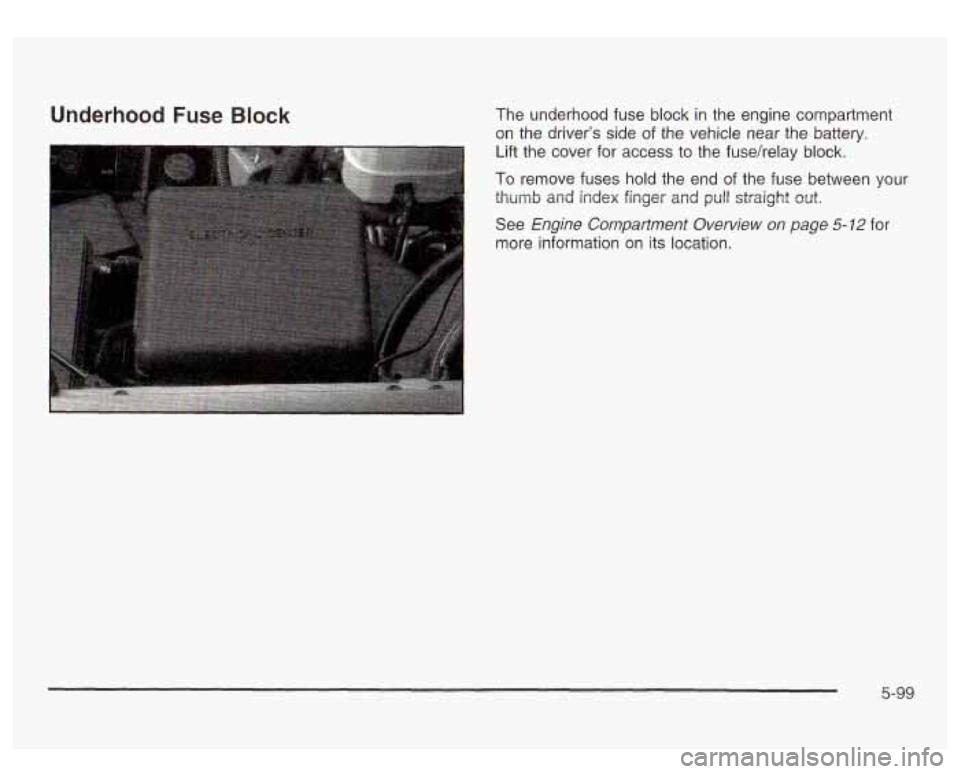
Underhood Fuse Block The underhood fuse block in the engine compartment
on the driver's side of the vehicle near the battery.
Lift the cover for access to the fusehelay block.
To remove fuses hold the end of the fuse between your
thumb and
index finger and pull straight out.
See
Engine Compartment Overview on page 5-12 for
more information on its location.
5-99