2003 FORD SUPER DUTY tow
[x] Cancel search: towPage 173 of 256
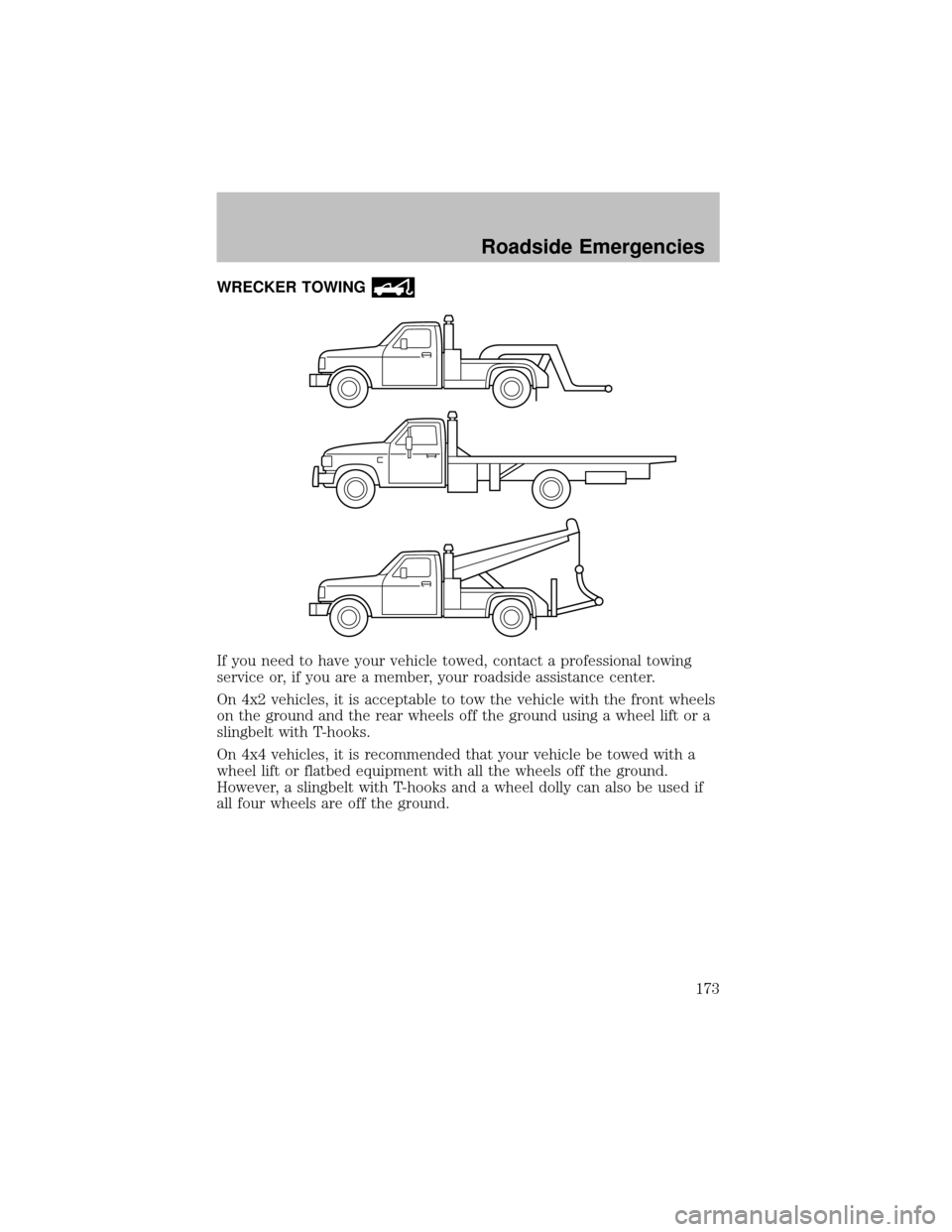
WRECKER TOWING
If you need to have your vehicle towed, contact a professional towing
service or, if you are a member, your roadside assistance center.
On 4x2 vehicles, it is acceptable to tow the vehicle with the front wheels
on the ground and the rear wheels off the ground using a wheel lift or a
slingbelt with T-hooks.
On 4x4 vehicles, it is recommended that your vehicle be towed with a
wheel lift or flatbed equipment with all the wheels off the ground.
However, a slingbelt with T-hooks and a wheel dollycan also be used if
all four wheels are off the ground.
Roadside Emergencies
173
Page 174 of 256

An alternative for towing a 4x4 vehicle is to:
•put the transfer case in neutral. On manual 4WD systems, put the
4WD shift lever in N (Neutral); on electronic shift on the fly4WD
systems, press the 2WD portion of the 4WD control.
•unlock the front hub locks (refer toFour wheel drive [4WD]
Operation [if equipped]in theDrivingchapter).
•lift the rear wheels of the vehicle using a wheel lift or a sling belt with
T-hooks.
If the vehicle is towed by other means or incorrectly, vehicle
damage may occur.
Ford Motor Companyproduces a towing manual for all authorized tow
truck operators. Have your tow truck operator refer to this manual for
proper hook-up and towing procedures for your vehicle.
Roadside Emergencies
174
Page 177 of 256

In some states (in the U.S.) you must directly notify Ford in writing
before pursuing remedies under your state’s warranty laws. Ford is also
allowed a final repair attempt in some states.
In the United States, a warrantydispute must be submitted to the
Dispute Settlement Board before taking action under the Magnuson-Moss
WarrantyAct, or to the extent allowed bystate law, before pursuing
replacement or repurchase remedies provided bycertain state laws. This
dispute handling procedure is not required prior to enforcing state
created rights or other rights which are independent of the
Magnuson-Moss WarrantyAct or state replacement or repurchase laws.
FORD EXTENDED SERVICE PLAN
You can get more protection for your new car or light truck by
purchasing Ford Extended Service Plan (Ford ESP) coverage. Ford ESP
is an optional service contract which is backed byFord Motor Company
or Ford Motor Service Company(in the U.S.) and Ford of Canada (in
Canada). It provides the following:
•Benefits during the warrantyperiod depending on the plan you
purchase (such as: reimbursement for rentals; coverage for certain
maintenance and wear items).
•Protection against covered repair costs after your Bumper-to-Bumper
Warrantyexpires.
You maypurchase Ford ESP from anyparticipating Ford and Lincoln
Mercuryand Ford of Canada dealer. There are several plans available in
various time, distance and deductible combinations which can be tailored
to fit your own driving needs. Ford ESP also offers reimbursement
benefits for towing and rental coverage.
When you buy Ford ESP, you receive Peace-of-Mind protection
throughout the United States and Canada, provided bya network of
more than 5,000 participating Ford or Lincoln Mercuryand Ford of
Canada dealers.
If you did not take advantage of the Ford Extended Service Plan at the
time of purchasing your vehicle, you may still be eligible. Please contact
your dealer for further information. Since this information is subject to
change, please ask your dealer for complete details about Ford Extended
Service Plan coverage options, or visit the Ford ESP website at
www.ford-esp.com.
THE DISPUTE SETTLEMENT BOARD (U.S. ONLY)
The Dispute Settlement Board is:
•an independent, third-partyarbitration program for warrantydisputes.
Customer Assistance
177
Page 184 of 256

WASHING THE EXTERIOR
Wash your vehicle regularly with cool or lukewarm water and a neutral
Ph shampoo, such as Motorcraft Detail Wash (ZC-3–A), which is available
from your dealer.
•Never use strong household detergents or soap, such as dish washing
or laundryliquid. These products can discolor and spot painted
surfaces.
•Never wash a vehicle that is “hot to the touch” or during exposure to
strong, direct sunlight.
•Always use a clean sponge or carwash mitt with plenty of water for
best results.
•Drythe vehicle with a chamois or soft terrycloth towel in order to
eliminate water spotting.
•It is especiallyimportant to wash the vehicle regularlyduring the
winter months, as dirt and road salt are difficult to remove and cause
damage to the vehicle.
•Immediatelyremove items such as gasoline, diesel fuel, bird droppings
and insect deposits because theycan cause damage to the vehicle’s
paintwork and trim over time.
•Remove anyexterior accessories, such as antennas, before entering a
car wash.
•Suntan lotions and insect repellents can damage any painted
surface; if these substances come in contact with your vehicle,
wash off as soon as possible.
•If your vehicle is equipped with running boards, do not use
rubber, plastic and vinyl protectant products on the running
board surface, as the area may become slippery.
WAXING
Applying a polymer paint sealant to your vehicle every six months will
assist in reducing minor scratches and paint damage.
•Wash the vehicle first.
•Do not use waxes that contain abrasives.
•Do not allow paint sealant to come in contact with anynon-body
(low-gloss black) colored trim, such as grained door handles, roof
racks, bumpers, side moldings, mirror housings or the windshield cowl
area. The paint sealant will “gray” or stain the parts over time.
Cleaning
184
Page 212 of 256

•Revving the engine before turning it off mayreduce fuel economy.
•Using the air conditioner or defroster mayreduce fuel economy.
•You maywant to turn off the speed control in hillyterrain if
unnecessaryshifting between third and fourth gear occurs.
Unnecessaryshifting of this type could result in reduced fuel
economy.
•Warming up a vehicle on cold mornings is not required and may
reduce fuel economy.
•Resting your foot on the brake pedal while driving may reduce fuel
economy.
•Combine errands and minimize stop-and-go driving.
Maintenance
•Keep tires properlyinflated and use onlyrecommended size.
•Operating a vehicle with the wheels out of alignment will reduce fuel
economy.
•Use recommended engine oil. Refer toLubricant specificationsin
this chapter.
•Perform all regularlyscheduled maintenance items. Follow the
recommended maintenance schedule and owner maintenance checks
found in your vehicle scheduled maintenance guide.
Conditions
•Heavilyloading a vehicle or towing a trailer mayreduce fuel economy
at anyspeed.
•Carrying unnecessaryweight mayreduce fuel economy(approximately
0.4 km/L [1 mpg] is lost for every180 kg [400 lb] of weight carried).
•Adding certain accessories to your vehicle (for example bug
deflectors, rollbars/light bars, running boards, ski/luggage racks) may
reduce fuel economy.
•Using fuel blended with alcohol maylower fuel economy.
•Fuel economymaydecrease with lower temperatures during the first
12–16 km (8–10 miles) of driving.
•Driving on flat terrain offers improved fuel economyas compared to
driving on hillyterrain.
•Transmissions give their best fuel economywhen operated in the top
cruise gear and with steadypressure on the gas pedal.
Maintenance and Specifications
212
Page 246 of 256

Travel equipment
Adjustable Towing System
Auto headlamp system with Daytime Running Lights (DRL)
Bed Tent
Box Aluminum Rack cargo storage systems (Trac Rac)
Daytime running lights (DRL)
Electrochromic inside mirror with compass
Electrochromic inside mirror with compass and temperature display
Fog lights
BatteryWarmer
Highwaysafetyand first aid kit
Off road lights
Pickup box rails
ROC2 hitch mounted bike courier
Running boards and tubular running bars
Running boards diamond plate
Seatback organizer
Speed control
Towing mirrors
Trailer hitch, Class IV
Trailer hitch bars and balls
Trailer hitch mounted bike carrier
Trailer hitch wiring adaptor
Trailer wiring harness
Trailgate table
Protection and appearance equipment
Air bag anti-theft locks
All weather vinyl floor mats
Bed mat
Bed hooks
Bed mats
Accessories
246
Page 252 of 256

Instrument panel
cleaning ...................................187
cluster ........................................10
lighting up panel and
interior .......................................37
J
Jump-starting your vehicle ......168
K
Keyless entry system
autolock .....................................61
Keys
positions of the ignition ...........98
L
Lamps
autolamp system .......................35
bulb replacement
specifications chart ..................38
cargo lamps ...............................37
daytime running light ...............36
fog lamps ...................................36
headlamps .................................35
headlamps, flash to pass ..........37
instrument panel, dimming .....37
interior lamps ...........................38
replacing bulbs ...................38–43
Lane change indicator
(see Turn signal) ........................37
Lights, warning and indicator ....10
anti-lock brakes (ABS) ..........103
speed control ............................51
Load limits .................................125
GAWR ......................................125
GVWR ......................................125
trailer towing ..........................125
Loading instructions .................127Locks
autolock .....................................61
childproof ..................................57
Lubricant specifications ...232, 235
Lumbar support, seats ...............67
M
Manual transmission .................109
fluid capacities ........................228
lubricant specifications ..........235
reverse .....................................110
Message center ...........................51
english/metric button ...............52
menu button .............................52
Mirrors .........................................45
fold away...................................48
side view mirrors (power) .......47
Motorcraft parts ................209, 228
O
Octane rating ............................208
Oil (see Engine oil) ..................194
P
Parking brake ............................104
Parts (see Motorcraft parts) ....228
Pedals (see Power adjustable
foot pedals) .................................48
Power adjustable foot pedals .....48
Power distribution box
(see Fuses) ...............................155
Power door locks ..................56, 61
Power point .................................46
Power steering ..........................105
fluid, checking and adding ....215
Index
252
Page 253 of 256

fluid, refill capacity................228
fluid, specifications .........232, 235
Power Windows ...........................47
Preparing to drive your
vehicle ........................................105
R
Radio ..........................17–18, 21, 25
Relays ........................................154
Remote entrysystem .................58
illuminated entry......................60
locking/unlocking doors ...........56
Reverse sensing system ...........111
Roadside assistance ..................152
S
Safetybelts (see Safety
restraints) ........................68–71, 73
Safetydefects, reporting ..........183
Safetyrestraints ....................68–73
belt minder ...............................74
cleaning the safetybelts ..........78
extension assembly..................78
for adults .............................69–71
for children .........................87–88
warning light and chime ..........74
Safetyseats for children ............90
Seat belts (see Safety
restraints) ....................................68
Seats ............................................63
child safetyseats ......................90
cleaning ...................................188
Servicing your vehicle ..............191
Snowplowing .................6, 148–150Spare tire
(see Changing the Tire) ...........159
Spark plugs,
specifications .....................228, 235
Special notice ................................7
ambulance conversions ..............6
diesel-powered vehicles .............6
four-wheel drive vehicles .......151
utility-type vehicles ....................6
Specification chart,
lubricants ...........................232, 235
Speed control ..............................48
Starting your vehicle ....98–99, 101
jump starting ..........................168
Steering wheel
tilting .........................................45
T
Tailgate ........................................55
Tires ...................................221–223
changing ..........................159, 161
checking the pressure ............223
replacing ..................................226
rotating ....................................224
snow tires and chains ............227
tire grades ...............................222
treadwear ................................222
Towing .......................................127
trailer towing ..........................127
wrecker ....................................173
Traction-lok rear axle ...............105
Transfer case
fluid checking .........................220
Transmission
automatic operation ...............106
fluid, checking and adding
(automatic) .............................216
Index
253