Page 212 of 256
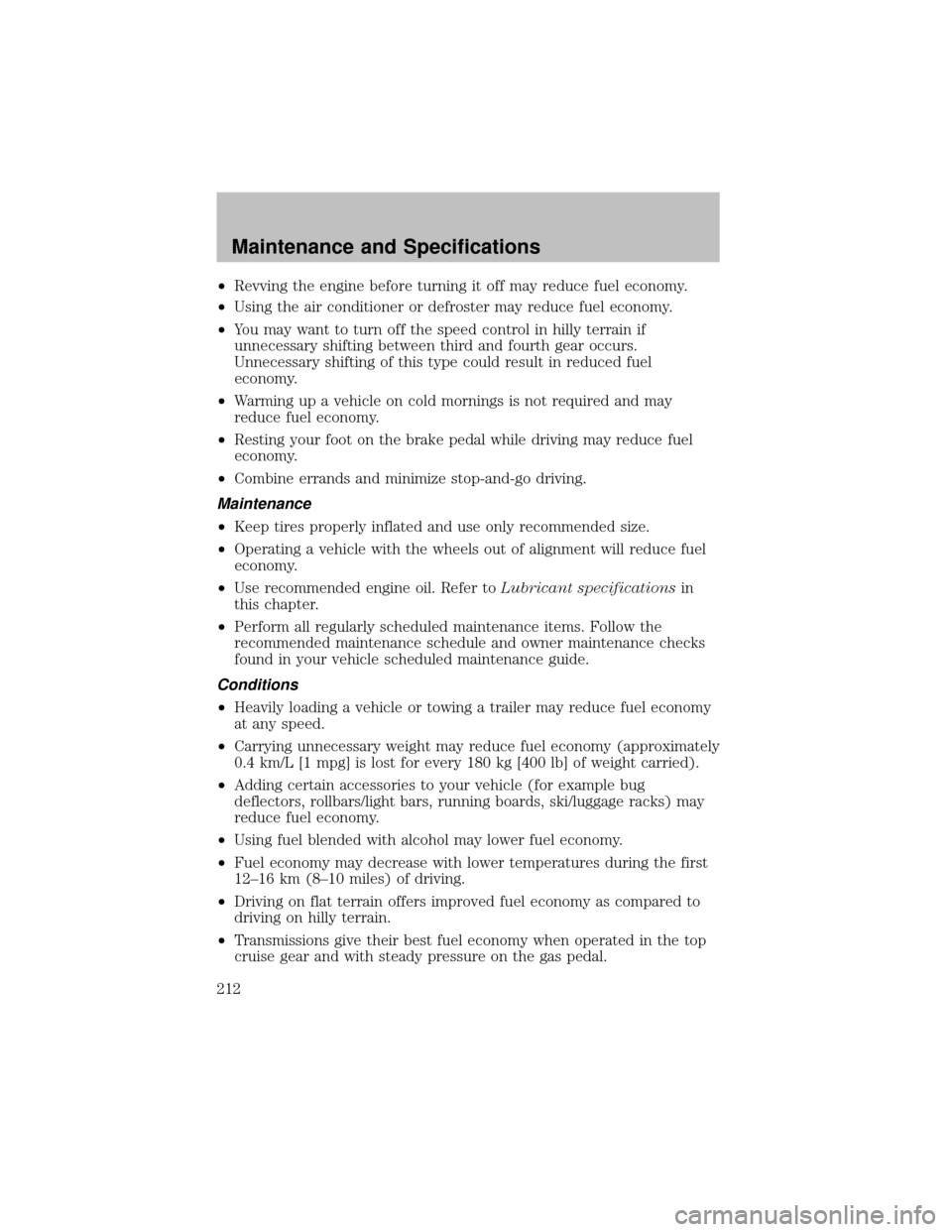
•Revving the engine before turning it off mayreduce fuel economy.
•Using the air conditioner or defroster mayreduce fuel economy.
•You maywant to turn off the speed control in hillyterrain if
unnecessaryshifting between third and fourth gear occurs.
Unnecessaryshifting of this type could result in reduced fuel
economy.
•Warming up a vehicle on cold mornings is not required and may
reduce fuel economy.
•Resting your foot on the brake pedal while driving may reduce fuel
economy.
•Combine errands and minimize stop-and-go driving.
Maintenance
•Keep tires properlyinflated and use onlyrecommended size.
•Operating a vehicle with the wheels out of alignment will reduce fuel
economy.
•Use recommended engine oil. Refer toLubricant specificationsin
this chapter.
•Perform all regularlyscheduled maintenance items. Follow the
recommended maintenance schedule and owner maintenance checks
found in your vehicle scheduled maintenance guide.
Conditions
•Heavilyloading a vehicle or towing a trailer mayreduce fuel economy
at anyspeed.
•Carrying unnecessaryweight mayreduce fuel economy(approximately
0.4 km/L [1 mpg] is lost for every180 kg [400 lb] of weight carried).
•Adding certain accessories to your vehicle (for example bug
deflectors, rollbars/light bars, running boards, ski/luggage racks) may
reduce fuel economy.
•Using fuel blended with alcohol maylower fuel economy.
•Fuel economymaydecrease with lower temperatures during the first
12–16 km (8–10 miles) of driving.
•Driving on flat terrain offers improved fuel economyas compared to
driving on hillyterrain.
•Transmissions give their best fuel economywhen operated in the top
cruise gear and with steadypressure on the gas pedal.
Maintenance and Specifications
212
Page 215 of 256
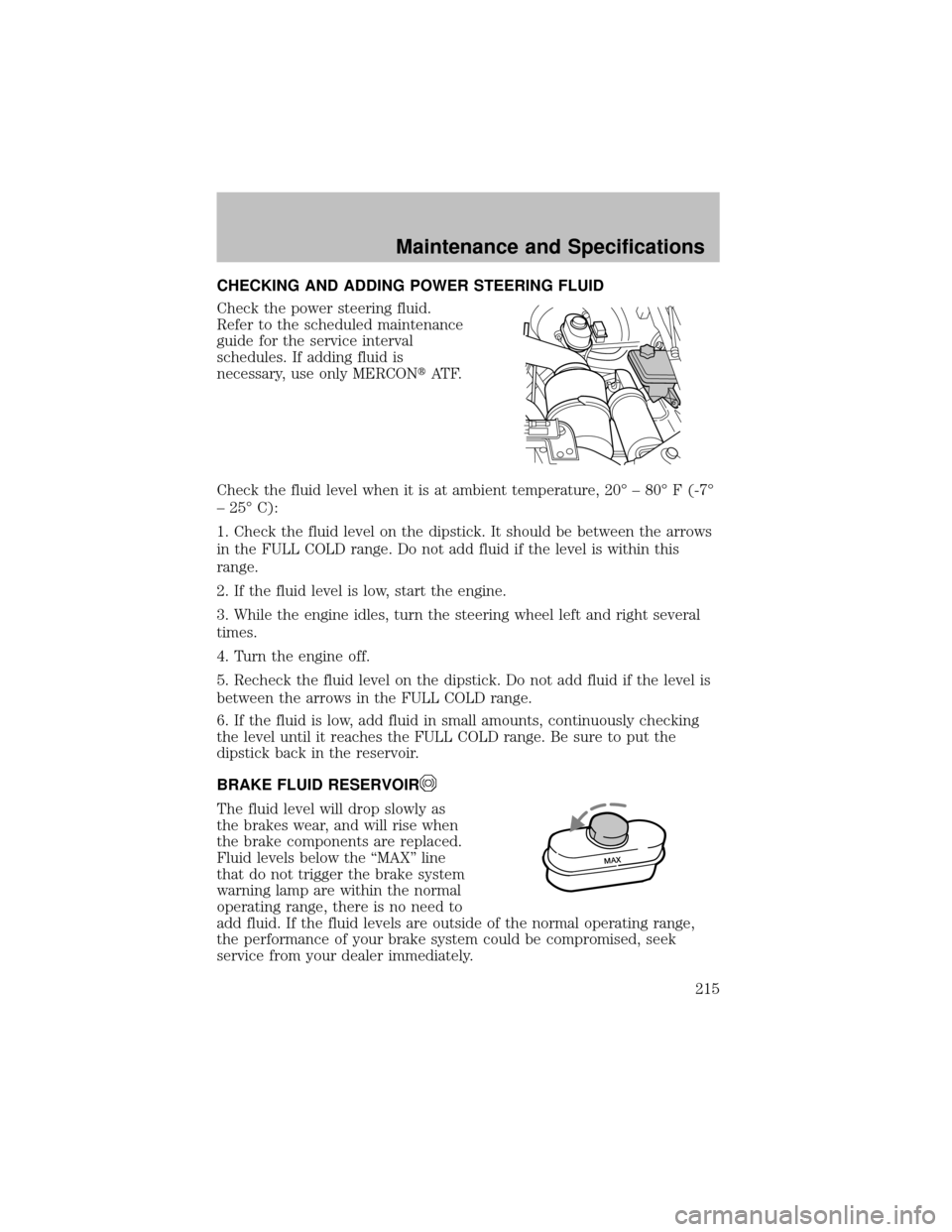
CHECKING AND ADDING POWER STEERING FLUID
Check the power steering fluid.
Refer to the scheduled maintenance
guide for the service interval
schedules. If adding fluid is
necessary, use only MERCON�AT F.
Check the fluid level when it is at ambient temperature, 20° – 80° F (-7°
– 25° C):
1. Check the fluid level on the dipstick. It should be between the arrows
in the FULL COLD range. Do not add fluid if the level is within this
range.
2. If the fluid level is low, start the engine.
3. While the engine idles, turn the steering wheel left and right several
times.
4. Turn the engine off.
5. Recheck the fluid level on the dipstick. Do not add fluid if the level is
between the arrows in the FULL COLD range.
6. If the fluid is low, add fluid in small amounts, continuouslychecking
the level until it reaches the FULL COLD range. Be sure to put the
dipstick back in the reservoir.
BRAKE FLUID RESERVOIR
The fluid level will drop slowlyas
the brakes wear, and will rise when
the brake components are replaced.
Fluid levels below the “MAX” line
that do not trigger the brake system
warning lamp are within the normal
operating range, there is no need to
add fluid. If the fluid levels are outside of the normal operating range,
the performance of your brake system could be compromised, seek
service from your dealer immediately.
M
A
X
Maintenance and Specifications
215
Page 216 of 256
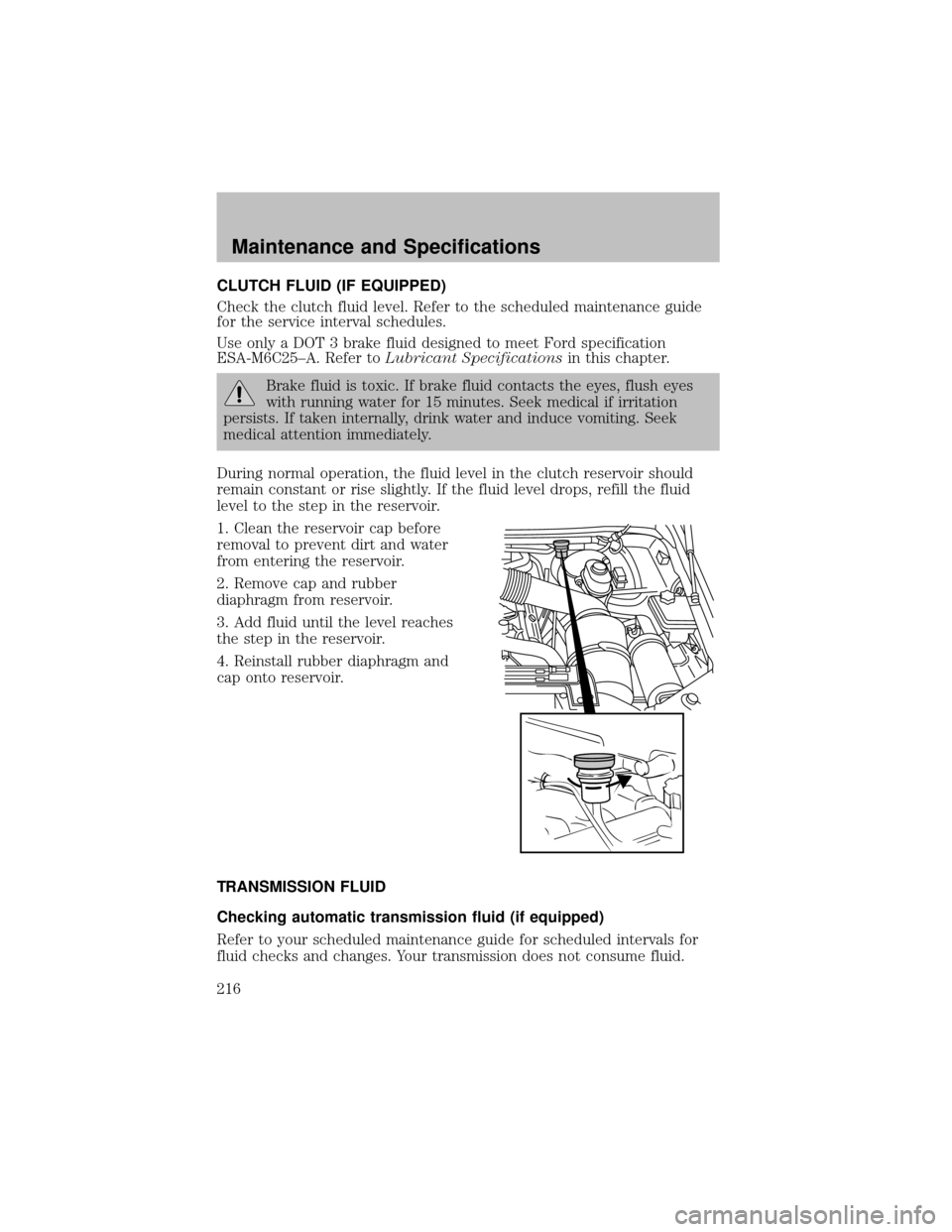
CLUTCH FLUID (IF EQUIPPED)
Check the clutch fluid level. Refer to the scheduled maintenance guide
for the service interval schedules.
Use onlya DOT 3 brake fluid designed to meet Ford specification
ESA-M6C25–A. Refer toLubricant Specificationsin this chapter.
Brake fluid is toxic. If brake fluid contacts the eyes, flush eyes
with running water for 15 minutes. Seek medical if irritation
persists. If taken internally, drink water and induce vomiting. Seek
medical attention immediately.
During normal operation, the fluid level in the clutch reservoir should
remain constant or rise slightly. If the fluid level drops, refill the fluid
level to the step in the reservoir.
1. Clean the reservoir cap before
removal to prevent dirt and water
from entering the reservoir.
2. Remove cap and rubber
diaphragm from reservoir.
3. Add fluid until the level reaches
the step in the reservoir.
4. Reinstall rubber diaphragm and
cap onto reservoir.
TRANSMISSION FLUID
Checking automatic transmission fluid (if equipped)
Refer to your scheduled maintenance guide for scheduled intervals for
fluid checks and changes. Your transmission does not consume fluid.
Maintenance and Specifications
216
Page 217 of 256
However, the fluid level should be checked if the transmission is not
working properly, i.e., if the transmission slips or shifts slowly or if y ou
notice some sign of fluid leakage.
Automatic transmission fluid expands when warmed. To obtain an
accurate fluid check, drive the vehicle until it is at normal operating
temperature (approximately30 km [20 miles]). If your vehicle has been
operated for an extended period at high speeds, in citytraffic during hot
weather or pulling a trailer, the vehicle should be turned off for about 30
minutes to allow fluid to cool before checking.
1. Drive the vehicle 30 km (20 miles) or until it reaches normal operating
temperature.
2. Park the vehicle on a level surface and engage the parking brake.
3. With the parking brake engaged and your foot on the brake pedal,
start the engine and move the gearshift lever through all of the gear
ranges. Allow sufficient time for each gear to engage.
4. Latch the gearshift lever in P (Park) and leave the engine running.
5. Remove the dipstick, wiping it clean with a clean, drylint free rag. If
necessary, refer toIdentifying components in the engine compartment
in this chapter for the location of the dipstick.
6. Install the dipstick making sure it is fullyseated in the filler tube.
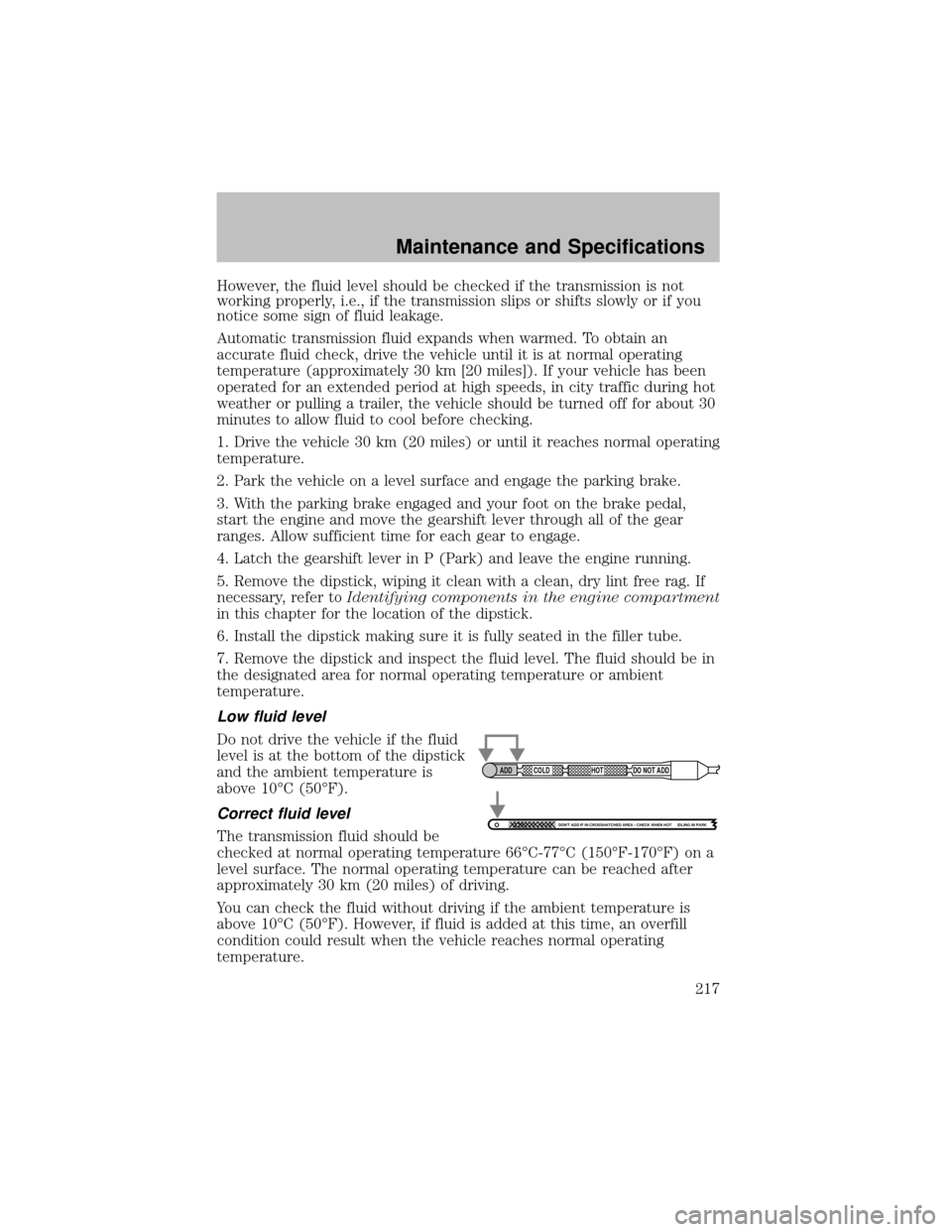
7. Remove the dipstick and inspect the fluid level. The fluid should be in
the designated area for normal operating temperature or ambient
temperature.
Low fluid level
Do not drive the vehicle if the fluid
level is at the bottom of the dipstick
and the ambient temperature is
above 10°C (50°F).
Correct fluid level
The transmission fluid should be
checked at normal operating temperature 66°C-77°C (150°F-170°F) on a
level surface. The normal operating temperature can be reached after
approximately30 km (20 miles) of driving.
You can check the fluid without driving if the ambient temperature is
above 10°C (50°F). However, if fluid is added at this time, an overfill
condition could result when the vehicle reaches normal operating
temperature.
ADD COLD HOT DO NOT ADD
DON'T ADD IF IN CROSSHATCHED AREA • CHECK WHEN HOT IDLING IN PARK
Maintenance and Specifications
217
Page 227 of 256
Make sure that all replacement tires are of the same size, type,
speed rating, load-carrying capacity and tread design (e.g., “All
Terrain”, “Touring”, etc.), as originallyoffered byFord.
Do not replace your tires with “high performance” tires or larger
size tires.
Failure to follow these precautions mayadverselyaffect the
handling of the vehicle, and increase the risk of loss of vehicle
control, vehicle rollover and/or personal injury.
Tires that are larger or smaller than your vehicle’s original tires may also
affect the accuracyof your speedometer.
SNOW TIRES AND CHAINS
Snow tires must be the same size and grade as the tires you
currentlyhave on your vehicle.
The tires on your vehicle have all weather treads to provide traction in
rain and snow. However, in some climates, you may need to use snow
tires and chains. If you need to use chains, it is recommended that steel
wheels (of the same size and specifications) be used, as chains maychip
aluminum wheels.
Follow these guidelines when using snow tires and chains:
•Use onlySAE Class S chains.
•Install chains securely, verify ing that the chains do not touch any
wiring, brake lines or fuel lines.
•Drive cautiously. If you hear the chains rub or bang against your
vehicle, stop and re-tighten the chains. If this does not work, remove
the chains to prevent damage to your vehicle.
•If possible, avoid fullyloading your vehicle.
•Remove the tire chains when theyare no longer needed. Do not use
tire chains on dryroads.
•The suspension insulation and bumpers will help prevent vehicle
damage. Do not remove these components from your vehicle when
using snow tires and chains.
Maintenance and Specifications
227
Page 229 of 256
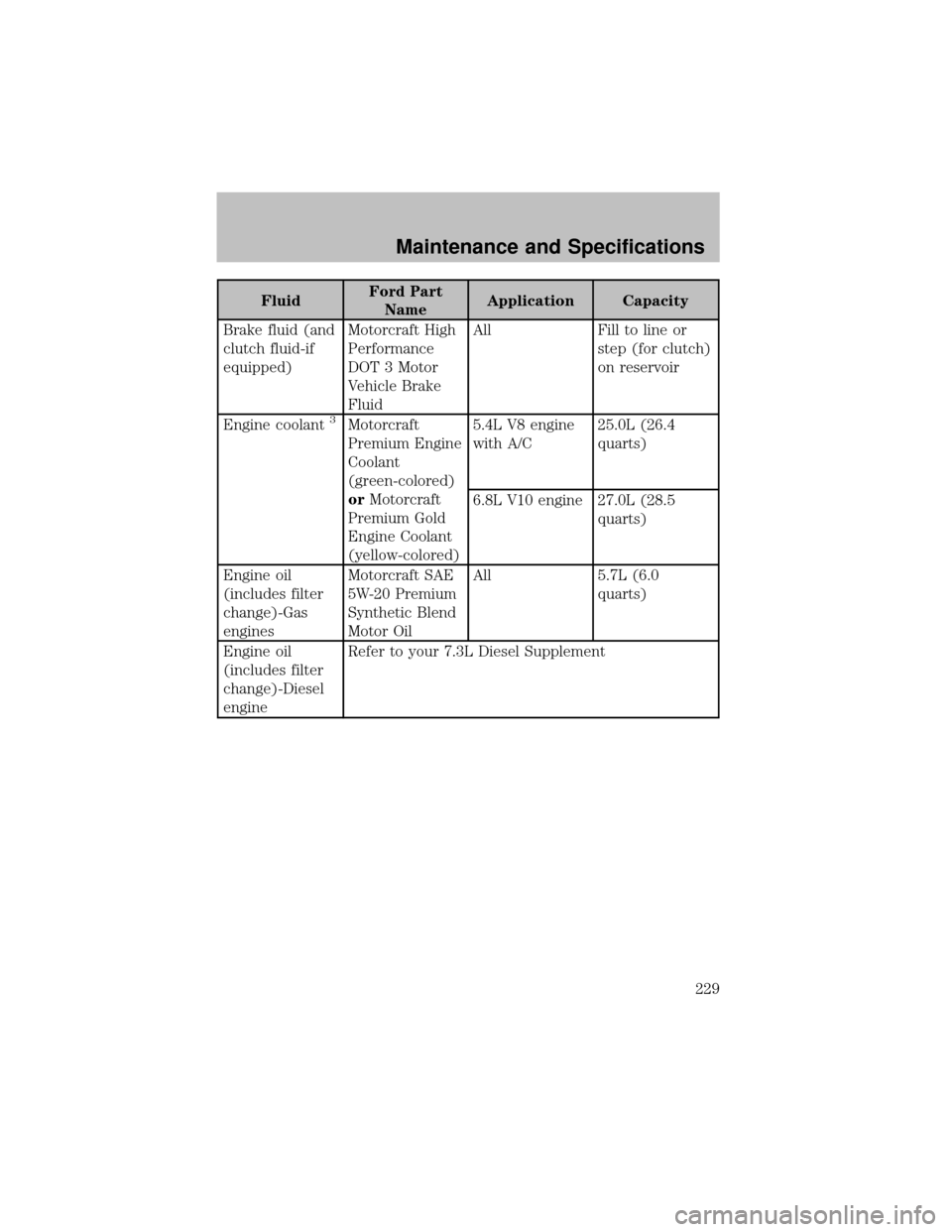
FluidFord Part
NameApplication Capacity
Brake fluid (and
clutch fluid-if
equipped)Motorcraft High
Performance
DOT 3 Motor
Vehicle Brake
FluidAll Fill to line or
step (for clutch)
on reservoir
Engine coolant
3Motorcraft
Premium Engine
Coolant
(green-colored)
orMotorcraft
Premium Gold
Engine Coolant
(yellow-colored)5.4L V8 engine
with A/C25.0L (26.4
quarts)
6.8L V10 engine 27.0L (28.5
quarts)
Engine oil
(includes filter
change)-Gas
enginesMotorcraft SAE
5W-20 Premium
Synthetic Blend
Motor OilAll 5.7L (6.0
quarts)
Engine oil
(includes filter
change)-Diesel
engineRefer to your 7.3L Diesel Supplement
Maintenance and Specifications
229
Page 232 of 256
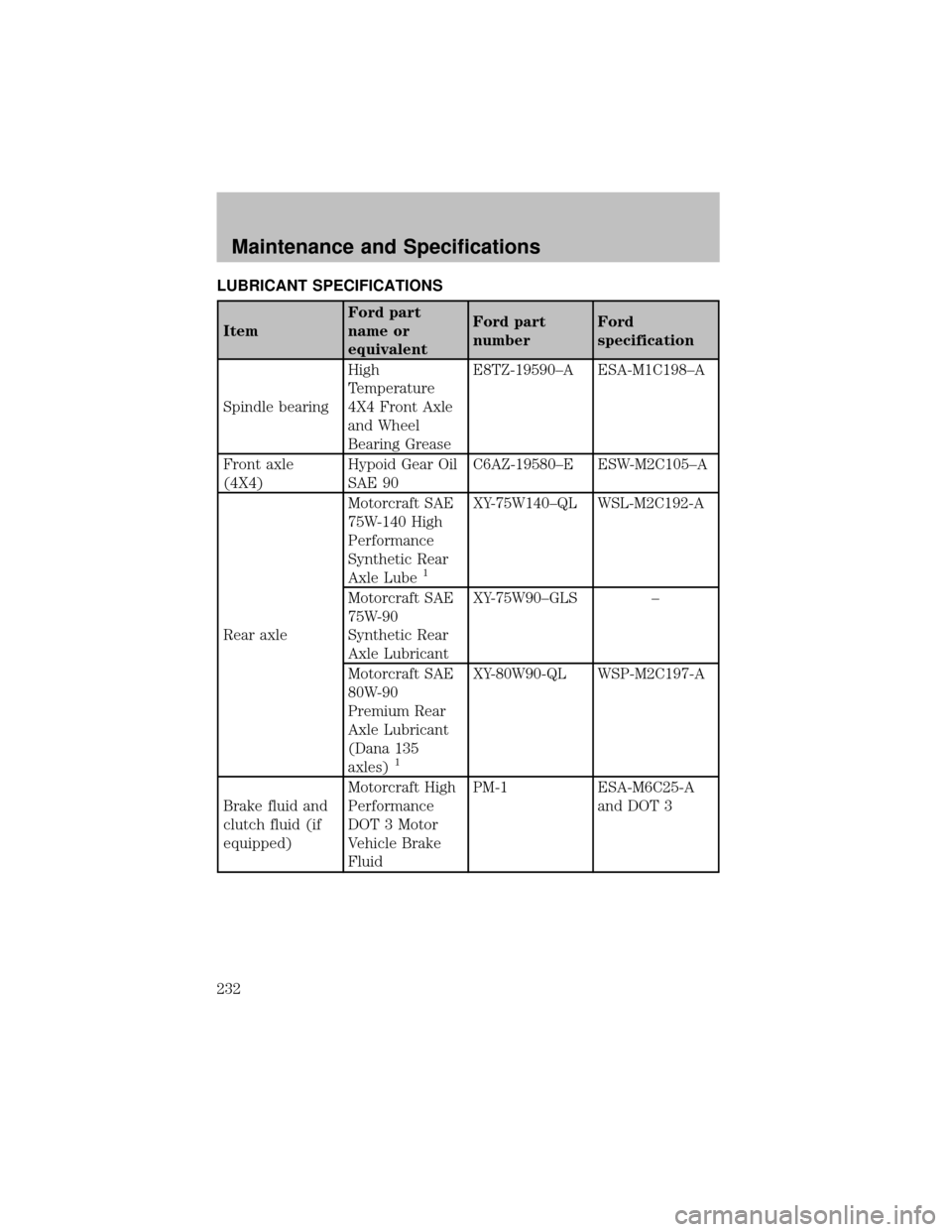
LUBRICANT SPECIFICATIONS
ItemFord part
name or
equivalentFord part
numberFord
specification
Spindle bearingHigh
Temperature
4X4 Front Axle
and Wheel
Bearing GreaseE8TZ-19590–A ESA-M1C198–A
Front axle
(4X4)Hypoid Gear Oil
SAE 90C6AZ-19580–E ESW-M2C105–A
Rear axleMotorcraft SAE
75W-140 High
Performance
Synthetic Rear
Axle Lube
1
XY-75W140–QL WSL-M2C192-A
Motorcraft SAE
75W-90
Synthetic Rear
Axle LubricantXY-75W90–GLS –
Motorcraft SAE
80W-90
Premium Rear
Axle Lubricant
(Dana 135
axles)
1
XY-80W90-QL WSP-M2C197-A
Brake fluid and
clutch fluid (if
equipped)Motorcraft High
Performance
DOT 3 Motor
Vehicle Brake
FluidPM-1 ESA-M6C25-A
and DOT 3
Maintenance and Specifications
232
Page 233 of 256
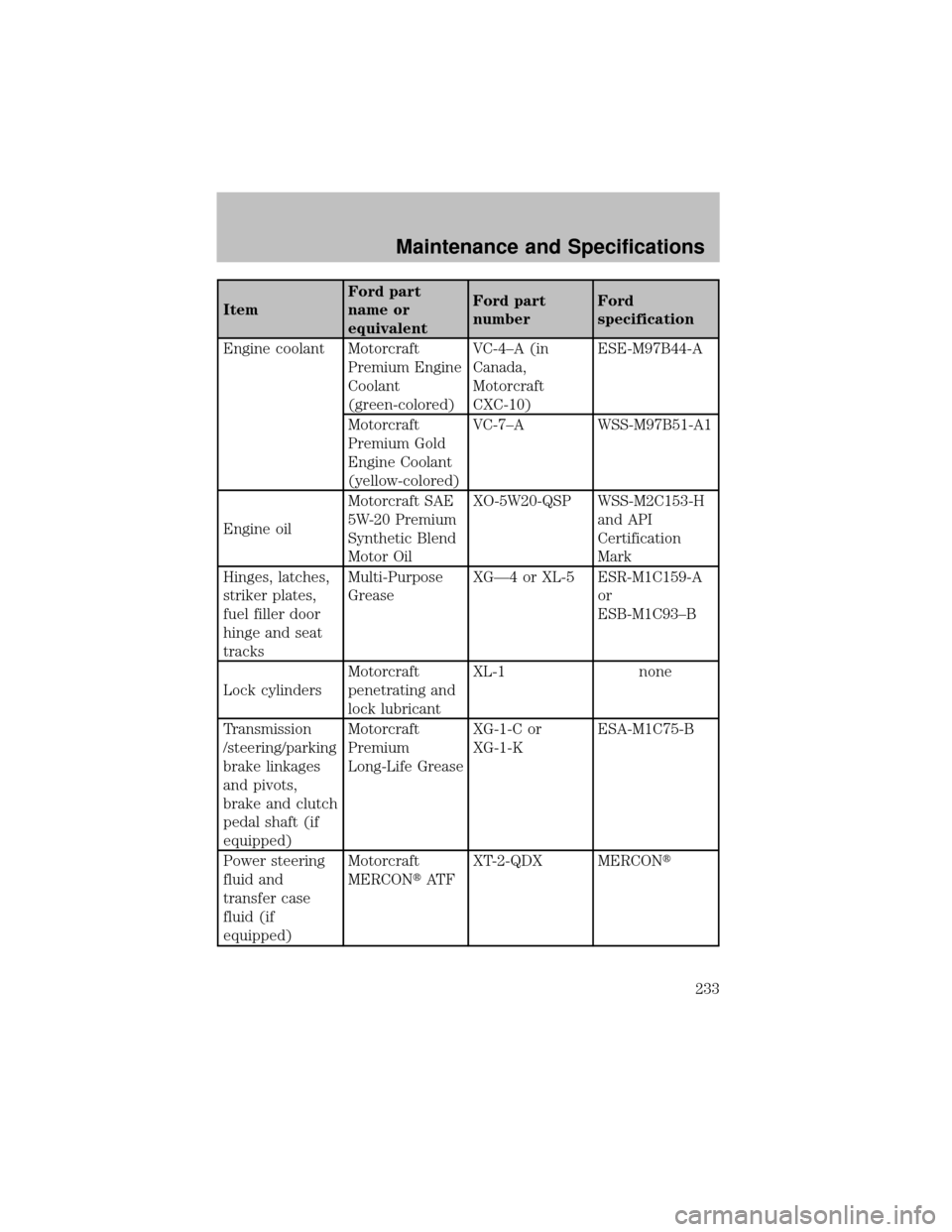
ItemFord part
name or
equivalentFord part
numberFord
specification
Engine coolant Motorcraft
Premium Engine
Coolant
(green-colored)VC-4–A (in
Canada,
Motorcraft
CXC-10)ESE-M97B44-A
Motorcraft
Premium Gold
Engine Coolant
(yellow-colored)VC-7–A WSS-M97B51-A1
Engine oilMotorcraft SAE
5W-20 Premium
Synthetic Blend
Motor OilXO-5W20-QSP WSS-M2C153-H
and API
Certification
Mark
Hinges, latches,
striker plates,
fuel filler door
hinge and seat
tracksMulti-Purpose
GreaseXG—4 or XL-5 ESR-M1C159-A
or
ESB-M1C93–B
Lock cylindersMotorcraft
penetrating and
lock lubricantXL-1 none
Transmission
/steering/parking
brake linkages
and pivots,
brake and clutch
pedal shaft (if
equipped)Motorcraft
Premium
Long-Life GreaseXG-1-C or
XG-1-KESA-M1C75-B
Power steering
fluid and
transfer case
fluid (if
equipped)Motorcraft
MERCON�AT FXT-2-QDX MERCON�
Maintenance and Specifications
233