2003 FORD MUSTANG tow
[x] Cancel search: towPage 154 of 256
VEHICLE LOADING
Before loading a vehicle, familiarize yourself with the
following terms:
•Base Curb Weight:Weight of the vehicle
including any standard equipment, fluids,
lubricants, etc. It does not include occupants or
aftermarket equipment.
•Payload:Combined maximum allowable weight of
cargo, occupants and optional equipment. The
payload equals the gross vehicle weight rating
minus base curb weight.
•GVW (Gross Vehicle Weight):Base curb weight
plus payload weight. The GVW is not a limit or a
specification.
•GVWR (Gross Vehicle Weight Rating):
Maximum permissible total weight of the base
vehicle, occupants, optional equipment and cargo.
The GVWR is specific to each vehicle and is listed
on the Safety Certification Label on the driver’s
door pillar.
•GAWR (Gross Axle Weight Rating):Carrying
capacity for each axle system. The GAWR is
specific to each vehicle and is listed on the Safety
Certification Label on the driver’s door pillar.
•GCW (Gross Combined Weight):The
combined weight of the towing vehicle (including
occupants and cargo) and the loaded trailer.
•GCWR (Gross Combined Weight Rating):
Maximum permissible combined weight of towing
vehicle (including occupants and cargo) and the
loaded trailer
•Maximum Trailer Weight Rating:Maximum
weight of a trailer the vehicle is permitted to tow.
The maximum trailer weight rating is determined
by subtracting the vehicle curb weight for each
engine/transmission combination, any required
option weight for trailer towing and the weight of
the driver from the GCWR for the towing vehicle.
•Maximum Trailer Weight:Maximum weight of a
trailer the loaded vehicle (including occupants
Driving
154
Page 155 of 256
and cargo) is permitted to tow. It is determined
by subtracting the weight of the loaded trailer
towing vehicle from the GCWR for the towing
vehicle.
•Trailer Weight Range:Specified weight range
that the trailer must fall within that ranges from
zero to the maximum trailer weight rating.
Remember to figure in the tongue load of your
loaded trailer when figuring the total weight.
Do not exceed the GVWR or the GAWR
specified on the certification label.
Do not use replacement tires with lower load
carrying capacities than the originals because they
may lower the vehicle’s GVWR and GAWR
limitations. Replacement tires with a higher limit
than the originals do not increase the GVWR and
GAWR limitations.
The Safety Certification Label, found on the driver’s
door pillar, lists several important vehicle weight
rating limitations. Before adding any additional
equipment, refer to these limitations. If you are
adding weight to the front of your vehicle,
(potentially including weight added to the cab), the
weight added should not exceed the front axle
reserve capacity (FARC). Additional frontal weight
may be added to the front axle reserve capacity
provided you limit your payload in other ways (i.e.
restrict the number of occupants or amount of cargo
carried).
Always ensure that the weight of occupants, cargo
and equipment being carried is within the weight
limitations that have been established for your
vehicle including both gross vehicle weight and front
and rear gross axle weight rating limits. Under no
circumstance should these limitations be exceeded.
Exceeding any vehicle weight rating
limitation could result in serious damage to
the vehicle and/or personal injury.
Driving
155
Page 156 of 256
TRAILERTOWING
Your vehicle is not equipped to tow. No towing
packages are available through Ford or
Lincoln/Mercury dealers.
RECREATIONAL TOWING
(ALL WHEELS ON THE GROUND)
Follow these guidelines for your specific powertrain
combination to tow your vehicle with all four wheels
on the ground (such as behind a recreational
vehicle).
These guidelines are designed to ensure that your
transmission is not damaged due to insufficient
lubrication.
All Rear Wheel Drive (RWD) vehicles:
This applies to all cars and 4x2 trucks/sport utilities
with rear wheel drive capability.
An example of recreational towing is towing your
vehicle behind a motorhome. The following
recreational towing guidelines are designed to
ensure that your transmission is not damaged.
•Place the transmission in N (Neutral)
•Maximum speed is 56 km/h (35 mph)
•Maximum distance is 80 km (50 miles)
If a distance of 80 km (50 miles) or a speed of 56
km/h (35 mph) must be exceeded, you must
disconnect the driveshaft. Ford recommends the
driveshaft be removed/installed only by a qualified
technician. See your local dealer for driveshaft
removal/installation.
Improper removal/installation of the driveshaft
can cause transmission fluid loss, damage to
the driveshaft and internal transmission
components.
Driving
156
Page 157 of 256
GETTINGROADSIDEASSISTANCE
To fully assist you should you have a vehicle
concern, Ford Motor Company offers a
complimentary roadside assistance program. This
program is separate from the New Vehicle Limited
Warranty. The service is available:
•24–hours, seven days a week
•for the New Vehicle Limited Warranty period of
three years or 60,000 km (36,000 miles),
whichever occurs first on Ford and Mercury
vehicles, and four years or 80,000 km (50,000
miles) on Lincoln vehicles.
Roadside assistance will cover:
•changing a flat tire
•jump-starts
•lock-out assistance
•limited fuel delivery
•towing of your disabled vehicle to the nearest
Ford Motor Company dealership, or your selling
dealer if within 56.3 km (35 miles) of the nearest
Ford Motor Company dealership (one tow per
disablement). Even non-warranty related tows,
like accidents or getting stuck in the mud or
snow, are covered (some exclusions apply, such as
impound towing or repossession).
Canadian customers refer to your Owner
Information Guide for information on:
•Coverage period
•Exact fuel amounts
•Towing of your disabled vehicle
•Emergency travel expense reimbursement
•Travel planning benefits
USING ROADSIDE ASSISTANCE
Complete the roadside assistance identification card
and place it in your wallet for quick reference. In the
United States, this card is found in the Owner Guide
Roadside Emergencies
157
Page 166 of 256
Ifyou use the temporary spare tire
continuously or do not follow these
precautions, the tire could fail, causing you to lose
control of the vehicle, possibly injuring yourself or
others.
When driving with the temporary spare tiredo not:
•use more than one temporary spare tire at a time
•exceed 80 km/h (50 mph) or drive further than 3
200 km (2 000 miles) total under any
circumstances
•load the vehicle beyond maximum vehicle load
rating listed on the tire pressure label on the
inside of the glove compartment door
•tow a trailer
•use tire chains
•drive through an automatic car wash, because of
the vehicle’s reduced ground clearance
•try to repair the temporary spare tire or remove it
from its wheel
•use the wheel for any other type of vehicle
Use of a temporary spare tire at any one wheel
location can lead to impairment of the following:
•handling, stability and braking performance
•comfort and noise
•ground clearance and parking at curbs
•Winter driving capability
Tire change procedure
To prevent the vehicle from moving when
you change a tire, be sure the parking brake
is set, then block (in both directions) the wheel
that is diagonally opposite (other side and end of
the vehicle) to the tire being changed.
Roadside Emergencies
166
Page 175 of 256
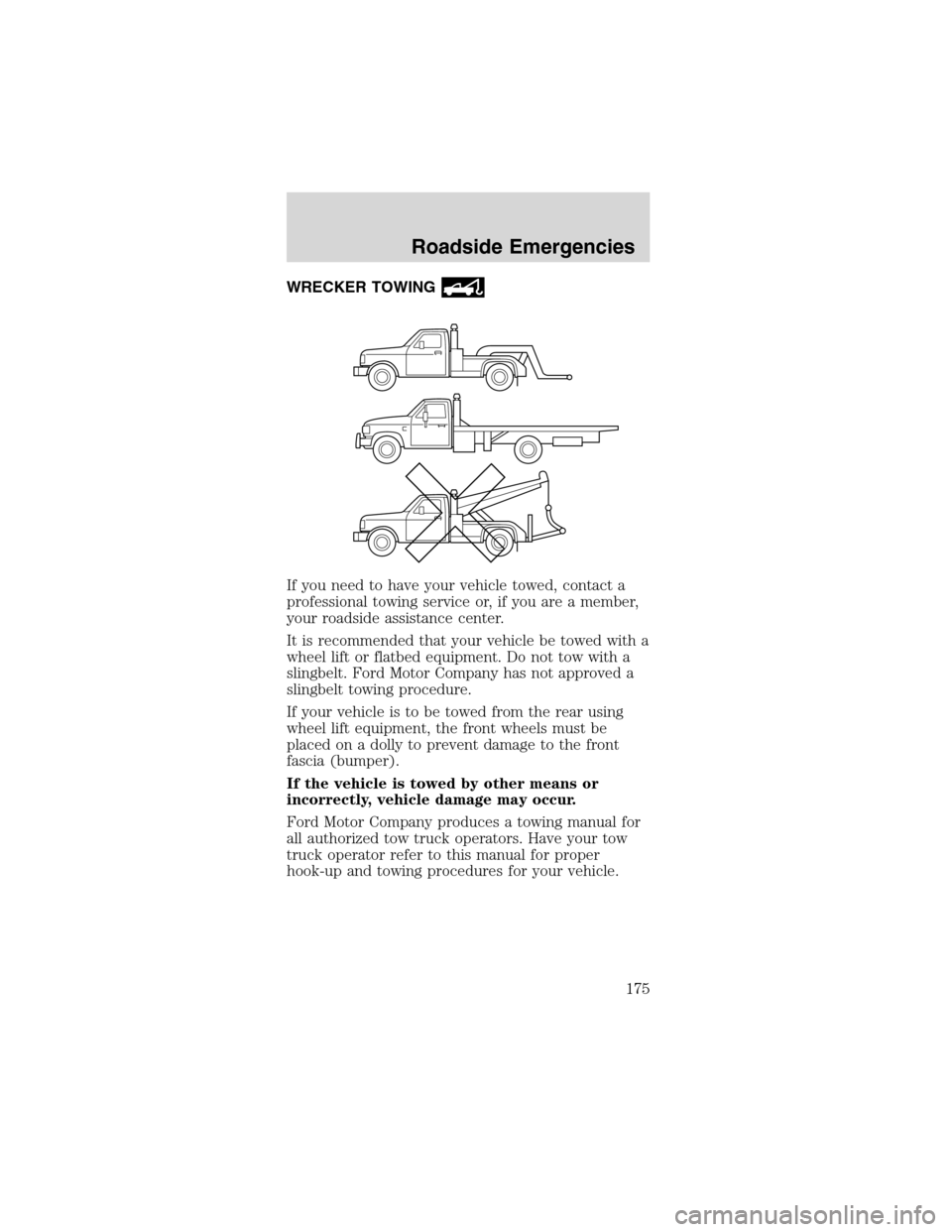
WRECKER TOWING
If you need to have your vehicle towed, contact a
professional towing service or, if you are a member,
your roadside assistance center.
It is recommended that your vehicle be towed with a
wheel lift or flatbed equipment. Do not tow with a
slingbelt. Ford Motor Company has not approved a
slingbelt towing procedure.
If your vehicle is to be towed from the rear using
wheel lift equipment, the front wheels must be
placed on a dolly to prevent damage to the front
fascia (bumper).
If the vehicle is towed by other means or
incorrectly, vehicle damage may occur.
Ford Motor Company produces a towing manual for
all authorized tow truck operators. Have your tow
truck operator refer to this manual for proper
hook-up and towing procedures for your vehicle.
Roadside Emergencies
175
Page 179 of 256
•Protection against covered repair costs after your
Bumper-to-Bumper Warranty expires.
You may purchase Ford ESP from any participating
Ford and Lincoln Mercury and Ford of Canada
dealer. There are several plans available in various
time, distance and deductible combinations which
can be tailored to fit your own driving needs. Ford
ESP also offers reimbursement benefits for towing
and rental coverage.
When you buy Ford ESP, you receive Peace-of-Mind
protection throughout the United States and Canada,
provided by a network of more than 5,000
participating Ford or Lincoln Mercury and Ford of
Canada dealers.
If you did not take advantage of the Ford Extended
Service Plan at the time of purchasing your vehicle,
you may still be eligible. Please contact your dealer
for further information. Since this information is
subject to change, please ask your dealer for
complete details about Ford Extended Service Plan
coverage options, or visit the Ford ESP website at
www.ford-esp.com.
THE DISPUTE SETTLEMENT BOARD
(U.S. ONLY)
The Dispute Settlement Board is:
•an independent, third-party arbitration program
for warranty disputes.
•available free to owners and lessees of qualifying
Ford Motor Company vehicles.
The Dispute Settlement Board may not be available in
all states. Ford Motor Company reserves the right to
change eligibility limitations, modify procedures
and/or to discontinue this service without notice and
without incurring obligations per applicable state law.
What kinds of cases does the Board review?
Unresolved warranty repair concerns or vehicle
performance concerns as on Ford and Lincoln
Mercury cars and Ford and Lincoln Mercury light
Customer Assistance
179
Page 187 of 256
WASHING THE EXTERIOR
Wash your vehicle regularly with cool or lukewarm
water and a neutral Ph shampoo, such as Detail
Wash (ZC-3–A), which is available from your dealer.
•Never use strong household detergents or soap,
such as dish washing or laundry liquid. These
products can discolor and spot painted surfaces.
•Never wash a vehicle that is“hot to the touch”or
during exposure to strong, direct sunlight.
•Always use a clean sponge or carwash mitt with
plenty of water for best results.
•Dry the vehicle with a chamois or soft terry cloth
towel in order to eliminate water spotting.
•It is especially important to wash the vehicle
regularly during the winter months, as dirt and
road salt are difficult to remove and cause
damage to the vehicle.
•Immediately remove items such as gasoline, diesel
fuel, bird droppings and insect deposits because
they can cause damage to the vehicle’s paintwork
and trim over time.
•Remove any exterior accessories, such as
antennas, before entering a car wash.
•Suntan lotions and insect repellents can
damage any painted surface; if these
substances come in contact with your
vehicle, wash off as soon as possible.
WAXING
Applying a polymer paint sealant to your vehicle
every six months will assist in reducing minor
scratches and paint damage.
•Wash the vehicle first.
•Do not use waxes that contain abrasives.
•Do not allow paint sealant to come in contact with
any non-body (low-gloss black) colored trim, such
as grained door handles, roof racks, bumpers, side
moldings, mirror housings or the windshield cowl
area. The paint sealant will“gray”or stain the
parts over time.
Cleaning
187