Page 87 of 256
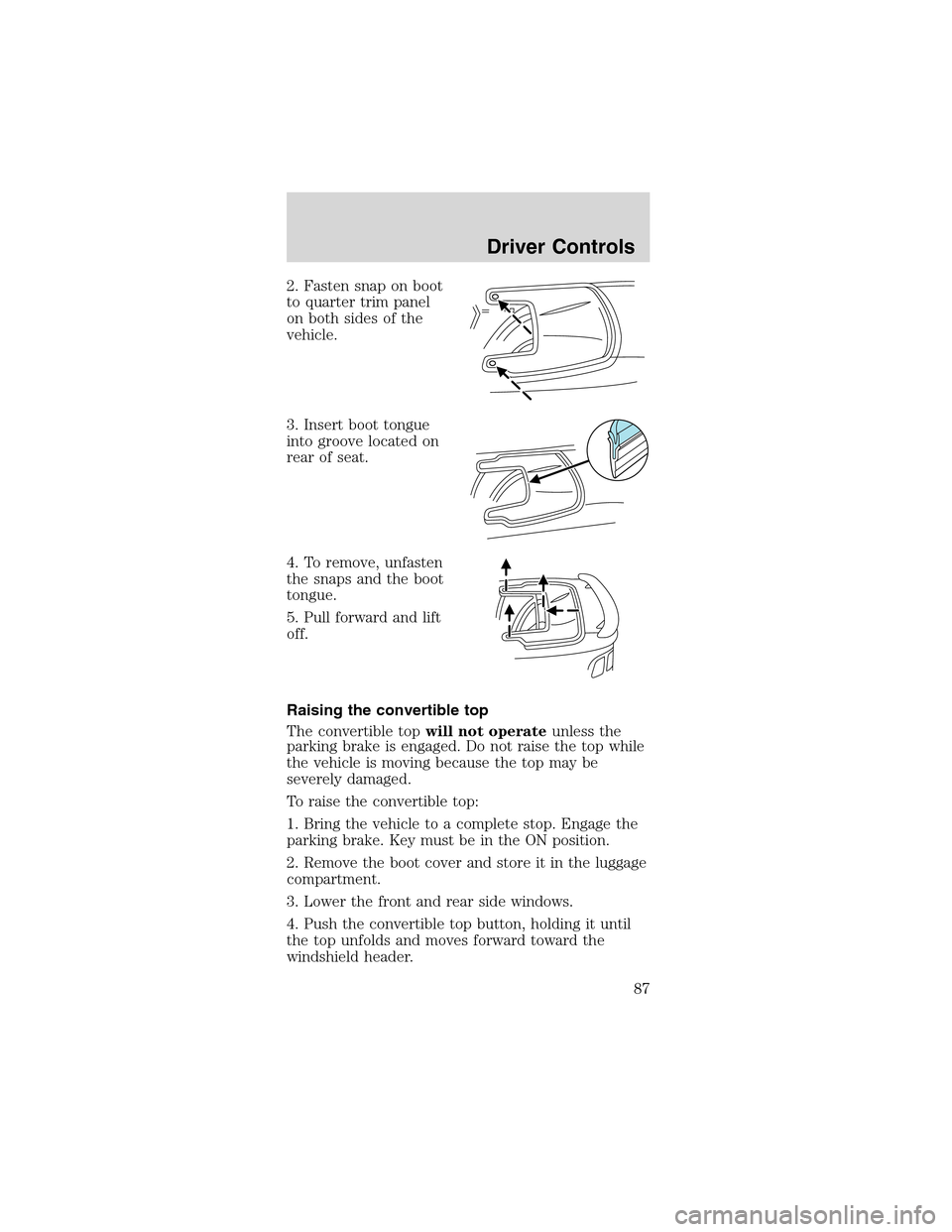
2. Fasten snap on boot
to quarter trim panel
on both sides of the
vehicle.
3. Insert boot tongue
into groove located on
rear of seat.
4. To remove, unfasten
the snaps and the boot
tongue.
5. Pull forward and lift
off.
Raising the convertible top
The convertible topwill not operateunless the
parking brake is engaged. Do not raise the top while
the vehicle is moving because the top may be
severely damaged.
To raise the convertible top:
1. Bring the vehicle to a complete stop. Engage the
parking brake. Key must be in the ON position.
2. Remove the boot cover and store it in the luggage
compartment.
3. Lower the front and rear side windows.
4. Push the convertible top button, holding it until
the top unfolds and moves forward toward the
windshield header.
Driver Controls
87
Page 93 of 256
Opening the trunk
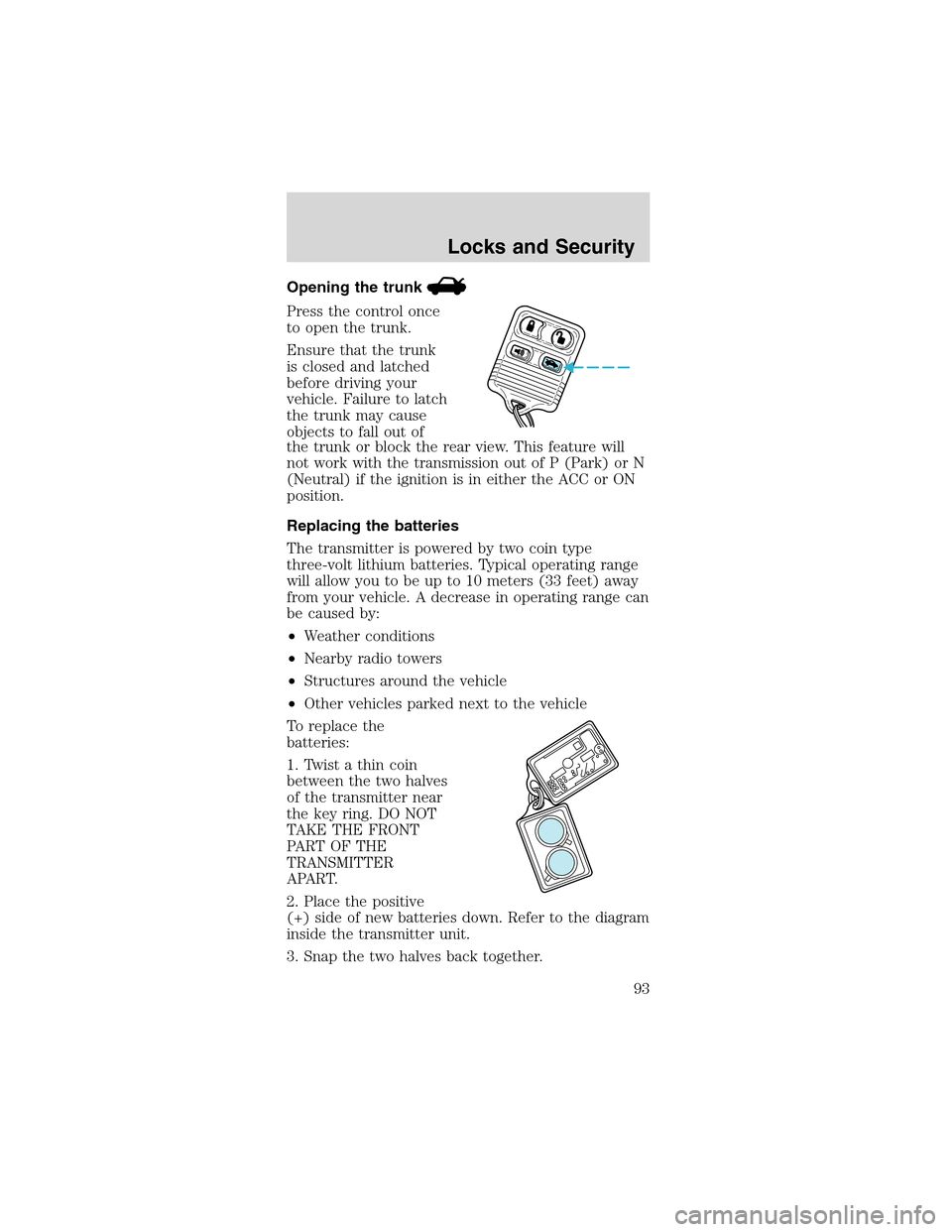
Press the control once
to open the trunk.
Ensure that the trunk
is closed and latched
before driving your
vehicle. Failure to latch
the trunk may cause
objects to fall out of
the trunk or block the rear view. This feature will
not work with the transmission out of P (Park) or N
(Neutral) if the ignition is in either the ACC or ON
position.
Replacing the batteries
The transmitter is powered by two coin type
three-volt lithium batteries. Typical operating range
will allow you to be up to 10 meters (33 feet) away
from your vehicle. A decrease in operating range can
be caused by:
•Weather conditions
•Nearby radio towers
•Structures around the vehicle
•Other vehicles parked next to the vehicle
To replace the
batteries:
1. Twist a thin coin
between the two halves
of the transmitter near
the key ring. DO NOT
TAKE THE FRONT
PART OF THE
TRANSMITTER
APART.
2. Place the positive
(+) side of new batteries down. Refer to the diagram
inside the transmitter unit.
3. Snap the two halves back together.
Locks and Security
93
Page 97 of 256
turn ignition OFF and restart the engine with all
other objects on the key ring held away from the
ignition key. Check to make sure thecoded keyis
an approved Fordcoded key.
If your keys are lost or stolen you will need to do
the following:
•Use your spare key to start the vehicle, or
•Have your vehicle towed to a dealership or a
locksmith. The key codes will need to be erased
from your vehicle and new key codes will need to
be re-coded.
Replacing coded keys can be very costly and you
may want to store an extra programmed key away
from the vehicle in a safe place to prevent an
unforeseen inconvenience.
The correctcoded keymust be used for your
vehicle. The use of the wrong type ofcoded key
may lead to a“no start”condition.
If an unprogrammed key is used in the ignition
it will cause a“no start”condition.
Programming spare keys
A maximum of eight keys can be coded to your
vehicle. Only SecuriLock�keys can be used. To
program acoded keyyourself, you will need two
previously programmedcoded keys(keys that
already operate your vehicle’s engine) and the new
unprogrammed key(s) readily accessible for timely
implementation of each step in the procedure.
If two previously programmed coded keys are not
available, you must bring your vehicle to your
dealership to have the spare coded key(s)
programmed.
Please read and understand the entire procedure
before you begin.
Locks and Security
97
Page 116 of 256
•Recline the seat slightly (one or two degrees)
from the upright position.
Do not put anything on or over the air bag
module. Placing objects on or over the air
bag inflation area may cause those objects to be
propelled by the air bag into your face and torso
causing serious injury.
Do not attempt to service, repair, or modify
the air bag supplemental restraint systems
or its fuses. See your Ford or Lincoln Mercury
dealer.
Modifications to the front end of the vehicle,
including frame, bumper, front end body
structure and tow hooks may affect the
performance of the air bag sensors increasing the
risk of injury. Do not modify the front end of the
vehicle.
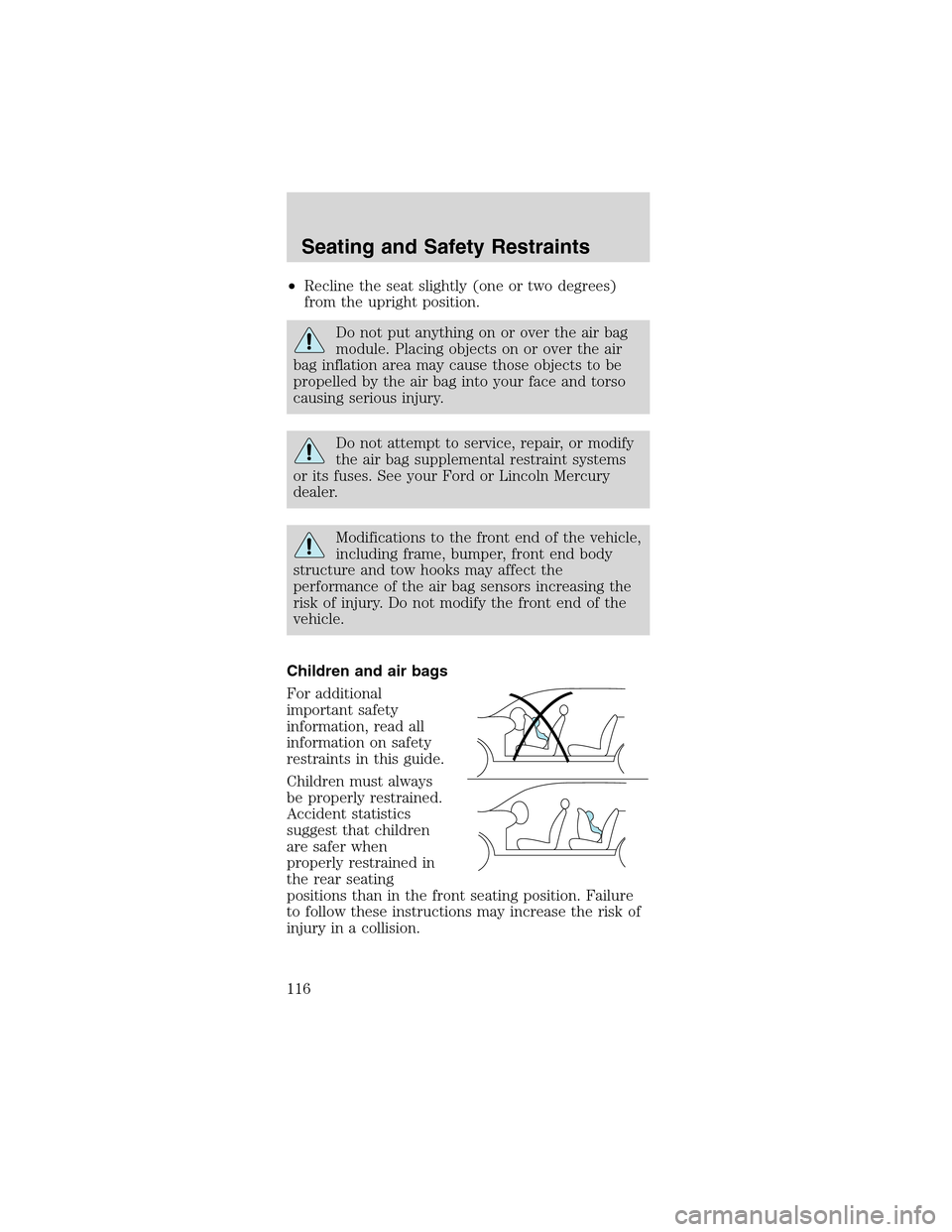
Children and air bags
For additional
important safety
information, read all
information on safety
restraints in this guide.
Children must always
be properly restrained.
Accident statistics
suggest that children
are safer when
properly restrained in
the rear seating
positions than in the front seating position. Failure
to follow these instructions may increase the risk of
injury in a collision.
Seating and Safety Restraints
116
Page 123 of 256
collision. For this reason, you should never use a
booster seat with a lap belt only. It is best to use a
booster seat with lap/shoulder belts in the back seat-
the safest place for children to ride.
Follow all instructions provided by the
manufacturer of the booster seat.
Never put the shoulder belt under a child’s
arm or behind the back because it
eliminates the protection for the upper part of the
body and may increase the risk of injury or death
in a collision.
Never use pillows, books, or towels to boost
a child. They can slide around and increase
the likelihood of injury or death in a collision.
SAFETY SEATS FOR CHILDREN
Child and infant or child safety seats
Use a safety seat that is recommended for the size
and weight of the child. Carefully follow all of the
manufacturer’s instructions with the safety seat you
Seating and Safety Restraints
123
Page 127 of 256
6. Allow the belt to retract. The belt will click as it
retracts to indicate it is in the automatic locking
mode.
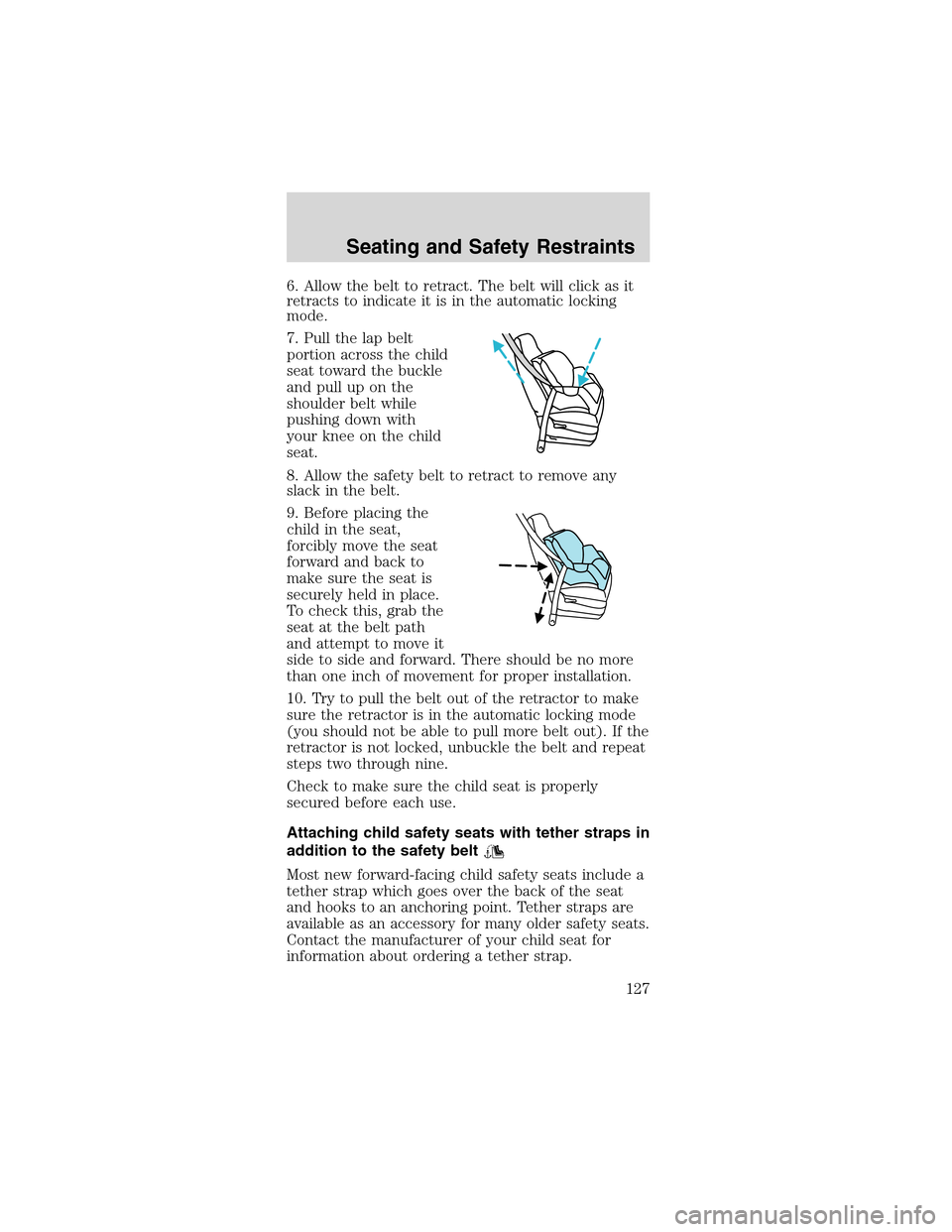
7. Pull the lap belt
portion across the child
seat toward the buckle
and pull up on the
shoulder belt while
pushing down with
your knee on the child
seat.
8. Allow the safety belt to retract to remove any
slack in the belt.
9. Before placing the
child in the seat,
forcibly move the seat
forward and back to
make sure the seat is
securely held in place.
To check this, grab the
seat at the belt path
and attempt to move it
side to side and forward. There should be no more
than one inch of movement for proper installation.
10. Try to pull the belt out of the retractor to make
sure the retractor is in the automatic locking mode
(you should not be able to pull more belt out). If the
retractor is not locked, unbuckle the belt and repeat
steps two through nine.
Check to make sure the child seat is properly
secured before each use.
Attaching child safety seats with tether straps in
addition to the safety belt
Most new forward-facing child safety seats include a
tether strap which goes over the back of the seat
and hooks to an anchoring point. Tether straps are
available as an accessory for many older safety seats.
Contact the manufacturer of your child seat for
information about ordering a tether strap.
Seating and Safety Restraints
127
Page 148 of 256
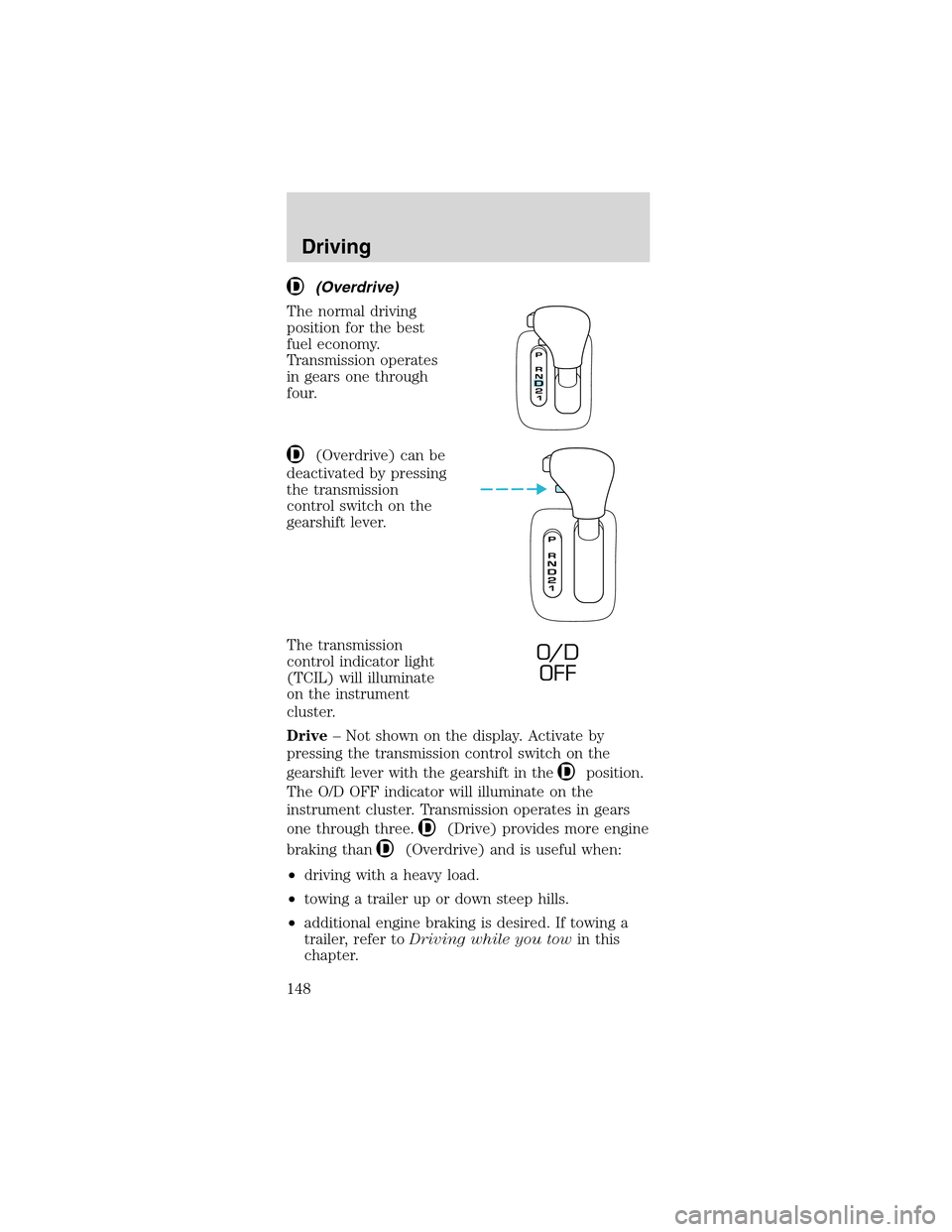
(Overdrive)
The normal driving
position for the best
fuel economy.
Transmission operates
in gears one through
four.
(Overdrive) can be
deactivated by pressing
the transmission
control switch on the
gearshift lever.
The transmission
control indicator light
(TCIL) will illuminate
on the instrument
cluster.
Drive–Not shown on the display. Activate by
pressing the transmission control switch on the
gearshift lever with the gearshift in the
position.
The O/D OFF indicator will illuminate on the
instrument cluster. Transmission operates in gears
one through three.
(Drive) provides more engine
braking than
(Overdrive) and is useful when:
•driving with a heavy load.
•towing a trailer up or down steep hills.
•additional engine braking is desired. If towing a
trailer, refer toDriving while you towin this
chapter.
O/ D
OFF
Driving
148
Page 153 of 256
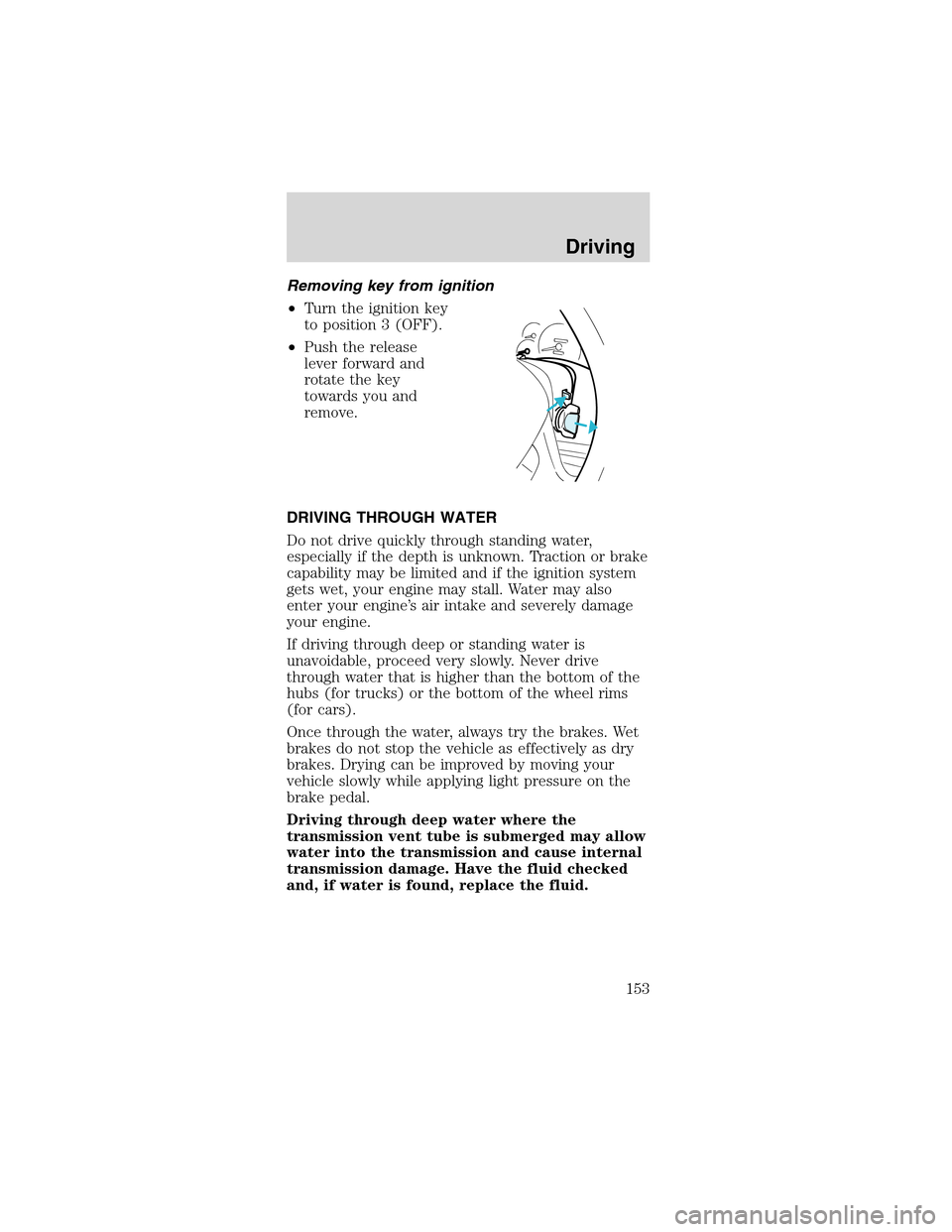
Removingkeyfrom ignition
•Turn the ignition key
to position 3 (OFF).
•Push the release
lever forward and
rotate the key
towards you and
remove.
DRIVING THROUGH WATER
Do not drive quickly through standing water,
especially if the depth is unknown. Traction or brake
capability may be limited and if the ignition system
gets wet, your engine may stall. Water may also
enter your engine’s air intake and severely damage
your engine.
If driving through deep or standing water is
unavoidable, proceed very slowly. Never drive
through water that is higher than the bottom of the
hubs (for trucks) or the bottom of the wheel rims
(for cars).
Once through the water, always try the brakes. Wet
brakes do not stop the vehicle as effectively as dry
brakes. Drying can be improved by moving your
vehicle slowly while applying light pressure on the
brake pedal.
Driving through deep water where the
transmission vent tube is submerged may allow
water into the transmission and cause internal
transmission damage. Have the fluid checked
and, if water is found, replace the fluid.
Driving
153