2003 DODGE RAM Drivers seat power
[x] Cancel search: Drivers seat powerPage 387 of 2895

DIAGNOSIS AND TESTING - FRONT CONTROL
MODULE
The front control module is a printed circuit board
based module with a on-board micro-processor. The
front control module interfaces with other electronic
modules in the vehicle via the Programmable Com-
munications Interface (PCI) data bus (J1850). In
order to obtain conclusive testing the Programmable
Communications Interface (PCI) data bus network
and all of the electronic modules that provide inputs
to, or receive outputs from the front control module
must be checked. All PCI (J1850) communication
faults must be resolved prior to further diagnosing
any front control module related issues.
The front control module was designed to be diag-
nosed with an appropriate diagnostic scan tool, such
as the DRB IIIt. The most reliable, efficient, and
accurate means to diagnose the front control module
requires the use of a DRB IIItscan tool and the
proper Body Diagnostic Procedures manual.
Before any testing of the front control module is
attempted, the battery should be fully charged and
all wire harness and ground connections inspected
around the affected areas on the vehicle.
REMOVAL
(1) Disconnect the positive and negative battery
cables from the battery.
(2) Partially remove the integrated power module
from the engine compartment (Refer to 8 - ELECTRI-
CAL/POWER DISTRIBUTION/INTEGRATED
POWER MODULE - REMOVAL).
(3) Remove the front control module retaining
screws.
(4) Using both hands, pull the front control module
straightfrom the integrated power module assembly
to disconnect the 49-way electrical connector and
remove the front control module from the vehicle.
INSTALLATION
(1) Install the front control module on the inte-
grated power module assembly by pushing the
49-way electrical connector straight in.
(2) Install the front control module retaining
screws. Torque the screws to 7 in. lbs.
(3) Install the integrated power module (Refer to 8
- ELECTRICAL/POWER DISTRIBUTION/INTE-
GRATED POWER MODULE - INSTALLATION).
(4) Connect the positive and negative battery
cables.
HEATED SEAT MODULE
DESCRIPTION
The heated seat module is also known as the Seat
Heat Interface Module. The heated seat module (Fig.
4) is located under the drivers front seat cushion,
where it is secured to a mounting bracket. The
heated seat module has a single connector receptacle
that allows the module to be connected to all of the
required inputs and outputs through the seat wire
harness.
The heated seat module is an electronic micropro-
cessor controlled device designed and programmed to
use inputs from the battery, the two heated seat
switches and the two heated seat sensors to operate
and control the heated seat elements in both front
seats and the two heated seat indicator lamp Light-
Emitting Diodes (LEDs) in each heated seat switch.
The heated seat module is also programmed to per-
form self-diagnosis of certain heated seat system
functions and provide feedback of that diagnosis
through the heated seat switch indicator lamps.
The heated seat module cannot be repaired. If the
heated seat module is damaged or faulty, the entire
module must be replaced.
OPERATION
The heated seat module operates on fused battery
current received from the integrated power module.
Inputs to the module include a resistor multiplexed
heated seat switch request circuit for each of the two
heated seat switches and the heated seat sensor
inputs from the seat cushions of each front seat. In
response to those inputs the heated seat module con-
trols battery current feeds to the heated seat ele-
Fig. 4 Heated Seat Module
1 - MOUNTING TABS (NOT USED ON DR)
2 - HEATED SEAT MODULE
3 - ELECTRICAL CONNECTOR RECEPTACLE
8E - 6 ELECTRONIC CONTROL MODULESDR
FRONT CONTROL MODULE (Continued)
Page 449 of 2895

OPERATION
The heated seat module receives fused battery cur-
rent through the Integrated Power Module only when
the engine is running. The heated seat switches
receive battery current through fuse #48 in the Inte-
grated Power Module only when the ignition switch
is in the On position. The heated seat module shares
a common ground circuit with each of the heated seat
elements. The heated seat system will only operate
when the surface temperature of the seat cushion is
below the designed temperature set points of the sys-
tem.
The heated seat system will also automatically
turn off whenever the ignition switch is turned to
any position except On, or if the engine quits run-
ning. If the ignition switch is turned to the Off posi-
tion or if the engine quits running while a heated
seat is ON, the heated seat will remain Off after the
engine is restarted until a heated seat switch is
depressed again. This helps prevent the vehicles bat-
tery from being drained by the heated seat system.The heated seat module monitors inputs from the
heated seat sensors and the heated seat switches. In
response to these inputs the heated seat module uses
its internal programming to control 12v to the heated
seat elements in both front seats and to control the
heated seat LED indicator lamps located in both of
the heated seat switches. The heated seat module is
also programmed to provide self-diagnostics, if a
problem with the heated seat system is detected. If
the module detects certain failures within the heated
seat system, it will provide a visual indication of the
failure by flashing the indicator lamps in the appro-
priate heated seat switch. The heated seat module
will automatically turn off the heated seat elements
if it detects a short or open in the heated seat ele-
ment circuit or a heated seat sensor value that is out
of range.
DIAGNOSIS AND TESTING - HEATED SEAT
SYSTEM
HEATED SEAT SYSTEM SELF-DIAGNOSIS
The heated seat system is capable of performing
some self-diagnostics. The following table depicts the
various monitored failures which will be reported to
the vehicle operator or technician by flashing the
individual heated seat switch Light Emitting Diode
(LED) indicator lamps. Refer to the HEATED SEAT
SYSTEM SELF-DIAGNOSIS table for failure identi-
fication. The drivers heated seat switch indicator
lamps will flash if a failure occurs in the driver
heated seat, and the passengers heated seat switch
indicator lamps will flash for a passenger heated seat
failure. If a monitored heated seat system failure
occurs, the switch indicator lamps will flash at a
pulse rate of about one-half second on, followed by
about one-half second off for a duration of about one
minute after the switch for the faulty heated seat is
depressed in either the Low or High direction. This
process will repeat every time the faulty heated seat
switch is actuated until the problem has been cor-
rected.
HEATED SEAT SYSTEM SELF-DIAGNOSIS
Monitored FailureSwitch High
Indicator LampSwitch Low
Indicator Lamp
Heated Seat
Element ShortedFlashing Flashing
Heated Seat
Element OpenFlashing Off
Heated Seat
Sensor Value Out
of RangeOff Flashing
Fig. 1 DR Heated Seat System Diagram
1 - WIRE HARNESS
2 - DRIVER HEATED SEAT SWITCH
3 - PASSENGER HEATED SEAT SWITCH
4 - PASSENGER HEATED SEAT CUSHION ELEMENT
5 - SEAT CUSHION/BACK ELEMENT ELECTRICAL CONNECTOR
LOCATION
6 - DRIVER HEATED SEAT BACK ELEMENT
7 - DRIVER HEATED SEAT CUSHION ELEMENT
8 - HEATED SEAT MODULE
8G - 4 HEATED SEAT SYSTEMDR
HEATED SEAT SYSTEM (Continued)
Page 2651 of 2895

SEATS
TABLE OF CONTENTS
page page
CENTER SEAT
REMOVAL.............................76
INSTALLATION.........................77
CENTER ARMREST / SEAT BACK
REMOVAL.............................77
INSTALLATION.........................78
CENTER SEAT BACK INERTIA HINGE COVER
REMOVAL.............................78
INSTALLATION.........................78
CENTER SEAT BACK HINGE
REMOVAL.............................79
INSTALLATION.........................80
CENTER SEAT BACK LID
REMOVAL.............................80
INSTALLATION.........................80
CENTER SEAT CUSHION
REMOVAL.............................80
INSTALLATION.........................80
CENTER SEAT CUSHION COVER
REMOVAL.............................81
INSTALLATION.........................81
UNDER SEAT STORAGE BIN
REMOVAL.............................81
INSTALLATION.........................81
UNDER SEAT STORAGE BIN COVERING
REMOVAL.............................81
INSTALLATION.........................81
UNDER SEAT STORAGE BIN LATCH
REMOVAL.............................81
INSTALLATION.........................81
HEADREST
REMOVAL.............................82
INSTALLATION.........................82
HEADREST SLEEVE
REMOVAL.............................82INSTALLATION.........................82
SEAT - FRONT
REMOVAL.............................82
INSTALLATION.........................82
SEAT BACK CUSHION / COVER - FRONT
REMOVAL.............................83
INSTALLATION.........................83
SEAT CUSHION / COVER - FRONT
REMOVAL.............................83
INSTALLATION.........................83
SEAT TRACK
REMOVAL.............................83
INSTALLATION.........................83
SEAT - REAR
REMOVAL.............................84
INSTALLATION.........................84
SEAT BACK - REAR
REMOVAL.............................84
INSTALLATION.........................84
SEAT BACK CUSHION / COVER - REAR
REMOVAL.............................85
INSTALLATION.........................85
SEAT CUSHION / COVER - REAR
REMOVAL.............................85
INSTALLATION.........................85
SEAT CUSHION FRAME - REAR
REMOVAL.............................85
INSTALLATION.........................85
SEAT BACK REAR - FOOTMANS LOOP
BRACKETS
REMOVAL.............................85
INSTALLATION.........................85
CENTER SEAT
REMOVAL
NOTE: Do not reuse the seat fasteners, always
replace with new ones.
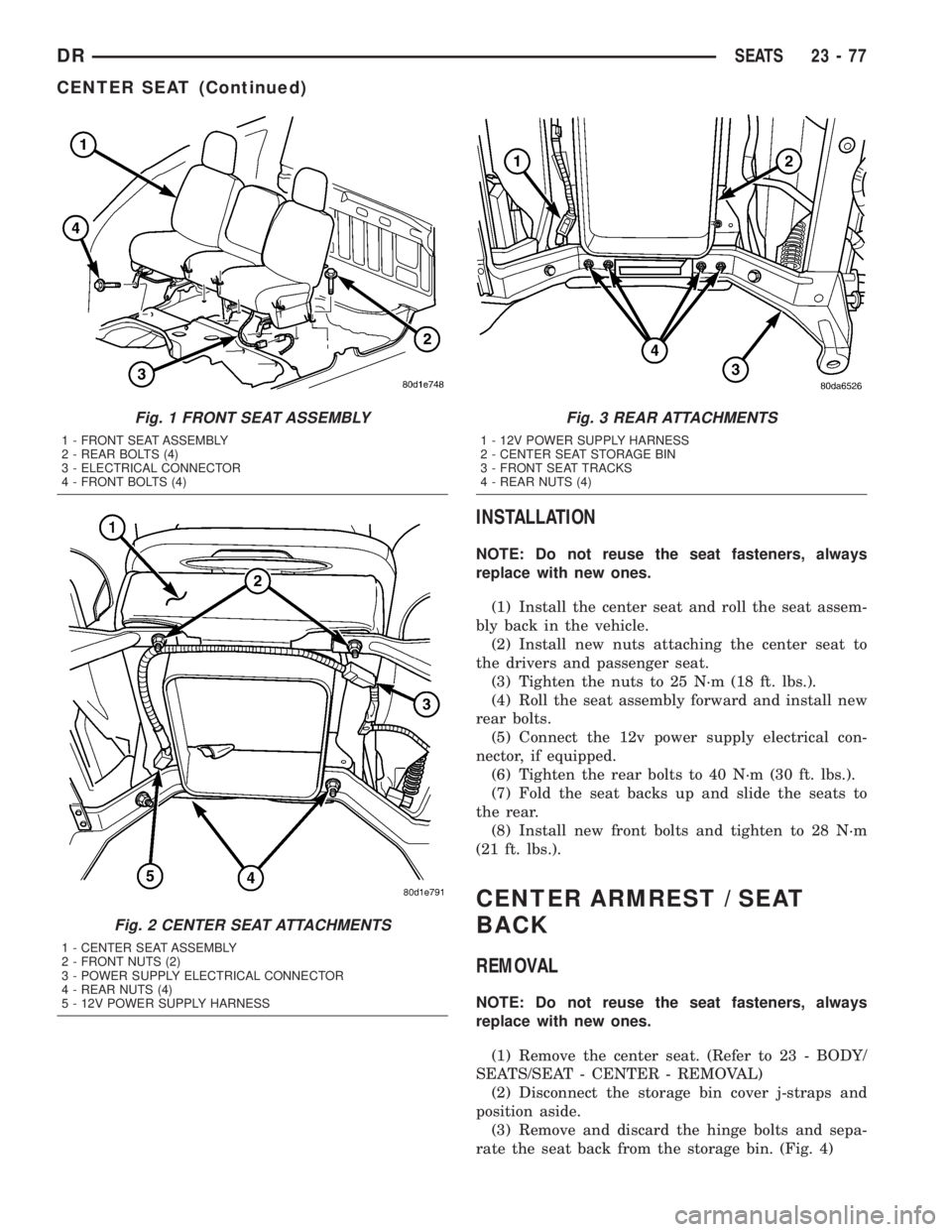
(1) Remove and discard the front bolts. (Fig. 1)
(2) Position the seats forward, remove the rear
bolts and discard.
(3) Disconnect the 12v power supply electrical con-
nector, if equipped. (Fig. 2)(4) Fold the seat backs forward and roll the seat
assembly back in the vehicle.
(5) Remove the nuts attaching the center seat to
the drivers seat and the passenger seat and discard.
(Fig. 3)
(6) Roll the seat assembly forward and remove the
center seat portion.
23 - 76 SEATSDR
Page 2652 of 2895
INSTALLATION
NOTE: Do not reuse the seat fasteners, always
replace with new ones.
(1) Install the center seat and roll the seat assem-
bly back in the vehicle.
(2) Install new nuts attaching the center seat to
the drivers and passenger seat.
(3) Tighten the nuts to 25 N´m (18 ft. lbs.).
(4) Roll the seat assembly forward and install new
rear bolts.
(5) Connect the 12v power supply electrical con-
nector, if equipped.
(6) Tighten the rear bolts to 40 N´m (30 ft. lbs.).
(7) Fold the seat backs up and slide the seats to
the rear.
(8) Install new front bolts and tighten to 28 N´m
(21 ft. lbs.).
CENTER ARMREST / SEAT
BACK
REMOVAL
NOTE: Do not reuse the seat fasteners, always
replace with new ones.
(1) Remove the center seat. (Refer to 23 - BODY/
SEATS/SEAT - CENTER - REMOVAL)
(2) Disconnect the storage bin cover j-straps and
position aside.
(3) Remove and discard the hinge bolts and sepa-
rate the seat back from the storage bin. (Fig. 4)
Fig. 1 FRONT SEAT ASSEMBLY
1 - FRONT SEAT ASSEMBLY
2 - REAR BOLTS (4)
3 - ELECTRICAL CONNECTOR
4 - FRONT BOLTS (4)
Fig. 2 CENTER SEAT ATTACHMENTS
1 - CENTER SEAT ASSEMBLY
2 - FRONT NUTS (2)
3 - POWER SUPPLY ELECTRICAL CONNECTOR
4 - REAR NUTS (4)
5 - 12V POWER SUPPLY HARNESS
Fig. 3 REAR ATTACHMENTS
1 - 12V POWER SUPPLY HARNESS
2 - CENTER SEAT STORAGE BIN
3 - FRONT SEAT TRACKS
4 - REAR NUTS (4)
DRSEATS 23 - 77
CENTER SEAT (Continued)
Page 2657 of 2895
HEADREST
REMOVAL
(1) Raise the headrest.
(2) Press the headrest release button and remove
the headrest.
INSTALLATION
(1) Position the headrest.
(2) Press the release button and install the head-
rest.
HEADREST SLEEVE
REMOVAL
(1) Remove the headrest. (Refer to 23 - BODY/
SEATS/HEADREST - REMOVAL)
(2) Grasp the sleeves and pull up and out of the
seat back to remove.
INSTALLATION
(1) Position each headrest sleeve into correct seat
back hole and press into place fully.
(2) Install the headrest. (Refer to 23 - BODY/
SEATS/HEADREST - INSTALLATION)
SEAT - FRONT
REMOVAL
NOTE: Do not reuse the seat fasteners, always
replace with new ones.
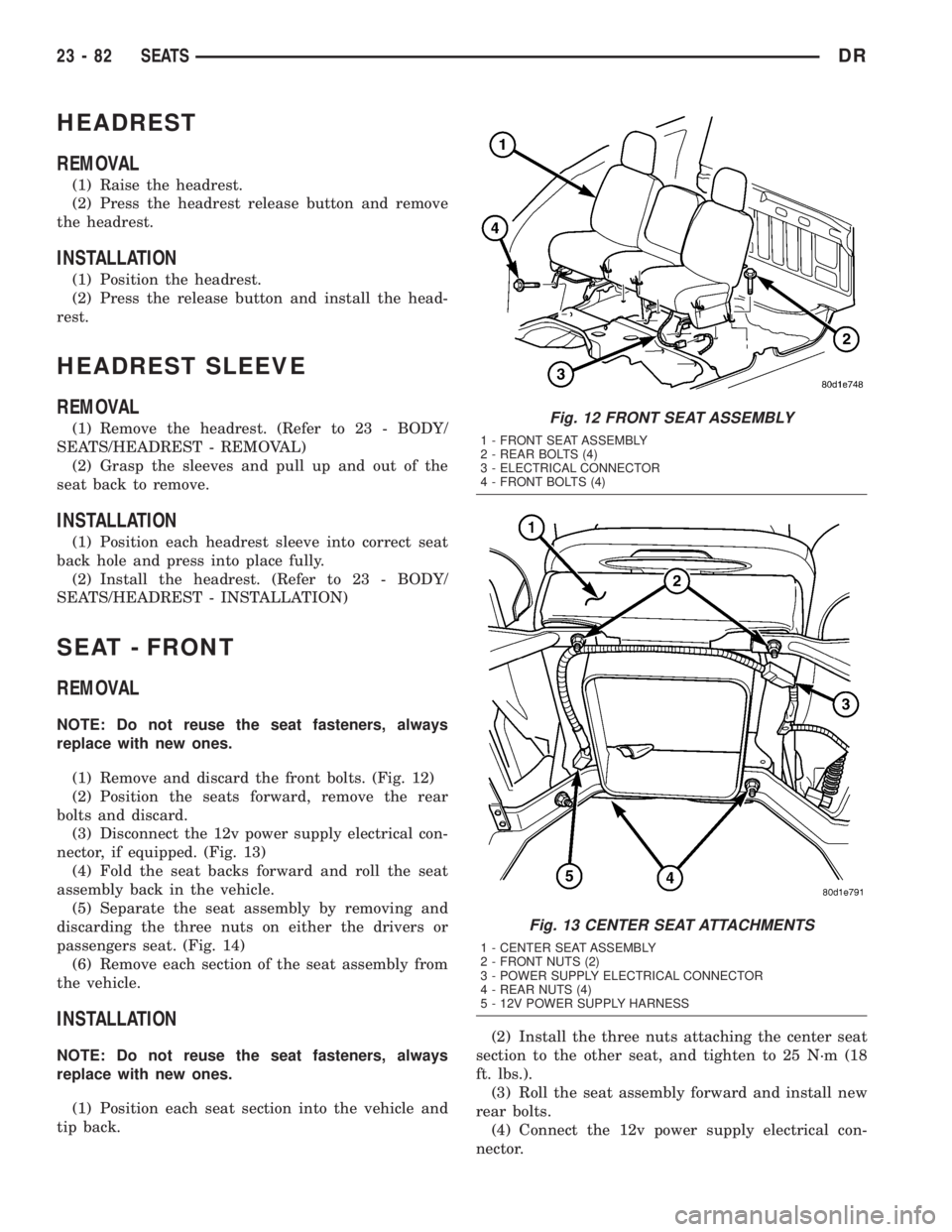
(1) Remove and discard the front bolts. (Fig. 12)
(2) Position the seats forward, remove the rear
bolts and discard.
(3) Disconnect the 12v power supply electrical con-
nector, if equipped. (Fig. 13)
(4) Fold the seat backs forward and roll the seat
assembly back in the vehicle.
(5) Separate the seat assembly by removing and
discarding the three nuts on either the drivers or
passengers seat. (Fig. 14)
(6) Remove each section of the seat assembly from
the vehicle.
INSTALLATION
NOTE: Do not reuse the seat fasteners, always
replace with new ones.
(1) Position each seat section into the vehicle and
tip back.(2) Install the three nuts attaching the center seat
section to the other seat, and tighten to 25 N´m (18
ft. lbs.).
(3) Roll the seat assembly forward and install new
rear bolts.
(4) Connect the 12v power supply electrical con-
nector.
Fig. 12 FRONT SEAT ASSEMBLY
1 - FRONT SEAT ASSEMBLY
2 - REAR BOLTS (4)
3 - ELECTRICAL CONNECTOR
4 - FRONT BOLTS (4)
Fig. 13 CENTER SEAT ATTACHMENTS
1 - CENTER SEAT ASSEMBLY
2 - FRONT NUTS (2)
3 - POWER SUPPLY ELECTRICAL CONNECTOR
4 - REAR NUTS (4)
5 - 12V POWER SUPPLY HARNESS
23 - 82 SEATSDR