2003 DODGE RAM seat controls
[x] Cancel search: seat controlsPage 655 of 2895

(SIACM) and its mounting bracket are secured with
four screws to the inside of each B-pillar behind
(standard cab) or above (quad cab) the front outboard
seat belt retractor, and concealed behind the B-pillar
trim (Fig. 50). Concealed within a hollow in the cen-
ter of the die cast aluminum SIACM housing is the
electronic circuitry of the SIACM which includes a
microprocessor and an electronic impact sensor.
The SIACM housing is secured to a die cast (stan-
dard cab) or stamped steel (quad cab) mounting
bracket, which is unique for the right or left side
application of this component. The SIACM should
never be removed from its mounting bracket. The
housing also receives a case ground through this
mounting bracket when it is secured to the vehicle. A
molded plastic electrical connector receptacle that
exits the top of the SIACM housing connects the unit
to the vehicle electrical system through a dedicated
take out and connector of the body wire harness.
Both the SIACM housing and its electrical connection
are sealed to protect the internal electronic circuitry
and components against moisture intrusion.
The impact sensor internal to the SIACM is cali-
brated for the specific vehicle, and is only serviced as
a unit with the SIACM. The SIACM cannot be
repaired or adjusted and, if damaged or faulty, it
must be replaced.
OPERATION
The microprocessor in the Side Impact Airbag Con-
trol Module (SIACM) contains the side curtain airbag
system logic circuits and controls all of the features
of only the side curtain airbag mounted on the same
side of the vehicle as the SIACM. The SIACM uses
On-Board Diagnostics (OBD) and can communicate
with other electronic modules in the vehicle as well
as with the DRBIIItscan tool using the Programma-
ble Communications Interface (PCI) data bus net-
work. This method of communication is used by the
SIACM to communicate with the Airbag Control
Module (ACM) and for supplemental restraint system
diagnosis and testing through the 16-way data link
connector located on the driver side lower edge of the
instrument panel. The ACM communicates with both
the left and right SIACM over the PCI data bus.
The SIACM microprocessor continuously monitors
all of the side curtain airbag electrical circuits to
determine the system readiness. If the SIACM
detects a monitored system fault, it sets an activeand stored Diagnostic Trouble Code (DTC) and sends
electronic messages to the ACM over the PCI data
bus. The ACM will respond by sending an electronic
message to the EMIC to turn on the airbag indicator,
and by storing a DTC that will indicate whether the
left or the right SIACM has stored the DTC that ini-
tiated the airbag indicator illumination. An active
fault only remains for the current ignition switch
cycle, while a stored fault causes a DTC to be stored
in memory by the SIACM. For some DTCs, if a fault
does not recur for a number of ignition cycles, the
SIACM will automatically erase the stored DTC. For
other internal faults, the stored DTC is latched for-
ever.
The SIACM receives battery current on a fused
ignition switch output (run-start) circuit through a
fuse in the Integrated Power Module (IPM). The
SIACM has a case ground through its mounting
bracket and also receives a power ground through a
ground circuit and take out of the body wire harness.
This take out has a single eyelet terminal connector
that is secured by a ground screw to the body sheet
metal. These connections allow the SIACM to be
operational whenever the ignition switch is in the
Start or On positions. An electronic impact sensor is
contained within the SIACM. The electronic impact
sensor is an accelerometer that senses the rate of
vehicle deceleration, which provides verification of
the direction and severity of an impact. A pre-pro-
grammed decision algorithm in the SIACM micropro-
cessor determines when the deceleration rate as
signaled by the impact sensor indicates a side impact
that is severe enough to require side curtain airbag
protection. When the programmed conditions are
met, the SIACM sends the proper electrical signals to
deploy the side curtain airbag.
The hard wired inputs and outputs for the SIACM
may be diagnosed and tested using conventional
diagnostic tools and procedures. However, conven-
tional diagnostic methods will not prove conclusive in
the diagnosis of the SIACM, the PCI data bus net-
work, or the electronic message inputs to and outputs
from the SIACM. The most reliable, efficient, and
accurate means to diagnose the SIACM, the PCI data
bus network, and the electronic message inputs to
and outputs from the SIACM requires the use of a
DRBIIItscan tool. Refer to the appropriate diagnos-
tic information.
8O - 54 RESTRAINTSDR
SIDE IMPACT AIRBAG CONTROL MODULE (Continued)
Page 696 of 2895
The wiper high/low relay terminals are connected
to the vehicle electrical system through a connector
receptacle in the Integrated Power Module (IPM).
The inputs and outputs of the wiper high/low relay
include:
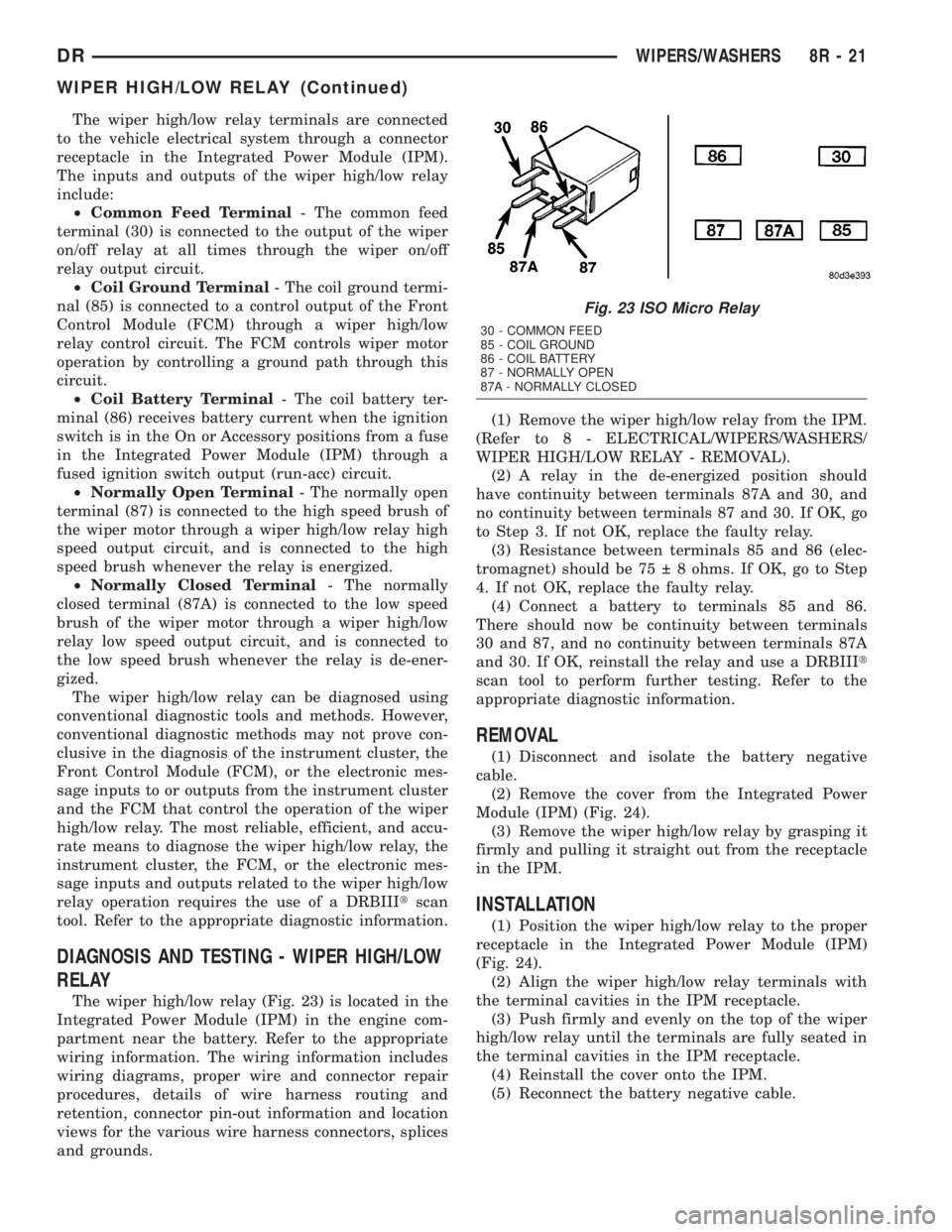
²Common Feed Terminal- The common feed
terminal (30) is connected to the output of the wiper
on/off relay at all times through the wiper on/off
relay output circuit.
²Coil Ground Terminal- The coil ground termi-
nal (85) is connected to a control output of the Front
Control Module (FCM) through a wiper high/low
relay control circuit. The FCM controls wiper motor
operation by controlling a ground path through this
circuit.
²Coil Battery Terminal- The coil battery ter-
minal (86) receives battery current when the ignition
switch is in the On or Accessory positions from a fuse
in the Integrated Power Module (IPM) through a
fused ignition switch output (run-acc) circuit.
²Normally Open Terminal- The normally open
terminal (87) is connected to the high speed brush of
the wiper motor through a wiper high/low relay high
speed output circuit, and is connected to the high
speed brush whenever the relay is energized.
²Normally Closed Terminal- The normally
closed terminal (87A) is connected to the low speed
brush of the wiper motor through a wiper high/low
relay low speed output circuit, and is connected to
the low speed brush whenever the relay is de-ener-
gized.
The wiper high/low relay can be diagnosed using
conventional diagnostic tools and methods. However,
conventional diagnostic methods may not prove con-
clusive in the diagnosis of the instrument cluster, the
Front Control Module (FCM), or the electronic mes-
sage inputs to or outputs from the instrument cluster
and the FCM that control the operation of the wiper
high/low relay. The most reliable, efficient, and accu-
rate means to diagnose the wiper high/low relay, the
instrument cluster, the FCM, or the electronic mes-
sage inputs and outputs related to the wiper high/low
relay operation requires the use of a DRBIIItscan
tool. Refer to the appropriate diagnostic information.
DIAGNOSIS AND TESTING - WIPER HIGH/LOW
RELAY
The wiper high/low relay (Fig. 23) is located in the
Integrated Power Module (IPM) in the engine com-
partment near the battery. Refer to the appropriate
wiring information. The wiring information includes
wiring diagrams, proper wire and connector repair
procedures, details of wire harness routing and
retention, connector pin-out information and location
views for the various wire harness connectors, splices
and grounds.(1) Remove the wiper high/low relay from the IPM.
(Refer to 8 - ELECTRICAL/WIPERS/WASHERS/
WIPER HIGH/LOW RELAY - REMOVAL).
(2) A relay in the de-energized position should
have continuity between terminals 87A and 30, and
no continuity between terminals 87 and 30. If OK, go
to Step 3. If not OK, replace the faulty relay.
(3) Resistance between terminals 85 and 86 (elec-
tromagnet) should be 75 8 ohms. If OK, go to Step
4. If not OK, replace the faulty relay.
(4) Connect a battery to terminals 85 and 86.
There should now be continuity between terminals
30 and 87, and no continuity between terminals 87A
and 30. If OK, reinstall the relay and use a DRBIIIt
scan tool to perform further testing. Refer to the
appropriate diagnostic information.
REMOVAL
(1) Disconnect and isolate the battery negative
cable.
(2) Remove the cover from the Integrated Power
Module (IPM) (Fig. 24).
(3) Remove the wiper high/low relay by grasping it
firmly and pulling it straight out from the receptacle
in the IPM.
INSTALLATION
(1) Position the wiper high/low relay to the proper
receptacle in the Integrated Power Module (IPM)
(Fig. 24).
(2) Align the wiper high/low relay terminals with
the terminal cavities in the IPM receptacle.
(3) Push firmly and evenly on the top of the wiper
high/low relay until the terminals are fully seated in
the terminal cavities in the IPM receptacle.
(4) Reinstall the cover onto the IPM.
(5) Reconnect the battery negative cable.
Fig. 23 ISO Micro Relay
30 - COMMON FEED
85 - COIL GROUND
86 - COIL BATTERY
87 - NORMALLY OPEN
87A - NORMALLY CLOSED
DRWIPERS/WASHERS 8R - 21
WIPER HIGH/LOW RELAY (Continued)
Page 2419 of 2895
control switch is in the OFF position, the clutch will
engage after the shift to third gear.
The TCM controls the torque converter by way of
internal logic software. The programming of the soft-
ware provides the TCM with control over the L/R-CC
Solenoid. There are four output logic states that can
be applied as follows:
²No EMCC
²Partial EMCC
²Full EMCC
²Gradual-to-no EMCC
NO EMCC
Under No EMCC conditions, the L/R Solenoid is
OFF. There are several conditions that can result in
NO EMCC operations. No EMCC can be initiated
due to a fault in the transmission or because the
TCM does not see the need for EMCC under current
driving conditions.
PARTIAL EMCC
Partial EMCC operation modulates the L/R Sole-
noid (duty cycle) to obtain partial torque converter
clutch application. Partial EMCC operation is main-
tained until Full EMCC is called for and actuated.
During Partial EMCC some slip does occur. Partial
EMCC will usually occur at low speeds, low load and
light throttle situations.
FULL EMCC
During Full EMCC operation, the TCM increases
the L/R Solenoid duty cycle to full ON after Partial
EMCC control brings the engine speed within thedesired slip range of transmission input speed rela-
tive to engine rpm.
GRADUAL-TO-NO EMCC
This operation is to soften the change from Full or
Partial EMCC to No EMCC. This is done at mid-
throttle by decreasing the L/R Solenoid duty cycle.
REMOVAL
(1) Remove transmission and torque converter
from vehicle.
(2) Place a suitable drain pan under the converter
housing end of the transmission.
CAUTION: Verify that transmission is secure on the
lifting device or work surface, the center of gravity
of the transmission will shift when the torque con-
verter is removed creating an unstable condition.
The torque converter is a heavy unit. Use caution
when separating the torque converter from the
transmission.
(3) Pull the torque converter forward until the cen-
ter hub clears the oil pump seal.
(4) Separate the torque converter from the trans-
mission.
INSTALLATION
Check converter hub and drive flats for sharp
edges, burrs, scratches, or nicks. Polish the hub and
flats with 320/400 grit paper or crocus cloth if neces-
sary. Verify that the converter hub o-ring is properly
installed and is free from debris. The hub must be
smooth to avoid damaging the pump seal at installa-
tion.
(1) Lubricate oil pump seal lip with transmission
fluid.
(2) Place torque converter in position on transmis-
sion.
CAUTION: Do not damage oil pump seal or con-
verter hub o-ring while inserting torque converter
into the front of the transmission.
(3) Align torque converter to oil pump seal open-
ing.
(4) Insert torque converter hub into oil pump.
(5) While pushing torque converter inward, rotate
converter until converter is fully seated in the oil
pump gears.
(6) Check converter seating with a scale and
straightedge (Fig. 125). Surface of converter lugs
should be at least 13 mm (1/2 in.) to rear of straight-
edge when converter is fully seated.
(7) If necessary, temporarily secure converter with
C-clamp attached to the converter housing.
(8) Install the transmission in the vehicle.
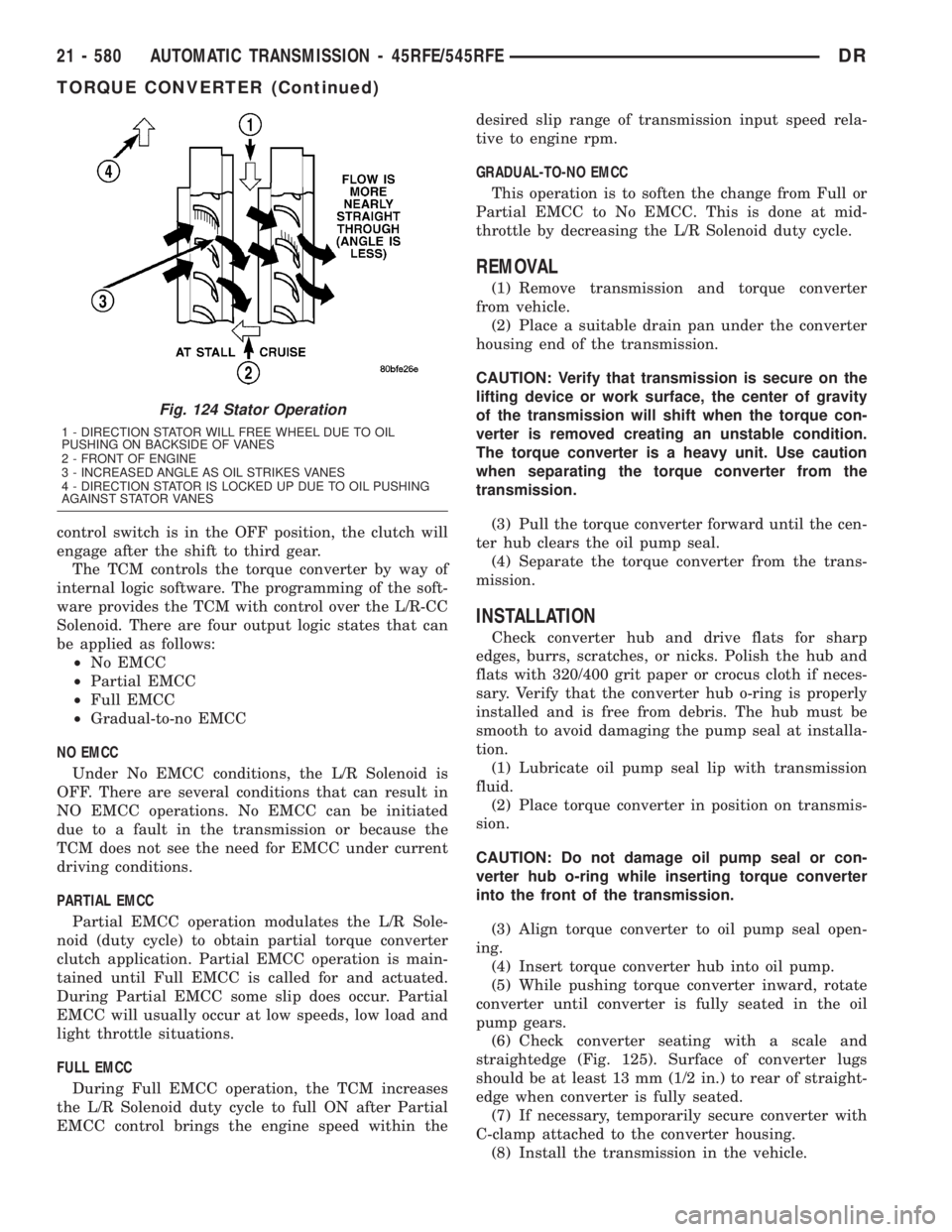
Fig. 124 Stator Operation
1 - DIRECTION STATOR WILL FREE WHEEL DUE TO OIL
PUSHING ON BACKSIDE OF VANES
2 - FRONT OF ENGINE
3 - INCREASED ANGLE AS OIL STRIKES VANES
4 - DIRECTION STATOR IS LOCKED UP DUE TO OIL PUSHING
AGAINST STATOR VANES
21 - 580 AUTOMATIC TRANSMISSION - 45RFE/545RFEDR
TORQUE CONVERTER (Continued)
Page 2658 of 2895
(5) Tighten the rear bolts to 40 N´m (30 ft. lbs.).
(6) Fold the seat backs up and slide the seats to
the rear.
(7) Install new front bolts and tighten to 28 N´m
(21 ft. lbs.).
SEAT BACK CUSHION / COVER
- FRONT
REMOVAL
(1) Remove the front seat. (Refer to 23 - BODY/
SEATS/SEAT - FRONT - REMOVAL)
(2) Remove the headrest sleeves. (Refer to 23 -
BODY/SEATS/HEADREST SLEEVE - REMOVAL)
(3) Unzip the zip strip at the lower end of the seat
back and remove the seat back cover and cushion.
INSTALLATION
(1) Install the seat back cushion and cover onto
the seat frame assembly.
(2) Connect the zip strip at the bottom of the seat
back.
(3) Install the headrest sleeves. (Refer to 23 -
BODY/SEATS/HEADREST SLEEVE - INSTALLA-
TION)
(4) Install the seat. (Refer to 23 - BODY/SEATS/
SEAT - FRONT - INSTALLATION)
SEAT CUSHION / COVER -
FRONT
REMOVAL
(1) Remove the front seat. (Refer to 23 - BODY/
SEATS/SEAT - FRONT - REMOVAL)
(2) Remove the screw and remove the recliner han-
dle.
(3) Remove the two screws and remove the power
seat controls, if equipped, and disconnect the electri-
cal connector.
(4) Remove the seat track. (Refer to 23 - BODY/
SEATS/SEAT TRACK - REMOVAL)
(5) Disconnect the j-straps and remove the seat
cushion and cover.
INSTALLATION
(1) Position the seat cushion and cover onto the
frame assembly and connect the j-straps.
(2) Install the seat track. (Refer to 23 - BODY/
SEATS/SEAT TRACK - INSTALLATION)
(3) Connect the power seat control switch electrical
connector, if equipped.
(4) Install the power seat control switch and
install the two screws, if equipped.
(5) Install the recliner handle and install the
screw.
(6) Install the front seat. (Refer to 23 - BODY/
SEATS/SEAT - FRONT - INSTALLATION)
SEAT TRACK
REMOVAL
(1) Remove the front seat. (Refer to 23 - BODY/
SEATS/SEAT - FRONT - REMOVAL)
(2) Disconnect the power lumbar and/or the heated
seat electrical connectors, if equipped.
(3) Remove the four nuts attaching the seat track
to the seat and remove the track.
INSTALLATION
(1) Position the seat track onto the seat and install
the four nuts.
(2) Tighten the four nuts to 25 N´m (18 ft. lbs.).
(3) Connect the power lumbar and/or heated seat
electrical connectors, if equipped.
(4) Install the seat. (Refer to 23 - BODY/SEATS/
SEAT - FRONT - INSTALLATION)
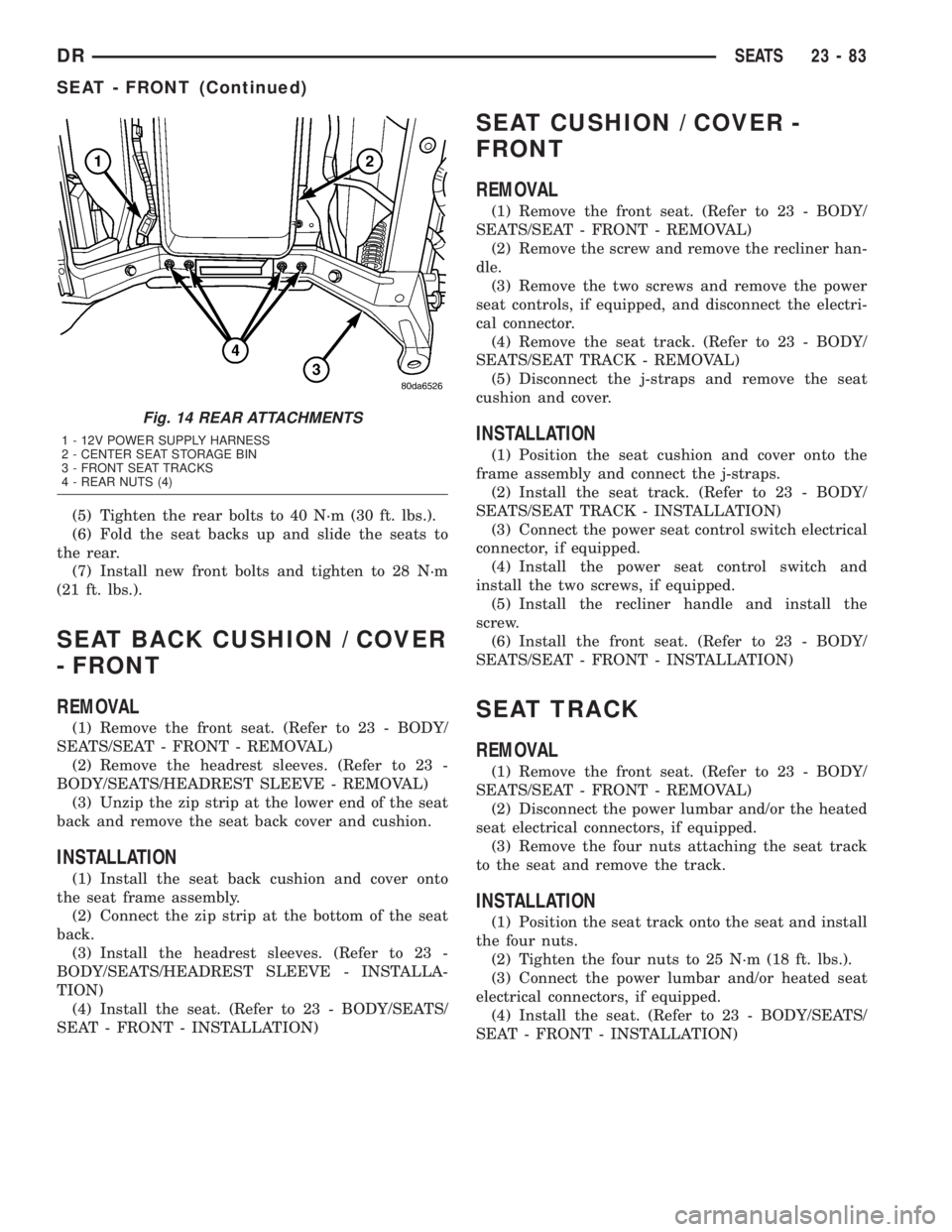
Fig. 14 REAR ATTACHMENTS
1 - 12V POWER SUPPLY HARNESS
2 - CENTER SEAT STORAGE BIN
3 - FRONT SEAT TRACKS
4 - REAR NUTS (4)
DRSEATS 23 - 83
SEAT - FRONT (Continued)
Page 2785 of 2895
seconds. Refer to Electronic Control Modules for
more information on the JTEC controls.
DIAGNOSIS AND TESTING - A/C COMPRESSOR
CLUTCH COIL
For circuit descriptions and diagrams, (Refer to
Appropriate Wiring Information). The battery must
be fully-charged before performing the following
tests. Refer to Battery for more information.
(1) Connect an ammeter (0 to 10 ampere scale) in
series with the clutch coil terminal. Use a voltmeter
(0 to 20 volt scale) with clip-type leads for measuring
the voltage across the battery and the compressor
clutch coil.
(2) With the A/C Heater mode control switch in
any A/C mode, and the blower motor switch in the
lowest speed position, start the engine and run it at
normal idle.
(3) The compressor clutch coil voltage should read
within 0.2 volts of the battery voltage. If there is
voltage at the clutch coil, but the reading is not
within 0.2 volts of the battery voltage, test the clutch
coil feed circuit for excessive voltage drop and repair
as required. If there is no voltage reading at the
clutch coil, use a DRB IIItscan tool and (Refer to
Appropriate Diagnostic Information) for testing of the
compressor clutch circuit and PCM control. The fol-
lowing components must be checked and repaired as
required before you can complete testing of the clutch
coil:
²Fuses in the junction block and the Power Dis-
tribution Center (PDC)
²A/C heater mode control switch
²Compressor clutch relay
²A/C high pressure transducer switch²JTEC
(4) The compressor clutch coil is acceptable if the
current draw measured at the clutch coil is 2.0 to 3.9
amperes with the electrical system voltage at 11.5 to
12.5 volts. This should only be checked with the work
area temperature at 21É C (70É F). If system voltage
is more than 12.5 volts, add electrical loads by turn-
ing on electrical accessories until the system voltage
drops below 12.5 volts.
(a) If the clutch coil current reading is four
amperes or more, the coil is shorted and should be
replaced.
(b) If the clutch coil current reading is zero, the
coil is open and should be replaced.
STANDARD PROCEDURE - A/C COMPRESSOR
CLUTCH BREAK-IN
After a new compressor clutch has been installed,
cycle the compressor clutch approximately twenty
times (five seconds on, then five seconds off). During
this procedure, set the A/C Heater control to the
Recirculation Mode, the blower motor switch in the
highest speed position, and the engine speed at 1500
to 2000 rpm. This procedure (burnishing) will seat
the opposing friction surfaces and provide a higher
compressor clutch torque capability.
REMOVAL
The refrigerant system can remain fully-charged
during compressor clutch, rotor, or coil replacement.
The compressor clutch can be serviced in the vehicle.
(1) Disconnect and isolate the battery negative
cable.
(2) Remove the serpentine drive belt(Refer to 7 -
COOLING/ACCESSORY DRIVE/DRIVE BELTS -
REMOVAL).
(3) Unplug the compressor clutch coil wire harness
connector.
(4) Remove the bolts that secure the compressor to
the mounting bracket.
(5) Remove the compressor from the mounting
bracket. Support the compressor in the engine com-
partment while servicing the clutch.
(6) Insert the two pins of the spanner wrench
(Special Tool C-4489 or equivalent) into the holes of
the clutch plate. Hold the clutch plate stationary and
remove the hex nut (Fig. 2).
(7) Remove the clutch plate.
(8) Remove the compressor clutch shims.
(9) Remove the external front housing snap ring
with snap ring pliers (Fig. 3).
(10)
Install the lip of the rotor puller (Special Tool
C-6141-1 or equivalent) into the snap ring groove
exposed in the previous step, and install the shaft pro-
tector (Special Tool C-6141-2 or equivalent) (Fig. 4).
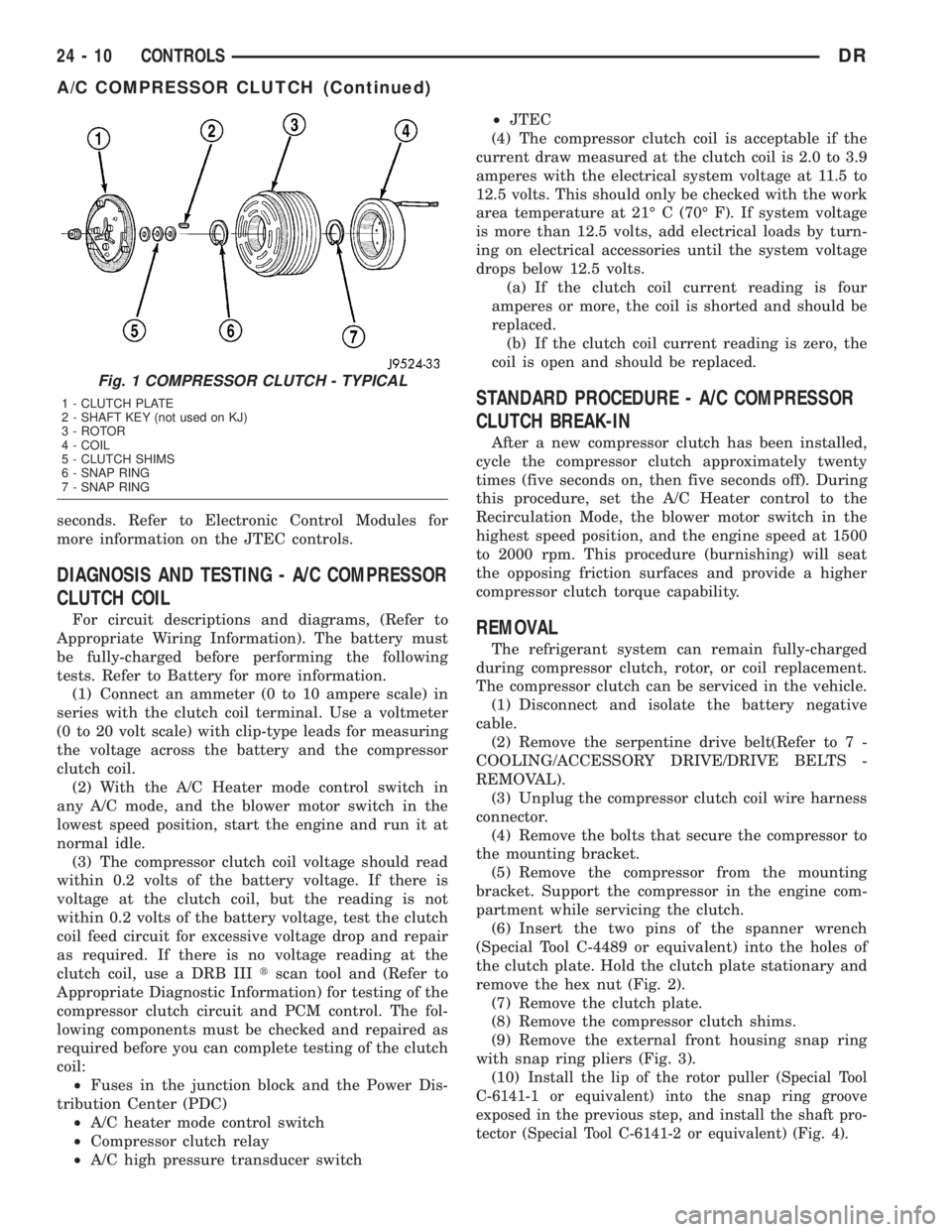
Fig. 1 COMPRESSOR CLUTCH - TYPICAL
1 - CLUTCH PLATE
2 - SHAFT KEY (not used on KJ)
3 - ROTOR
4 - COIL
5 - CLUTCH SHIMS
6 - SNAP RING
7 - SNAP RING
24 - 10 CONTROLSDR
A/C COMPRESSOR CLUTCH (Continued)
Page 2787 of 2895
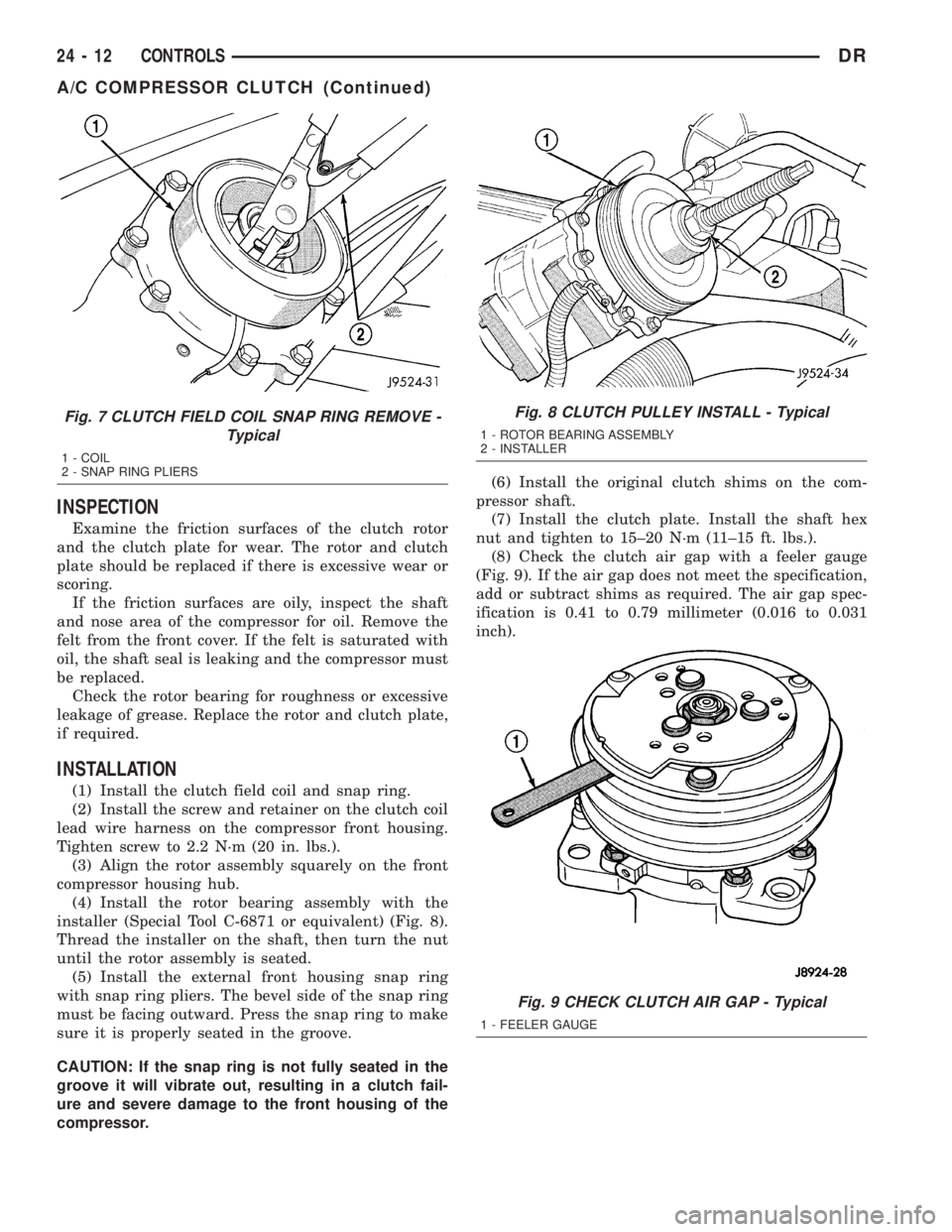
INSPECTION
Examine the friction surfaces of the clutch rotor
and the clutch plate for wear. The rotor and clutch
plate should be replaced if there is excessive wear or
scoring.
If the friction surfaces are oily, inspect the shaft
and nose area of the compressor for oil. Remove the
felt from the front cover. If the felt is saturated with
oil, the shaft seal is leaking and the compressor must
be replaced.
Check the rotor bearing for roughness or excessive
leakage of grease. Replace the rotor and clutch plate,
if required.
INSTALLATION
(1) Install the clutch field coil and snap ring.
(2) Install the screw and retainer on the clutch coil
lead wire harness on the compressor front housing.
Tighten screw to 2.2 N´m (20 in. lbs.).
(3) Align the rotor assembly squarely on the front
compressor housing hub.
(4) Install the rotor bearing assembly with the
installer (Special Tool C-6871 or equivalent) (Fig. 8).
Thread the installer on the shaft, then turn the nut
until the rotor assembly is seated.
(5) Install the external front housing snap ring
with snap ring pliers. The bevel side of the snap ring
must be facing outward. Press the snap ring to make
sure it is properly seated in the groove.
CAUTION: If the snap ring is not fully seated in the
groove it will vibrate out, resulting in a clutch fail-
ure and severe damage to the front housing of the
compressor.(6) Install the original clutch shims on the com-
pressor shaft.
(7) Install the clutch plate. Install the shaft hex
nut and tighten to 15±20 N´m (11±15 ft. lbs.).
(8) Check the clutch air gap with a feeler gauge
(Fig. 9). If the air gap does not meet the specification,
add or subtract shims as required. The air gap spec-
ification is 0.41 to 0.79 millimeter (0.016 to 0.031
inch).
Fig. 7 CLUTCH FIELD COIL SNAP RING REMOVE -
Typical
1 - COIL
2 - SNAP RING PLIERS
Fig. 8 CLUTCH PULLEY INSTALL - Typical
1 - ROTOR BEARING ASSEMBLY
2 - INSTALLER
Fig. 9 CHECK CLUTCH AIR GAP - Typical
1 - FEELER GAUGE
24 - 12 CONTROLSDR
A/C COMPRESSOR CLUTCH (Continued)
Page 2811 of 2895
nents, caused by condenser air flow restriction or an
overcharge of refrigerant.
OPERATION
OPERATION
The compressor is driven by the engine through an
electric clutch, drive rotor and belt arrangement. The
compressor is lubricated by refrigerant oil that is cir-
culated throughout the refrigerant system with the
refrigerant.
The compressor draws in low-pressure refrigerant
vapor from the evaporator through its suction port. It
then compresses the refrigerant into a high-pressure,
high-temperature refrigerant vapor, which is then
pumped to the condenser through the compressor dis-
charge port.
The compressor cannot be repaired. If faulty or
damaged, the entire compressor assembly must be
replaced. The compressor clutch, pulley and clutch
coil are available for service.
OPERATION - HIGH PRESSURE RELIEF VALVE
The high pressure relief valve vents the system
when a discharge pressure of 3445 to 4135 kPa (500
to 600 psi) or above is reached. The valve closes
when a minimum discharge pressure of 2756 kPa
(400 psi) is reached.
The high pressure relief valve vents only enough
refrigerant to reduce the system pressure, and then
re-seats itself. The majority of the refrigerant is con-
served in the system. If the valve vents refrigerant, it
does not mean that the valve is faulty.
The high pressure relief valve is a factory-cali-
brated unit. The valve cannot be adjusted or
repaired, and must not be removed or otherwise dis-
turbed. The valve is only serviced as a part of the
compressor assembly.
DIAGNOSIS AND TESTING - A/C COMPRESSOR
NOISE
When investigating an air conditioning related
noise, you must first know the conditions under
which the noise occurs. These conditions include:
weather, vehicle speed, transmission in gear or neu-
tral, engine speed, engine temperature, and any
other special conditions. Noises that develop during
air conditioning operation can often be misleading.
For example: What sounds like a failed front bearing
or connecting rod, may be caused by loose bolts, nuts,
mounting brackets, or a loose compressor clutch
assembly.
Drive belts are speed sensitive. At different engine
speeds and depending upon belt tension, belts can
develop noises that are mistaken for a compressornoise. Improper belt tension can cause a misleading
noise when the compressor clutch is engaged, which
may not occur when the compressor clutch is disen-
gaged. Check the serpentine drive belt condition and
tension as described in Cooling before beginning this
procedure.
(1) Select a quiet area for testing. Duplicate the
complaint conditions as much as possible. Switch the
compressor on and off several times to clearly iden-
tify the compressor noise. Listen to the compressor
while the clutch is engaged and disengaged. Probe
the compressor with an engine stethoscope or a long
screwdriver with the handle held to your ear to bet-
ter localize the source of the noise.
(2) Loosen all of the compressor mounting hard-
ware and retighten. Tighten the compressor clutch
mounting nut. Be certain that the clutch coil is
mounted securely to the compressor, and that the
clutch plate and rotor are properly aligned and have
the correct air gap. (Refer to 24 - HEATING & AIR
CONDITIONING/CONTROLS/A/C COMPRESSOR
CLUTCH - INSTALLATION)
(3) To duplicate a high-ambient temperature condi-
tion (high head pressure), restrict the air flow
through the condenser. Install a manifold gauge set
to be certain that the discharge pressure does not
exceed 2760 kPa (400 psi).
(4) Check the refrigerant system plumbing for
incorrect routing, rubbing or interference, which can
cause unusual noises. Also check the refrigerant lines
for kinks or sharp bends that will restrict refrigerant
flow, which can cause noises. (Refer to 24 - HEAT-
ING & AIR CONDITIONING/PLUMBING - CAU-
TION)
(5) If the noise is from opening and closing of the
high pressure relief valve, evacuate and recharge the
refrigerant system. (Refer to 24 - HEATING & AIR
CONDITIONING/PLUMBING - STANDARD PRO-
CEDURE - REFRIGERANT SYSTEM EVACUATE)
(Refer to 24 - HEATING & AIR CONDITIONING/
PLUMBING - STANDARD PROCEDURE - REFRIG-
ERANT SYSTEM CHARGE) If the high pressure
relief valve still does not seat properly, replace the
compressor.
(6) If the noise is from liquid slugging on the suc-
tion line. Check the refrigerant oil level and the
refrigerant system charge. (Refer to 24 - HEATING
& AIR CONDITIONING/PLUMBING/REFRIGER-
ANT OIL - STANDARD PROCEDURE) (Refer to 24 -
HEATING & AIR CONDITIONING/PLUMBING -
SPECIFICATIONS - CHARGE CAPACITY) If either
is out of specification range reclaim, evacuate and
recharge the refrigerent system(Refer to 24 - HEAT-
ING & AIR CONDITIONING/PLUMBING/REFRIG-
ERANT - STANDARD PROCEDURE), (Refer to 24 -
HEATING & AIR CONDITIONING/PLUMBING/RE-
24 - 36 PLUMBINGDR
A/C COMPRESSOR (Continued)
Page 2867 of 2895
DROP - STANDARD PROCEDURE,
TESTING FOR A VOLTAGE...........8W-01-10
DRUM IN HAT BRAKE - CLEANING,
REAR...............................5-33
DRUM IN HAT BRAKE - INSPECTION,
REAR...............................5-33
DUAL REAR WHEEL INSTALLATION -
STANDARD PROCEDURE...............22-12
DUCTS - INSTALLATION, FLOOR
DISTRIBUTION.......................24-27
DUCTS - INSTALLATION, INSTRUMENT
PANEL.............................24-29
DUCTS - REMOVAL, FLOOR
DISTRIBUTION.......................24-27
DUCTS - REMOVAL, INSTRUMENT
PANEL.............................24-29
DUST BOOT - INSTALLATION,
EXTENSION HOUSING SEAL.....21-652,21-716
DUST BOOT - REMOVAL, EXTENSION
HOUSING SEAL...............21-652,21-716
DUTY FRONT FRAME RAIL TIP
REPLACEMENT - STANDARD
PROCEDURE, LIGHT...................13-4
ECM - DESCRIPTION...................8E-4
ECM - OPERATION....................8E-4
EFFECTS OF INCORRECT FLUID LEVEL -
DIAGNOSIS AND TESTING......21-201,21-381,
21-541
ELECTRICAL CONTROLS - DIAGNOSIS
AND TESTING, OVERDRIVE......21-219,21-397
ELECTRONIC GOVERNOR -
DESCRIPTION................21-196,21-376
ELECTRONIC GOVERNOR -
INSTALLATION.................21-199,21-379
ELECTRONIC GOVERNOR - OPERATION . 21-196,
21-377
ELECTRONIC GOVERNOR - REMOVAL . . . 21-198,
21-378
ELECTRONIC VARIABLE BRAKE
PROPORTIONING - DESCRIPTION........5-43
ELECTRONIC VARIABLE BRAKE
PROPORTIONING - OPERATION..........5-43
ELECTRONIC VEHICLE INFO CENTER -
DESCRIPTION........................8M-7
ELECTRONIC VEHICLE INFO CENTER -
INSTALLATION......................8M-10
ELECTRONIC VEHICLE INFO CENTER -
OPERATION.........................8M-8
ELECTRONIC VEHICLE INFO CENTER -
REMOVAL..........................8M-10
ELECTRONIC VEHICLE INFORMATION
CENTER - DIAGNOSIS AND TESTING......8M-8
ELECTRONIC VEHICLE INFORMATION
CENTER PROGRAMMING - STANDARD
PROCEDURE.........................8M-8
ELECTRONICLY CONTOLLED VISCOUS
FAN DRIVE - DIAGNOSIS AND TESTING....7-56
ELECTROSTATIC DISCHARGE (ESD)
SENSITIVE DEVICES - STANDARD
PROCEDURE......................8W-01-8
ELEMENT - DESCRIPTION, HEATED SEAT . . 8G-5
ELEMENT - DIAGNOSIS AND TESTING,
HEATED SEAT ........................8G-6
ELEMENT - INSTALLATION, AIR
CLEANER........9-105,9-20,9-242,9-298,9-370
ELEMENT - INSTALLATION, HEATED
SEAT ...............................8G-6
ELEMENT - OPERATION, HEATED SEAT....8G-6
ELEMENT - REMOVAL, AIR CLEANER....9-105,
9-20,9-242,9-297,9-370
ELEMENT - REMOVAL, HEATED SEAT.....8G-6
EMISSION CONTROL INFORMATION
(VECI) - DESCRIPTION, VEHICLE.......Intro.-3
END - DIAGNOSIS AND TESTING, OUTER
TIE ROD............................19-31
END - INSTALLATION, OUTER TIE ROD . . . 19-32
END - INSTALLATION, TIE ROD.........19-37
END - REMOVAL, OUTER TIE ROD.......19-31
END - REMOVAL, TIE ROD.............19-36
ENGINE - 3.7L - DESCRIPTION............9-3
ENGINE - 5.7L - DESCRIPTION
..........9-178
ENGINE - 5.9L - DESCRIPTION
..........9-224
ENGINE - DESCRIPTION, COOLING
SYSTEM FLOW - 5.9L
...................7-1
ENGINE - DESCRIPTION, COOLING
SYSTEM FLOW 3.7L/4.7L
................7-1
ENGINE - DESCRIPTION, FUEL
REQUIREMENTS - DIESEL
...............0-1ENGINE - DIAGNOSIS AND TESTING,
COOLING SYSTEM DIESEL...............7-7
ENGINE - DIAGNOSIS AND TESTING,
DIESEL.............................11-3
ENGINE - DIAGNOSIS AND TESTING,
GAS................................11-2
ENGINE - FIRING ORDER / CABLE
ROUTING, 5.7L V-8....................8I-4
ENGINE - IGNITION COIL RESISTANCE,
8.0L V-10............................8I-6
ENGINE - INSTALLATION...............9-291
ENGINE - INSTALLATION, 5.9L DIESEL . . . 24-39,
24-42,24-44
ENGINE - INSTALLATION, 8.0L..........24-42
ENGINE - INSTALLATION, EXCEPT V-10
OR DIESEL.........................8R-17
ENGINE - INSTALLATION, GAS..........19-24
ENGINE - INSTALLATION, V-10 OR
DIESEL............................8R-17
ENGINE - REMOVAL..................9-290
ENGINE - REMOVAL, 5.9L DIESEL . . 24-37,24-40,
24-43,24-46
ENGINE - REMOVAL, 8.0L..............24-40
ENGINE - REMOVAL, EXCEPT V-10 OR
DIESEL............................8R-16
ENGINE - REMOVAL, GAS..............19-23
ENGINE - REMOVAL, V-10 OR DIESEL....8R-16
ENGINE - SPARK PLUG CABLE ORDER,
8.0L V-10............................8I-5
ENGINE - SPECIFICATIONS, 3.7L.........9-12
ENGINE - STANDARD PROCEDURE,
DRAINING COOLING SYSTEM
3.7L/4.7L/5.7L........................7-18
ENGINE - STANDARD PROCEDURE,
DRAINING COOLING SYSTEM 5.9L
DIESEL.............................7-19
ENGINE - STANDARD PROCEDURE,
DRAINING COOLING SYSTEM
5.9L/8.0L............................7-18
ENGINE - STANDARD PROCEDURE,
REFILLING COOLING SYSTEM
3.7L/4.7L/5.7L........................7-18
ENGINE - STANDARD PROCEDURE,
REFILLING COOLING SYSTEM 5.9L
DIESEL.............................7-19
ENGINE - STANDARD PROCEDURE,
REFILLING COOLING SYSTEM
5.9L/8.0L............................7-18
ENGINE 5.9L DIESEL - DESCRIPTION.....9-282
ENGINE 8.0L - DESCRIPTION...........9-353
ENGINE BLOCK - CLEANING . 9-127,9-200,9-249,
9-38,9-380
ENGINE BLOCK - DESCRIPTION.....9-126,9-37
ENGINE BLOCK - INSPECTION.....9-127,9-200,
9-249,9-38,9-380
ENGINE BLOCK HEATER - 5.9L DIESEL -
DESCRIPTION........................7-43
ENGINE BLOCK HEATER - 5.9L DIESEL -
INSTALLATION........................7-44
ENGINE BLOCK HEATER - 5.9L DIESEL -
OPERATION..........................7-43
ENGINE BLOCK HEATER - 5.9L DIESEL -
REMOVAL...........................7-43
ENGINE BLOCK HEATER - DESCRIPTION . . . 7-42
ENGINE BLOCK HEATER - DIAGNOSIS
AND TESTING........................7-42
ENGINE BLOCK HEATER - INSTALLATION . . . 7-43
ENGINE BLOCK HEATER - OPERATION.....7-42
ENGINE BLOCK HEATER - REMOVAL......7-43
ENGINE CONTROL MODULE -
INSTALLATION........................8E-5
ENGINE CONTROL MODULE - REMOVAL . . . 8E-4
ENGINE COOLANT - DESCRIPTION........7-36
ENGINE COOLANT - DESCRIPTION.........0-3
ENGINE COOLANT TEMPERATURE
SENSOR - DESCRIPTION...............7-44
ENGINE COOLANT TEMPERATURE
SENSOR - INSTALLATION...............7-47
ENGINE COOLANT TEMPERATURE
SENSOR - OPERATION
.................7-44
ENGINE COOLANT TEMPERATURE
SENSOR - REMOVAL
...................7-44
ENGINE COOLANT THERMOSTAT -
3.7L/4.7L - DESCRIPTION
...............7-50
ENGINE COOLANT THERMOSTAT -
3.7L/4.7L - INSTALLATION
..............7-51
ENGINE COOLANT THERMOSTAT -
3.7L/4.7L - OPERATION
.................7-51ENGINE COOLANT THERMOSTAT -
3.7L/4.7L - REMOVAL..................7-51
ENGINE COOLANT THERMOSTAT - 5.9L
DIESEL - DESCRIPTION................7-52
ENGINE COOLANT THERMOSTAT - 5.9L
DIESEL - INSTALLATION................7-53
ENGINE COOLANT THERMOSTAT - 5.9L
DIESEL - OPERATION..................7-52
ENGINE COOLANT THERMOSTAT - 5.9L
DIESEL - REMOVAL....................7-53
ENGINE COOLANT THERMOSTAT-
5.7L/5.9L - DESCRIPTION...............7-47
ENGINE COOLANT THERMOSTAT-
5.7L/5.9L - INSTALLATION..............7-49
ENGINE COOLANT THERMOSTAT-
5.7L/5.9L - OPERATION.................7-48
ENGINE COOLANT THERMOSTAT-
5.7L/5.9L - REMOVAL..................7-48
ENGINE DATA PLATE - DESCRIPTION.....9-297
ENGINE DIAGNOSIS - INTRODUCTION -
DIAGNOSIS AND TESTING . . . 9-178,9-225,9-353,
9-4,9-93
ENGINE DIAGNOSIS - LUBRICATION -
DIAGNOSIS AND TESTING . . . 9-183,9-230,9-358,
9-7
ENGINE DIAGNOSIS - MECHANICAL -
DIAGNOSIS AND TESTING . . . 9-181,9-184,9-228,
9-283,9-356,9-6,9-91
ENGINE DIAGNOSIS - PERFORMANCE -
DIAGNOSIS AND TESTING . . . 9-179,9-226,9-354,
9-4,9-89
ENGINE FIRING ORDER, 3.7L V-6.........8I-4
ENGINE FIRING ORDER, 4.7L V-8.........8I-4
ENGINE FIRING ORDER, 5.9L V-8...........8I-4
ENGINE GASKET SURFACE
PREPARATION - STANDARD
PROCEDURE.........................9-10
ENGINE OIL - STANDARD PROCEDURE . . . 9-269,
9-396
ENGINE OIL AND LUBRICANTS -
DESCRIPTION.........................0-2
ENGINE OIL LEAK - DIAGNOSIS AND
TESTING..................9-150,9-214,9-63
ENGINE OIL LEAKS - DIAGNOSIS AND
TESTING......................9-269,9-394
ENGINE OIL LEVEL - STANDARD
PROCEDURE........................9-341
ENGINE OIL PRESSURE - DIAGNOSIS
AND TESTING.............9-269,9-338,9-396
ENGINE OIL PRESSURE - DIAGNOSIS
AND TESTING, CHECKING.....9-150,9-214,9-64
ENGINE OIL SERVICE - STANDARD
PROCEDURE..........9-151,9-215,9-341,9-70
ENGINE, SPECIAL TOOLS - 4.7L.........9-102
ENGINE, SPECIAL TOOLS - 5.7L.........9-192
ENGINE, SPECIAL TOOLS - 5.9L.........9-240
ENGINE, SPECIAL TOOLS - 5.9L DIESEL . . 9-294
ENGINE, SPECIAL TOOLS - 8.0L.........9-367
ENGINE, SPECIFICATIONS - 4.7L.........9-98
ENGINE, SPECIFICATIONS - 5.7L........9-188
ENGINE, SPECIFICATIONS - 5.9L........9-235
ENGINE, SPECIFICATIONS - 8.OL........9-364
ENGINE TEMPERATURE GAUGE -
DESCRIPTION
.......................8J-23
ENGINE TEMPERATURE GAUGE -
OPERATION
.........................8J-23
ENGINE TIMING - VERIFICATION -
STANDARD PROCEDURE
...............9-165
ENGINES - INSTALLATION, 3.7, 4.7 AND
5.7L
...............................24-41
ENGINES - REMOVAL, 3.7, 4.7 AND 5.7L
. . 24-39
ENTRY MODULE - DESCRIPTION,
REMOTE KEYLESS
....................8N-7
ENTRY MODULE - DIAGNOSIS AND
TESTING, REMOTE KEYLESS
............8N-8
ENTRY MODULE - INSTALLATION,
REMOTE KEYLESS
....................8N-8
ENTRY MODULE - OPERATION, REMOTE
KEYLESS
............................8N-8
ENTRY MODULE - REMOVAL, REMOTE
KEYLESS
............................8N-8
ENTRY TRANSMITTER - DIAGNOSIS AND
TESTING, REMOTE KEYLESS
............8N-8
ENTRY TRANSMITTER -
SPECIFICATIONS, REMOTE KEYLESS
.....8N-10
EQUIPMENT - STANDARD PROCEDURE,
REFRIGERANT SYSTEM SERVICE
........24-34
12 INDEXDR
Description Group-Page Description Group-Page Description Group-Page