2003 CHEVROLET SILVERADO tow
[x] Cancel search: towPage 101 of 556
Rear Doors
Your vehicle may be equipped with a rear access
door(s) that allows easier access to the rear area of the
extended cab.
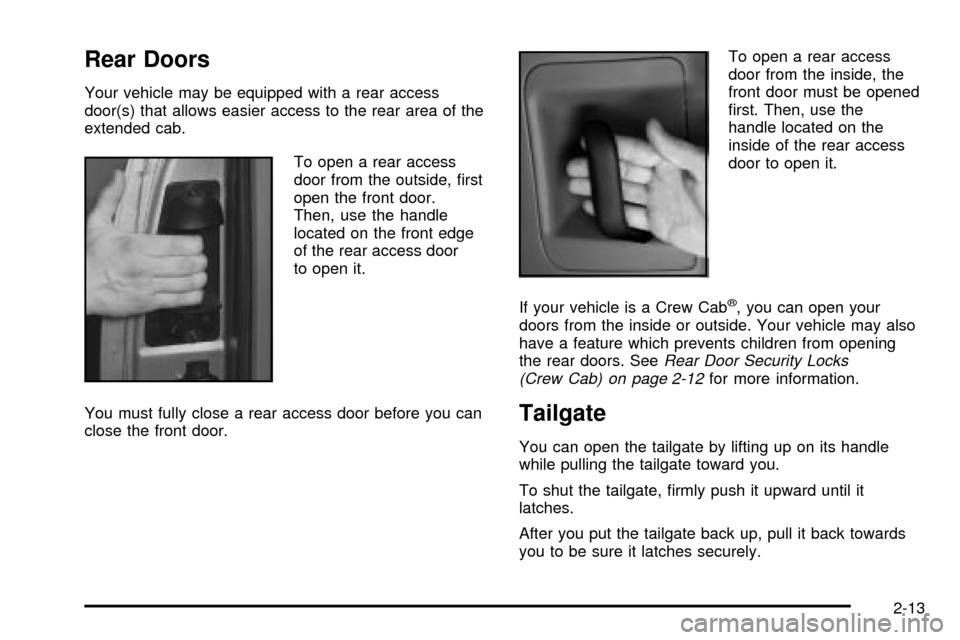
To open a rear access
door from the outside, ®rst
open the front door.
Then, use the handle
located on the front edge
of the rear access door
to open it.
You must fully close a rear access door before you can
close the front door.To open a rear access
door from the inside, the
front door must be opened
®rst. Then, use the
handle located on the
inside of the rear access
door to open it.
If your vehicle is a Crew Cab
ž, you can open your
doors from the inside or outside. Your vehicle may also
have a feature which prevents children from opening
the rear doors. See
Rear Door Security Locks
(Crew Cab) on page 2-12for more information.
Tailgate
You can open the tailgate by lifting up on its handle
while pulling the tailgate toward you.
To shut the tailgate, ®rmly push it upward until it
latches.
After you put the tailgate back up, pull it back towards
you to be sure it latches securely.
2-13
Page 108 of 556

Starting and Operating Your
Vehicle
New Vehicle Break-In
Notice:Your vehicle doesn't need an elaborate
ªbreak-in.º But it will perform better in the long run
if you follow these guidelines:
·Keep your speed at 55 mph (88 km/h) or less for
the ®rst 500 miles (805 km).
·Don't drive at any one speed Ð fast or slow Ð
for the ®rst 500 miles (805 km). Don't make
full-throttle starts.
·Avoid making hard stops for the ®rst 200 miles
(322 km) or so. During this time your new
brake linings aren't yet broken in. Hard stops
with new linings can mean premature wear and
earlier replacement. Follow this breaking-in
guideline every time you get new brake linings.
·Don't tow a trailer during break-in. See ªTowing
a Trailerº in the Index for more information.
Ignition Positions
With the key in the ignition switch, you can turn it to
four different positions.
A (LOCK):This position locks your ignition and manual
transmission. It's a theft-deterrent feature. You will
only be able to remove your key when the ignition is
turned to LOCK.
B (ACCESSORY):This position allows you to use
things like the radio, power windows and the windshield
wipers when the engine is off.
2-20
Page 113 of 556
Automatic Transmission Operation
If your vehicle is equipped with an automatic
transmission, it features an electronic shift position
indicator within the instrument panel cluster. This display
must be powered anytime the shift lever is capable of
being moved out of PARK (P). See
Fuses and Circuit
Breakers on page 5-110.
There are several different positions for your shift lever.
PARK (P):This position locks your rear wheels. It's the
best position to use when you start your engine because
your vehicle can't move easily. If your vehicle is equipped
with the Allison
žTransmission, use park for stationary
operation of the Power Takeoff (PTO) (if equipped).
{CAUTION:
It is dangerous to get out of your vehicle if the
shift lever is not fully in PARK (P) with the
parking brake ®rmly set. Your vehicle can roll.
Do not leave your vehicle when the engine is
running unless you have to. If you have left the
engine running, the vehicle can move suddenly.
CAUTION: (Continued)
CAUTION: (Continued)
You or others could be injured. To be sure
your vehicle will not move, even when you are
on fairly level ground, always set your parking
brake and move the shift lever to PARK (P).
See ªShifting Into Park (P)º in the Index. If you
are pulling a trailer, see ªTowing a Trailerº in
the Index.
{CAUTION:
If you have four-wheel drive, your vehicle will be
free to roll Ð even if your shift lever is in PARK
(P) Ð if your transfer case is in NEUTRAL. So,
be sure the transfer case is in a drive gear,
two-wheel high (2H) or four-wheel high (4H) or
four-wheel low (4L) Ð not in NEUTRAL. See
ªShifting into Park (P)º in the index.
2-25
Page 114 of 556

REVERSE (R):Use this gear to back up. If your vehicle
is equipped with the Allison Transmissionž, the R
may blink on the PRNDL if the shift inhibitor is active.
Notice:Shifting to REVERSE (R) while your vehicle
is moving forward could damage your transmission.
Shift to REVERSE (R) only after your vehicle is
stopped.
To rock your vehicle back and forth to get out of snow,
ice or sand without damaging your transmission,
see If You Are Stuck: In Sand, Mud, Ice or Snow on
page 4-52.
NEUTRAL (N):In this position, your engine doesn't
connect with the wheels. To restart when you're already
moving, use NEUTRAL (N) only. Also, use
NEUTRAL (N) when your vehicle is being towed.
{CAUTION:
Shifting into a drive gear while your engine is
running at high speed is dangerous. Unless
your foot is ®rmly on the brake pedal, your
vehicle could move very rapidly. You could
lose control and hit people or objects. Do not
shift into a drive gear while your engine is
running at high speed.
Notice:Damage to your transmission caused by
shifting out of PARK (P) or NEUTRAL (N) with
the engine racing isn't covered by your warranty.
DRIVE (D):This position is for normal driving. If
you need more power for passing, and you're:
·Going less than about 35 mph (55 km/h), push your
accelerator pedal about halfway down.
·Going about 35 mph (55 km/h) or more, push the
accelerator all the way down.
You'll shift down to the next gear and have more power.
2-26
Page 115 of 556

Drive (D) can be used when towing a trailer, carrying a
heavy load, driving on steep hills or for off-road
driving. You may want to shift the transmission to
THIRD (3) or, if necessary, a lower gear selection if the
transmission shifts too often.
Notice:If your vehicle is equipped with the
AllisionžTransmission, do not idle in DRIVE (D) for
more than ®ve minutes. Extended idling in
DRIVE (D) may cause transmission overheating and
damage. Always select PARK (P) if idle time is
longer than ®ve minutes.
If your vehicle is equipped with the Allison
ž
Transmission, it will initially attain ®rst range when
DRIVE (D) is selected. As vehicle speed increases, the
transmission will upshift automatically through each
available range up to FIFTH (5). As the vehicle slows,
the transmission will downshift automatically.
THIRD (3):This position is also used for normal driving,
however it offers more power and lower fuel economy
than DRIVE (D).
SECOND (2):This position gives you more power but
lower fuel economy. You can use SECOND (2) on
hills. It can help control your speed as you go down
steep mountain roads, but then you would also want to
use your brakes off and on.If you manually select SECOND (2) in a light duty
automatic transmission, the transmission will drive in
second gear. You may use this feature for reducing the
speed of the rear wheels when you are trying to start
your vehicle from a stop on slippery road surfaces.
FIRST (1):This position gives you even more power
(but lower fuel economy) than SECOND (2). You
can use it on very steep hills, or in deep snow or mud.
If the selector lever is put in FIRST (1) while the
vehicle is moving forward, the transmission won't shift
into ®rst gear until the vehicle is going slowly enough.Notice:If your wheels won't turn, don't try to drive.
This might happen if you were stuck in very deep
sand or mud or were up against a solid object. You
could damage your transmission. Also, if you
stop when going uphill, don't hold your vehicle there
with only the accelerator pedal. This could overheat
and damage the transmission. Use your brakes
or shift into PARK (P) to hold your vehicle in
position on a hill.
On cold days, approximately 32ÉF (0ÉC) or colder, your
transmission is designed to shift differently until the
engine reaches normal operating temperature. This is
intended to improve heater performance.
2-27
Page 116 of 556
Tow/Haul Mode
(Automatic Transmission)
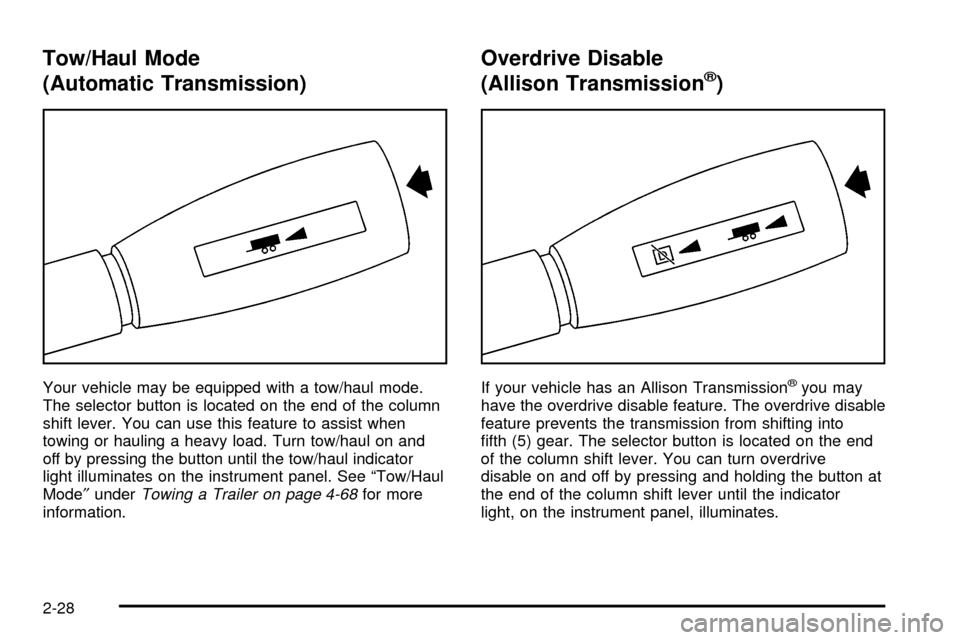
Your vehicle may be equipped with a tow/haul mode.
The selector button is located on the end of the column
shift lever. You can use this feature to assist when
towing or hauling a heavy load. Turn tow/haul on and
off by pressing the button until the tow/haul indicator
light illuminates on the instrument panel. See ªTow/Haul
Mode²under
Towing a Trailer on page 4-68for more
information.
Overdrive Disable
(Allison Transmissionž)
If your vehicle has an Allison Transmissionžyou may
have the overdrive disable feature. The overdrive disable
feature prevents the transmission from shifting into
®fth (5) gear. The selector button is located on the end
of the column shift lever. You can turn overdrive
disable on and off by pressing and holding the button at
the end of the column shift lever until the indicator
light, on the instrument panel, illuminates.
2-28
Page 117 of 556
If your vehicle has both tow/haul and overdrive disable
tap the button once to enable or disable tow/haul,
and press and hold the button to enable or disable
overdrive disable.
Manual Transmission Operation
Five-Speed
(VORTECŸ 6000 V8 Engine)
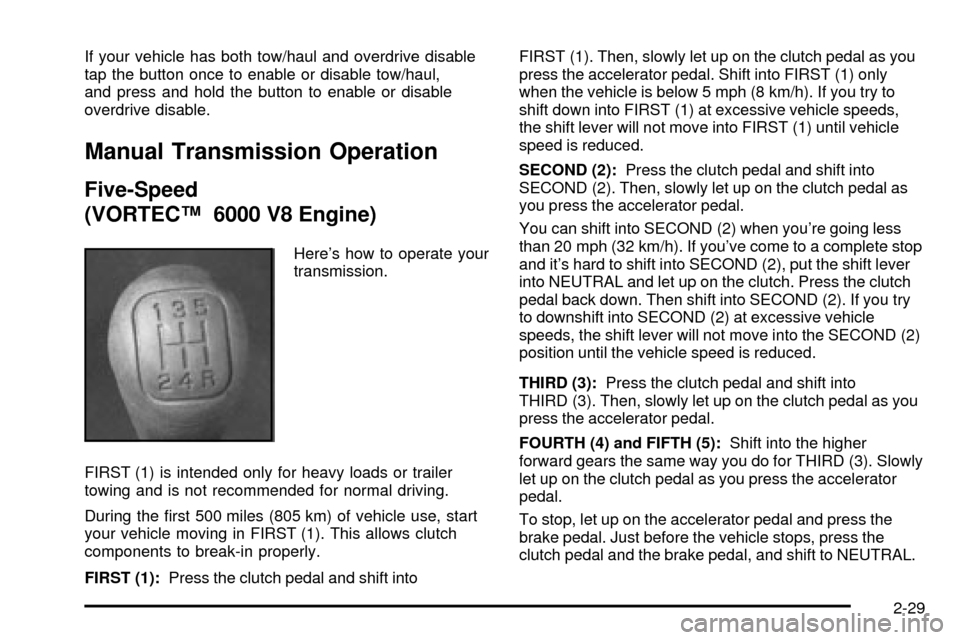
Here's how to operate your
transmission.
FIRST (1) is intended only for heavy loads or trailer
towing and is not recommended for normal driving.
During the ®rst 500 miles (805 km) of vehicle use, start
your vehicle moving in FIRST (1). This allows clutch
components to break-in properly.
FIRST (1):Press the clutch pedal and shift intoFIRST (1). Then, slowly let up on the clutch pedal as you
press the accelerator pedal. Shift into FIRST (1) only
when the vehicle is below 5 mph (8 km/h). If you try to
shift down into FIRST (1) at excessive vehicle speeds,
the shift lever will not move into FIRST (1) until vehicle
speed is reduced.
SECOND (2):Press the clutch pedal and shift into
SECOND (2). Then, slowly let up on the clutch pedal as
you press the accelerator pedal.
You can shift into SECOND (2) when you're going less
than 20 mph (32 km/h). If you've come to a complete stop
and it's hard to shift into SECOND (2), put the shift lever
into NEUTRAL and let up on the clutch. Press the clutch
pedal back down. Then shift into SECOND (2). If you try
to downshift into SECOND (2) at excessive vehicle
speeds, the shift lever will not move into the SECOND (2)
position until the vehicle speed is reduced.
THIRD (3):Press the clutch pedal and shift into
THIRD (3). Then, slowly let up on the clutch pedal as you
press the accelerator pedal.
FOURTH (4) and FIFTH (5):Shift into the higher
forward gears the same way you do for THIRD (3). Slowly
let up on the clutch pedal as you press the accelerator
pedal.
To stop, let up on the accelerator pedal and press the
brake pedal. Just before the vehicle stops, press the
clutch pedal and the brake pedal, and shift to NEUTRAL.
2-29
Page 119 of 556
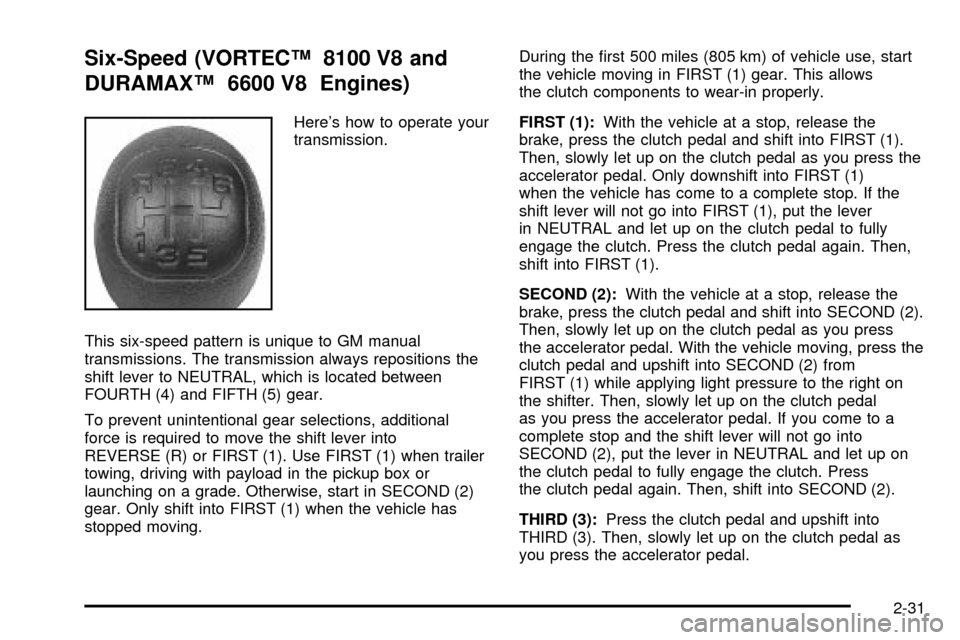
Six-Speed (VORTECŸ 8100 V8 and
DURAMAXŸ 6600 V8 Engines)
Here's how to operate your
transmission.
This six-speed pattern is unique to GM manual
transmissions. The transmission always repositions the
shift lever to NEUTRAL, which is located between
FOURTH (4) and FIFTH (5) gear.
To prevent unintentional gear selections, additional
force is required to move the shift lever into
REVERSE (R) or FIRST (1). Use FIRST (1) when trailer
towing, driving with payload in the pickup box or
launching on a grade. Otherwise, start in SECOND (2)
gear. Only shift into FIRST (1) when the vehicle has
stopped moving.During the ®rst 500 miles (805 km) of vehicle use, start
the vehicle moving in FIRST (1) gear. This allows
the clutch components to wear-in properly.
FIRST (1):With the vehicle at a stop, release the
brake, press the clutch pedal and shift into FIRST (1).
Then, slowly let up on the clutch pedal as you press the
accelerator pedal. Only downshift into FIRST (1)
when the vehicle has come to a complete stop. If the
shift lever will not go into FIRST (1), put the lever
in NEUTRAL and let up on the clutch pedal to fully
engage the clutch. Press the clutch pedal again. Then,
shift into FIRST (1).
SECOND (2):With the vehicle at a stop, release the
brake, press the clutch pedal and shift into SECOND (2).
Then, slowly let up on the clutch pedal as you press
the accelerator pedal. With the vehicle moving, press the
clutch pedal and upshift into SECOND (2) from
FIRST (1) while applying light pressure to the right on
the shifter. Then, slowly let up on the clutch pedal
as you press the accelerator pedal. If you come to a
complete stop and the shift lever will not go into
SECOND (2), put the lever in NEUTRAL and let up on
the clutch pedal to fully engage the clutch. Press
the clutch pedal again. Then, shift into SECOND (2).
THIRD (3):Press the clutch pedal and upshift into
THIRD (3). Then, slowly let up on the clutch pedal as
you press the accelerator pedal.
2-31