Page 453 of 556
{CAUTION:
Rust or dirt on a wheel, or on the parts to
which it is fastened, can make wheel nuts
become loose after a time. The wheel could
come off and cause an accident. When you
change a wheel, remove any rust or dirt from
places where the wheel attaches to the vehicle.
In an emergency, you can use a cloth or a
paper towel to do this; but be sure to use a
scraper or wire brush later, if you need to, to
get all the rust or dirt off. See ªChanging a Flat
Tireº in the Index.
When It Is Time for New Tires
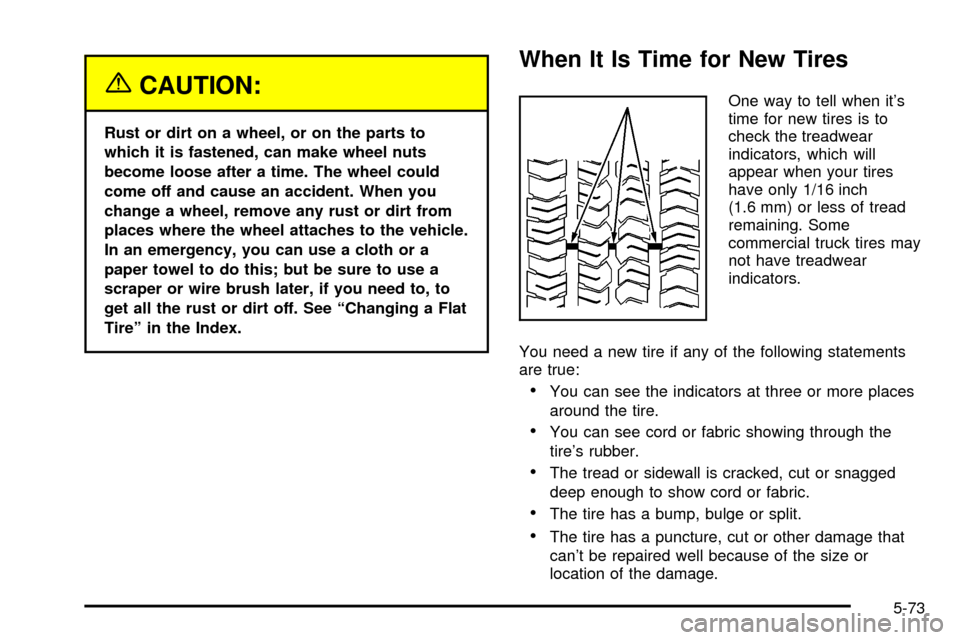
One way to tell when it's
time for new tires is to
check the treadwear
indicators, which will
appear when your tires
have only 1/16 inch
(1.6 mm) or less of tread
remaining. Some
commercial truck tires may
not have treadwear
indicators.
You need a new tire if any of the following statements
are true:
·You can see the indicators at three or more places
around the tire.
·You can see cord or fabric showing through the
tire's rubber.
·The tread or sidewall is cracked, cut or snagged
deep enough to show cord or fabric.
·The tire has a bump, bulge or split.
·The tire has a puncture, cut or other damage that
can't be repaired well because of the size or
location of the damage.
5-73
Page 454 of 556
Buying New Tires
To ®nd out what kind and size of tires you need, look at
the Certi®cation/Tire label.
The tires installed on your vehicle when it was new had a
Tire Performance Criteria Speci®cation (TPC Spec)
number on each tire's sidewall. When you get new tires,
get ones with that same TPC Spec number. That way
your vehicle will continue to have tires that are designed
to give proper endurance, handling, speed rating,
traction, ride and other things during normal service on
your vehicle. If your tires have an all-season tread design,
the TPC number will be followed by an ªMSº (for mud
and snow).
If you ever replace your tires with those not having a TPC
Spec number, make sure they are the same size, load
range, speed rating and construction type (bias,
bias-belted or radial) as your original tires.
{CAUTION:
Mixing tires could cause you to lose control
while driving. If you mix tires of different sizes
or types (radial and bias-belted tires), the
vehicle may not handle properly, and you could
CAUTION: (Continued)
CAUTION: (Continued)
have a crash. Using tires of different sizes may
also cause damage to your vehicle. Be sure to
use the same size and type tires on all wheels.
If your vehicle has 20 inch road tires (those
originally installed on your vehicle) it is all
right to drive with the 16 inch spare tire that
came with your vehicle. When new, your
vehicle included a spare tire and wheel
assembly with the same overall diameter as
your vehicle's road tires and wheels. Because
this spare tire was developed for use on your
vehicle, it will not affect vehicle handling or
cause damage to your vehicle.
{CAUTION:
If you use bias-ply tires on your vehicle, the
wheel rim ¯anges could develop cracks after
many miles of driving. A tire and/or wheel could
fail suddenly, causing a crash. Use only
radial-ply tires with the wheels on your vehicle.
5-74
Page 458 of 556
Tire Chains
{CAUTION:
If your vehicle has dual wheels or P265/75R16,
LT265/75R16 or P275/55R20 size tires, don't
use tire chains. They can damage your vehicle
because there's not enough clearance. Tire
chains used on a vehicle without the proper
amount of clearance can cause damage to the
brakes, suspension or other vehicle parts. The
area damaged by the tire chains could cause
you to lose control of your vehicle and you or
others may be injured in a crash.
Use another type of traction device only if its
manufacturer recommends it for use on your
vehicle and tire size combination and road
conditions. Follow that manufacturer's
instructions. To help avoid damage to your
vehicle, drive slowly, readjust or remove the
device if it's contacting your vehicle, and don't
spin your wheels.
If you do ®nd traction devices that will ®t,
install them on the rear tires.²
Notice:If your vehicle does not have dual wheels
and is equipped with a tire size other than
P265/75R16, LT65/75R16 or P275/55R20, use tire
chains only where legal and only when you must.
Use chains that are the proper size for your
tires. Install them on the tires of the rear axle. Don't
use chains on the tires of the front axle. Tighten
them as tightly as possible with the ends securely
fastened. Drive slowly and follow the chain
manufacturer's instructions. If you can hear the
chains contacting your vehicle, stop and retighten
them. If the contact continues, slow down until
it stops. Driving too fast or spinning the wheels with
chains on will damage your vehicle.
5-78