Page 3 of 386
ii
GENERAL MOTORS, GM, the GM Emblem,
CHEVROLET and the CHEVROLET Emblem are
registered trademarks of General Motors Corporation.
This manual includes the latest information at the time
it was printed. We reserve the right to make changes
after that time without further notice. For vehicles first
sold in Canada, substitute the name ªGeneral Motors of
Canada Limitedº for GM Medium Duty Truck Division
whenever it appears in this manual.
Please keep this manual in your vehicle, so it will
be there if you ever need it when you're on the road.
If you sell the vehicle, please leave this manual in it
so the new owner can use it.
We support voluntary
technician certification.
Litho in U.S.A.�Copyright General Motors Corporation 12/03/01
Part Number C2301 A First Edition All Rights Reserved
Page 5 of 386

iv
Vehicle Damage Warnings
Also, in this book you will find these notices:
NOTICE:
These mean there is something that could damage
your vehicle.
In the notice area, we tell you about something that can
damage your vehicle. Many times, this damage would
not be covered by your warranty, and it could be costly.
But the notice will tell you what to do to help avoid
the damage.
When you read other manuals, you might see
CAUTION and NOTICE warnings in different
colors or in different words.
You'll also see warning labels on your vehicle.
They use the same words, CAUTION or NOTICE.
Vehicle Symbols
Your vehicle may be equipped with components and
labels that use symbols instead of text. Symbols,
used on your vehicle, are shown along with the text
describing the operation or information relating to a
specific component, control, message, gage or indicator.
If you need help figuring out a specific name of a
component, gage or indicator reference the following
topics in the Index:
�ªInstrument Panelº
�ªComfort Controlsº
�ªAudio Systemsº
Also see ªWarning Lights and Gagesº in the Index.
Page 7 of 386
vi
Model Reference
This manual contains information which covers
conventional cab models as shown. Most models
are unfinished from the factory.
C4C042
C5C042
C4V042
C5V042
C4U042
C5U042C6C042
C7C042
C8C042
C6V042
C7V042
C8V042
C8C064
C8V064
C4E042
C5E042
C6E042
C7E042
C8E042
C8E064
Since C-Series models delivered from the factory are
finished in a variety of ways by a number of companies,
you'll probably find other manuals in your finished
vehicle. These manuals are put there by the companies
that have added components or equipment to the
C-Series model. Read all these materials
-- as well
as this manual
-- carefully, to get all of the information
on your vehicle.
Page 15 of 386
1-8 Rear Seats (Crew Cab
�)
Folding the Rear Seat
The Crew Cab's rear bench seat can be folded down to
provide more cargo space.
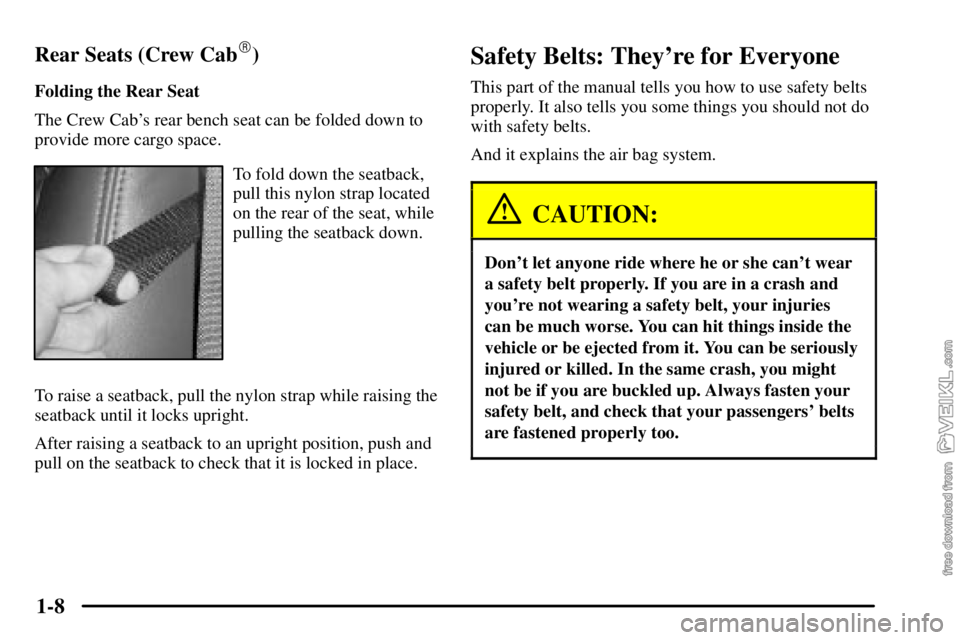
To fold down the seatback,
pull this nylon strap located
on the rear of the seat, while
pulling the seatback down.
To raise a seatback, pull the nylon strap while raising the
seatback until it locks upright.
After raising a seatback to an upright position, push and
pull on the seatback to check that it is locked in place.
Safety Belts: They're for Everyone
This part of the manual tells you how to use safety belts
properly. It also tells you some things you should not do
with safety belts.
And it explains the air bag system.
CAUTION:
Don't let anyone ride where he or she can't wear
a safety belt properly. If you are in a crash and
you're not wearing a safety belt, your injuries
can be much worse. You can hit things inside the
vehicle or be ejected from it. You can be seriously
injured or killed. In the same crash, you might
not be if you are buckled up. Always fasten your
safety belt, and check that your passengers' belts
are fastened properly too.
Page 20 of 386

1-13
Q:If I'm a good driver, and I never drive far from
home, why should I wear safety belts?
A:You may be an excellent driver, but if you're in an
accident
-- even one that isn't your fault -- you
and your passengers can be hurt. Being a good
driver doesn't protect you from things beyond your
control, such as bad drivers.
Most accidents occur within 25 miles (40 km)
of home. And the greatest number of serious
injuries and deaths occur at speeds of less
than 40 mph (65 km/h).
Safety belts are for everyone.
How to Wear Safety Belts Properly
Adults
This part is only for people of adult size.
Be aware that there are special things to know about
safety belts and children. And there are different rules
for smaller children and babies. If a child will be riding
in your vehicle, see the part of this manual called
ªChildren.º Follow those rules for everyone's
protection.
First, you'll want to know which restraint systems your
vehicle has.
We'll start with the driver position.
Driver Position
This part describes the driver's restraint system.
Lap-Shoulder Belt
The driver has a lap-shoulder belt. Here's how to wear
it properly.
1. Close and lock the door.
2. Adjust the seat so you can sit up straight. To see
how, see ªSeatsº in the Index.
Page 32 of 386
1-25
If your vehicle has an air bag for the right front
passenger, please read this:
CAUTION:
Anyone who is up against, or very close to, any
air bag when it inflates can be seriously injured
or killed. Air bags plus lap
-shoulder belts offer
the best protection for adults, but not for young
children and infants. Neither the vehicle's safety
belt system nor its air bag system is designed for
them. Young children and infants need the
protection that a child restraint system can
provide. Always secure children properly in your
vehicle. To read how, see the part of this manual
called ªChildren.º
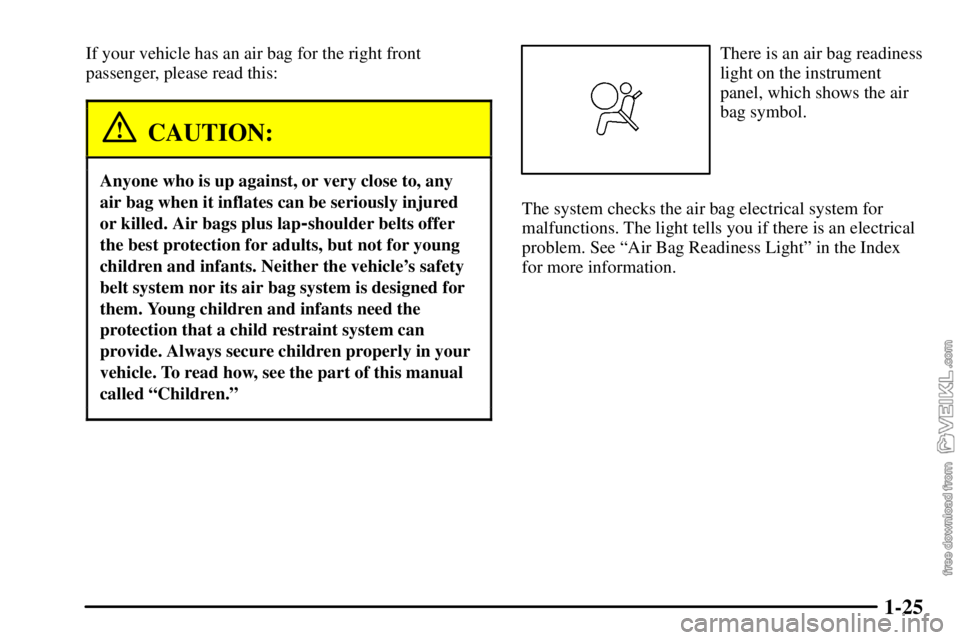
There is an air bag readiness
light on the instrument
panel, which shows the air
bag symbol.
The system checks the air bag electrical system for
malfunctions. The light tells you if there is an electrical
problem. See ªAir Bag Readiness Lightº in the Index
for more information.
Page 36 of 386
1-29
In many crashes severe enough to inflate an air bag,
windshields are broken by vehicle deformation.
Additional windshield breakage may also occur from the
right front passenger air bag.
�Air bags are designed to inflate only once. After they
inflate, you'll need some new parts for your air bag
system. If you don't get them, the air bag system
won't be there to help protect you in another crash.
A new system will include air bag modules and
possibly other parts. The service manual for your
vehicle covers the need to replace other parts.
�Your vehicle is equipped with a crash sensing and
diagnostic module, which records information about
the air bag system. The module records information
about the readiness of the system, when the system
commands air bag inflation. The module also records
speed, engine rpm, brake and throttle data.�Let only qualified technicians work on your air bag
system. Improper service can mean that your air
bag system won't work properly. See your dealer
for service.
NOTICE:
If you damage the covering for the driver's or the
right front passenger's air bag, the bag may not
work properly. You may have to replace the air
bag module in the steering wheel or both the air
bag module and the instrument panel for the
right front passenger's air bag. Do not open or
break the air bag coverings.
Page 41 of 386
1-34
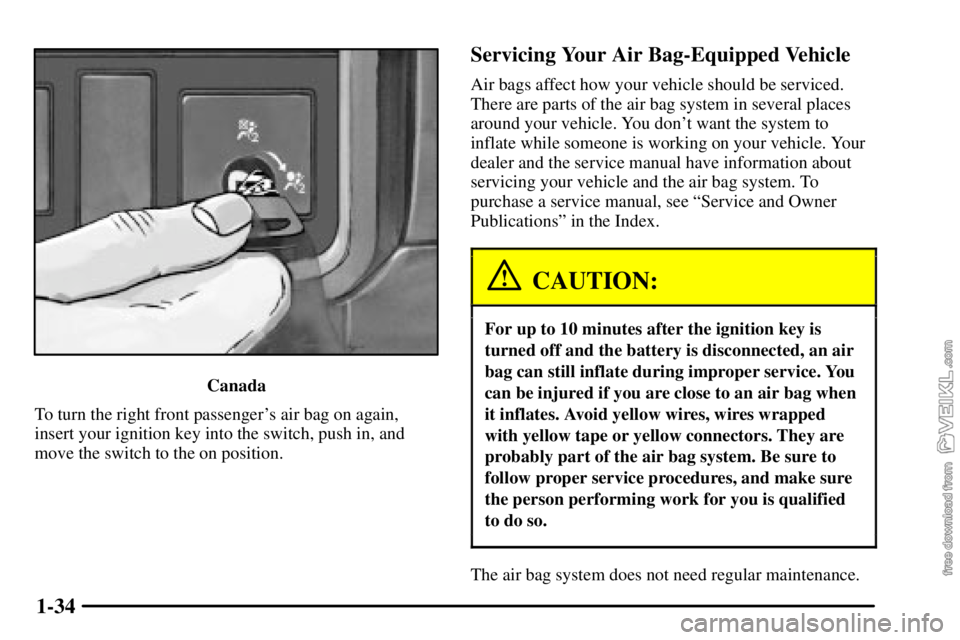
Canada
To turn the right front passenger's air bag on again,
insert your ignition key into the switch, push in, and
move the switch to the on position.
Servicing Your Air Bag-Equipped Vehicle
Air bags affect how your vehicle should be serviced.
There are parts of the air bag system in several places
around your vehicle. You don't want the system to
inflate while someone is working on your vehicle. Your
dealer and the service manual have information about
servicing your vehicle and the air bag system. To
purchase a service manual, see ªService and Owner
Publicationsº in the Index.
CAUTION:
For up to 10 minutes after the ignition key is
turned off and the battery is disconnected, an air
bag can still inflate during improper service. You
can be injured if you are close to an air bag when
it inflates. Avoid yellow wires, wires wrapped
with yellow tape or yellow connectors. They are
probably part of the air bag system. Be sure to
follow proper service procedures, and make sure
the person performing work for you is qualified
to do so.
The air bag system does not need regular maintenance.