Page 42 of 386

1-35 Adding Equipment to Your Air
Bag-Equipped Vehicle
Q:If I add a push bumper or a bicycle rack to the
front of my vehicle, will it keep the air bags
from working properly?
A:As long as the push bumper or bicycle rack is
attached to your vehicle so that the vehicle's basic
structure isn't changed, it's not likely to keep the
air bags from working properly in a crash.
Q:Is there anything I might add to the front of the
vehicle that could keep the air bags from
working properly?
A:Yes. If you add things that change your vehicle's
frame, bumper system, front end sheet metal or
height, they may keep the air bag system from
working properly. Also, the air bag system may not
work properly if you relocate any of the air bag
sensors. If you have any questions about this, you
should contact Customer Assistance before you
modify your vehicle. The phone numbers and
addresses for Customer Assistance are in Step Two
of the Customer Satisfaction Procedure in this
manual. See ªCustomer Satisfaction Procedureº in
the Index.
Page 55 of 386
1-48
When choosing a child restraint, be sure the child
restraint is designed to be used in a vehicle. If it is, it
will have a label saying that it meets federal motor
vehicle safety standards.
Then follow the instructions for the restraint. You may
find these instructions on the restraint itself or in a
booklet, or both. These restraints use the belt system in
your vehicle, but the child also has to be secured within
the restraint to help reduce the chance of personal injury.
When securing an add
-on child restraint, refer to the
instructions that come with the restraint which may be
on the restraint itself or in a booklet, or both, and to this
manual. The child restraint instructions are important, so
if they are not available, obtain a replacement copy from
the manufacturer.
Where to Put the Restraint
(Regular Cab Models)
If your vehicle is a regular cab model with an
air
-suspension seat in the right front passenger's
position, there is no place in your vehicle to secure a
child restraint. The only answer is to have smaller
children make the trip in another vehicle, where they
can get the protection they need.
CAUTION:
A child restraint cannot be secured properly in
an air
-suspension type seat. This is because an
air
-suspension seat is designed to move up and
down for an adult passenger. Don't use a child
restraint in an air
-suspension seat.
If your vehicle is a regular cab model with a static seat
in the right front passenger's position, or if it has a
bench seat, the child restraint must be secured properly
in the right front passenger's seat. If your vehicle has air
bags and you want to secure a rear
-facing child restraint
in the right front passenger's seat, turn off the
passenger's air bag. See ªAir Bag Off Switchº and
ªSecuring a Child Restraint in the Right Front Seat
Positionº in the Index for more on this, including
important safety information.
Page 76 of 386

2-
2-1
Section 2 Features and Controls
Here you can learn about the many standard and optional features on your vehicle, and information on starting,
shifting and braking. Also explained are the instrument panel and the warning systems that tell you if everything is
working properly
-- and what to do if you have a problem.
2
-2 Windows
2-5 Keys
2-7 Door Locks
2-8 Keyless Entry System (If Equipped)
2-12 Switchbanks
2-13 Theft
2-14 New Vehicle ªBreak-Inº
2-15 Ignition Positions
2-16 Starting Your Gasoline Engine
2-19 Starting the Diesel Engine
2-24 Starting Your DURAMAX� Diesel Engine
2-27 Engine Checks Before Operating
2-28 Engine Coolant Heater (If Equipped)
2-30 Diesel Engine Exhaust Brake (If Equipped)
2-31 Two-Speed Rear Axle Electric Shift Control
(If Equipped)
2
-34 Automatic Transmission Operation
2-36 Manual Transmission Operation
2-40 Parking
2-45 Parking Over Things That Burn
2-45 Engine Exhaust2
-46 Running Your Engine While You're Parked
(Automatic Transmission)
2
-47 Horn
2-48 Tilt Wheel (If Equipped)
2-48 Turn Signal/Multifunction Lever
2-55 Inter-Axle Differential Lock Control
(If Equipped)
2
-56 Rear Axle Differential Lock Control
(If Equipped)
2
-57 Exterior Lamps
2-60 Interior Lamps
2-61 Mirrors
2-63 Storage Compartments
2-65 Accessory Power Outlets
2-66 Trailer Connections (C4/C5 Models Only)
(If Equipped)
2
-67 Trailer Connections (C6/C7/C8 Models Only)
(If Equipped)
2
-68 The Instrument Panel-Your
Information System
2
-70 Instrument Panel Cluster
2-73 Warning Lights, Gages and Indicators
Page 78 of 386
2-3 Manual Windows
Turn the hand crank on each door to raise or lower
the window.
Power Windows (If Equipped)
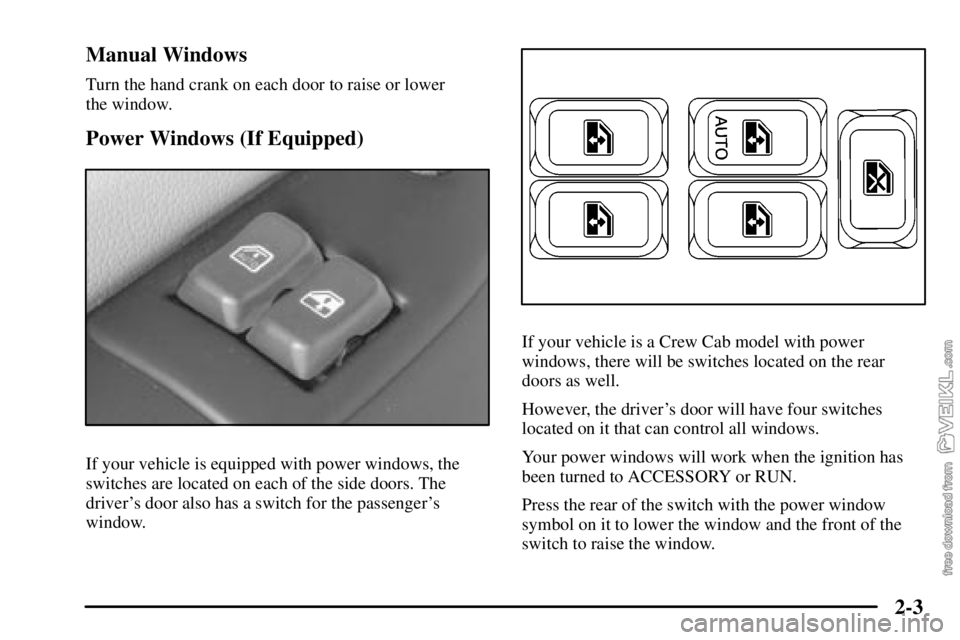
If your vehicle is equipped with power windows, the
switches are located on each of the side doors. The
driver's door also has a switch for the passenger's
window.
If your vehicle is a Crew Cab model with power
windows, there will be switches located on the rear
doors as well.
However, the driver's door will have four switches
located on it that can control all windows.
Your power windows will work when the ignition has
been turned to ACCESSORY or RUN.
Press the rear of the switch with the power window
symbol on it to lower the window and the front of the
switch to raise the window.
Page 82 of 386

2-7
Door Locks
CAUTION:
Unlocked doors can be dangerous.
�Passengers -- especially children -- can
easily open the doors and fall out of a
moving vehicle. When a door is locked, the
handle won't open it. You increase the
chance of being thrown out of the vehicle in
a crash if the doors aren't locked. So, wear
safety belts properly and lock the doors
whenever you drive.
�Young children who get into unlocked
vehicles may be unable to get out. A child
can be overcome by extreme heat and can
suffer permanent injuries or even death
from heat stroke. Always lock your vehicle
whenever you leave it.
�Outsiders can easily enter through an
unlocked door when you slow down or stop
your vehicle. Locking your doors can help
prevent this from happening.
There are several ways to lock and unlock your vehicle.
If your vehicle is equipped with keyless entry, you can
use your transmitter to lock or unlock your vehicle.
See ªKeyless Entry Systemº later in this section for
more information.
To lock or unlock your door from the outside, use
your key.
To lock your door from the
inside, slide the manual
lever on your door down.
To unlock the door, slide the
manual lever up.
Page 89 of 386

2-14
New Vehicle ªBreak-Inº
NOTICE:
Your vehicle doesn't need an elaborate
ªbreak
-in.º But it will perform better in the long
run if you follow these guidelines:
�Let your engine warm up before you
operate your vehicle under load.
�Keep your speed at 55 mph (88 km/h) or
less for the first 500 miles (805 km).
�Don't drive at any one speed
-- fast or
slow
-- for the first 500 miles (805 km).
Don't make full
-throttle starts.
NOTICE: (Continued)
NOTICE: (Continued)
�Avoid making hard stops for the first
200 miles (322 km) or so. During this time
your new brake linings aren't yet broken
in. Hard stops with new linings can mean
premature wear and earlier replacement.
Follow this breaking
-in guideline every
time you get new brake linings.
�Use the lowest gear you can when you start
a loaded vehicle in motion and when going
up hills to avoid overloading the engine.
�Check and adjust engine and transmission
fluid levels often and be sure tires are
properly inflated for the load you're
carrying.
�If you have a Caterpillar
� diesel engine, see
the Caterpillar� Diesel Engine Operation
& Maintenance Manual.
Page 91 of 386

2-16 Engine Starter Over-Crank Protection
(If Equipped)
Your vehicle may have an engine starter over-crank
protection system. If the starter motor overheats and
shuts off due to over
-cranking, the motor must cool
down before it will reset and allow starter operation.
It can take up to six minutes before the starter will
work again.
Starting Your Gasoline Engine
Engines start differently. The 8th digit of your Vehicle
Identification Number (VIN) shows the code letter for
your engine. See ªVehicle Identification Numberº in
the Index. Follow the proper steps to start the engine.
To start a diesel engine, see ªStarting Your Diesel
Engineº in the Index.
Automatic Transmission
Set the parking brake and move your shift lever to
NEUTRAL (N) or PARK (P) if so equipped. Your
engine won't start in any other position
-- that's a
safety feature.
Manual Transmission
Set the parking brake, shift to neutral and hold the clutch
pedal to the floor while starting the engine.
Starter Motor Operation
�The starter motor will disengage if you release
the key or the engine reaches a predetermined
engine speed.
�To prevent overheating, the starter motor will
disengage after continuously operating for
15 seconds. You must release the key from the
start position to re
-engage the starter.
�The starter motor will not engage if the engine is
already running.
�The starter motor will disengage if, after
two seconds, the starter pinion gear does not
engage the flywheel or there is no engine rpm
signal from the engine speed sensor.
Page 92 of 386

2-17 Starting Your Engine
1. Without pushing the accelerator pedal, turn your
ignition key to START. When the engine starts, let
go of the key. The idle speed will go down as your
engine gets warm.
2. If the engine doesn't start in 10 seconds, push the
accelerator pedal all the way down and crank the
engine for five more seconds, unless it starts sooner.
3. If your engine still won't start (or starts but then
stops), it could be flooded with too much gasoline.
Wait 15 seconds to let the starter motor cool down.
Do Steps 1 through 3 again.
When the engine starts, let go of the key and the
accelerator pedal.NOTICE:
Your engine is designed to work with the
electronics in your vehicle. If you add electrical
parts or accessories, you could change the way
the engine operates. Before adding electrical
equipment, check with your dealer. If you don't,
your engine might not perform properly.
NOTICE:
If you ever need to have your vehicle towed, see
the part of this manual that tells how to do it
without damaging your vehicle. See ªTowing
Your Vehicleº in the Index.