Page 168 of 386

2-93 Fuel Gage
Your fuel gage is located on
the right side of your
instrument panel cluster.
When the ignition is on, your fuel gage lets you know
about how much fuel you have left. When the gage first
shows empty, you'll still have a little fuel left, but you
should get more fuel soon.
If your vehicle has dual fuel tanks, the reading on the
gage is the total fuel left in both tanks.
Here are four concerns of some operators. None of these
shows a problem with your fuel gage:
�The gage moves a little when you turn a corner or
speed up.�The gage doesn't go back to empty when you turn
off the ignition.
�At the gas station, the pump shuts off before the gage
reads full.
�It takes a little more or less fuel to fill up than the
gage indicated.
If you have a diesel engine, also see your Caterpillar
�
Operation & Maintenance Manual.
Water in Fuel Warning Light (If Equipped)
If your vehicle is equipped
with a diesel engine, you
may have this light
This light will come on to warn you that there is water
in the fuel system. For more information on how this
light works, see ªDiesel Fuel Requirements and Fuel
Systemº in the Index.
Page 258 of 386

6-4
Fuel (Gasoline Engine)
If your vehicle has a diesel engine, see ªDiesel Engine
Fuelº in this section. For vehicles with gasoline engines,
please read this.
Gasoline Octane
Use regular unleaded gasoline with a posted octane of
87 or higher. If the octane is less than 87, you may get
a heavy knocking noise when you drive. If it is bad
enough, it can damage your engine. A little pinging
noise when you accelerate or drive uphill is considered
normal. This does not indicate a problem exists or that a
higher
-octane fuel is necessary.
Gasoline Specifications
It is recommended that gasoline meet specifications
which were developed by the American Automobile
Manufacturers Association and endorsed by the
Canadian Vehicle Manufacturers' Association for better
vehicle performance and engine protection. Gasolines
meeting these specifications could provide improved
driveability and emission control system performance
compared to other gasolines.
In Canada, look for
the ªAuto Makers'
Choiceº label on
the pump.
Canada Only
Additives
Some gasolines that are not reformulated for low
emissions may contain an octane
-enhancing additive
called methylcyclopentadienyl manganese tricarbonyl
(MMT); ask the attendant where you buy gasoline
whether the fuel contains MMT. General Motors does
not recommend the use of such gasolines. Fuels
containing MMT can reduce the life of spark plugs and
the performance of the emission control system may be
affected. The malfunction indicator lamp may turn on.
If this occurs, return to your authorized GM dealer
for service.
Page 260 of 386

6-6 What Fuel to Use
In the United States, for best results use Number 2-D
diesel fuel year
-round (above and below freezing
conditions) as oil companies blend Number 2
-D fuel to
address climate differences. Number 1
-D diesel fuel
may be used in very cold temperatures (when it stays
below 0�F or
-18�C); however, it will produce a power
and fuel economy loss. Avoid the use of Number 1
-D
diesel fuel in warm or hot climates. It may result in
stalling, poor starting when the engine is hot and may
damage the fuel injection system.
At a minimum, the diesel fuel you use should meet
specifications ASTM D975
-00 (Grade Low Sulfur) in
the United States. In addition, the Engine Manufacturers
Association (EMA) has identified properties of an
improved diesel fuel for better engine performance and
durability. Diesel fuels corresponding to the EMA
Recommended Guideline on Premium Diesel Fuel
(FQP
-1A) could provide better starting, less noise and
better vehicle performance. If there are questions about
the fuel you are using, contact your fuel supplier.Diesel fuel may foam when you fill your tank. This can
cause the automatic pump nozzle to shut off, even
though your tank isn't full. If this happens, just wait for
the foaming to stop and then continue to fill your tank.
CAUTION:
Heat coming from the engine may cause the fuel
to expand and force the fuel out of your tank. If
something ignites the fuel, a fire could start and
people could be burned. To help avoid this, fill
your fuel tank only until the automatic nozzle
shuts off. Don't try to ªtop it off.º
Page 262 of 386
6-8 Water in Fuel
CAUTION:
Diesel fuel containing water is still flammable.
You could be burned. If you ever try to drain
water from your fuel, keep sparks, flames and
smoking materials away from the mixture.
NOTICE:
If there is water in your diesel fuel and the
weather is warm or humid, fungus and bacteria
can grow in the fuel. They can damage your fuel
system. You'll need a diesel fuel biocide to
sterilize your fuel system. Your dealer can advise
you if you ever need this.
If your fuel tank needs to be purged to remove
water, see your dealer or a qualified technician.
Improper purging can damage your fuel system.
Sometimes, water can be pumped into your fuel tank
along with your diesel fuel. This can happen if a service
station doesn't regularly inspect and clean its fuel tanks,
or if it gets contaminated fuel from its suppliers.
If this happens, a
water
-in-fuel indicator
will come on. If it does,
the water must be drained.
Your dealer can show you
how to do this.
Page 263 of 386
6-9
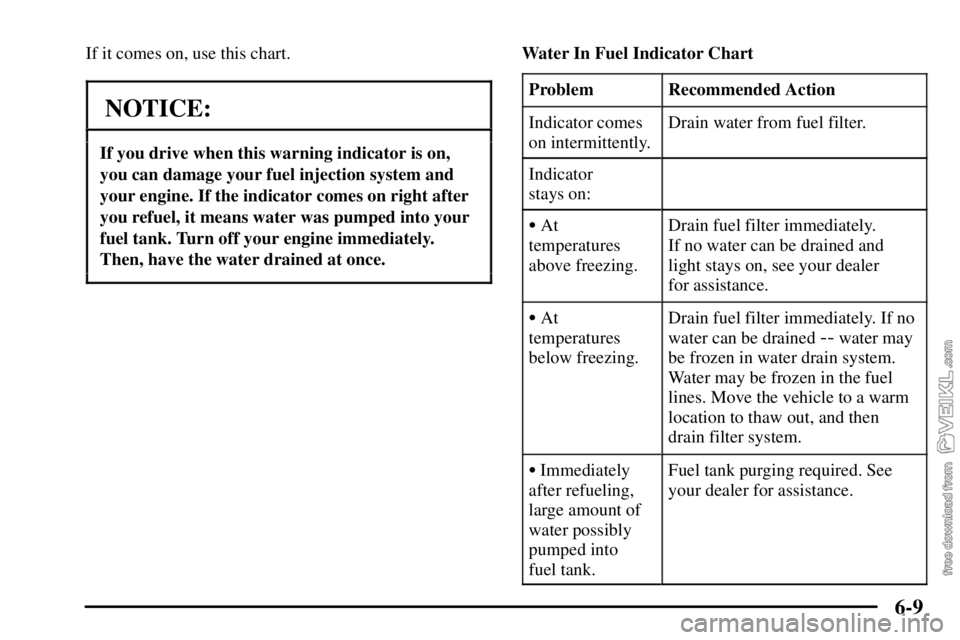
If it comes on, use this chart.
NOTICE:
If you drive when this warning indicator is on,
you can damage your fuel injection system and
your engine. If the indicator comes on right after
you refuel, it means water was pumped into your
fuel tank. Turn off your engine immediately.
Then, have the water drained at once.
Water In Fuel Indicator Chart
Problem
Recommended Action
Indicator comes
on intermittently.Drain water from fuel filter.
Indicator
stays on:
� At
temperatures
above freezing.Drain fuel filter immediately.
If no water can be drained and
light stays on, see your dealer
for assistance.
� At
temperatures
below freezing.Drain fuel filter immediately. If no
water can be drained
-- water may
be frozen in water drain system.
Water may be frozen in the fuel
lines. Move the vehicle to a warm
location to thaw out, and then
drain filter system.
� Immediately
after refueling,
large amount of
water possibly
pumped into
fuel tank.Fuel tank purging required. See
your dealer for assistance.
Page 264 of 386

6-10
To drain water, do the following:
1. Stop and park the vehicle in a safe place. Turn off
the engine and apply the parking brake.
2. Remove the fuel cap.
3. Place a fuel
-resistant container under the fuel filter.
The filter drain valve is located on the bottom of the
fuel filter. The fuel filter is located in the engine
compartment on the passenger's side of the vehicle,
or on the driver's side frame rail near the engine.
4. Open the drain valve by
turning two to three
turns. When fuel
empties from the valve,
all the water has been
drained. Close the valve
hand tight.5. Remove the fuel
-resistant container and properly
dispose of the contaminated fuel. To find out how to
properly dispose of contaminated diesel fuel, see
ªWhat to Do with Used Oilº in the ªEngine Oil
(Diesel Engines)º part, later in this section.
6. Install the fuel cap.
7. Start the engine and let it run for a few minutes.
If the engine stalls, the fuel system may need to be
primed. While draining the water from the fuel filter,
air may enter the fuel system. If air has entered the
fuel system the fuel system will need to be primed.
Refer to ªFuel Primingº later in this section.
If the water in fuel indicator comes on again after
driving a short distance or the engine runs rough or
stalls, a large amount of water has probably been
pumped into the fuel tank. The fuel tank should
be purged.
Fuel Priming
In order for the DURAMAX diesel engine fuel system
to work properly, the fuel lines must be full of fuel and
contain no air. If air gets into the fuel lines, it will be
necessary to prime the fuel lines to eliminate air before
operating the vehicle.
Page 265 of 386

6-11
Q:How does air get into the fuel lines?
A:One of the following may have happened:
�The vehicle ran out of fuel, or
�The fuel filter was removed for servicing or
replacement, or
�The fuel lines were removed or disconnected for
servicing, or
�The fuel filter water drain valve was opened while
the engine was running.
If one or more of the above occur, it is very likely that
air has entered your fuel system and that you will need
to prime the fuel system before operating the vehicle.
Air in the fuel lines will not harm the engine or
the vehicle.
However, the engine may not be able to start until the
fuel system is primed and the air is removed.
Q:How do I prime the vehicle?
A:Your vehicle is equipped with a priming pump
which is part of the engine mounted fuel filter.
The vent valve and the fuel filter primer pump
are located on top of the fuel filter housing. The
priming pump is hand operated and is designed to
bring fuel to the engine to eliminate any air that
may be in the fuel lines.
To prime the engine, do the following:
1. Make sure there is fuel in the tank.
2. Make sure the fuel filter had been installed and
properly tightened.
3. Make sure the fuel lines are properly connected and
the fuel filter is cool enough to touch.
4. Remove any dirt from the fuel filter head and vent
valve by wiping with a cloth.
Page 266 of 386
6-12
5. Open the fuel filter vent
valve by turning the
screw counterclockwise
several full turns.
6. Repeatedly press down
on the fuel filter primer
pump with the palm
of your hand. Let the
pump return upward
between presses.7. Operate the priming pump until a small amount of
fuel seeps from the vent valve. When you see the
fuel, the filter is now full of fuel and the system
should be primed.
8. Close the vent valve.
9. Clean any fuel which accumulated on the fuel filter.
10. Start the engine and let it idle for a few minutes.
11. Check the filter for leaks.