Page 228 of 386

5-3
Other Warning Devices
If you carry reflective triangles, you can set one up at
the side of the road behind your vehicle in the
recommended manner per Federal Motor Carrier Safety
Regulation (FMCSR) Section 392.22, to warn others.
Jump Starting
If your battery (or batteries) has run down, you may
want to use another vehicle and some jumper cables to
start your vehicle. Be sure to follow the steps below to
do it safely.
CAUTION:
Batteries can hurt you. They can be dangerous
because:
�They contain acid that can burn you.
�They contain gas that can explode or ignite.
�They contain enough electricity to
burn you.
If you don't follow these steps exactly, some or all
of these things can hurt you.
NOTICE:
Ignoring these steps could result in costly damage
to your vehicle that wouldn't be covered by your
warranty.
The ACDelco� battery in your vehicle has a
built
-in hydrometer. Do not charge, test or jump
start the battery if the hydrometer looks clear or
light yellow. Replace the battery when there is a
clear or light yellow hydrometer and a cranking
complaint.
Trying to start your vehicle by pushing or pulling
it won't work, and it could damage your vehicle.
1. Check the other vehicle. It must have a 12-volt
battery (or batteries) with a negative ground system.
NOTICE:
If the other system isn't a 12-volt system with a
negative ground, both vehicles can be damaged.
Page 229 of 386

5-4
If you have a diesel engine vehicle with two batteries
(or more), you should know before you begin that,
especially in cold weather, you may not be able to
get enough power from a single battery in another
vehicle to start your diesel engine.
If your vehicle has more than one battery, use the
one closest to the starter
-- this will reduce electrical
resistance.
2. Get the vehicles close enough so the jumper cables
can reach, but be sure the vehicles aren't touching
each other. If they are, it could cause a ground
connection you don't want. You wouldn't be able to
start your vehicle, and the bad grounding could
damage the electrical systems.
To avoid the possibility of the vehicles rolling, set
the parking brake firmly on both vehicles involved in
the jump start procedure. Put an automatic
transmission in PARK (P) or a manual transmission
in neutral before setting the parking brake.
NOTICE:
If you leave your radio on, it could be badly
damaged. The repairs wouldn't be covered by
your warranty.
3. Turn off the ignition on both vehicles. Unplug
unnecessary accessories plugged into the cigarette
lighter or accessory power outlets. Turn off the radio
and all lamps that aren't needed. This will avoid
sparks and help save both batteries, and it could save
your radio!
Page 231 of 386
5-6
CAUTION:
Fans or other moving engine parts can injure you
badly. Keep your hands away from moving parts
once the engine is running.
5. Check that the jumper cables don't have loose or
missing insulation. If they do, you could get a shock.
The vehicles could be damaged, too.
Before you connect the cables, here are some basic
things you should know. Positive (+) will go to
positive (+) or to a remote positive (+) terminal if
the vehicle has one. Negative (
-) will go to a heavy,
unpainted metal engine part or to a remote
negative (
-) terminal if the vehicle has one.
Don't connect the positive (+) to negative (
-) or
you'll get a short that would damage the battery and
maybe other parts too. And don't connect the
negative (
-) cable to the negative (-) terminal on the
dead battery because this can cause sparks.
6. Connect the red
positive (+) cable
to the positive (+)
terminal of the
dead battery. Use a
remote positive (+)
terminal if the
vehicle has one.
Page 233 of 386
5-8
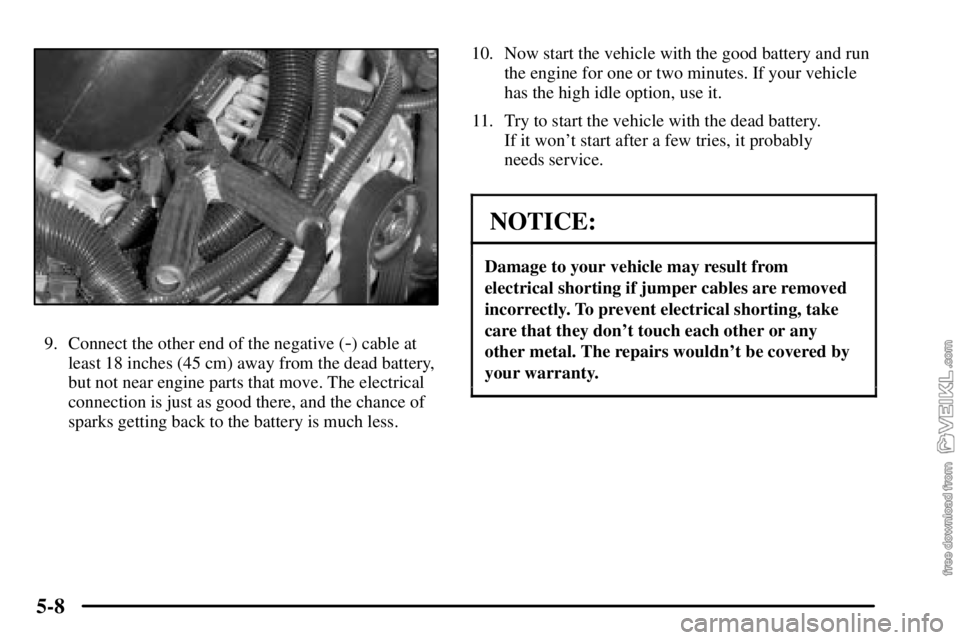
9. Connect the other end of the negative (-) cable at
least 18 inches (45 cm) away from the dead battery,
but not near engine parts that move. The electrical
connection is just as good there, and the chance of
sparks getting back to the battery is much less.10. Now start the vehicle with the good battery and run
the engine for one or two minutes. If your vehicle
has the high idle option, use it.
11. Try to start the vehicle with the dead battery.
If it won't start after a few tries, it probably
needs service.
NOTICE:
Damage to your vehicle may result from
electrical shorting if jumper cables are removed
incorrectly. To prevent electrical shorting, take
care that they don't touch each other or any
other metal. The repairs wouldn't be covered by
your warranty.
Page 234 of 386
5-9
Jumper Cable Removal
A. Heavy, Unpainted Metal Engine Part or Remote
Negative (
-) Terminal
B. Good Battery or Remote Positive (+) and Remote
Negative (
-) Terminals
C. Dead Battery or Remote Positive (+) TerminalTo disconnect the jumper cables from both vehicles, do
the following:
1. Disconnect the black negative (
-) cable from the
vehicle that had the dead battery.
2. Disconnect the black negative (
-) cable from the
vehicle with the good battery.
3. Disconnect the red positive (+) cable from the
vehicle with the good battery.
4. Disconnect the red positive (+) cable from the
other vehicle.
5. Return the positive (+) remote terminal cover to its
original position.
Page 306 of 386
6-52
Battery
Your new vehicle comes with one or more maintenance
free ACDelco� batteries. When it's time for a new
battery, be sure it has the replacement number shown
on the original battery's label. We recommend an
ACDelco battery.
WARNING: Battery posts, terminals and related
accessories contain lead and lead compounds, chemicals
known to the State of California to cause cancer and
reproductive harm. Wash hands after handling.
Vehicle Storage
If you're not going to drive your vehicle for 25 days or
more, remove the black, negative (
-) cable from the
battery. This will help keep your battery from running
down. (If your vehicle has more than one battery, be
sure to remove the negative (
-) battery cable from
each battery.)
CAUTION:
Batteries have acid that can burn you and gas
that can explode. You can be badly hurt if you
aren't careful. See ªJump Startingº in the Index
for tips on working around a battery without
getting hurt.
When you are ready to use the vehicle again, refer to the
engine starting procedure in the Index.
Contact your dealer to learn how to prepare your vehicle
for longer storage periods.