Page 267 of 386
6-13 Running Out of Fuel (Diesel Engines)
If the engine stalls and you think that you've run out of
fuel, do this:
CAUTION:
Diesel fuel is flammable. It could start a fire if it
gets on hot engine parts. You could be burned.
Don't let too much fuel flow from the air bleed
valve, and wipe up any spilled fuel with a cloth.
To restart your engine:
1. If you're parked on a level surface, add at least two
gallons of fuel to each fuel tank your vehicle may
have. However, if you're parked on a slope, you may
need to add up to five gallons of fuel.
2. Follow the fuel priming procedure earlier in this
section to prime the fuel filter.
3. Close the air bleed valve
4. Turn the ignition key to START for 10 to 15 seconds
at a time until your engine starts. If the engine tries
to run, but does not run smoothly, increase the rpm a
little using the accelerator pedal. This will help force
air through the system.
Page 268 of 386

6-14 Fuel Filter Replacement (Diesel Engines)
If you want to change the fuel filter yourself, here's how
to do it:
CAUTION:
Diesel fuel is flammable. It could start a fire if
something ignites it, and you could be burned.
Don't let it get on hot engine parts, and keep
matches or other ignition sources away.
First, drain any water from the filter following the
procedure for draining water listed previously.
Your vehicle's engine should be off until the end of
this procedure.
The fuel filter is located in the engine compartment on
the passenger's side of the vehicle, or on the driver's
side frame rail in front of the fuel tank.
1. Apply the parking brake.
2. Unplug the water sensor
wire connected to the
fuel filter and unscrew
the filter element.
3. Remove the filter element. If there is any dirt on the
filter sealing surface, clean it off. Remove and reuse
the water sensor float switch located on the bottom
of the fuel filter.
4. Install the new filter element.
5. Reinstall and tighten the filter container and
reconnect the water sensor wire to the filter.
6. Use the fuel filter priming procedure earlier in this
section to prime the fuel filter.
7. Tighten the air bleed valve by turning it clockwise
until hand tight.
8. Start your engine and let it idle for five minutes.
Check your fuel filter and air bleed valve for leaks.
Page 269 of 386
6-15
Fuels in Foreign Countries
(Gasoline Engines)
If you plan on driving in another country outside the
United States or Canada, the proper fuel may be hard to
find. Never use leaded gasoline or any other fuel not
recommended in the previous text on fuel. Costly repairs
caused by use of improper fuel wouldn't be covered by
your warranty.
To check on fuel availability, ask an auto club, or
contact a major oil company that does business in the
country where you'll be driving.
Filling Your Tank
C4/C5 Models
Page 270 of 386
6-16
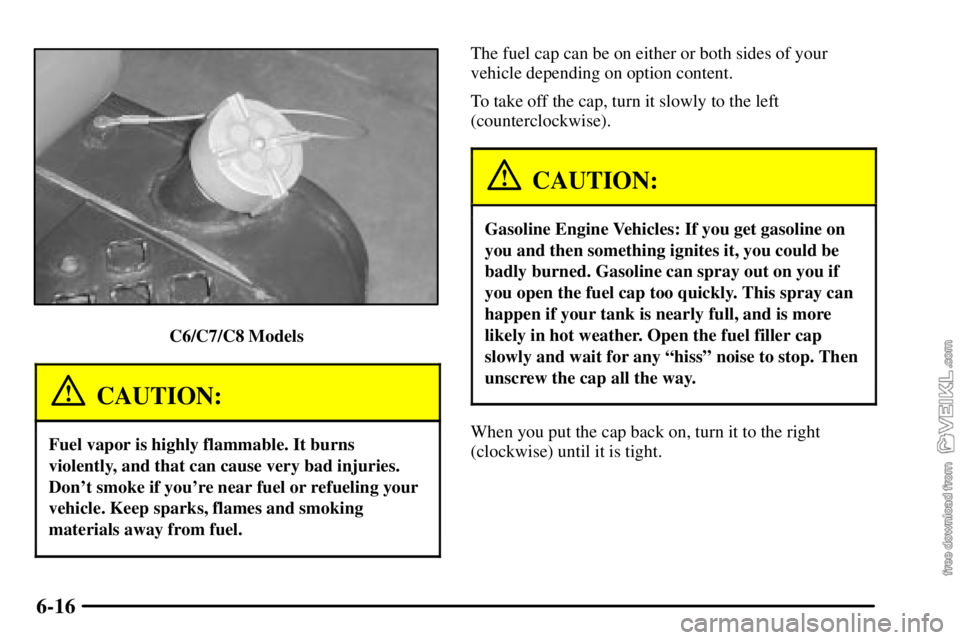
C6/C7/C8 Models
CAUTION:
Fuel vapor is highly flammable. It burns
violently, and that can cause very bad injuries.
Don't smoke if you're near fuel or refueling your
vehicle. Keep sparks, flames and smoking
materials away from fuel.
The fuel cap can be on either or both sides of your
vehicle depending on option content.
To take off the cap, turn it slowly to the left
(counterclockwise).
CAUTION:
Gasoline Engine Vehicles: If you get gasoline on
you and then something ignites it, you could be
badly burned. Gasoline can spray out on you if
you open the fuel cap too quickly. This spray can
happen if your tank is nearly full, and is more
likely in hot weather. Open the fuel filler cap
slowly and wait for any ªhissº noise to stop. Then
unscrew the cap all the way.
When you put the cap back on, turn it to the right
(clockwise) until it is tight.
Page 271 of 386
6-17
NOTICE:
If you need a new fuel cap, be sure to get the
right type. Your dealer can get one for you. If you
get the wrong type, it may not fit or have proper
venting, and your fuel tank and emissions system
might be damaged.
If you have dual tanks, fill the driver's side tank, or
forward tank, first. The fuel gage will give better
readings this way. Your gage will show the average level
of both tanks combined.
Filling a Portable Fuel Container
CAUTION:
Never fill a portable fuel container while it is in
your vehicle. Static electricity discharge from the
container can ignite the gasoline vapor. You can
be badly burned and your vehicle damaged if this
occurs. To help avoid injury to you and others:
�Dispense gasoline only into approved
containers.
�Do not fill a container while it is inside a
vehicle, in a vehicle's trunk, pickup bed or
on any surface other than the ground.
�Bring the fill nozzle in contact with the
inside of the fill opening before operating
the nozzle. Contact should be maintained
until the filling is complete.
�Don't smoke while pumping gasoline.
Page 272 of 386
6-18
Checking Things Under the Hood
CAUTION:
Things that burn can get on hot engine parts and
start a fire. These include liquids like fuel, oil,
coolant, brake fluid, windshield washer and other
fluids, and plastic or rubber. You or others could
be burned. Be careful not to drop or spill things
that will burn onto a hot engine.
Hood Latches
To tilt the hood forward, pull back and up on each of the
hood latches, located above the wheel wells on both
sides of the vehicle.
Page 276 of 386
6-22 Checking Engine Oil
It's a good idea to check your engine oil every time you
get fuel. In order to get an accurate reading, the oil must
be warm and the vehicle must be on level ground.
The engine oil dipstick
is located in the engine
compartment on the
driver's side of the vehicle.
Turn off the engine and give the oil several minutes to
drain back into the oil pan. If you don't, the oil dipstick
might not show the actual level.Pull out the dipstick and clean it with a paper towel or
cloth, then push it back in all the way. Remove it again,
keeping the tip down, and check the level.
Page 279 of 386

6-25
As in the chart shown previously, SAE 5W-30 is best for
your vehicle. However, you can use SAE 10W
-30 if it's
going to be 0�F (
-18�C) or above. These numbers on
an oil container show its viscosity, or thickness. Do not
use other viscosity oils, such as SAE 20W
-50.
NOTICE:
Use only engine oil with the American Petroleum
Institute Certified For Gasoline Engines
starburst symbol. Failure to use the
recommended oil can result in engine damage not
covered by your warranty.
GM Goodwrench� oil meets all the requirements for
your vehicle.
If you are in an area where the temperature falls
below
-20�F (-29�C), consider using either an
SAE 5W
-30 synthetic oil or an SAE 0W-30 oil. Both
will provide easier cold starting and better protection for
your engine at extremely low temperatures.
Engine Oil Additives
Don't add anything to your oil. The recommended oils
with the starburst symbol are all you will need for good
performance and engine protection.
When to Change Engine Oil
(GM Oil Life System�)
Your vehicle has a computer system that lets you know
when to change the engine oil and filter. This is based on
engine revolutions and engine temperature, and not on
mileage. Based on driving conditions, the mileage at
which an oil change will be indicated can vary
considerably. For the oil life system to work properly,
you must reset the system every time the oil is changed.
When the system has calculated that oil life has been
diminished, it will indicate that an oil change is
necessary. A change oil light will come on. Change your
oil as soon as possible within the next two times you
stop for fuel. It is possible that, if you are driving under
the best conditions, the oil life system may not indicate
that an oil change is necessary for over a year. However,
your engine oil and filter must be changed at least once
a year and at this time the system must be reset. It is also
important to check your oil regularly and keep it at the
proper level.
If the system is ever reset accidentally, you must change
your oil at 3,000 miles (5 000 km) since your last oil
change. Remember to reset the oil life system whenever
the oil is changed.