Page 20 of 386

1-13
Q:If I'm a good driver, and I never drive far from
home, why should I wear safety belts?
A:You may be an excellent driver, but if you're in an
accident
-- even one that isn't your fault -- you
and your passengers can be hurt. Being a good
driver doesn't protect you from things beyond your
control, such as bad drivers.
Most accidents occur within 25 miles (40 km)
of home. And the greatest number of serious
injuries and deaths occur at speeds of less
than 40 mph (65 km/h).
Safety belts are for everyone.
How to Wear Safety Belts Properly
Adults
This part is only for people of adult size.
Be aware that there are special things to know about
safety belts and children. And there are different rules
for smaller children and babies. If a child will be riding
in your vehicle, see the part of this manual called
ªChildren.º Follow those rules for everyone's
protection.
First, you'll want to know which restraint systems your
vehicle has.
We'll start with the driver position.
Driver Position
This part describes the driver's restraint system.
Lap-Shoulder Belt
The driver has a lap-shoulder belt. Here's how to wear
it properly.
1. Close and lock the door.
2. Adjust the seat so you can sit up straight. To see
how, see ªSeatsº in the Index.
Page 29 of 386
1-22
The best way to protect the fetus is to protect the
mother. When a safety belt is worn properly, it's more
likely that the fetus won't be hurt in a crash. For
pregnant women, as for anyone, the key to making
safety belts effective is wearing them properly.
Right Front Passenger Position
To learn how to wear the right front passenger's
safety belt properly, see ªDriver Positionº earlier
in this section.
The right front passenger's safety belt works the same
way as the driver's safety belt. If your vehicle has a
static seat in this position and if you ever pull the
shoulder portion of the belt out all the way, you will
engage the child restraint locking feature. If this
happens, just let the belt go back all the way and
start again.
Air Bag System
This part explains the air bag system.
Page 69 of 386
1-62
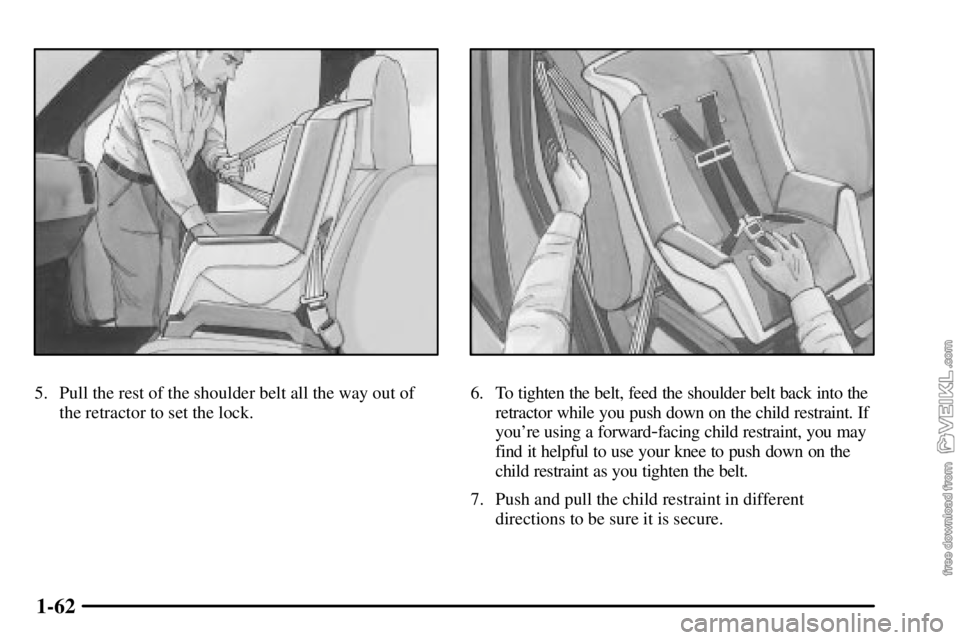
5. Pull the rest of the shoulder belt all the way out of
the retractor to set the lock.6. To tighten the belt, feed the shoulder belt back into the
retractor while you push down on the child restraint. If
you're using a forward
-facing child restraint, you may
find it helpful to use your knee to push down on the
child restraint as you tighten the belt.
7. Push and pull the child restraint in different
directions to be sure it is secure.
Page 82 of 386

2-7
Door Locks
CAUTION:
Unlocked doors can be dangerous.
�Passengers -- especially children -- can
easily open the doors and fall out of a
moving vehicle. When a door is locked, the
handle won't open it. You increase the
chance of being thrown out of the vehicle in
a crash if the doors aren't locked. So, wear
safety belts properly and lock the doors
whenever you drive.
�Young children who get into unlocked
vehicles may be unable to get out. A child
can be overcome by extreme heat and can
suffer permanent injuries or even death
from heat stroke. Always lock your vehicle
whenever you leave it.
�Outsiders can easily enter through an
unlocked door when you slow down or stop
your vehicle. Locking your doors can help
prevent this from happening.
There are several ways to lock and unlock your vehicle.
If your vehicle is equipped with keyless entry, you can
use your transmitter to lock or unlock your vehicle.
See ªKeyless Entry Systemº later in this section for
more information.
To lock or unlock your door from the outside, use
your key.
To lock your door from the
inside, slide the manual
lever on your door down.
To unlock the door, slide the
manual lever up.
Page 205 of 386

4-12 Steering in Emergencies
There are times when steering can be more effective
than braking. For example, you come over a hill and
find a truck stopped in your lane, or a car suddenly pulls
out from nowhere, or a child darts out from between
parked cars and stops right in front of you. You can
avoid these problems by braking
-- if you can stop
in time. But sometimes you can't; there isn't room.
That's the time for evasive action
-- steering around
the problem.
In emergencies like these, first apply your brakes. See
ªBraking in Emergenciesº earlier in this section. It is
better to remove as much speed as you can from a
possible collision. Then steer around the problem, to the
left or right depending on the space available. Since
your vehicle has anti
-lock brakes, you don't need to
release the brakes to maintain steering control.
An emergency like this requires close attention and a
quick decision. If you are holding the steering wheel at
the recommended 9 and 3 o'clock positions, you may be
able to turn it just enough to miss the object without
removing either hand. But you must act fast, steering
precisely. The more sharply you turn, the greater the
chance of a skid, a rollover or a ªjackknifeº with a
tractor
-trailer. Just as quickly straighten the wheel once
you have avoided the object.
The fact that such emergency situations are always
possible is a good reason to practice defensive driving at
all times and wear safety belts properly.