Page 236 of 386

5-11
Here are specific towing instructions:
Towing Your Vehicle From the Front
(Front Wheels Off the Ground)
Before Towing
Block the rear wheels of the disabled vehicle. On
vehicles with air brakes, release the emergency brake
system by compressing the brake chamber springs
as outlined in this section. (This is to prevent the
possibility of the emergency brake being applied
during towing.)
On vehicles with hydraulic brakes, release the parking
brake fully by moving the lever to the fully
-released
position.
Disconnect the propshaft at the rear axle (forward axle
on tandem axle models). Secure the propshaft to the
frame or crossmember.
Towing the Vehicle with the Front Bumper Removed
1. Remove the front bumper.
2. Connect and lock the lift chains to the front axle,
outside of the spring anchor plates as shown.
A. Spring Anchor Plate
B. Lift Chain
C. Front Axle
3. Place a 6º x 6º x 5' hardwood beam underneath and
slightly behind the front spring shackle brackets.
4. Connect the lift chains to the tow bar and raise the
tow bar until lift chain slack has been taken up and
the hardwood beam is fully seated against the spring
shackle brackets as shown.
Page 240 of 386

5-15 Towing Your Vehicle From the Front
(All Wheels On the Ground)
Your vehicle may be towed on all wheels provided the
steering is working. Remember that the power brakes
and power steering will not have power assist. Vehicles
with air brakes will not have brakes. There must be a
tow bar installed between the towing vehicle and the
disabled vehicle.
Before Towing
Block the wheels of the disabled vehicle. On vehicles
with air brakes, release the emergency brake system by
compressing the brake chamber springs as outlined in
this section. (This is to prevent the possibility of the
emergency brake being applied during towing.)
On vehicles with hydraulic brakes, release the parking
brake fully by moving the lever to the fully
-released
position.
Disconnect the propshaft at the rear axle (forward axle
on tandem axle models). Secure the propshaft to the
frame or crossmember.
If there is damage or suspected damage to the axle(s),
remove the axle shafts. Cover the hub openings to
prevent the loss of lubricant or entry of dirt or
foreign objects.After Towing
1. Block the rear wheels and install axle and propshafts.
2. Check for proper phasing of universal joints.
3. Apply the parking brake system before
disconnecting from the towing vehicle.
4. Check and fill with oil as required.
Towing Your Vehicle From the Rear
Before Towing
Secure the steering wheel to maintain a straight
-ahead
position. Make certain that the front axle is not loaded
above the front axle Gross Axle Weight Rating (GAWR)
as indicated on the vehicle's Gross Vehicle Weight
Rating (GVWR) label. See ªGross Vehicle Weight
Rating (GVWR)º in the index for more information.
After Towing
Block the rear wheels and release the steering. Apply the
parking brake system before disconnecting from the
towing vehicle.
Refer to the transmission shift label for additional
information.
Page 241 of 386
5-16 Releasing Air-Operated Parking Brakes
(If Equipped)
If your vehicle has air brakes, you could have a special
towing problem. If your vehicle has to be towed because
of a complete loss of air pressure from both systems, the
parking brakes will have automatically engaged. The
tow operator can release the brakes manually by using
the following steps. Then your vehicle can be towed
with all wheels or only the rear wheels on the ground.
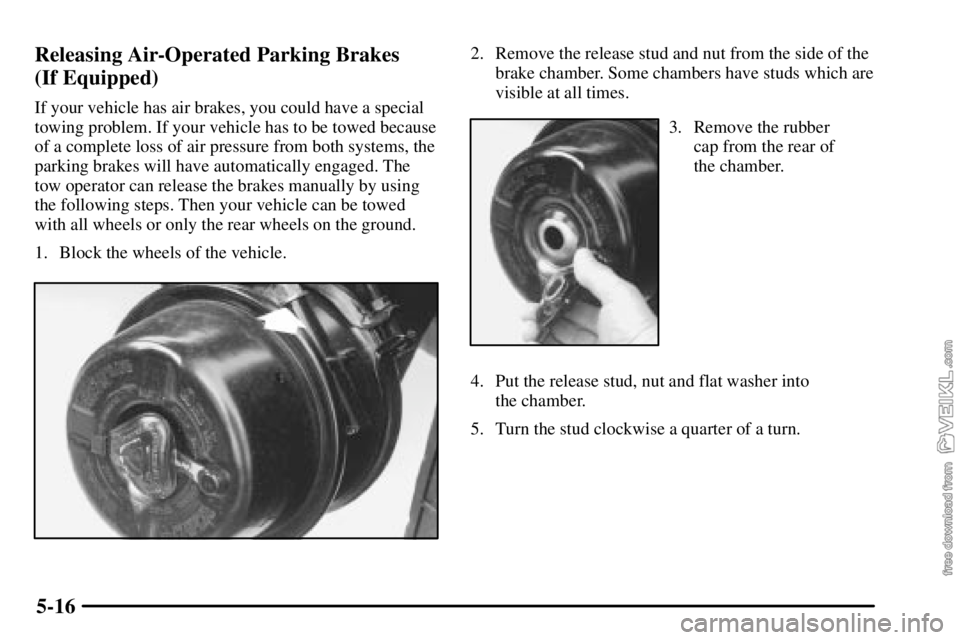
1. Block the wheels of the vehicle.
2. Remove the release stud and nut from the side of the
brake chamber. Some chambers have studs which are
visible at all times.
3. Remove the rubber
cap from the rear of
the chamber.
4. Put the release stud, nut and flat washer into
the chamber.
5. Turn the stud clockwise a quarter of a turn.
Page 242 of 386
5-17
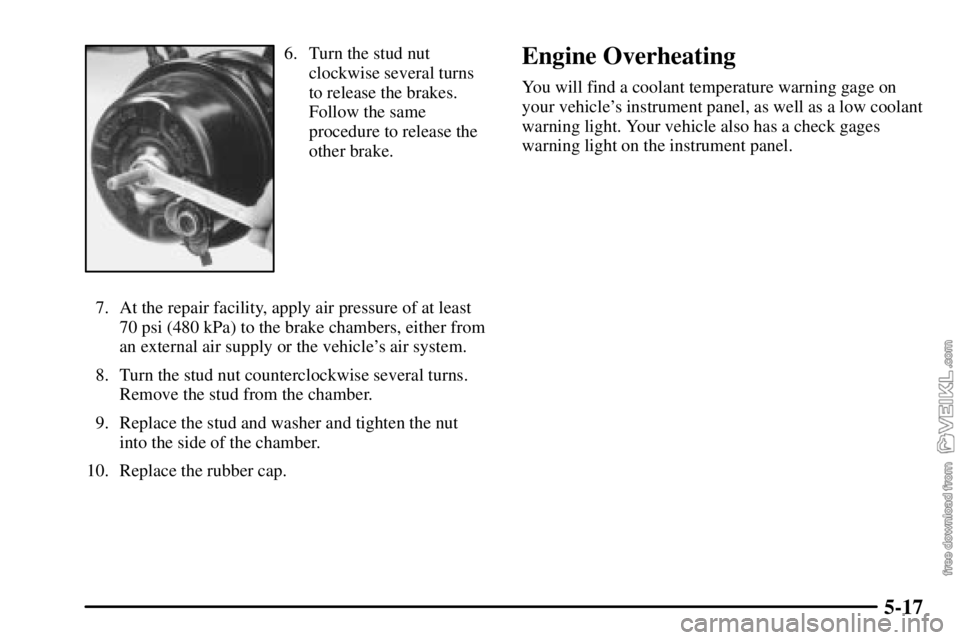
6. Turn the stud nut
clockwise several turns
to release the brakes.
Follow the same
procedure to release the
other brake.
7. At the repair facility, apply air pressure of at least
70 psi (480 kPa) to the brake chambers, either from
an external air supply or the vehicle's air system.
8. Turn the stud nut counterclockwise several turns.
Remove the stud from the chamber.
9. Replace the stud and washer and tighten the nut
into the side of the chamber.
10. Replace the rubber cap.Engine Overheating
You will find a coolant temperature warning gage on
your vehicle's instrument panel, as well as a low coolant
warning light. Your vehicle also has a check gages
warning light on the instrument panel.
Page 255 of 386

6-
6-1
Section 6 Service and Appearance Care
Here you will find information about the care of your vehicle. This section begins with service and fuel information,
and then it shows how to check important fluid and lubricant levels. There is also technical information about your
vehicle, and a part devoted to its appearance care.
6
-2 Service
6
-4 Fuel (Gasoline Engine)
6
-5 Diesel Fuel Requirements and Fuel System
6
-15 Fuels in Foreign Countries (Gasoline Engines)
6
-15 Filling Your Tank
6
-17 Filling a Portable Fuel Container
6
-18 Checking Things Under the Hood
6
-20 Noise Control System
6
-21 Engine Oil (Gasoline Engines)
6
-27 Engine Oil (Caterpillar� Diesel Engines)
6
-27 Engine Oil (DURAMAX� Diesel)
6
-30 Engine Air Cleaner/Filter
6
-32 Automatic Transmission Fluid
6
-32 Manual Transmission Fluid
6
-34 Rear Axle
6
-34 Rear Axle Shift Motor (Option)
6
-35 Engine Coolant
6
-38 Engine Coolant (Caterpillar� Diesel Engine)6
-38 Surge Tank Pressure Cap
6
-39 Power Steering Fluid
6
-40 Windshield Washer Fluid
6
-41 Brakes
6
-52 Battery
6
-54 Other Service Items
6
-58 Tires
6
-67 Appearance Care
6
-68 Cleaning the Inside of Your Vehicle
6
-71 Cleaning the Outside Your Vehicle
6
-75 GM Vehicle Care/Appearance Materials
6
-76 Vehicle Identification Number (VIN)
6
-76 Service Statement
6
-77 Service Parts Identification Label
6
-77 Electrical System
6
-86 Capacities and Specifications
6
-90 Normal Maintenance Replacement Parts
Page 295 of 386

6-41
NOTICE:
�When using concentrated washer fluid,
follow the manufacturer's instructions for
adding water.
�Don't mix water with ready
-to-use washer
fluid. Water can cause the solution to freeze
and damage your washer fluid tank and
other parts of the washer system. Also,
water doesn't clean as well as washer fluid.
�Fill your washer fluid tank only
three
-quarters full when it's very cold.
This allows for expansion if freezing occurs,
which could damage the tank if it is
completely full.
�Don't use engine coolant (antifreeze) in
your windshield washer. It can damage
your washer system and paint.
Brakes
Brake Fluid
If your vehicle has hydraulic brakes, there's a brake
master cylinder. Refer to the Maintenance Schedule to
determine when to check your brake fluid.
CAUTION:
Don't add brake fluid before you check the level.
If you do, you could get too much brake fluid.
Brake fluid could spill on the hot engine and it
can catch fire. You could be burned and your
vehicle could be damaged. See ªChecking Brake
Fluidº in this section.
Page 297 of 386
6-43
What to Add
Use the proper fluid listed in your Maintenance
Schedule. Use new brake fluid from a sealed
container only.
Always clean the brake fluid reservoir cap/cover and the
area around the cap/cover before removing it. This will
help keep dirt from entering the reservoir.
CAUTION:
With the wrong kind of fluid in your brake
system, your brakes may not work well, or they
may not even work at all. This could cause a
crash. Always use the proper brake fluid.
NOTICE:
�Using the wrong fluid can badly damage
brake system parts. For example, just a few
drops of mineral
-based oil, such as engine
oil, in your brake system can damage brake
system parts so badly that they'll have to be
replaced. Don't let someone put in the
wrong kind of fluid, and don't use DOT
-5
silicone brake fluid.
�If you spill brake fluid on your vehicle's
painted surfaces, the paint finish can be
damaged. Be careful not to spill brake fluid
on your vehicle. If you do, wash it off
immediately. See ªAppearance Careº in
the Index.
Page 298 of 386
6-44 Four-Wheel Disc Brakes (Hydraulic Only)
Your vehicle has four-wheel disc brakes.
Some driving conditions or climates may cause a brake
squeal when the brakes are first applied or lightly
applied. This does not mean something is wrong with
your brakes.
Brake linings should always be replaced as complete
axle sets.
Four-Wheel and Six-Wheel Drum Brakes
(Air Only)
The brake drums should be removed and inspected each
time the tires are removed for rotation or changing.
When you have the front brakes replaced, have the rear
brakes inspected, too.
Brake linings should always be replaced as complete
axle sets.