Page 155 of 386

2-80 Range Inhibited Warning Indicator
(If Equipped)
If your vehicle is equipped with an Allison
1000/2000/2400 series automatic transmission, a lighted
bar under the current gear selected will flash.
If your vehicle is equipped with an Allison MD
automatic transmission, the current gear selected on
the pushbutton display will flash.
The flashing bar or gear selection indicates that
transmission range shifts may not occur.
For detailed information on shift inhibit limitations, see
the Allison Automatic Transmission Operator's Manual
in your vehicle for further information.
Brake System Warning Light
Your vehicle has either hydraulic or air brakes.
Each system has different warning lights.
Hydraulic Brake System Warning Lights
Vehicles with hydraulic systems have two brake system
warning lights on the instrument panel.
If the BRAKE warning light
comes on, it means that the
fluid level in the master
cylinder reservoir is low or
there is another problem
with your hydraulic brakes.
When it comes on, you will also hear a warning tone.
The BRAKE warning light may come on, and the
warning tone may sound, when you're turning and
braking at the same time. This is normal. See ªHydraulic
Brake Systemsº in the Index.
Page 156 of 386

2-81
If the amber SERVICE
BRAKES SOON warning
light comes on, it means
that there is something
wrong in the brake system.
When this light comes on, you will also hear a warning
tone. If this light comes on, have the system repaired
immediately.
Both of these lights should come on briefly every time
you start the engine. If they don't come on then, have
them fixed so they will be ready to warn you if there's a
problem. If one or both of these warning lights stay on
after you start the engine, there could be a brake
problem. Have your brake system inspected right away.If one or both of these lights come on and stay on while
you are driving, pull off the road and stop carefully. You
may notice that the pedal is harder to push. Or, the pedal
may go closer to the floor. It may take longer to stop. If
the BRAKE light is still on, have the vehicle towed for
service. See ªTowing Your Vehicleº in the Index. See
ªHydraulic Brake Systemsº in the Index for more
information.
CAUTION:
Your brake system may not be working properly
if a brake system warning light is on. Driving
with a brake system warning light on can lead to
an accident. If the light is still on after you've
pulled off the road and stopped carefully, have
the vehicle towed for service.
Page 158 of 386

2-83 Parking Brake Indicator Light
Your vehicle has a brake
indicator light. When the
ignition is on, this light will
come on when you set your
parking brake. The light
will stay on if your parking
brake doesn't release fully.
This light should also come on when you turn the
ignition key to START. If it doesn't come on then, have
it fixed so it will be ready to remind you if the parking
brake is applied or hasn't released fully.
Anti-Lock Brake System Warning Light
With the anti-lock brake
system, this light will come
on when you start your
engine and it may stay
on for several seconds.
That's normal.
If the light stays on, or comes on when you're driving,
your vehicle needs service. If the BRAKE or LOW AIR
warning light isn't on, you still have brakes, but you
don't have the anti
-lock brake feature. If the BRAKE
and/or LOW AIR warning light is on, you don't have
anti
-lock brakes and there's a problem with your regular
brakes. See ªBrake System Warning Lightº earlier in
this section.
The anti
-lock brake system warning light should come
on briefly when you start the engine. If the light doesn't
come on then, have it fixed so it will be ready to warn
you if there is a problem.
Page 169 of 386

2-94 Air Pressure Gage (If Equipped)
If your vehicle has air
brakes, the air pressure gage
is located above the
switchbank in the center of
the instrument panel.
This gage shows the air pressure for both your front and
rear brake systems.
If the needle on the gage indicates that the air pressure is
below 60 to 75 psi (415 to 517 kPa), the low air warning
light will come on. An alarm will also sound if this
happens.
The yellow pointer shows the pressure available for the
front system, while the green pointer shows pressure for
the rear. There should be no more than 4 psi (28 kPa)
difference showing between the systems.
Don't drive until both pointers are showing at least
115 psi (793 kPa), so you'll have enough air if you
need to apply your brakes.
Air Filter Restriction Indicator (Option)
This optional gage is
located above the
switchbank in the center
of the instrument panel.
It monitors the engine
air filter.
As the filter gets dirty, the yellow indicator will begin to
rise. When it reaches 25 inches of vacuum on the scale,
the filter should be replaced.
After replacing the filter, reset the gage by pressing in
the yellow reset button at the bottom of the gage.
If you have a diesel engine, also see your Caterpillar
�
Operation & Maintenance Manual.
Page 199 of 386

4-6
Control of a Vehicle
You have three systems that make your vehicle go where
you want it to go. They are the brakes, the steering and
the accelerator. All three systems have to do their work
at the places where the tires meet the road.
Sometimes, as when you're driving on snow or ice, it's
easy to ask more of those control systems than the tires
and road can provide. That means you can lose control
of your vehicle.
Braking
Braking action involves perception time and
reaction time.
First, you have to decide to push on the brake pedal.
That's perception time. Then you have to bring up your
foot and do it. That's reaction time.
Average reaction time is about 3/4 of a second. But
that's only an average. It might be less with one driver
and as long as two or three seconds or more with
another. Age, physical condition, alertness, coordination
and eyesight all play a part. So do alcohol, drugs and
frustration. But even in 3/4 of a second, a vehicle
moving at 60 mph (100 km/h) travels 66 feet (20 m).
That could be a lot of distance in an emergency, so
keeping enough space between your vehicle and others
is important.
And, of course, actual stopping distances vary greatly
with the surface of the road (whether it's pavement or
gravel); the condition of the road (wet, dry, icy); tire
tread; the condition of your brakes; the weight of the
vehicle and the amount of brake force applied.
Page 200 of 386

4-7
Avoid needless heavy braking. Some people drive in
spurts
-- heavy acceleration followed by heavy
braking
-- rather than keeping pace with traffic. This is a
mistake. Your brakes may not have time to cool between
hard stops. Your brakes will wear out much faster if you
do a lot of heavy braking. If you keep pace with the
traffic and allow realistic following distances, you will
eliminate a lot of unnecessary braking. That means
better braking and longer brake life.
If your engine ever stops while you're driving, brake
normally but don't pump your brakes. If you do, the
pedal may get harder to push down. If your engine
stops, you will still have some power brake assist. But
you will use it when you brake. Once the power assist is
used up, it may take longer to stop and the brake pedal
will be harder to push.
Hydraulic Brake Systems
If your engine stops running, or if your primary brake
system stops working, your vehicle has a reserve power
assist system to help you slow down. Just slowly and
steadily apply the brake pedal until you can safely get
off the road. The pedal will seem harder to push down.
Don't pump the pedal; the system won't work well or at
all that way.
You may find that the steering wheel seems hard to turn
when you're turning and braking at the same time. Also,
the PRIMARY BRAKE warning light may come on and
the warning tone may sound. This is normal because the
main hydraulic brake system and power steering both
use the power steering pump. If this ever happens, let up
on the brake pedal a little. When you let up on the brake
pedal in that situation, it lets the steering get a little
more help from the pump.
Page 201 of 386
4-8 Anti-Lock Brake System (ABS)
Your vehicle has anti-lock brakes. ABS is an advanced
electronic braking system that will help prevent a
braking skid.
When you start your engine and begin to drive away,
your anti
-lock brake system will check itself. You may
hear a momentary motor or clicking noise while this test
is going on. This is normal.
If there's a problem with the
anti
-lock brake system, this
warning light will stay on.
See ªAnti
-Lock Brake
System Warning Lightº in
the Index.
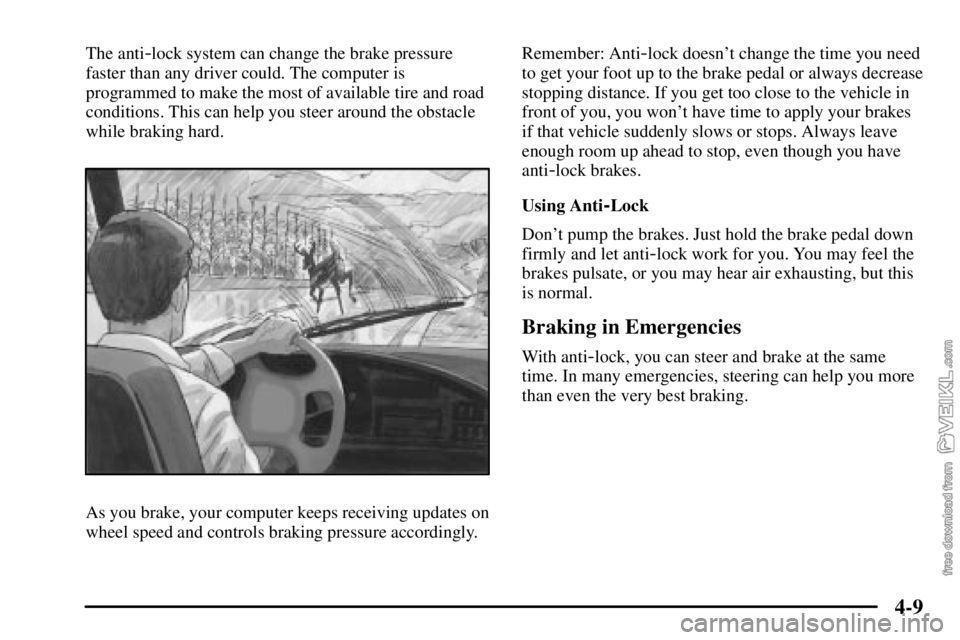
Let's say the road is wet and you're driving safely.
Suddenly, an animal jumps out in front of you. You slam
on the brakes and continue braking. Here's what
happens with ABS:
A computer senses that wheels are slowing down. If one
of the wheels is about to stop rolling, the computer will
separately work the brakes at each wheel.
Page 202 of 386
4-9
The anti-lock system can change the brake pressure
faster than any driver could. The computer is
programmed to make the most of available tire and road
conditions. This can help you steer around the obstacle
while braking hard.
As you brake, your computer keeps receiving updates on
wheel speed and controls braking pressure accordingly.Remember: Anti
-lock doesn't change the time you need
to get your foot up to the brake pedal or always decrease
stopping distance. If you get too close to the vehicle in
front of you, you won't have time to apply your brakes
if that vehicle suddenly slows or stops. Always leave
enough room up ahead to stop, even though you have
anti
-lock brakes.
Using Anti
-Lock
Don't pump the brakes. Just hold the brake pedal down
firmly and let anti
-lock work for you. You may feel the
brakes pulsate, or you may hear air exhausting, but this
is normal.
Braking in Emergencies
With anti-lock, you can steer and brake at the same
time. In many emergencies, steering can help you more
than even the very best braking.
