Page 166 of 386
2-91 Exhaust Brake Indicator Light
(If Equipped)
If your vehicle is equipped
with an exhaust brake, you
will have this light, located
above the comfort controls
in the center of the
instrument panel.
The exhaust brake indicator light will come on and stay
on whenever the diesel engine exhaust brake or exhaust
restrictor is active. For more information, see ªDiesel
Engine Exhaust Brakeº in the Index.
Diff Lock Indicator Light (If Equipped)
This light located in the
center of the instrument
panel is on when the
inter
-axle differential
lock system is in use.
The light will come on momentarily during starting.
If the light fails to come on, have it repaired as soon
as possible so you will be aware when the lock system
is in use.
Page 169 of 386

2-94 Air Pressure Gage (If Equipped)
If your vehicle has air
brakes, the air pressure gage
is located above the
switchbank in the center of
the instrument panel.
This gage shows the air pressure for both your front and
rear brake systems.
If the needle on the gage indicates that the air pressure is
below 60 to 75 psi (415 to 517 kPa), the low air warning
light will come on. An alarm will also sound if this
happens.
The yellow pointer shows the pressure available for the
front system, while the green pointer shows pressure for
the rear. There should be no more than 4 psi (28 kPa)
difference showing between the systems.
Don't drive until both pointers are showing at least
115 psi (793 kPa), so you'll have enough air if you
need to apply your brakes.
Air Filter Restriction Indicator (Option)
This optional gage is
located above the
switchbank in the center
of the instrument panel.
It monitors the engine
air filter.
As the filter gets dirty, the yellow indicator will begin to
rise. When it reaches 25 inches of vacuum on the scale,
the filter should be replaced.
After replacing the filter, reset the gage by pressing in
the yellow reset button at the bottom of the gage.
If you have a diesel engine, also see your Caterpillar
�
Operation & Maintenance Manual.
Page 200 of 386

4-7
Avoid needless heavy braking. Some people drive in
spurts
-- heavy acceleration followed by heavy
braking
-- rather than keeping pace with traffic. This is a
mistake. Your brakes may not have time to cool between
hard stops. Your brakes will wear out much faster if you
do a lot of heavy braking. If you keep pace with the
traffic and allow realistic following distances, you will
eliminate a lot of unnecessary braking. That means
better braking and longer brake life.
If your engine ever stops while you're driving, brake
normally but don't pump your brakes. If you do, the
pedal may get harder to push down. If your engine
stops, you will still have some power brake assist. But
you will use it when you brake. Once the power assist is
used up, it may take longer to stop and the brake pedal
will be harder to push.
Hydraulic Brake Systems
If your engine stops running, or if your primary brake
system stops working, your vehicle has a reserve power
assist system to help you slow down. Just slowly and
steadily apply the brake pedal until you can safely get
off the road. The pedal will seem harder to push down.
Don't pump the pedal; the system won't work well or at
all that way.
You may find that the steering wheel seems hard to turn
when you're turning and braking at the same time. Also,
the PRIMARY BRAKE warning light may come on and
the warning tone may sound. This is normal because the
main hydraulic brake system and power steering both
use the power steering pump. If this ever happens, let up
on the brake pedal a little. When you let up on the brake
pedal in that situation, it lets the steering get a little
more help from the pump.
Page 201 of 386
4-8 Anti-Lock Brake System (ABS)
Your vehicle has anti-lock brakes. ABS is an advanced
electronic braking system that will help prevent a
braking skid.
When you start your engine and begin to drive away,
your anti
-lock brake system will check itself. You may
hear a momentary motor or clicking noise while this test
is going on. This is normal.
If there's a problem with the
anti
-lock brake system, this
warning light will stay on.
See ªAnti
-Lock Brake
System Warning Lightº in
the Index.
Let's say the road is wet and you're driving safely.
Suddenly, an animal jumps out in front of you. You slam
on the brakes and continue braking. Here's what
happens with ABS:
A computer senses that wheels are slowing down. If one
of the wheels is about to stop rolling, the computer will
separately work the brakes at each wheel.
Page 203 of 386

4-10
Traction Control System (TCS)
(Option)
Your vehicle may have a traction control system that
limits wheel spin. This is especially useful in slippery
road conditions. The system operates only if it senses
that one or both of the rear wheels are spinning or
beginning to lose traction. When this happens, the
system applies the brake(s) at the affected wheel(s).
The bottom light on the TCS on/off button will come on
when the TCS is limiting wheel spin. You may feel or
hear the system working, but this is normal. The TCS
will function at speeds up to about 25 mph (42 km/h).
The TCS may operate on dry roads under some
conditions. When this happens, you may notice a
reduction in acceleration. This is normal and doesn't
mean there's a problem with your vehicle. Examples of
these conditions include a hard acceleration in a turn, an
abrupt upshift or downshift of the transmission or
driving on rough roads.
When the light in the top of the TCS button is on, the
TCS is off and will not limit wheel spin. Adjust your
driving accordingly.
The light in the top of the TCS button will come on if
the TCS is turned off by pressing the TCS on/off button.The light may also come on if a problem has been
detected in either the traction control system or the
anti
-lock brake system.
The traction control system automatically comes on
whenever you start your vehicle. To limit wheel spin,
especially in slippery road conditions, you should
always leave the system on. But you can turn the
traction control system off if you ever need to. You
should turn the system off if your vehicle ever gets stuck
in sand, mud or snow and rocking the vehicle is
required. See ªRocking Your Vehicleº in the Index.
To turn the system on
or off, press the traction
control button located in
the instrument panel
switchbank.
If you used the TCS button to turn the system off, the
light in the top of the button will come on and stay on.
You can turn the TCS back on at any time by pressing
the button again; the light should go off.
Page 212 of 386
4-19
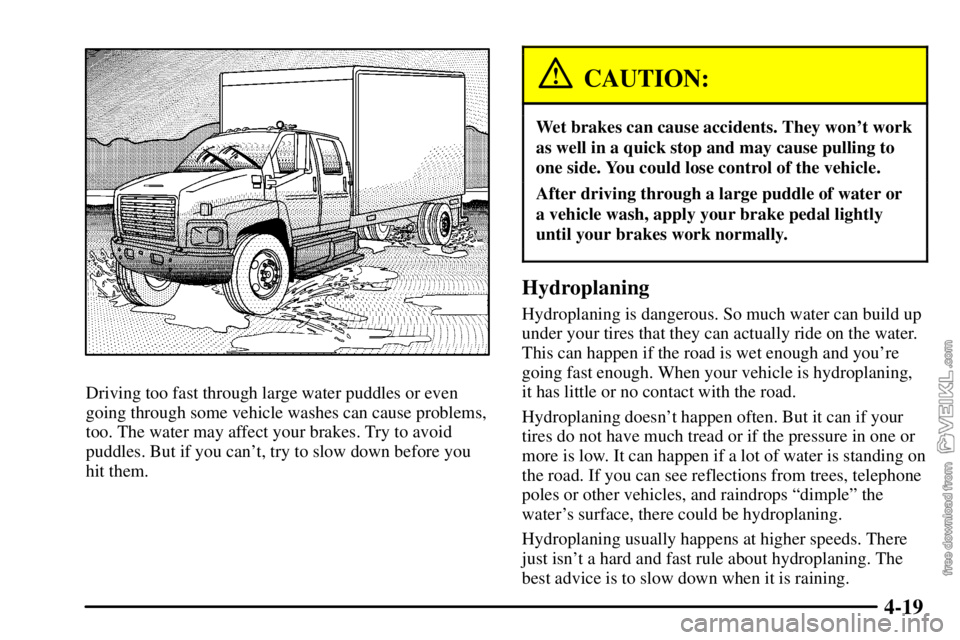
Driving too fast through large water puddles or even
going through some vehicle washes can cause problems,
too. The water may affect your brakes. Try to avoid
puddles. But if you can't, try to slow down before you
hit them.
CAUTION:
Wet brakes can cause accidents. They won't work
as well in a quick stop and may cause pulling to
one side. You could lose control of the vehicle.
After driving through a large puddle of water or
a vehicle wash, apply your brake pedal lightly
until your brakes work normally.
Hydroplaning
Hydroplaning is dangerous. So much water can build up
under your tires that they can actually ride on the water.
This can happen if the road is wet enough and you're
going fast enough. When your vehicle is hydroplaning,
it has little or no contact with the road.
Hydroplaning doesn't happen often. But it can if your
tires do not have much tread or if the pressure in one or
more is low. It can happen if a lot of water is standing on
the road. If you can see reflections from trees, telephone
poles or other vehicles, and raindrops ªdimpleº the
water's surface, there could be hydroplaning.
Hydroplaning usually happens at higher speeds. There
just isn't a hard and fast rule about hydroplaning. The
best advice is to slow down when it is raining.
Page 229 of 386

5-4
If you have a diesel engine vehicle with two batteries
(or more), you should know before you begin that,
especially in cold weather, you may not be able to
get enough power from a single battery in another
vehicle to start your diesel engine.
If your vehicle has more than one battery, use the
one closest to the starter
-- this will reduce electrical
resistance.
2. Get the vehicles close enough so the jumper cables
can reach, but be sure the vehicles aren't touching
each other. If they are, it could cause a ground
connection you don't want. You wouldn't be able to
start your vehicle, and the bad grounding could
damage the electrical systems.
To avoid the possibility of the vehicles rolling, set
the parking brake firmly on both vehicles involved in
the jump start procedure. Put an automatic
transmission in PARK (P) or a manual transmission
in neutral before setting the parking brake.
NOTICE:
If you leave your radio on, it could be badly
damaged. The repairs wouldn't be covered by
your warranty.
3. Turn off the ignition on both vehicles. Unplug
unnecessary accessories plugged into the cigarette
lighter or accessory power outlets. Turn off the radio
and all lamps that aren't needed. This will avoid
sparks and help save both batteries, and it could save
your radio!
Page 236 of 386

5-11
Here are specific towing instructions:
Towing Your Vehicle From the Front
(Front Wheels Off the Ground)
Before Towing
Block the rear wheels of the disabled vehicle. On
vehicles with air brakes, release the emergency brake
system by compressing the brake chamber springs
as outlined in this section. (This is to prevent the
possibility of the emergency brake being applied
during towing.)
On vehicles with hydraulic brakes, release the parking
brake fully by moving the lever to the fully
-released
position.
Disconnect the propshaft at the rear axle (forward axle
on tandem axle models). Secure the propshaft to the
frame or crossmember.
Towing the Vehicle with the Front Bumper Removed
1. Remove the front bumper.
2. Connect and lock the lift chains to the front axle,
outside of the spring anchor plates as shown.
A. Spring Anchor Plate
B. Lift Chain
C. Front Axle
3. Place a 6º x 6º x 5' hardwood beam underneath and
slightly behind the front spring shackle brackets.
4. Connect the lift chains to the tow bar and raise the
tow bar until lift chain slack has been taken up and
the hardwood beam is fully seated against the spring
shackle brackets as shown.