Page 242 of 386
5-17
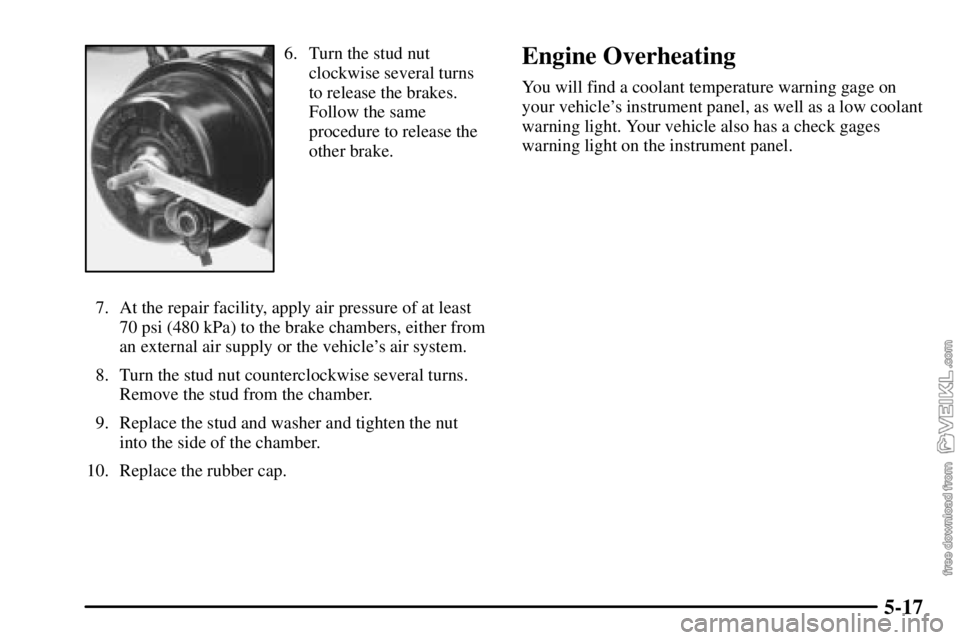
6. Turn the stud nut
clockwise several turns
to release the brakes.
Follow the same
procedure to release the
other brake.
7. At the repair facility, apply air pressure of at least
70 psi (480 kPa) to the brake chambers, either from
an external air supply or the vehicle's air system.
8. Turn the stud nut counterclockwise several turns.
Remove the stud from the chamber.
9. Replace the stud and washer and tighten the nut
into the side of the chamber.
10. Replace the rubber cap.Engine Overheating
You will find a coolant temperature warning gage on
your vehicle's instrument panel, as well as a low coolant
warning light. Your vehicle also has a check gages
warning light on the instrument panel.
Page 293 of 386

6-39
Power Steering Fluid
See your Maintenance Schedule for when to check your
power steering fluid.
How To Check Power Steering Fluid
Check your power steering fluid only when the engine is
warm. If the engine isn't warm, you probably won't get
an accurate reading.
If the fluid level is
between the MIN and
MAX marks, you have
enough. If you need
fluid, add only enough
of the proper fluid to
bring it into view in
the sight glass.If your power steering fluid level is low, this can cause
the BRAKE or service brake soon warning lights to
come on. If either light remains on after you have added
power steering fluid to the proper level, then shut off the
engine for 10 seconds. This should reset the brake
warning lights. If one or both lights stay on though, see
ªHydraulic Brake Warning Lightsº in the Index.
What to Use
To determine what kind of fluid to use, see
ªRecommended Fluids and Lubricantsº in the Index.
NOTICE:
When adding power steering fluid or making a
complete fluid change, always use the proper
fluid. Failure to use the proper fluid can cause
leaks and damage hoses and seals.
Page 298 of 386
6-44 Four-Wheel Disc Brakes (Hydraulic Only)
Your vehicle has four-wheel disc brakes.
Some driving conditions or climates may cause a brake
squeal when the brakes are first applied or lightly
applied. This does not mean something is wrong with
your brakes.
Brake linings should always be replaced as complete
axle sets.
Four-Wheel and Six-Wheel Drum Brakes
(Air Only)
The brake drums should be removed and inspected each
time the tires are removed for rotation or changing.
When you have the front brakes replaced, have the rear
brakes inspected, too.
Brake linings should always be replaced as complete
axle sets.
Page 332 of 386

6-78 Headlamp Wiring
The headlamp wiring is protected by a circuit breaker in
the light switch. An electrical overload will cause the
lights to go on and off, or in some cases to remain off.
If this happens, have your headlamp wiring checked
right away.
Windshield Wiper Fuses
The windshield wiper motor is protected by a circuit
breaker inside the motor and a circuit breaker or fuse in
the fuse block. If the motor overheats, the wipers will
stop until the motor cools. If the overload is caused by
an electrical problem, be sure to get it fixed.
Fusible Links
A fusible link is a short piece of wire several gauge sizes
smaller than the circuit it protects. It will melt in an
overload situation, opening the circuit.
Your starter and other circuits have these fusible links.
The size is printed on the insulation. If the insulation is
burned beyond recognition, consult your GM dealer for
the proper size. Replace a fusible link with one of the
same size and insulation type. Fusible link insulation is a
special purpose high
-temperature material.
The hydraulic brake booster motor feed circuit and
starter circuit are protected by a fusible link. Vehicles
with a diesel engine have a fusible link for the intake
heater feed circuit.
Page 336 of 386
6-82
Fuse Block 2
Circuit Breaker Usage
1 Stoplamps
2 Center High Mounted Stop Lamp
3 Parking Lamps
4 Powertrain Control Module
5 Auxiliary Wiring
6 Heater/Air ConditioningCircuit Breaker Usage
7 Hazard Warning Flashers
8 Power Post
9 Courtesy Lamps
10 Warning Lights, Gages
and Indicators
11 Crank
12 Rear Axle
13 Trailer Turn Signals/Hazard
Warning Flashers
14 Radio/Chime
15 Daytime Running Lamps
16 Air Bag System
17 Exterior/Interior Lamps
18 Parking Brake
19 Accessory Power
20 Ignition
21 Sidemarker Lamps
22 Turn Signal/Backup Lamps
23 Transmission
24 Chassis
A Spare
B Spare
Page 339 of 386
6-85
Fuse Usage
BLANK Empty
A/C COMP Air Conditioning Compressor
ABS 1 Anti
-Lock Brake System 1
ABS 2 Anti
-Lock Brake System 2
ABS 3 Anti
-Lock Brake System 3
ENGINE Engine
E/A PUMP Electronic/Automatic Pump
HORN Horn
NOTE 2 L18/LB7 Fuel, LG4 Powertrain
Control Valve, LG5 Electronic
Control Module
BLANK Empty
STUD A Spare
STUD B Spare
Secondary Underhood Fuse Block
Fuse Usage
IGN 1 Ignition 1
IGN 4 Ignition 4
IGN 3 Ignition 3
BATT/HAZ Battery/Hazard Warning Flashers
HEADLAMP Headlamps
LIGHTING Interior/Exterior Lamps
HVAC Comfort Control System
NOTE C4/C5 Electric Brake,
C6/C7/C8 Brake Lamps
Page 362 of 386

7-16
Footnotes
� = The U.S. Environmental Protection Agency or the
California Air Resources Board has determined that the
failure to perform this maintenance item will not nullify
the emission warranty or limit recall liability prior to the
completion of the vehicle's useful life. We, however,
urge that all recommended maintenance services be
performed at the indicated intervals and the maintenance
be recorded.
(1) = If your vehicle has an Allison automatic
transmission, your GM owner's manual is supplemented
by an Allison Transmission Operator's Manual. Always
refer to these manuals for related maintenance services.
(2) = Refer to the Caterpillar Diesel Engine Operation
and Maintenance Manual for oil recommendations and
change intervals.
(3) = An Emission Control Service.
(4) = A Noise Emission Control Device.
(5) = Applies only to vehicles sold in the United States.(6) = Check fluid level in brake master cylinder, power
steering pump, axle, transmission and hydraulic spring
parking brake pump (if equipped). A low fluid level in
the brake master cylinder can indicate worn brake
linings and should be checked accordingly.
(7) = Inspect brake lines and hoses for proper hook
-up,
binding, leaks, cracks, chafing, etc. Inspect disc brake
pads for wear and rotors for surface condition. Inspect
caliper assemblies. Check brake pedal for excessive free
play or travel (or every 6 months, whichever occurs first)
and have serviced if needed. Check brakes more often if
driving habits and conditions result in frequent braking.
(8) = Inspect parking brake drum and linings for wear or
cracks and check linkage and adjustment.
(9) = This vehicle has the GM Oil Life System. This
system will show you when to change the engine oil and
filter
-- usually between 3,000 miles (5 000 km) and
7,500 miles (12 000 km) since your last oil change.
Under severe conditions, the indicator may come on
before 3,000 miles (5 000 km). Never drive your vehicle
more than 7,500 miles (12 000 km) or 12 months
without an oil and filter change.
Remember to reset the Oil Life System whenever the oil
is changed. For more information, see ªChange Oil
Lightº in the Index.
Page 371 of 386

7-25
Defroster Check
Move the control to the defrost symbol and the fan to
HI or the high symbol. Then check the airflow from the
ducts at the inside base of the windshield.
Mirrors and Sun Visors Check
Check that friction joints hold mirrors and sun visors
in place.
Seat Adjuster Check
When adjusting a manual seat, be sure seat adjusters
latch by attempting to move the seat after latching.
Lamps Check
Check panel lighting, warning lights, indicator lights
and interior lamps. On the outside, check: license plate
lamps, sidemarker lamps, reflectors or lights on outside
mirrors, headlamps, parking lamps, identification and
clearance lamps, taillamps, brake lamps, turn signals,
backup lamps and hazard warning flashers. Have
headlamp aim checked at once if beams seem
improperly aimed.Glass, Mirrors, Lamps and/or Reflectors
Condition Check
Look for broken, scratched, dirty or damaged glass,
mirrors, lamps or reflectors that could reduce the view
or visibility or cause injury. Replace, clean or repair
promptly.
Door Latches Check
Check that doors close, latch and lock tightly. Check for
broken, damaged or missing parts that might prevent
tight latching.
Hood Latches Check
Check that the hood closes firmly. Check for broken,
damaged, loose or missing parts that might prevent tight
latching. Make sure the secondary latch (if equipped)
keeps the hood from opening all the way when the
primary latch is released.