Page 299 of 386

6-45 Brake Pedal Travel
See your dealer if the brake pedal does not return to
normal height, or if there is a rapid increase in pedal
travel. This could be a sign of brake trouble.
Brake Adjustment
Every time you make a brake stop, your brakes adjust
for wear.
Replacing Brake System Parts
The braking system on a vehicle is complex. Its many
parts have to be of top quality and work well together if
the vehicle is to have really good braking. Your vehicle
was designed and tested with top
-quality GM brake
parts. When you replace parts of your braking
system
-- for example, when your brake linings wear
down and you need new ones put in
-- be sure you get
new approved GM replacement parts. If you don't, your
brakes may no longer work properly. For example, if
someone puts in brake linings that are wrong for your
vehicle, the balance between your front and rear brakes
can change
-- for the worse. The braking performance
you've come to expect can change in many other ways if
someone puts in the wrong replacement brake parts.
Page 300 of 386

6-46 Air Brake Systems (If Equipped)
If you have air brakes, it is important to get rid of
moisture in the system. Moisture will damage your
system if it isn't removed daily.
There are two ways to do this. One is automatic if your
air
-brake vehicle has the optional moisture ejector.
If your vehicle doesn't have that option, however, you
must drain the air reservoirs occasionally to be sure the
air dryer is working properly.
Drain the air brakes at full system pressure. To be sure
you're at full pressure, check your air pressure gage.
It should read at least 100 psi (692 kPa).
Moisture Ejector (Option)
If you have air brakes with a moisture ejector, the valve
automatically ejects moisture from the reserve tank
when the air compressor cycles.
Air Dryer
If your vehicle has air brakes, you have an air dryer.
This collects and removes dirt, moisture or other foreign
matter from the air prior to entering the brake system.
It is mounted on the passenger's side frame rail.
If your dryer is a Bendix
-Westinghouse, it has a
filter that you need to change at intervals. See your
Maintenance Schedule for more about servicing
this filter.
Page 301 of 386
6-47 Electric Air Compressor (If Equipped)
Your vehicle may be equipped with an electric air
compressor. This compressor is used to run options that
require pressurized air, such as an air horn, air seat,
exhaust restrictor or an exhaust brake.
This air compressor is used when vehicles are not
equipped with an air brake system.
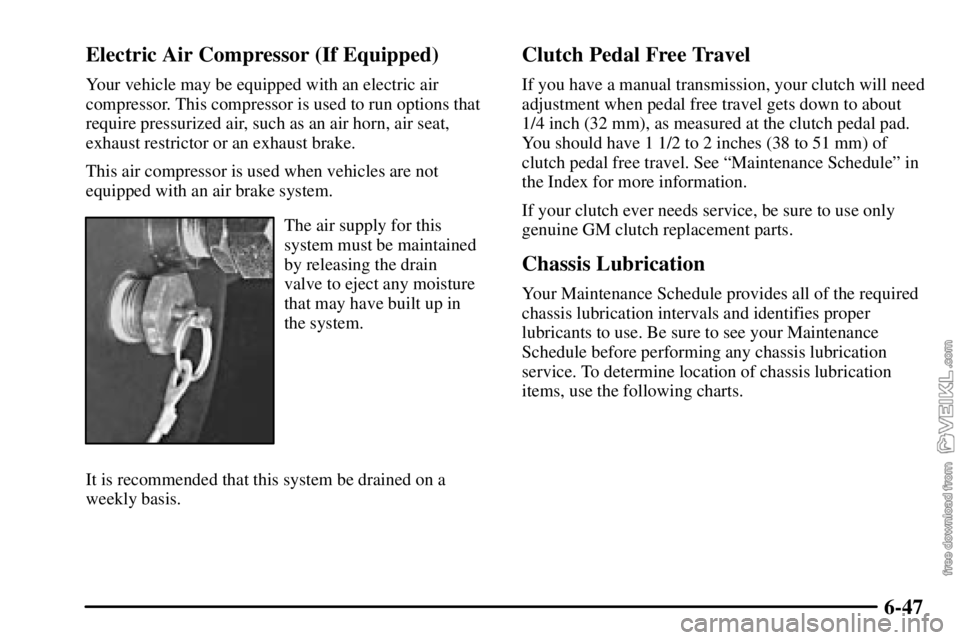
The air supply for this
system must be maintained
by releasing the drain
valve to eject any moisture
that may have built up in
the system.
It is recommended that this system be drained on a
weekly basis.
Clutch Pedal Free Travel
If you have a manual transmission, your clutch will need
adjustment when pedal free travel gets down to about
1/4 inch (32 mm), as measured at the clutch pedal pad.
You should have 1 1/2 to 2 inches (38 to 51 mm) of
clutch pedal free travel. See ªMaintenance Scheduleº in
the Index for more information.
If your clutch ever needs service, be sure to use only
genuine GM clutch replacement parts.
Chassis Lubrication
Your Maintenance Schedule provides all of the required
chassis lubrication intervals and identifies proper
lubricants to use. Be sure to see your Maintenance
Schedule before performing any chassis lubrication
service. To determine location of chassis lubrication
items, use the following charts.
Page 303 of 386
6-49
ITEM NO. ITEM REMARKS
1
Brake Camshaft �One fitting each (apply sparingly).
2 Steering Column Slip Joint* One fitting.
3 Steering Drag Link Ends One fitting at each end.
4 Pivot Points and Hinges Apply chassis lubricant
5 Pivot Points and Hinges Apply chassis lubricant.
6
Slack Adjuster �One fitting.
7 Brake Cam Roller Pins at
interface of pin and shoe �Apply engine oil.
8 Front Steering Knuckles
One fitting each side, lower bushing (hand
-operated
grease gun only). Hand
-pack upper bearing.
9 Front Wheel Bearings
Hand
-pack or lubricate.
10 Steering Tie Rod Ends One fitting each end.
11 Spring Slip Pads*
(Multi
-Leaf Only)Apply chassis lubricant.
Page 304 of 386
6-50
ITEM NO. ITEM REMARKS
12 Clutch Release Bearing* Cup or fitting.
13 Battery Terminal
(except ªSTº type)Keep coated with petroleum jelly.
14 Transmission Fill to level of filler plug.
15 Propshaft Slip Joints Lubricate with GM Part No. 1051344
Wheel Bearing Lubricant.
16 Parking Brake Clevis Pins$ Apply chassis lubricant.
17 Parking Brake Lever Pivot*$ Apply chassis lubricant.
18 Clutch Release Cross Shaft,
Master Cylinder$Apply chassis lubricant, Fill to 1/4, (6 mm) below opening.
19 Release Bearing,
Clutch Cross ShaftTwo fittings, Apply chassis lubricant
20 Clutch Release Fork Two fittings.
* Applies to some vehicles.
� Applies to air brakes only.
� Refer to Allison Transmission Operator's Manual.
$ Applies to hydraulic brakes only.
Page 305 of 386
6-51
Tandem Axle Models
ITEM
NO. ITEM REMARKS
1 Brake Camshafts One fitting each.
2
Propshaft U
-JointOne fitting each joint.
Lubricate with
GM Part No. 1051344,
Wheel Bearing Lubricant.
4 Brake Shoe
Roller PinsApply engine oil at pin
to shoe joint only.
5 Rear Spring Pin One fitting each side.
6 Rear Axles Fill to level of filler plug.
Page 321 of 386

6-67
NOTICE:
The wrong wheel can cause trouble in bearing
life, brake cooling, speedometer/odometer
calibration, headlamp aim, bumper height,
vehicle ground clearance, stopping distance and
tire clearance to the body and chassis. You could
also have other problems like a tire air
-out.
Used Replacement Wheels
CAUTION:
Putting a used wheel on your vehicle is
dangerous. You can't know how it's been used or
how many miles it's been driven. It could fail
suddenly and cause an accident. If you have to
replace a wheel, use a new GM original
equipment wheel.
Appearance Care
Remember, cleaning products can be hazardous. Some
are toxic. Others can burst into flame if you strike a
match or get them on a hot part of the vehicle. Some are
dangerous if you breathe their fumes in a closed space.
When you use anything from a container to clean your
vehicle, be sure to follow the manufacturer's warnings
and instructions. And always open your doors or
windows when you're cleaning the inside.
Never use these to clean your vehicle:
�Gasoline
�Benzene
�Naphtha
�Carbon Tetrachloride
�Acetone
�Paint Thinner
�Turpentine
�Lacquer Thinner
�Nail Polish Remover
They can all be hazardous
-- some more than
others
-- and they can all damage your vehicle, too.
Page 332 of 386

6-78 Headlamp Wiring
The headlamp wiring is protected by a circuit breaker in
the light switch. An electrical overload will cause the
lights to go on and off, or in some cases to remain off.
If this happens, have your headlamp wiring checked
right away.
Windshield Wiper Fuses
The windshield wiper motor is protected by a circuit
breaker inside the motor and a circuit breaker or fuse in
the fuse block. If the motor overheats, the wipers will
stop until the motor cools. If the overload is caused by
an electrical problem, be sure to get it fixed.
Fusible Links
A fusible link is a short piece of wire several gauge sizes
smaller than the circuit it protects. It will melt in an
overload situation, opening the circuit.
Your starter and other circuits have these fusible links.
The size is printed on the insulation. If the insulation is
burned beyond recognition, consult your GM dealer for
the proper size. Replace a fusible link with one of the
same size and insulation type. Fusible link insulation is a
special purpose high
-temperature material.
The hydraulic brake booster motor feed circuit and
starter circuit are protected by a fusible link. Vehicles
with a diesel engine have a fusible link for the intake
heater feed circuit.