2003 CHEVROLET BLAZER wheel
[x] Cancel search: wheelPage 247 of 420

1. Follow the dolly manufacturer's instructions to
attach and secure the vehicle being towed to
the dolly and then the loaded dolly to the tow
vehicle.
2. Firmly set the parking brake.
3. Put an automatic or a manual transmission in
NEUTRAL (N).
4. Shift the transfer case to 2HI. See ªElectronic
Transfer Caseº under
Four-Wheel Drive on
page 2-28for how to shift the transfer case to 2HI.
5. Release the parking brake only after the vehicle
being towed is ®rmly attached to the towing
vehicle.
Notice:Do not exceed the posted speed limit when
towing your vehicle. If you do, your vehicle could
be badly damaged.
Notice:If you tow your vehicle from the front for
more than 50 miles (80 km) on a dolly, you could
damage it. Never dolly tow your vehicle from
the front more than 50 miles (80 km).
6. Turn the ignition to OFF. To prevent your battery
from draining while towing, remove the RDO BATT
and CLSTR fuses from the instrument panel
fuse block. Be sure to replace the fuse when you
reach your destination See
Fuses and Circuit
Breakers on page 5-85.
Rear Towing (Rear Wheels off the Ground)
Notice:Do not tow your vehicle from the rear.
Your vehicle could be badly damaged and the
repairs would not be covered by your warranty.
If your vehicle has an electronic transfer case, you can
dolly tow your vehicle from the rear only if the rear
wheels are on the dolly. Use the following steps to dolly
tow your vehicle:
1. Follow the dolly manufacturer's instructions to
attach and secure the vehicle being towed to
the dolly and then the loaded dolly to the tow
vehicle.
4-49
Page 248 of 420

2. Firmly set the parking brake.
3. Put the automatic or manual transmission in
NEUTRAL (N).
4. Release the parking brake only after the vehicle
being towed is ®rmly attached to the towing
vehicle.
Notice:Do not exceed the posted speed limit when
towing your vehicle. If you do, your vehicle could
be badly damaged.
5. Turn the ignition to OFF. To prevent your battery
from draining while towing, remove the RDO BATT
and CLSTR fuses from the instrument panel
fuse block. Be sure to replace the fuse when you
reach your destination See
Fuses and Circuit
Breakers on page 5-85.
Dolly Towing (Two-Wheel Drive
Vehicles)
Front Towing (Front Wheels off the
Ground)
You can dolly tow your vehicle from the front. Use the
following steps to dolly tow your vehicle:
1. Follow the dolly manufacturer's instructions to
attach and secure the vehicle being towed to
the dolly and then the loaded dolly to the tow
vehicle.
2. Firmly set the parking brake.
4-50
Page 249 of 420

3. Put the automatic or manual transmission in
NEUTRAL (N).
4. Release the parking brake only after the vehicle
being towed is ®rmly attached to the towing
vehicle.
5. Turn the ignition to OFF. To prevent your battery
from draining while towing, remove the RDO BATT
and CLSTR fuses from the instrument panel
fuse block. Be sure to replace the fuse when you
reach your destination See
Fuses and Circuit
Breakers on page 5-85.
Notice:Do not exceed the posted speed limit when
towing your vehicle. If you do, your vehicle could
be badly damaged.
Notice:If you tow your vehicle from the front for
more than 50 miles (80 km) on a dolly, you could
damage it. Never dolly tow your vehicle from
the front more than 50 miles (80 km).
Rear Towing (Rear Wheels off the Ground)
You can dolly tow your vehicle from the rear. Use the
following steps to dolly tow your vehicle:
1. Follow the dolly manufacturer's instructions to attach
and secure the vehicle being towed to the dolly and
then the loaded dolly to the tow vehicle.
2. Firmly set the parking brake.
3. Put the automatic or manual transmission in
NEUTRAL (N).
4. Release the parking brake only after the vehicle
being towed is ®rmly attached to the towing
vehicle.
4-51
Page 251 of 420
{CAUTION:
Do not load your vehicle any heavier than the
GVWR, or either the maximum front or rear
GAWR. If you do, parts on your vehicle can
break, and it can change the way your vehicle
handles. These could cause you to lose
control and crash. Also, overloading can
shorten the life of your vehicle.
Using heavier suspension components to get added
durability might not change your weight ratings. Ask your
dealer to help you load your vehicle the right way.
Notice:Your warranty does not cover parts
or components that fail because of overloading.
If you put things inside your vehicle±like suitcases, tools,
packages, or anything else±they will go as fast as the
vehicle goes. If you have to stop or turn quickly, or
if there is a crash, they'll keep going.
{CAUTION:
Things you put inside your vehicle can strike
and injure people in a sudden stop or turn, or
in a crash.
·Put things in the cargo area of your
vehicle. Try to spread the weight evenly.
·Never stack heavier things, like suitcases,
inside the vehicle so that some of them
are above the tops of the seats.
·Don't leave an unsecured child restraint in
your vehicle.
·When you carry something inside the
vehicle, secure it whenever you can.
·Don't leave a seat folded down unless you
need to.
There's also important loading information for off-road
driving in this manual. See
ªLoading Your Vehicle
for Off-Road DrivingºunderOff-Road Driving with Your
Four-Wheel-Drive Vehicle on page 4-15.
4-53
Page 255 of 420
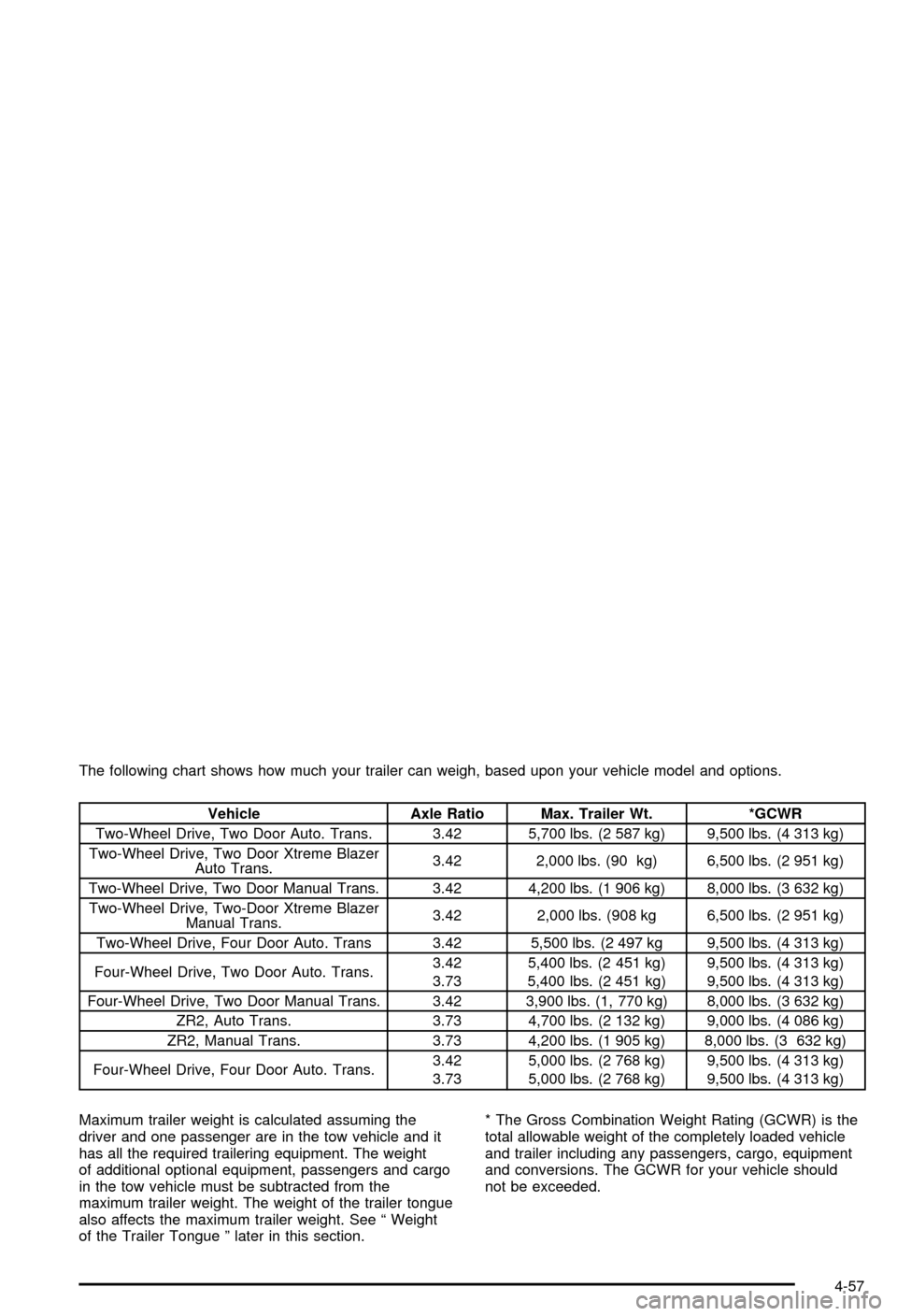
The following chart shows how much your trailer can weigh, based upon your vehicle model and options.
Vehicle Axle Ratio Max. Trailer Wt. *GCWR
Two-Wheel Drive, Two Door Auto. Trans. 3.42 5,700 lbs. (2 587 kg) 9,500 lbs. (4 313 kg)
Two-Wheel Drive, Two Door Xtreme Blazer
Auto Trans.3.42 2,000 lbs. (90 kg) 6,500 lbs. (2 951 kg)
Two-Wheel Drive, Two Door Manual Trans. 3.42 4,200 lbs. (1 906 kg) 8,000 lbs. (3 632 kg)
Two-Wheel Drive, Two-Door Xtreme Blazer
Manual Trans.3.42 2,000 lbs. (908 kg 6,500 lbs. (2 951 kg)
Two-Wheel Drive, Four Door Auto. Trans 3.42 5,500 lbs. (2 497 kg 9,500 lbs. (4 313 kg)
Four-Wheel Drive, Two Door Auto. Trans.3.42
3.735,400 lbs. (2 451 kg)
5,400 lbs. (2 451 kg)9,500 lbs. (4 313 kg)
9,500 lbs. (4 313 kg)
Four-Wheel Drive, Two Door Manual Trans. 3.42 3,900 lbs. (1, 770 kg) 8,000 lbs. (3 632 kg)
ZR2, Auto Trans. 3.73 4,700 lbs. (2 132 kg) 9,000 lbs. (4 086 kg)
ZR2, Manual Trans. 3.73 4,200 lbs. (1 905 kg) 8,000 lbs. (3 632 kg)
Four-Wheel Drive, Four Door Auto. Trans.3.42
3.735,000 lbs. (2 768 kg)
5,000 lbs. (2 768 kg)9,500 lbs. (4 313 kg)
9,500 lbs. (4 313 kg)
Maximum trailer weight is calculated assuming the
driver and one passenger are in the tow vehicle and it
has all the required trailering equipment. The weight
of additional optional equipment, passengers and cargo
in the tow vehicle must be subtracted from the
maximum trailer weight. The weight of the trailer tongue
also affects the maximum trailer weight. See ª Weight
of the Trailer Tongue º later in this section.* The Gross Combination Weight Rating (GCWR) is the
total allowable weight of the completely loaded vehicle
and trailer including any passengers, cargo, equipment
and conversions. The GCWR for your vehicle should
not be exceeded.
4-57
Page 259 of 420

Towing a trailer requires a certain amount of experience.
Before setting out for the open road, you'll want to get
to know your rig. Acquaint yourself with the feel of
handling and braking with the added weight of the trailer.
And always keep in mind that the vehicle you are
driving is now a good deal longer and not nearly as
responsive as your vehicle is by itself.
Before you start, check the trailer hitch and platform
(and attachments), safety chains, electrical connector,
lamps, tires and mirror adjustment. If the trailer has
electric brakes, start your vehicle and trailer moving and
then apply the trailer brake controller by hand to be
sure the brakes are working. This lets you check your
electrical connection at the same time.
During your trip, check occasionally to be sure that the
load is secure, and that the lamps and any trailer
brakes are still working.
Following Distance
Stay at least twice as far behind the vehicle ahead as
you would when driving your vehicle without a trailer.
This can help you avoid situations that require
heavy braking and sudden turns.
Passing
You'll need more passing distance up ahead when
you're towing a trailer. And, because you're a good deal
longer, you'll need to go much farther beyond the
passed vehicle before you can return to your lane.
Backing Up
Hold the bottom of the steering wheel with one hand.
Then, to move the trailer to the left, just move that hand
to the left. To move the trailer to the right, move your
hand to the right. Always back up slowly and, if possible,
have someone guide you.
Making Turns
Notice:Making very sharp turns while trailering
could cause the trailer to come in contact with the
vehicle. Your vehicle could be damaged. Avoid
making very sharp turns while trailering.
When you're turning with a trailer, make wider turns
than normal. Do this so your trailer won't strike
soft shoulders, curbs, road signs, trees or other objects.
Avoid jerky or sudden maneuvers. Signal well in
advance.
4-61
Page 261 of 420
Parking on Hills
{CAUTION:
You really should not park your vehicle, with a
trailer attached, on a hill. If something goes
wrong, your rig could start to move. People
can be injured, and both your vehicle and the
trailer can be damaged.
But if you ever have to park your rig on a hill, here's
how to do it:
1. Apply your regular brakes, but don't shift into
PARK (P) yet, or into gear for a manual
transmission. Then turn your wheels into the curb if
facing downhill or into traffic if facing uphill.
2. Have someone place chocks under the trailer
wheels.
3. When the wheel chocks are in place, release the
regular brakes until the chocks absorb the load.
4. Reapply the regular brakes. Then apply your
parking brake, and then shift into PARK (P), or
REVERSE (R) for a manual transmission.5. If you have a four-wheel-drive vehicle with an
automatic transfer case, be sure the transfer case is
in a drive gear±not in NEUTRAL.
6. Release the regular brakes.{CAUTION:
It can be dangerous to get out of your vehicle if
the shift lever is not fully in PARK (P) with the
parking brake ®rmly set. Your vehicle can roll.
If you have left the engine running, the vehicle
can move suddenly. You or others could be
injured. To be sure your vehicle won't move,
even when you're on fairly level ground, use the
steps that follow.
Always put the shift lever fully in PARK (P) with
the parking brake ®rmly set.
If the transfer case on four-wheel drive vehicles
is in NEUTRAL, your vehicle will be free to roll,
even if your shift lever is in
PARK (P). So, be sure the transfer case is in a
drive gear Ð not in NEUTRAL.
See ªFour-Wheel Drive (Automatic Transfer
Case)º in the Index.
4-63
Page 265 of 420

Service............................................................5-3
Doing Your Own Service Work.........................5-3
Adding Equipment to the Outside of Your
Vehicle......................................................5-4
Fuel................................................................5-4
Gasoline Octane............................................5-4
Gasoline Speci®cations....................................5-5
California Fuel...............................................5-5
Additives.......................................................5-5
Fuels in Foreign Countries...............................5-6
Filling Your Tank............................................5-6
Filling a Portable Fuel Container.......................5-8
Checking Things Under
the Hood......................................................5-8
Hood Release................................................5-9
Engine Compartment Overview.......................5-10
Engine Oil...................................................5-11
Engine Air Cleaner/Filter................................5-15
Automatic Transmission Fluid.........................5-17
Manual Transmission Fluid.............................5-20
Hydraulic Clutch...........................................5-21
Engine Coolant.............................................5-22
Radiator Pressure Cap..................................5-25
Engine Overheating.......................................5-25
Cooling System............................................5-27
Engine Fan Noise.........................................5-34Power Steering Fluid.....................................5-35
Windshield Washer Fluid................................5-36
Brakes........................................................5-37
Battery........................................................5-40
Jump Starting...............................................5-41
Rear Axle.......................................................5-45
Four-Wheel Drive............................................5-45
Front Axle......................................................5-46
Bulb Replacement..........................................5-47
Halogen Bulbs..............................................5-47
Headlamps..................................................5-48
One-Piece Front Turn Signal Lamps................5-50
Two-Piece Front Turn Signal Lamps................5-50
Taillamps.....................................................5-51
Replacement Bulbs.......................................5-52
Windshield Wiper Blade Replacement..............5-52
Tires..............................................................5-54
In¯ation -- Tire Pressure................................5-55
Tire Inspection and Rotation...........................5-56
When It Is Time for New Tires.......................5-57
Buying New Tires.........................................5-58
Uniform Tire Quality Grading..........................5-59
Wheel Alignment and Tire Balance..................5-60
Wheel Replacement......................................5-60
Tire Chains..................................................5-62
Section 5 Service and Appearance Care
5-1