Page 334 of 420
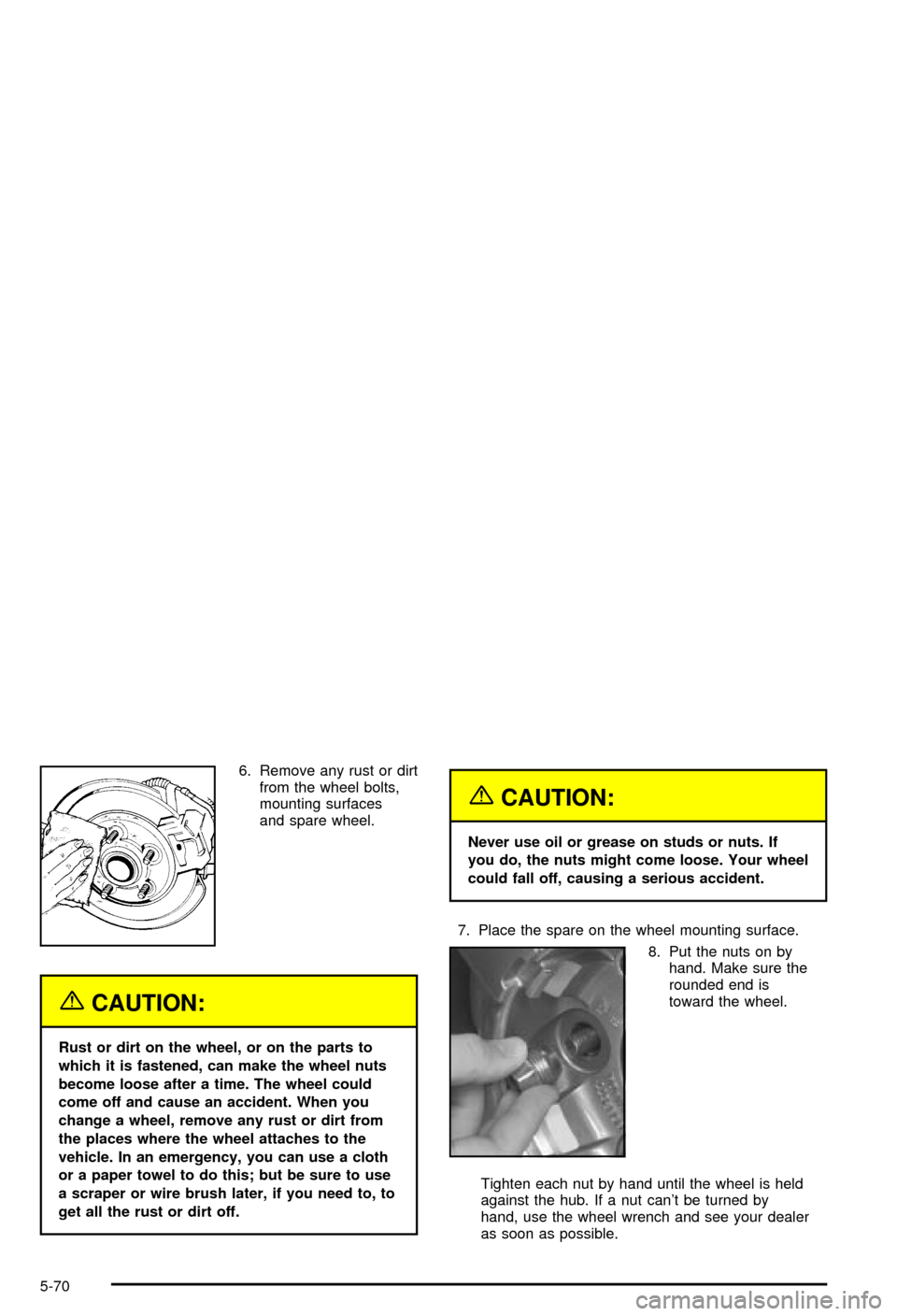
6. Remove any rust or dirt
from the wheel bolts,
mounting surfaces
and spare wheel.
{CAUTION:
Rust or dirt on the wheel, or on the parts to
which it is fastened, can make the wheel nuts
become loose after a time. The wheel could
come off and cause an accident. When you
change a wheel, remove any rust or dirt from
the places where the wheel attaches to the
vehicle. In an emergency, you can use a cloth
or a paper towel to do this; but be sure to use
a scraper or wire brush later, if you need to, to
get all the rust or dirt off.
{CAUTION:
Never use oil or grease on studs or nuts. If
you do, the nuts might come loose. Your wheel
could fall off, causing a serious accident.
7. Place the spare on the wheel mounting surface.
8. Put the nuts on by
hand. Make sure the
rounded end is
toward the wheel.
Tighten each nut by hand until the wheel is held
against the hub. If a nut can't be turned by
hand, use the wheel wrench and see your dealer
as soon as possible.
5-70
Page 335 of 420
9. Lower the vehicle by turning the jack handle
counterclockwise. Lower the jack completely.
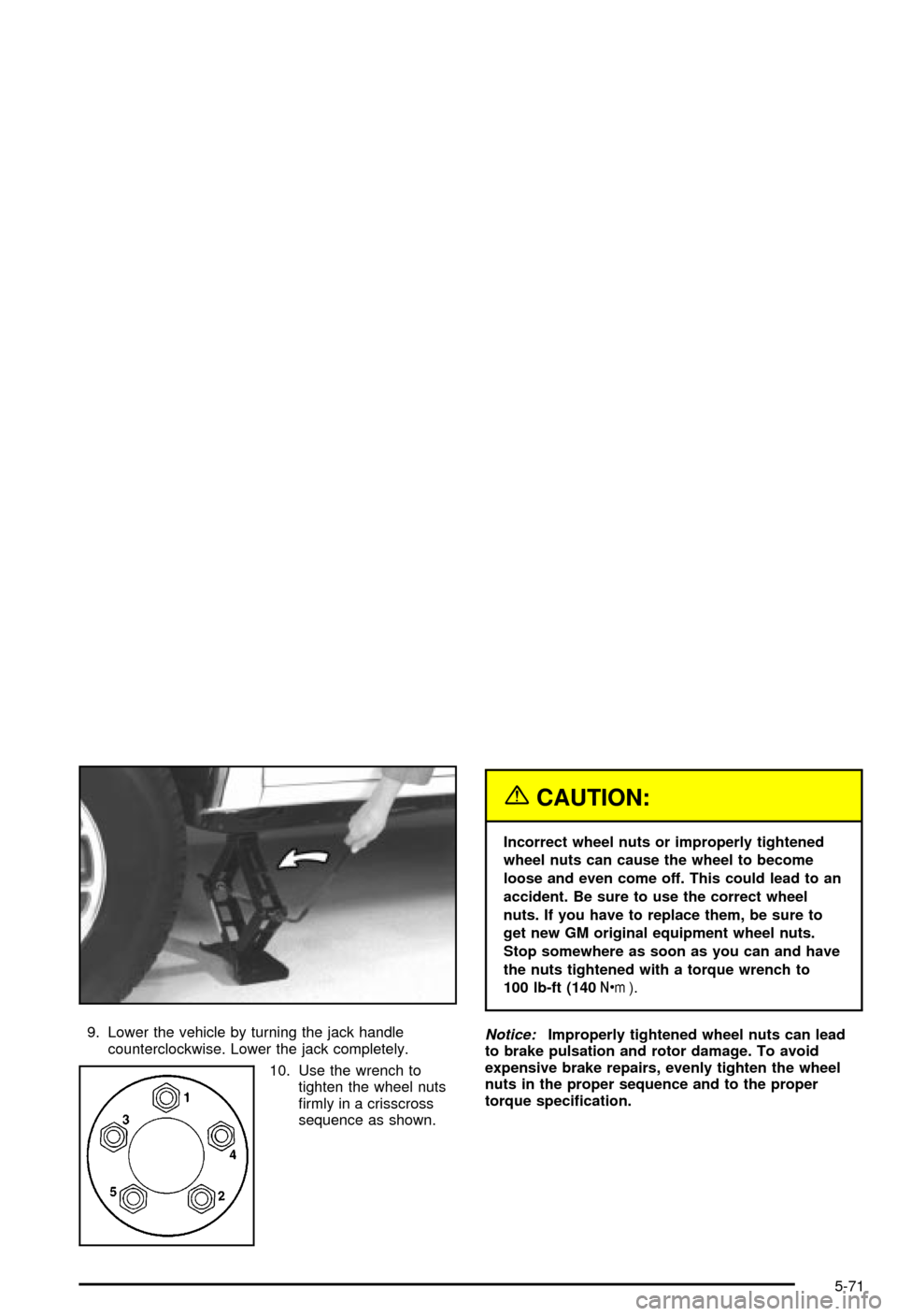
10. Use the wrench to
tighten the wheel nuts
®rmly in a crisscross
sequence as shown.
{CAUTION:
Incorrect wheel nuts or improperly tightened
wheel nuts can cause the wheel to become
loose and even come off. This could lead to an
accident. Be sure to use the correct wheel
nuts. If you have to replace them, be sure to
get new GM original equipment wheel nuts.
Stop somewhere as soon as you can and have
the nuts tightened with a torque wrench to
100 lb-ft (140Y).
Notice:Improperly tightened wheel nuts can lead
to brake pulsation and rotor damage. To avoid
expensive brake repairs, evenly tighten the wheel
nuts in the proper sequence and to the proper
torque speci®cation.
5-71
Page 336 of 420
Storing a Flat or Spare Tire and Tools
{CAUTION:
Storing a jack, a tire, or other equipment in the
passenger compartment of the vehicle could
cause injury. In a sudden stop or collision,
loose equipment could strike someone. Store
all these in the proper place.
Notice:An aluminum wheel with a ¯at tire should
always be stored under the vehicle with the
hoist. However, storing it that way for an extended
period could damage the wheel. To avoid this,
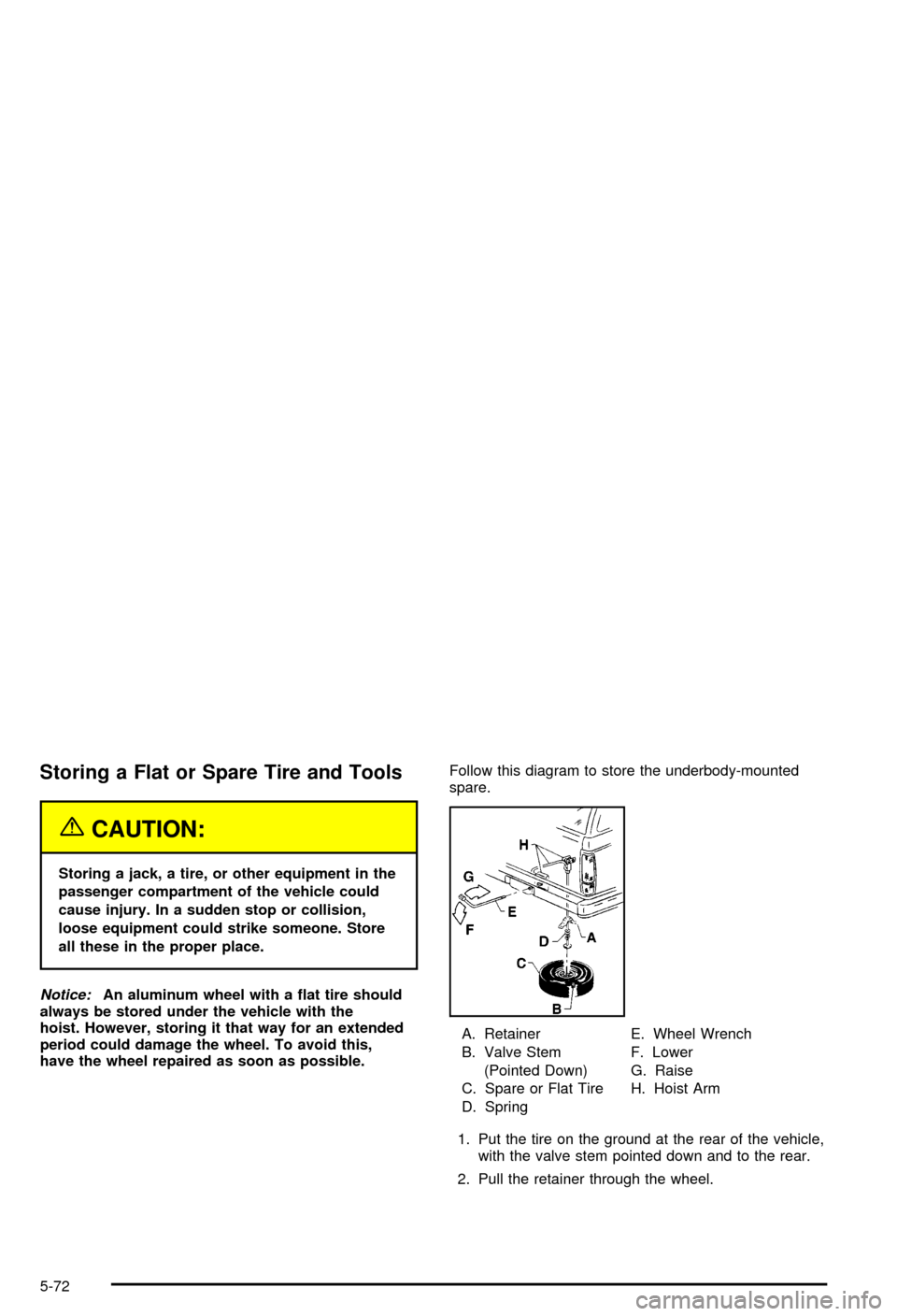
have the wheel repaired as soon as possible.Follow this diagram to store the underbody-mounted
spare.
A. Retainer
B. Valve Stem
(Pointed Down)
C. Spare or Flat Tire
D. SpringE. Wheel Wrench
F. Lower
G. Raise
H. Hoist Arm
1. Put the tire on the ground at the rear of the vehicle,
with the valve stem pointed down and to the rear.
2. Pull the retainer through the wheel.
5-72
Page 337 of 420
3. Put the chisel end of the wheel wrench, on an
angle, through the hole in the rear bumper and
into the hoist shaft.
4. Raise the tire fully against the underside of the
vehicle by turning the wrench clockwise until you
hear two clicks or feel it skip twice. The spare
tire hoist cannot be overtightened.
5. Make sure the tire is stored securely. Push, pull,
and then try to turn the tire. If the tire moves, use
the wheel wrench to tighten the cable.Follow this diagram for the inside-mounted spare.
A. Spare or Flat Tire
B. Retainer
C. NutD. Wheel Carrier
E. Hook
5-73
Page 338 of 420
Follow this diagram for the rear-mounted spare.
A. Wheel Carrier
B. Spare or Flat TireC. Wheel Nut and
Locking Nut
Cylinder (If
Equipped)6. Reinstall the locking wheel nut using the wheel
wrench. Then push the lock case onto the lug
nut until it stops. The key does not have to
be inserted into the lock. Push the lock case to be
sure it is secured. The special lug nut and lock
case is not intended to be used on any road wheel,
only on the spare wheel carrier. Tighten the nuts
on the wheel carrier to 22 to 32 lb-ft (30 to 40 N´m).
{CAUTION:
Make sure the tire and carrier are secure.
Driving with the tire or carrier unlatched could
injure pedestrians or damage the vehicle.
7. Return the jack, wheel wrench and wheel blocks to
the proper location in your vehicle's rear area.
Secure the items and replace the jack cover.
5-74
Page 339 of 420

Use the following diagram as a guide.
D. Retainer
E. Rubber Band
(Some Models)
F. Jack Storage Cover
G. Wheel Blocks
H. Hub Cap Removal
Tool (Some
Models)I. Wheel Wrench
J. Jack
K. Jacking
Instructions (roll
and place
instructions above
the jack after it is
installed)Compact Spare Tire
The compact spare tire is a temporary replacement tire
made to perform at speeds up to 65 mph (105 km/h)
and for distances up to 3,000 miles (5 000 km). With the
compact spare installed, you can ®nish your trip and
then have the damaged or ¯at road tire repaired
or replaced. Of course, it's best to repair or replace the
damaged road tire as soon as you can. Your compact
spare tire will last longer and be in good shape in case
you need it again.
The compact spare may lose air after a time, so check
the in¯ation pressure regularly. After installing the
compact spare on your vehicle, stop as soon as possible
and make sure it's correctly in¯ated. It should be 60
psi (420 kPa).
Don't use your compact spare tire on other vehicles and
don't mix your compact spare tire or wheel with other
wheels or tires, they won't ®t. Keep your compact spare
and its wheel together. Don't include the compact
spare in your tire rotation.
Notice:When the compact spare is installed, don't
take your vehicle through an automatic car wash
with guide rails. The compact spare can get caught
on the rails. That can damage the tire and wheel,
and maybe other parts of your vehicle.
5-75
Page 340 of 420

Spare Tire
Your vehicle, when new, had a fully in¯ated spare tire.
A spare tire, whether compact±size or full±size, may
lose air over time, so check its in¯ation pressure
regularly. See
In¯ation -- Tire Pressure on page 5-55andLoading Your Vehicle on page 4-52for information
regarding proper tire in¯ation and loading your
vehicle. For instruction on how to remove, install or
store a spare tire, see
Changing a Flat Tire on
page 5-63.
After installing the spare tire on your vehicle, you should
stop as soon as possible and make sure the spare is
correctly in¯ated. Have the damaged or ¯at road
tire repaired or replaced as soon as you can and
installed back onto your vehicle. This way, a spare tire
will be available in case you need it again.
Don't mix tires and wheels of different sizes, because
they won't ®t. Keep your spare tire and its wheel
together.
If your vehicle has the XtremeŸ Sport Appearance
Package (RPO V4A), the spare tire is smaller than your
vehicle's original road tires, so don't include the spare
in the tire rotation.
Appearance Care
Remember, cleaning products can be hazardous. Some
are toxic. Others can burst into ¯ames if you strike a
match or get them on a hot part of the vehicle. Some are
dangerous if you breathe their fumes in a closed
space. When you use anything from a container to clean
your vehicle, be sure to follow the manufacturer's
warnings and instructions. And always open your doors
or windows when you're cleaning the inside.
Neveruse these to clean your vehicle:
·Gasoline
·Benzene
·Naphtha
·Carbon Tetrachloride
·Acetone
·Paint Thinner
·Turpentine
·Lacquer Thinner
·Nail Polish Remover
They can all be hazardous ± some more than
others ± and they can all damage your vehicle, too.
5-76
Page 344 of 420

Foreign materials such as calcium chloride and other
salts, ice melting agents, road oil and tar, tree sap, bird
droppings, chemicals from industrial chimneys, etc.,
can damage your vehicle's ®nish if they remain
on painted surfaces. Wash the vehicle as soon as
possible. If necessary, use non-abrasive cleaners that
are marked safe for painted surfaces to remove
foreign matter.
Exterior painted surfaces are subject to aging, weather
and chemical fallout that can take their toll over a
period of years. You can help to keep the paint ®nish
looking new by keeping your vehicle garaged or covered
whenever possible.
Protecting Exterior Bright Metal Parts
Bright metal parts should be cleaned regularly to keep
their luster. Washing with water is all that is usually
needed. However, you may use chrome polish on
chrome or stainless steel trim, if necessary.
Use special care with aluminum trim. To avoid damaging
protective trim, never use auto or chrome polish,
steam or caustic soap to clean aluminum. A coating of
wax, rubbed to high polish, is recommended for all
bright metal parts.
Cleaning the Windshield, Backglass
and Wiper Blades
If the windshield is not clear after using the windshield
washer, or if the wiper blade chatters when running,
wax, sap or other material may be on the blade or
windshield.
Clean the outside of the windshield with a full-strength
glass cleaning liquid. The windshield is clean if beads do
not form when you rinse it with water.
Grime from the windshield will stick to the wiper blades
and affect their performance. Clean the blade by
wiping vigorously with a cloth soaked in full-strength
windshield washer solvent. Then rinse the blade
with water.
Check the wiper blades and clean them as necessary;
replace blades that look worn.
Cleaning Aluminum Wheels
Keep your wheels clean using a soft clean cloth with
mild soap and water. Rinse with clean water. After
rinsing thoroughly, dry with a soft clean towel. A wax
may then be applied.
5-80