Page 325 of 420

Each new wheel should have the same load-carrying
capacity, diameter, width, offset and be mounted
the same way as the one it replaces.
If you need to replace any of your wheels, wheel bolts
or wheel nuts, replace them only with new GM
original equipment parts. This way, you will be sure to
have the right wheel, wheel bolts and wheel nuts
for your vehicle.
{CAUTION:
Using the wrong replacement wheels, wheel
bolts or wheel nuts on your vehicle can be
dangerous. It could affect the braking and
handling of your vehicle, make your tires lose
air and make you lose control. You could have
a collision in which you or others could be
injured. Always use the correct wheel, wheel
bolts and wheel nuts for replacement.
Notice:The wrong wheel can also cause problems
with bearing life, brake cooling, speedometer or
odometer calibration, headlamp aim, bumper height,
vehicle ground clearance and tire or tire chain
clearance to the body and chassis.
See
Changing a Flat Tire on page 5-63for more
information.
Used Replacement Wheels
{CAUTION:
Putting a used wheel on your vehicle is
dangerous. You can't know how it's been used
or how far it's been driven. It could fail
suddenly and cause a crash. If you have to
replace a wheel, use a new GM original
equipment wheel.
5-61
Page 326 of 420
Tire Chains
{CAUTION:
Don't use tire chains. There's not enough
clearance. Tire chains used on a vehicle
without the proper amount of clearance can
cause damage to the brakes, suspension or
other vehicle parts. The area damaged by the
tire chains could cause you to lose control of
your vehicle and you or others may be injured
in a crash. Use another type of traction device
only if its manufacturer recommends it for use
on your vehicle and tire size combination and
road conditions. Follow that manufacturer's
instructions. To help avoid damage to your
vehicle, drive slowly, readjust or remove the
device if it's contacting your vehicle, and don't
spin your wheels. If you do ®nd traction
devices that will ®t, install them on the
rear tires.
If a Tire Goes Flat
It's unusual for a tire to ªblowoutº while you're driving,
especially if you maintain your tires properly. If air goes
out of a tire, it's much more likely to leak out slowly.
But if you should ever have a ªblowout,º here are a few
tips about what to expect and what to do:
If a front tire fails, the ¯at tire will create a drag that
pulls the vehicle toward that side. Take your foot off the
accelerator pedal and grip the steering wheel ®rmly.
Steer to maintain lane position, and then gently brake to
a stop well out of the traffic lane.
A rear blowout, particularly on a curve, acts much like a
skid and may require the same correction you'd use
in a skid. In any rear blowout, remove your foot from the
accelerator pedal. Get the vehicle under control by
steering the way you want the vehicle to go. It may be
very bumpy and noisy, but you can still steer. Gently
brake to a stop, well off the road if possible.
If a tire goes ¯at, the next part shows how to use your
jacking equipment to change a ¯at tire safely.
5-62
Page 327 of 420
Changing a Flat Tire
If a tire goes ¯at, avoid further tire and wheel damage
by driving slowly to a level place. Turn on your
hazard warning ¯ashers.
{CAUTION:
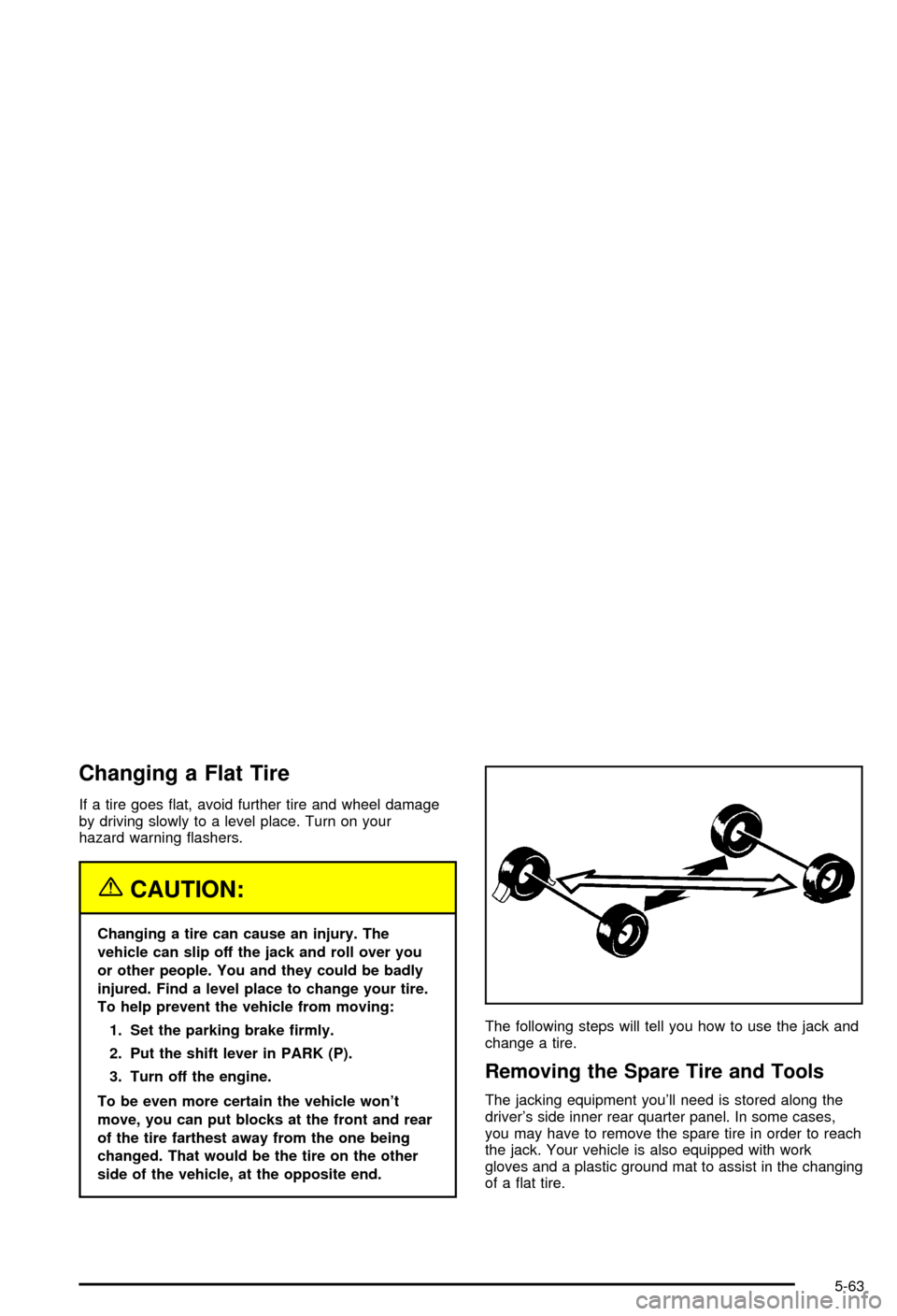
Changing a tire can cause an injury. The
vehicle can slip off the jack and roll over you
or other people. You and they could be badly
injured. Find a level place to change your tire.
To help prevent the vehicle from moving:
1. Set the parking brake ®rmly.
2. Put the shift lever in PARK (P).
3. Turn off the engine.
To be even more certain the vehicle won't
move, you can put blocks at the front and rear
of the tire farthest away from the one being
changed. That would be the tire on the other
side of the vehicle, at the opposite end.The following steps will tell you how to use the jack and
change a tire.
Removing the Spare Tire and Tools
The jacking equipment you'll need is stored along the
driver's side inner rear quarter panel. In some cases,
you may have to remove the spare tire in order to reach
the jack. Your vehicle is also equipped with work
gloves and a plastic ground mat to assist in the changing
of a ¯at tire.
5-63
Page 328 of 420
The following instructions explain how to remove the
spare tire, depending on where it is mounted on
your vehicle. See
Compact Spare Tire on page 5-75orSpare Tire on page 5-76for more information about
the spare.
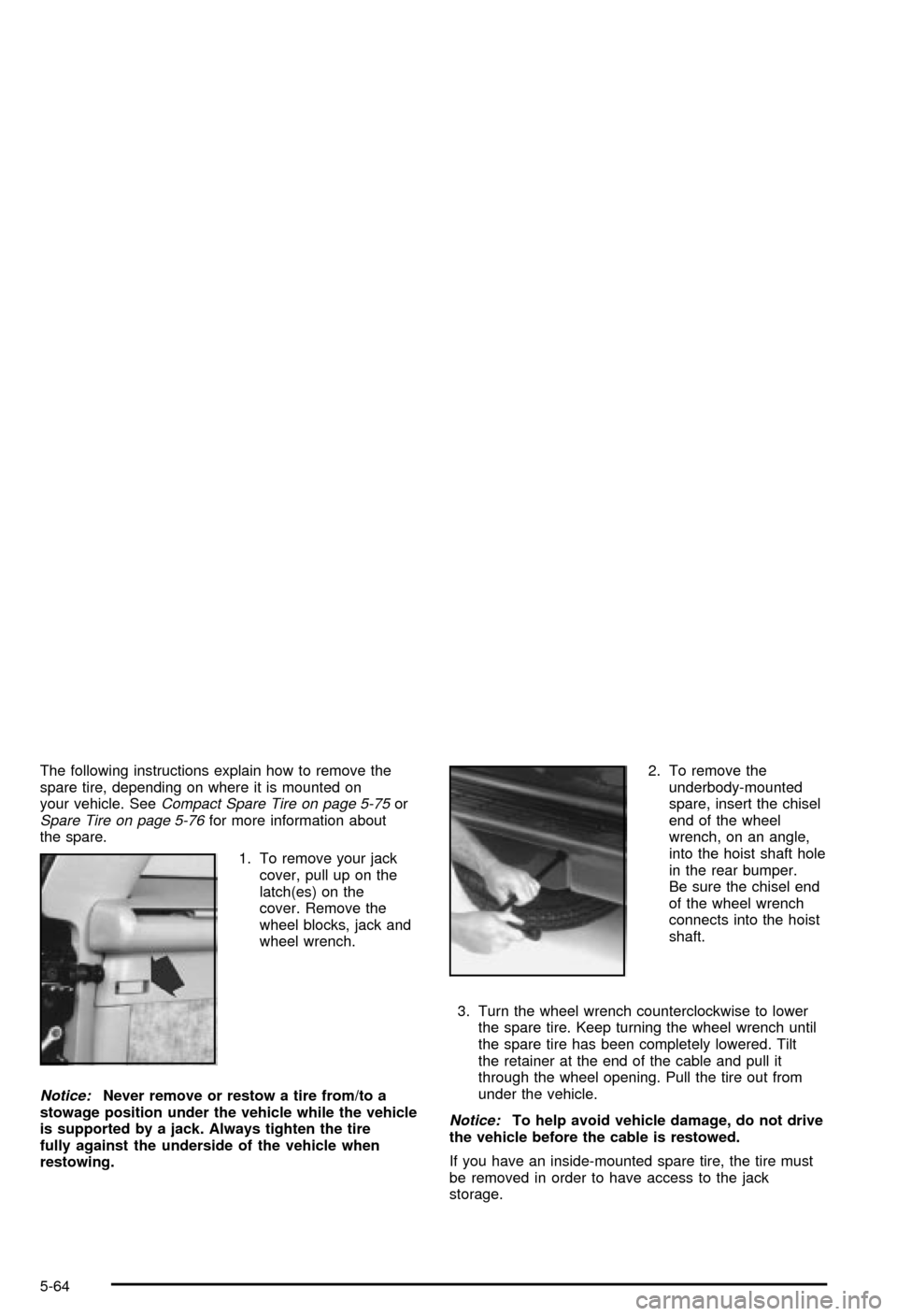
1. To remove your jack
cover, pull up on the
latch(es) on the
cover. Remove the
wheel blocks, jack and
wheel wrench.
Notice:Never remove or restow a tire from/to a
stowage position under the vehicle while the vehicle
is supported by a jack. Always tighten the tire
fully against the underside of the vehicle when
restowing.2. To remove the
underbody-mounted
spare, insert the chisel
end of the wheel
wrench, on an angle,
into the hoist shaft hole
in the rear bumper.
Be sure the chisel end
of the wheel wrench
connects into the hoist
shaft.
3. Turn the wheel wrench counterclockwise to lower
the spare tire. Keep turning the wheel wrench until
the spare tire has been completely lowered. Tilt
the retainer at the end of the cable and pull it
through the wheel opening. Pull the tire out from
under the vehicle.
Notice:To help avoid vehicle damage, do not drive
the vehicle before the cable is restowed.
If you have an inside-mounted spare tire, the tire must
be removed in order to have access to the jack
storage.
5-64
Page 329 of 420
To remove an inside-mounted spare tire, reach into your
tire's cover and unscrew the wing nut at the center of
the wheel. Remove it and the retainer. Unhook the
tire from the mounting bracket and remove the cover.
To remove a rear-mounted spare tire, ®rst make
sure that the carrier arm is fully-latched to the tailgate.
Then remove the spare tire cover.
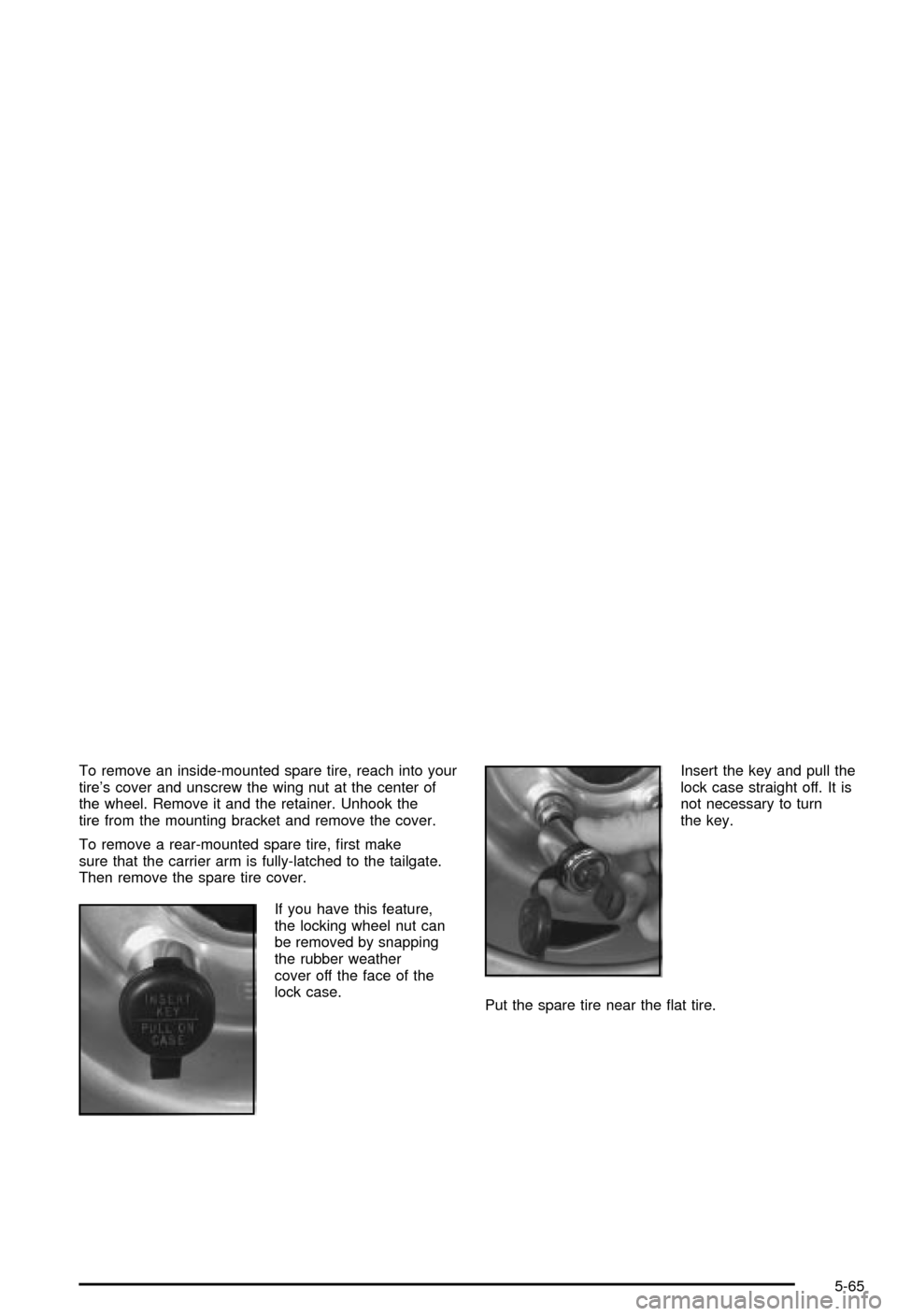
If you have this feature,
the locking wheel nut can
be removed by snapping
the rubber weather
cover off the face of the
lock case.Insert the key and pull the
lock case straight off. It is
not necessary to turn
the key.
Put the spare tire near the ¯at tire.
5-65
Page 330 of 420
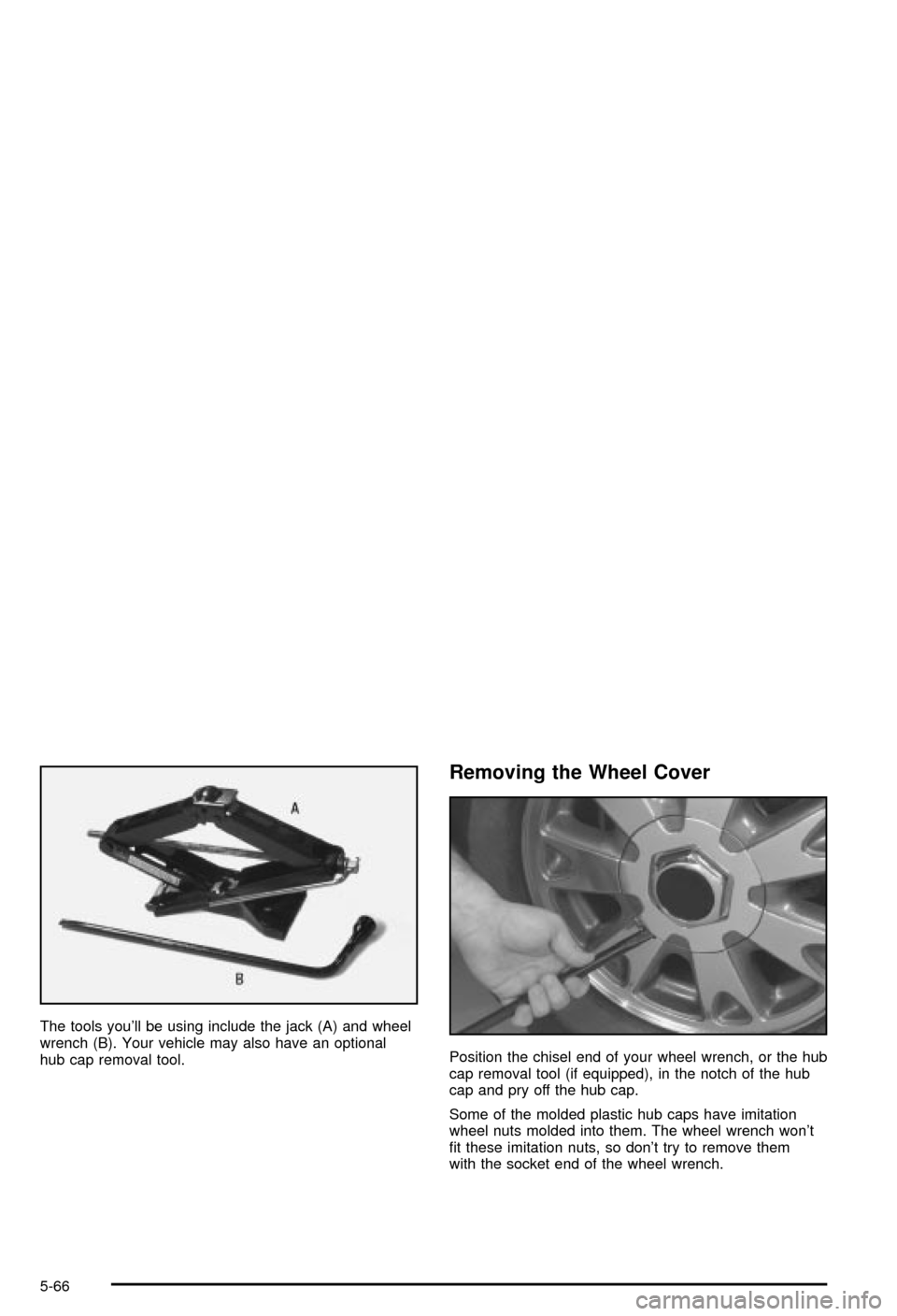
The tools you'll be using include the jack (A) and wheel
wrench (B). Your vehicle may also have an optional
hub cap removal tool.
Removing the Wheel Cover
Position the chisel end of your wheel wrench, or the hub
cap removal tool (if equipped), in the notch of the hub
cap and pry off the hub cap.
Some of the molded plastic hub caps have imitation
wheel nuts molded into them. The wheel wrench won't
®t these imitation nuts, so don't try to remove them
with the socket end of the wheel wrench.
5-66
Page 331 of 420
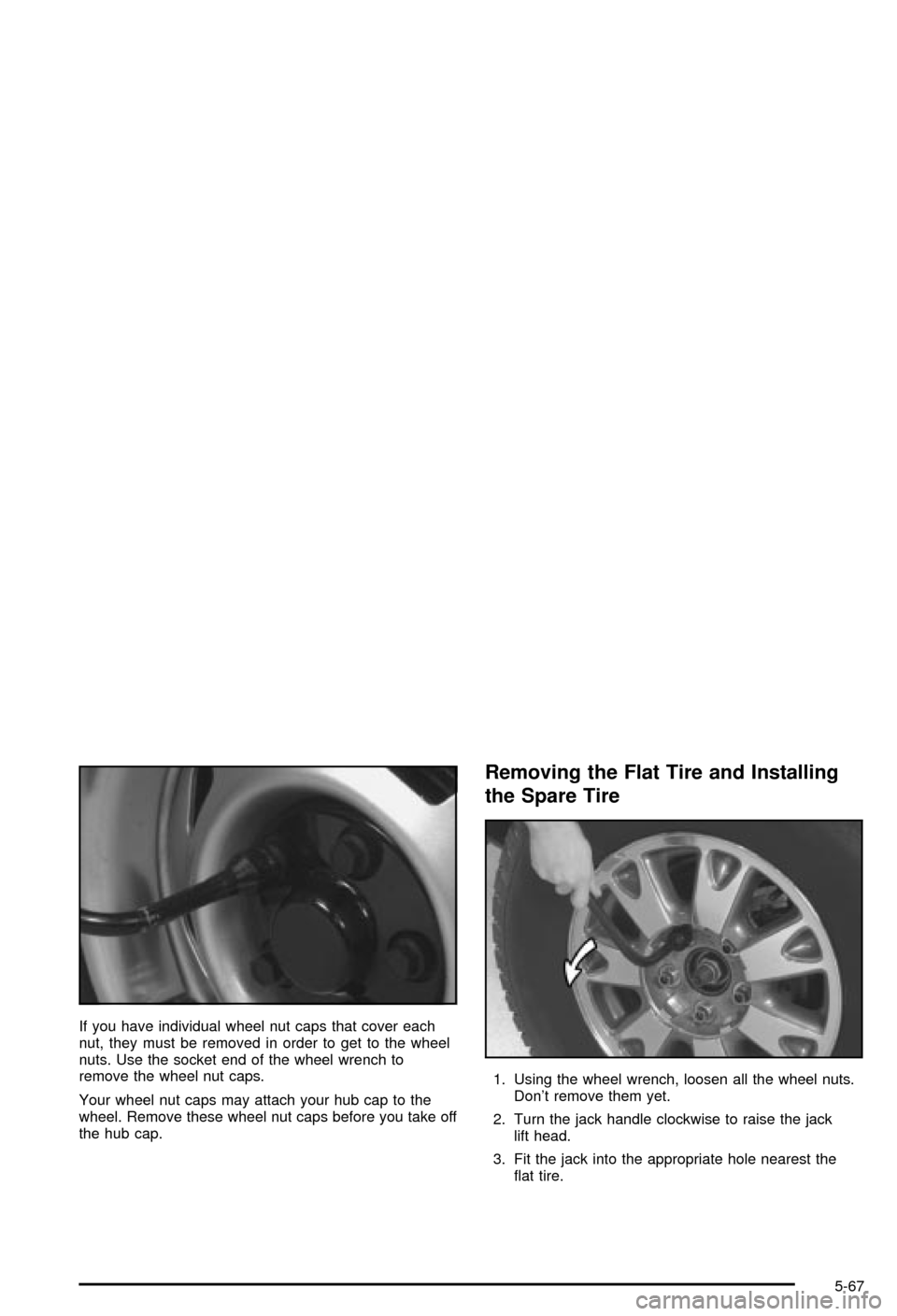
If you have individual wheel nut caps that cover each
nut, they must be removed in order to get to the wheel
nuts. Use the socket end of the wheel wrench to
remove the wheel nut caps.
Your wheel nut caps may attach your hub cap to the
wheel. Remove these wheel nut caps before you take off
the hub cap.
Removing the Flat Tire and Installing
the Spare Tire
1. Using the wheel wrench, loosen all the wheel nuts.
Don't remove them yet.
2. Turn the jack handle clockwise to raise the jack
lift head.
3. Fit the jack into the appropriate hole nearest the
¯at tire.
5-67
Page 333 of 420
{CAUTION:
Raising your vehicle with the jack improperly
positioned can damage the vehicle and even
make the vehicle fall. To help avoid personal
injury and vehicle damage, be sure to ®t the
jack lift head into the proper location before
raising the vehicle.
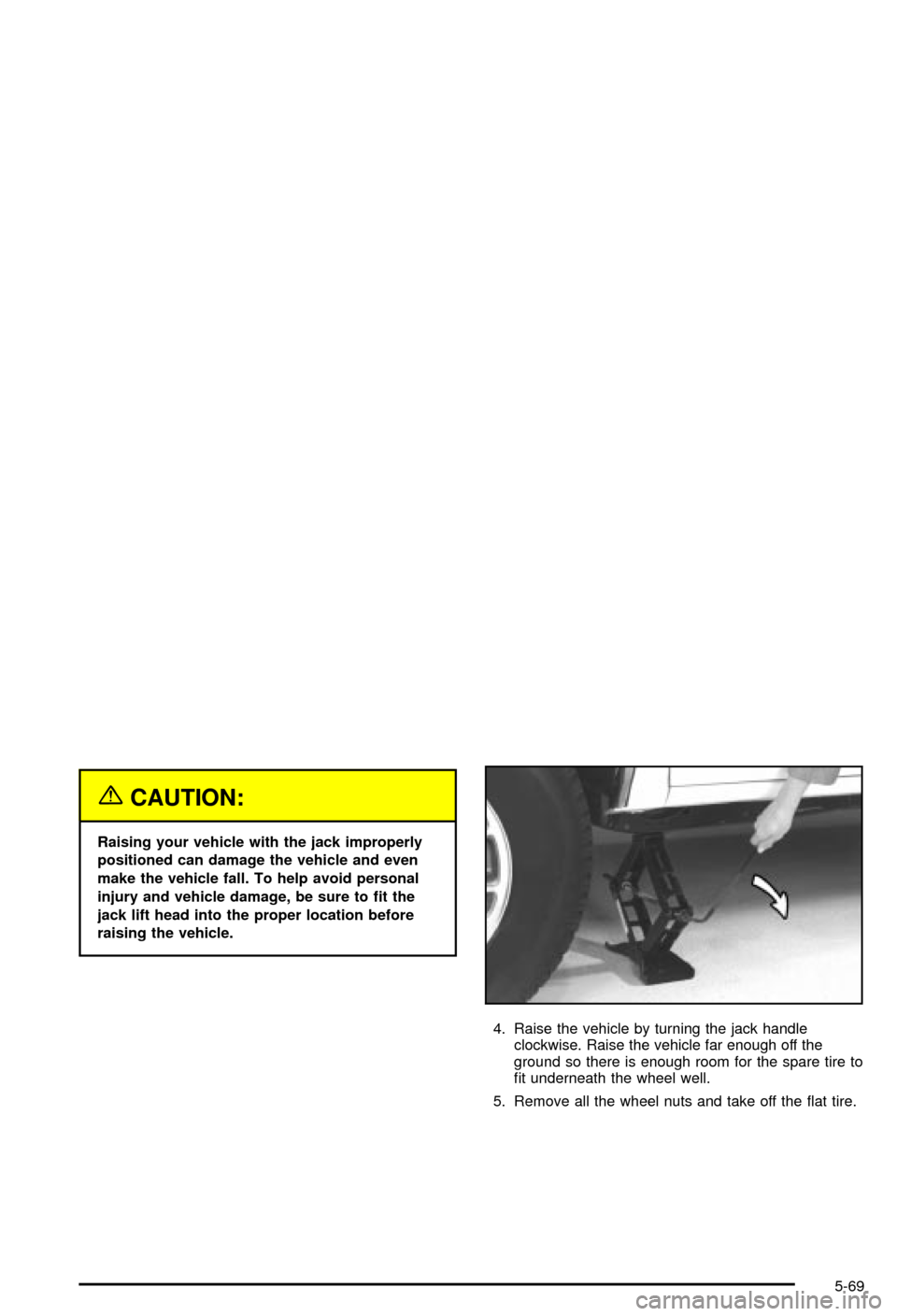
4. Raise the vehicle by turning the jack handle
clockwise. Raise the vehicle far enough off the
ground so there is enough room for the spare tire to
®t underneath the wheel well.
5. Remove all the wheel nuts and take off the ¯at tire.
5-69