2003 BMW Z4 2.5I wheel
[x] Cancel search: wheelPage 39 of 106
At a glance
Controls
Driving tips
Mobility
Reference
39
the ignition key immediately when the
engine starts.<
Extended starting attempts, charac-
terized by excessively frequent or
long periods with the starter engaged, can
damage the catalytic converter.<
If the engine fails to start on the first
attempt – if it is very hot or cold, for
instance:
>Press the accelerator pedal halfway
down.
Cold starts at very low temperatures –
starting at approx. +57 / –156
>Press the accelerator pedal halfway
down while engaging the starter
>On the first start attempt, engage the
starter for a longer period –
approx. 10 seconds.
Manual transmission
1.Engage the parking brake
2.Gearshift lever in idling position
3.Depress clutch pedal
4.Start the engine.
Automatic transmission
1.Depress footbrake
2.Place selector lever in position P or N
3.Start the engine.
Before leaving the vehicle with the
engine running, place the selector
lever in position P and pull the parking
brake.
Do not leave the vehicle unattended with
the engine running. An unattended vehicle
with a running engine poses a safety haz-
ard.<
Switching off the engine
Do not remove the ignition key while
the vehicle is still moving. If you did so,
the steering lock would engage when the
steering wheel is turned.
When you leave the vehicle, always remove
the ignition key and engage the steering lock.
Always engage the parking brake when park-
ing on downhill roads.<
Manual transmission
Turn the ignition key to position 1 or 0.
Automatic transmission
Place the selector lever in position P and
turn the ignition key to position 1 or 0.
Parking brake
The parking brake is designed primarily to
prevent the vehicle from rolling when
parked. It operates against the rear wheels.
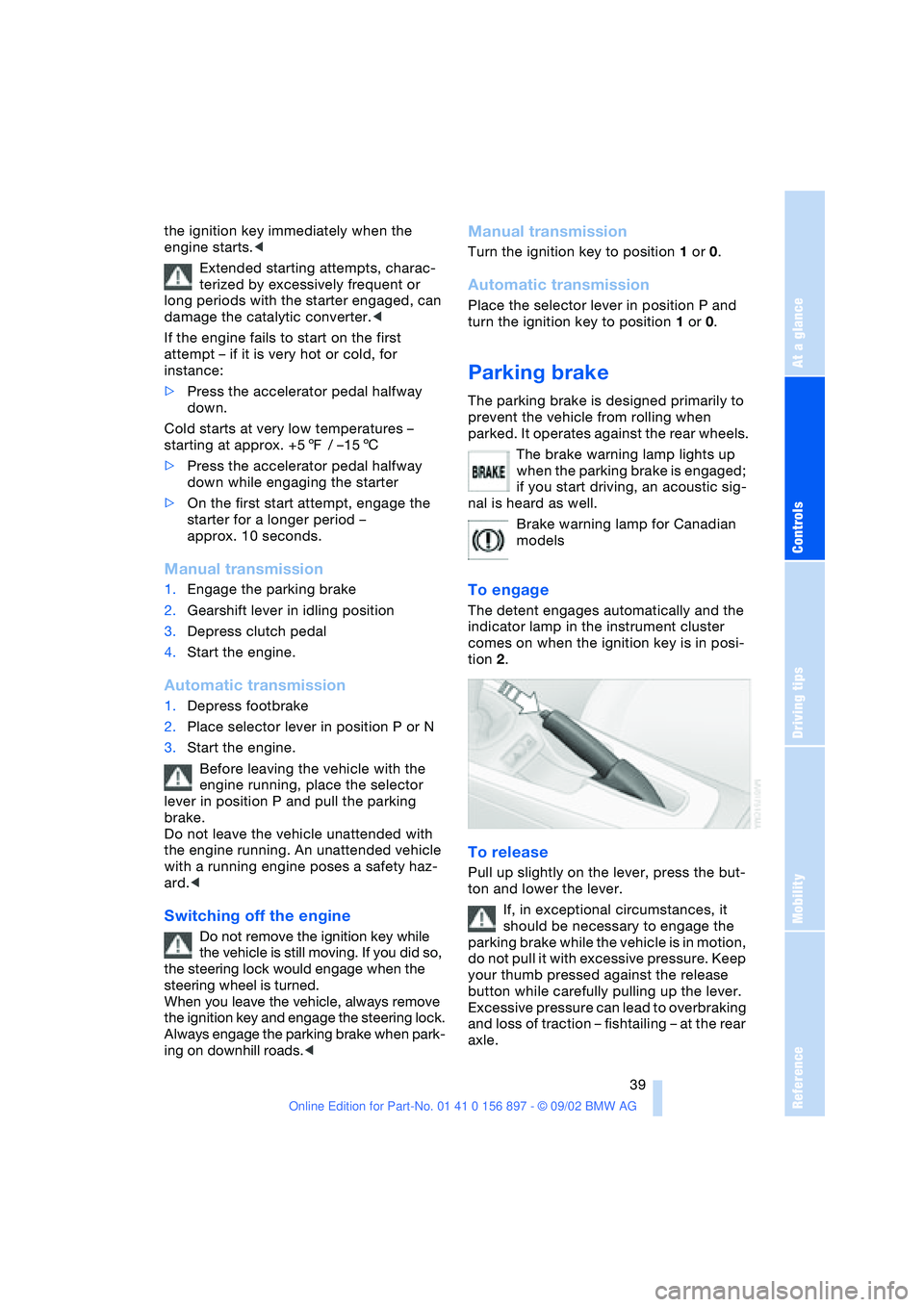
The brake warning lamp lights up
when the parking brake is engaged;
if you start driving, an acoustic sig-
nal is heard as well.
Brake warning lamp for Canadian
models
To engage
The detent engages automatically and the
indicator lamp in the instrument cluster
comes on when the ignition key is in posi-
tion 2.
To release
Pull up slightly on the lever, press the but-
ton and lower the lever.
If, in exceptional circumstances, it
should be necessary to engage the
parking brake while the vehicle is in motion,
do not pull it with excessive pressure. Keep
your thumb pressed against the release
button while carefully pulling up the lever.
Excessive pressure can lead to overbraking
and loss of traction – fishtailing – at the rear
axle.
Page 41 of 106
At a glance
Controls
Driving tips
Mobility
Reference
41
If you leave the vehicle with the
engine running, move the selector
lever to the P position and apply the park-
ing brake. If you fail to do this, the vehicle
could move.
Do not leave the vehicle unattended with
the engine running. An unattended vehicle
with a running engine poses a safety haz-
ard.<
PPark
Select reverse only when the vehicle is sta-
tionary. The transmission locks to prevent
the rear wheels from turning.
RReverse
Select reverse only when the vehicle is sta-
tionary.
NNeutral – idling
Select only when stopping for an extended
period.
DDrive – automatic shift program
This position is designed for driving under
all normal operating conditions. All forward
gears are available.
Kickdown
In the kickdown mode, you achieve maxi-
mum acceleration in position D.
Depress the accelerator pedal past the
increased resistance point at the full-throt-
tle position.
M/S Manual mode and
Sport program
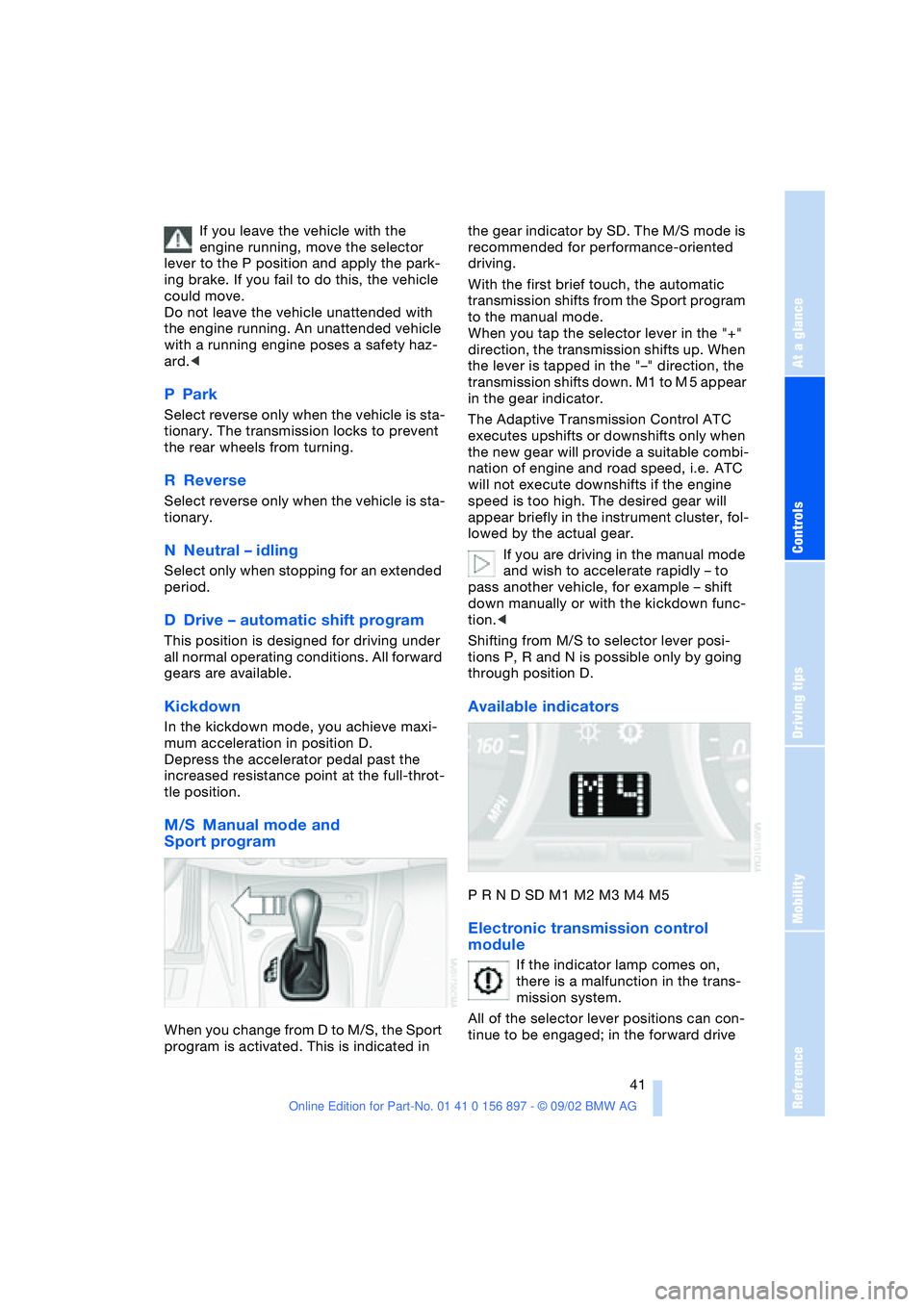
When you change from D to M/S, the Sport
program is activated. This is indicated in the gear indicator by SD. The M/S mode is
recommended for performance-oriented
driving.
With the first brief touch, the automatic
transmission shifts from the Sport program
to the manual mode.
When you tap the selector lever in the "+"
direction, the transmission shifts up. When
the lever is tapped in the "–" direction, the
transmission shifts down. M1 to M 5 appear
in the gear indicator.
The Adaptive Transmission Control ATC
executes upshifts or downshifts only when
the new gear will provide a suitable combi-
nation of engine and road speed, i.e. ATC
will not execute downshifts if the engine
speed is too high. The desired gear will
appear briefly in the instrument cluster, fol-
lowed by the actual gear.
If you are driving in the manual mode
and wish to accelerate rapidly – to
pass another vehicle, for example – shift
down manually or with the kickdown func-
tion.<
Shifting from M/S to selector lever posi-
tions P, R and N is possible only by going
through position D.
Available indicators
P R N D SD M1 M2 M3 M4 M5
Electronic transmission control
module
If the indicator lamp comes on,
there is a malfunction in the trans-
mission system.
All of the selector lever positions can con-
tinue to be engaged; in the forward drive
Page 53 of 106

At a glance
Controls
Driving tips
Mobility
Reference
53
>Forceful braking and braking with ABS:
Brake lamps 1 and 2 light up on both
vehicle sides together with the center
brake lamp.
Antilock Brake System ABS
The concept
ABS keeps the wheels from locking during
braking, thereby enhancing active driving
safety.
Malfunction
If the yellow indicator lamps for the
Antilock Brake System ABS come
on together with the brake warning
lamp and the indicator lamp for the
Dynamic Stability Control DSC:
The entire ABS and DSC control
system has failed. Continue driving
cautiously and defensively. Avoid
hard brake applications. Please have the
system checked by your BMW center as
soon as possible.
ABS and DSC indicator and warn-
ing lamps for Canadian models.
Braking with ABS
If you are in a situation which requires full
braking, you will exploit the full benefits of
the ABS system if you apply maximum
brake pressure – panic stop.
Pulsation at the brake pedal combines with
sounds from the hydraulic circuits to indi-
cate to the driver that ABS is in its active
mode.
Flat Tire Monitor
The concept
The tire pressure is determined using the
signals of the ABS sensors.
The system provides an alert whenever the
tire pressure of one tire drops relative to
that of another.
Prerequisites
In order for the system to "learn" the cor-
rect tire inflation pressures, please do the
following:
>Check the inflation pressure in all tires
>Compare to the inflation pressure table
– refer to page 72 – and correct if nec-
essary
>Initialize the system.
Check the tire pressures regularly
and correct if necessary. Refer to
page 71.<
Indicator lamp
In the event of a flat tire
The indicator lamp lights up red; in
addition, an acoustic signal is
sounded:
Respond immediately by carefully reducing
vehicle speed to under 50 mph / 80 km/h.
Avoid hard brake applications and steering
maneuvers.
If your vehicle is equipped with
Run Flat tires, note the information on
page 75.<
The Flat Tire Monitor cannot alert you
to severe and sudden tire damage
caused by external factors. Another factor
which the Flat Tire Monitor does not recog-
nize is the even and very gradual pressure
loss that takes place in all tires over an
extended period of time.<
Page 54 of 106
Technology for safety and driving convenience
54
System malfunction
The indicator lamp lights up yellow:
There is a malfunction or fault in the
Flat Tire Monitor.
In the event of this, please contact your
BMW center.
Initializing the system
Initialize the system only when the inflation
pressure has been corrected or modified,
e.g. if a tire was changed.
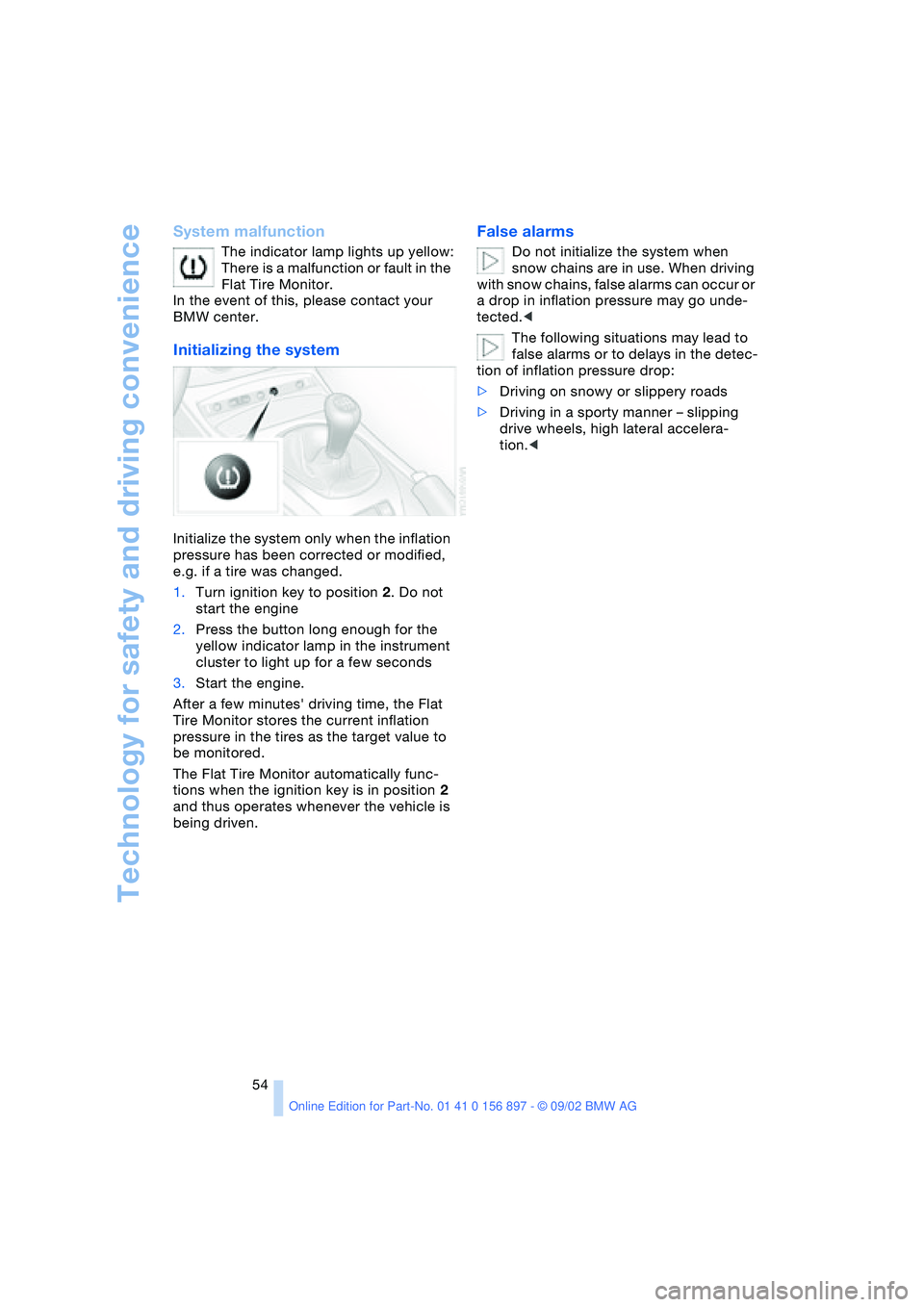
1.Turn ignition key to position 2. Do not
start the engine
2.Press the button long enough for the
yellow indicator lamp in the instrument
cluster to light up for a few seconds
3.Start the engine.
After a few minutes' driving time, the Flat
Tire Monitor stores the current inflation
pressure in the tires as the target value to
be monitored.
The Flat Tire Monitor automatically func-
tions when the ignition key is in position 2
and thus operates whenever the vehicle is
being driven.
False alarms
Do not initialize the system when
snow chains are in use. When driving
with snow chains, false alarms can occur or
a drop in inflation pressure may go unde-
tected.<
The following situations may lead to
false alarms or to delays in the detec-
tion of inflation pressure drop:
>Driving on snowy or slippery roads
>Driving in a sporty manner – slipping
drive wheels, high lateral accelera-
tion.<
Page 69 of 106
Mobility
To ensure that you stay mobile,
the following chapter provides you with im-
portant information on fuels and fluids, tires
and wheels, maintenance procedures and
steps to take in the event of a breakdown.
Page 71 of 106
At a glance
Controls
Driving tips
Mobility
Reference
71
Wheels and tires
Tire inflation pressure
Information for your safety
The factory-approved Run Flat tires are
matched to the vehicle and have been
selected to provide optimum safety and
driving comfort.
It is not merely the tire's service life, but
also driving comfort and – above all else –
driving safety that depend on the condition
of the tires and the maintenance of the
specified tire pressure.
Incorrect tire inflation pressure is a fre-
quent cause of tire damage. It also signifi-
cantly influences the roadholding ability of
your BMW.
Check tire inflation pressures regu-
larly – at least every two weeks and
before every extended journey. If this is not
done, incorrect tire pressures can cause
driving instability or tire damage, ultimately
resulting in accidents.<
Checking tire pressures
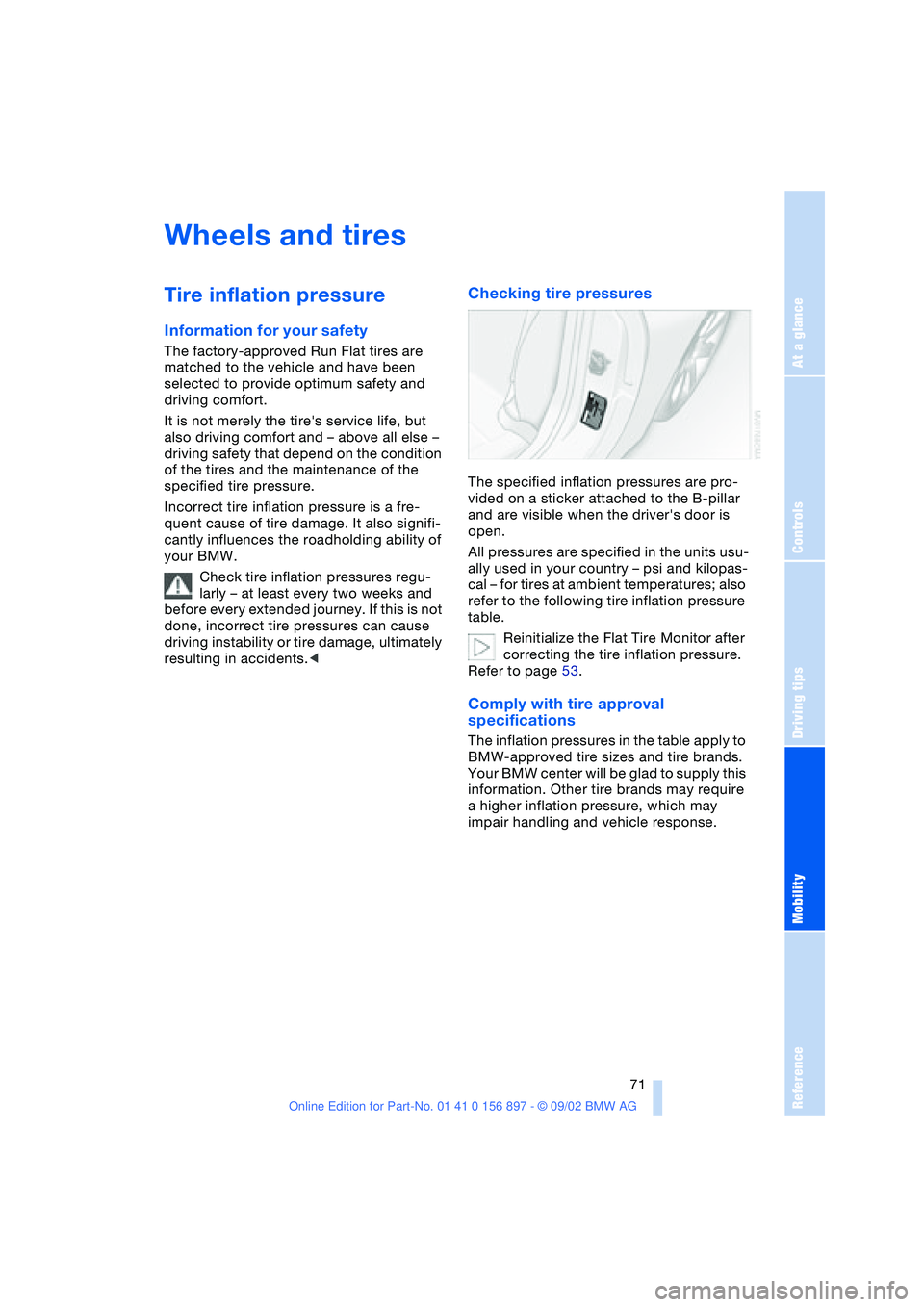
The specified inflation pressures are pro-
vided on a sticker attached to the B-pillar
and are visible when the driver's door is
open.
All pressures are specified in the units usu-
ally used in your country – psi and kilopas-
cal – for tires at ambient temperatures; also
refer to the following tire inflation pressure
table.
Reinitialize the Flat Tire Monitor after
correcting the tire inflation pressure.
Refer to page 53.
Comply with tire approval
specifications
The inflation pressures in the table apply to
BMW-approved tire sizes and tire brands.
Your BMW center will be glad to supply this
information. Other tire brands may require
a higher inflation pressure, which may
impair handling and vehicle response.
Page 72 of 106
Wheels and tires
72
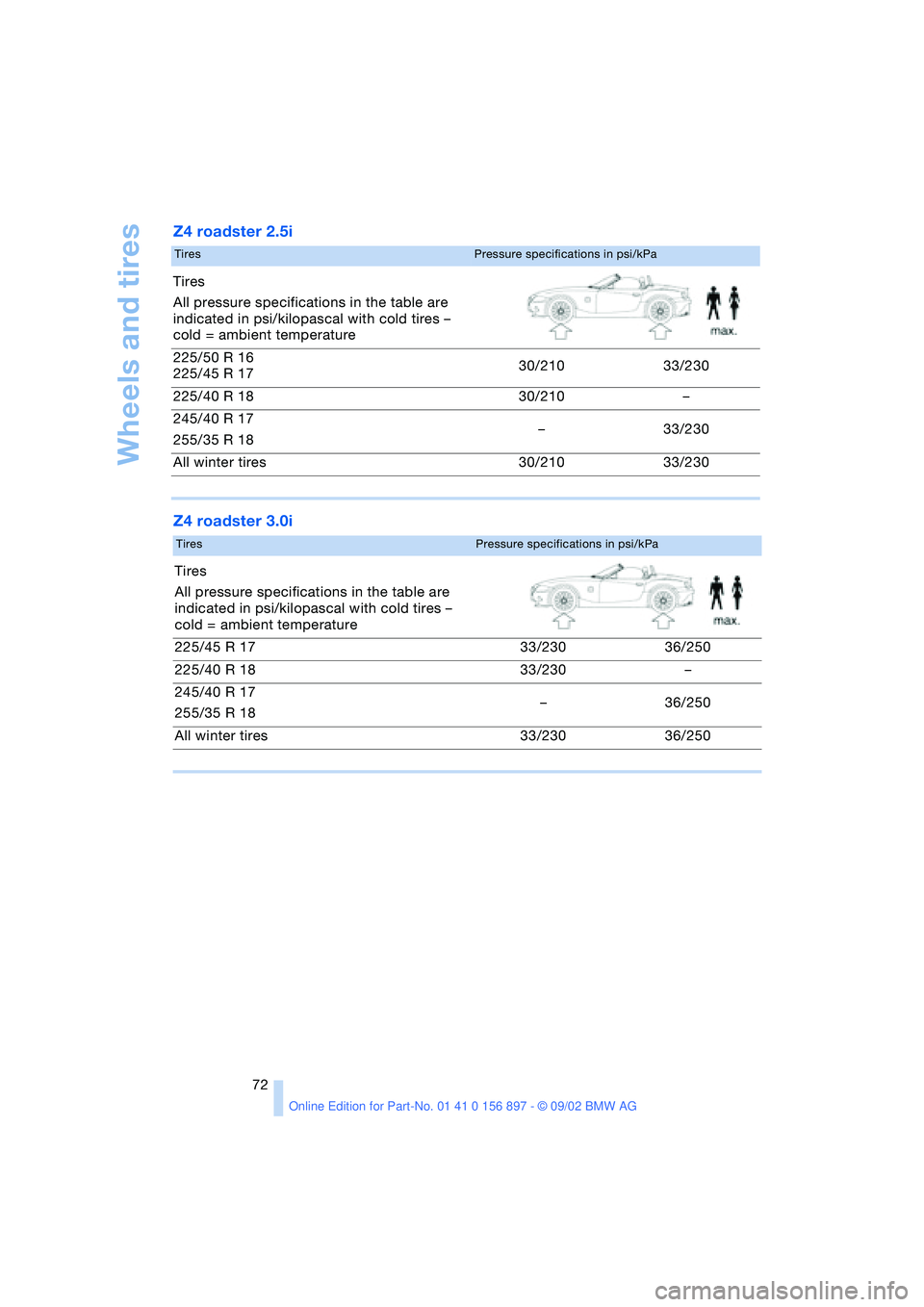
Z4 roadster 2.5i
Z4 roadster 3.0i
TiresPressure specifications in psi/kPa
Tires
All pressure specifications in the table are
indicated in psi/kilopascal with cold tires –
cold = ambient temperature
225/50 R 16
225/45 R 17 30/210 33/230
225/40 R 18 30/210 –
245/40 R 17
255/35 R 18 –33/230
All winter tires 30/210 33/230
TiresPressure specifications in psi/kPa
Tires
All pressure specifications in the table are
indicated in psi/kilopascal with cold tires –
cold = ambient temperature
225/45 R 17 33/230 36/250
225/40 R 18 33/230 –
245/40 R 17
255/35 R 18 –36/250
All winter tires 33/230 36/250
Page 73 of 106
At a glance
Controls
Driving tips
Mobility
Reference
73
Tire condition
Tire tread – Tire damage
Inspect your tires frequently for tread wear,
signs of damage and for foreign objects
lodged in the tread. Check the tread depth.
Tread depth should not be allowed to go
below
1/8 in / 3 mm, even though in
Europe, for example, the legally specified
minimum tread depth is only
1/16 in /
1.6 mm.
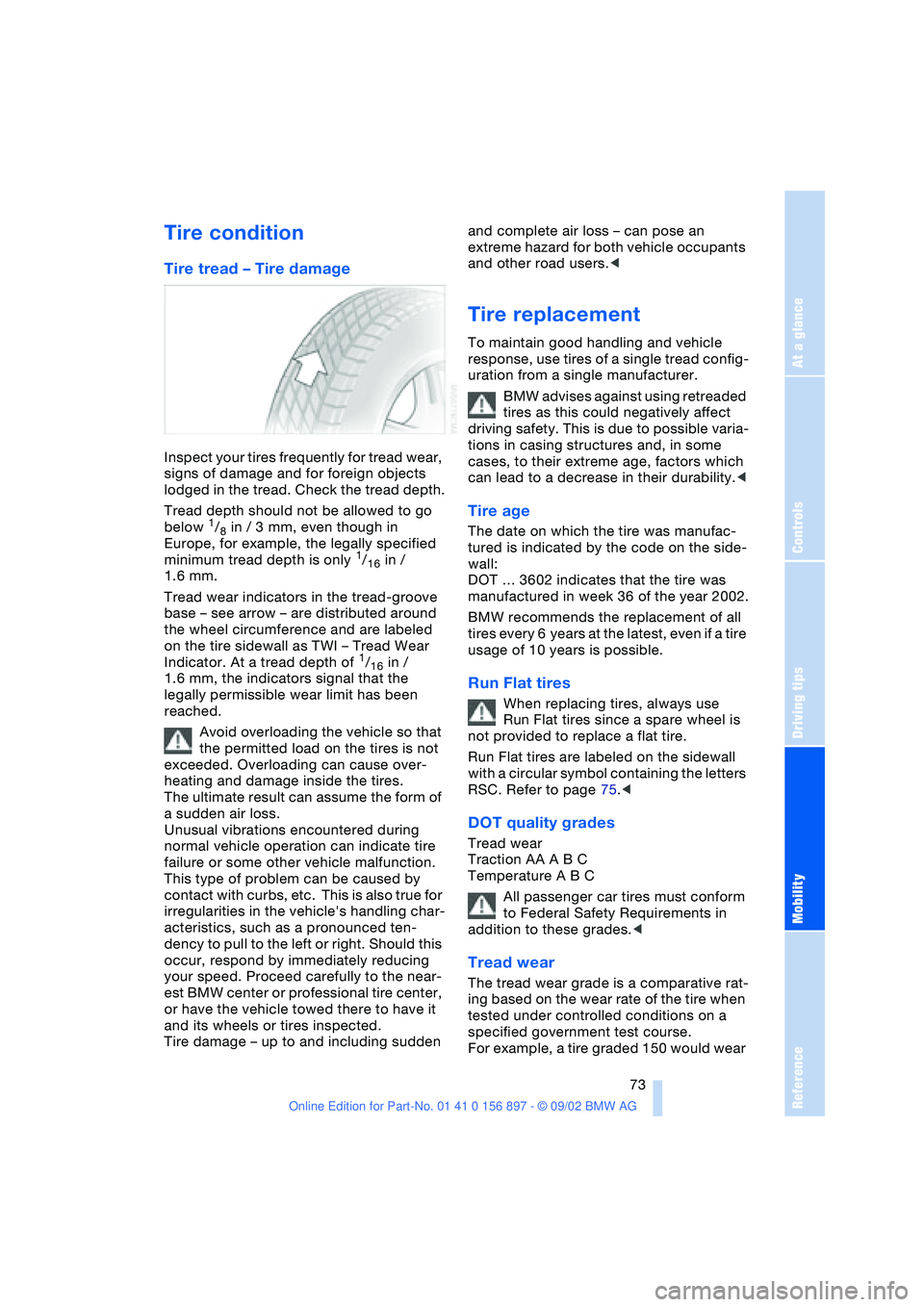
Tread wear indicators in the tread-groove
base – see arrow – are distributed around
the wheel circumference and are labeled
on the tire sidewall as TWI – Tread Wear
Indicator. At a tread depth of
1/16 in /
1.6 mm, the indicators signal that the
legally permissible wear limit has been
reached.
Avoid overloading the vehicle so that
the permitted load on the tires is not
exceeded. Overloading can cause over-
heating and damage inside the tires.
The ultimate result can assume the form of
a sudden air loss.
Unusual vibrations encountered during
normal vehicle operation can indicate tire
failure or some other vehicle malfunction.
This type of problem can be caused by
contact with curbs, etc. This is also true for
irregularities in the vehicle's handling char-
acteristics, such as a pronounced ten-
dency to pull to the left or right. Should this
occur, respond by immediately reducing
your speed. Proceed carefully to the near-
est BMW center or professional tire center,
or have the vehicle towed there to have it
and its wheels or tires inspected.
Tire damage – up to and including sudden and complete air loss – can pose an
extreme hazard for both vehicle occupants
and other road users.<
Tire replacement
To maintain good handling and vehicle
response, use tires of a single tread config-
uration from a single manufacturer.
BMW advises against using retreaded
tires as this could negatively affect
driving safety. This is due to possible varia-
tions in casing structures and, in some
cases, to their extreme age, factors which
can lead to a decrease in their durability.<
Tire age
The date on which the tire was manufac-
tured is indicated by the code on the side-
wall:
DOT … 3602 indicates that the tire was
manufactured in week 36 of the year 2002.
BMW recommends the replacement of all
tires every 6 years at the latest, even if a tire
usage of 10 years is possible.
Run Flat tires
When replacing tires, always use
Run Flat tires since a spare wheel is
not provided to replace a flat tire.
Run Flat tires are labeled on the sidewall
with a circular symbol containing the letters
RSC. Refer to page 75.<
DOT quality grades
Tread wear
Traction AA A B C
Temperature A B C
All passenger car tires must conform
to Federal Safety Requirements in
addition to these grades.<
Tread wear
The tread wear grade is a comparative rat-
ing based on the wear rate of the tire when
tested under controlled conditions on a
specified government test course.
For example, a tire graded 150 would wear