2003 BMW Z4 2.5I wheel
[x] Cancel search: wheelPage 74 of 106
Wheels and tires
74 one and one-half (1 γ) times as well on the
government course as a tire graded 100.
The relative performance of tires depends
upon the actual conditions of their use,
however, and may depart significantly from
the norm due to variations in driving habits,
service practices and differences in road
characteristics and climate.
Traction
The traction grades, from highest to lowest,
are AA, A, B and C.
Those grades represent the tire's ability to
stop on wet pavement as measured under
controlled conditions on specified govern-
ment test surfaces of asphalt and concrete.
A tire marked C may have poor traction
performance.
The traction grade assigned to this
tire is based on straight-ahead brak-
ing traction tests, and does not include
acceleration, cornering, hydroplaning, or
peak traction characteristics.<
Temperature
The temperature grades are A – the
highest – B, and C, representing the tire's
resistance to the generation of heat and its
ability to dissipate heat when tested under
controlled conditions on a specified indoor
laboratory test wheel.
Sustained high temperature can cause the
material of the tire to degenerate and
reduce tire life, and excessive temperature
can lead to sudden tire failure. The grade C
corresponds to a level of performance
which all passenger car tires must meet
under the Federal Motor Vehicle Safety
Standard No. 109. Grades B and A repre-
sent higher levels of performance on the
laboratory test wheel than the minimum
required by law.
The temperature grade for this tire is
established for a tire that is properly
inflated and not overloaded. Excessive
speed, under-inflation, or excessive load-
ing, either separately or in combination,
can cause heat buildup and possible tire
failure.<
Uniform Tire Quality Grading
Quality grades can be found where appli-
cable on the tire sidewall between tread
shoulder and maximum section width. For
example:
Tread wear 200 Traction AA
Temperature A
Wheel and tire combina-
tions
The right choice
Use wheels and tires approved by
BMW for your particular vehicle. Vari-
ations in factors such as manufacturing tol-
erances mean that even wheels and tires
with identical official size ratings could
actually have dimensions different from the
approved units. These differences could
lead to body contact, and with it the risk of
severe accidents. If non-approved wheels
and tires are used, BMW cannot evaluate
their suitability, and therefore cannot be
held liable for driving safety.<
BMW tests certain tire brands for each tire
size, classifies them as road-safe and
approves them. Consult your BMW center
for more information. Observe any country-
specific regulations, e.g. on making a cor-
responding entry in the vehicle documents.
The correct wheel and tire combina-
tion affects different systems such as
ABS, DSC, DTC and DBC. The function of
these systems is impaired if improper
wheel and tire combinations are used.
For this reason, use tires of the same brand
and tread configuration. In the event of a
flat tire, for example, remount the approved
wheel and tire combination as soon as pos-
sible.<
Page 76 of 106
Wheels and tires
76
Winter tires
Choosing the right tire
BMW recommends Run Flat winter tires –
M+S – for operation under inclement winter
driving conditions. While all-season tires
with the M+S identification mark do indeed
possess better winter traction than summer
tires that have the H, V, W, Y and ZR speed
ratings, they generally do not provide the
same levels of performance as true winter
tires.
In the interests of sure tracking and safe
steering response, mount winter tires
which are made by the same manufacturer
and which have the same tread configura-
tion on all four wheels.
Your BMW is equipped with Run Flat tires.
Please consult your BMW center if you
wish to replace the tires of your BMW or
change from summer to winter tires, or vice
versa.
When replacing tires or changing from
summer to winter tires – or vice versa –
use only Run Flat tires since a spare tire will
not be available in the event of a flat tire.<
Comply with recommended speed
Never exceed the maximum speed for
which the winter tires are rated.
Unprofessional attempts by laymen to ser-
vice tires can lead to damage and acci-
dents.
Have this work performed by skilled pro-
fessionals only. Any BMW center has the
required technical knowledge and the
proper equipment and will be happy to
assist you.<
Tire condition, tire pressure
Once the tire wears to below 3/16 in /
4 mm, winter tires display a perceptible
decrease in their ability to cope with winter
driving conditions, and should be replaced
in the interest of safety.
Comply with the specified tire inflation
pressures – and be sure to have the wheel
and tire assemblies balanced every time
you change the tires.
Storage
Store tires in a cool, dry place, protecting
them against light whenever possible. Pro-
tect the tires from contact with oil, grease
and fuel.
Snow chains*
Only certain types of snow chains have
been tested by BMW, classified as road-
safe and approved. Consult your BMW
center for more information. BMW recom-
mends using only approved fine-link snow
chains.
Their use is only permitted in pairs on the
winter tires on the rear wheels. Comply
with all manufacturer's safety precautions
when mounting the chains.
You cannot mount snow chains on the fol-
lowing tires:
245/40 R 17
255/35 R 18
Do not exceed a speed of 30 mph /
50 km/h when using snow chains.<
Do not initialize the Flat Tire Monitor
after snow chains have been
mounted.
When driving with snow chains, it may be
useful to deactivate the DSC briefly. Refer
to page 51.<
Page 84 of 106
Replacement procedures
84
Replacement procedures
Onboard tool kit
The onboard tool kit is stored in a tool
pouch. It is located in the luggage compart-
ment beneath the floor panel.
Windshield wiper blades
1.Fold the wiper arm completely out from
the windshield
2.Position the wiper blade at an angle and
pull the release spring, see arrow
3.Fold the wiper blade down and unhook
it toward the windshield
4.Pull the wiper blade past the wiper arm
toward the top
5.Insert a new wiper blade and apply
pressure until you hear it engage.
Lamps and bulbs
The lamps and bulbs make essential contri-
butions to the safety of your vehicle. There-
fore, comply fully with the following instruc-
tions during bulb replacement. If you are
not familiar with the procedures, BMW rec-
ommends that you have your BMW center
carry out the work.
Do not touch the glass portion of a
new bulb with your bare hands since
even small amounts of impurities burn into
the surface and reduce the service life of
the bulb. Use a clean cloth, paper napkin or
a similar material, or hold the bulb by its
metallic base.<
A replacement bulb set is available from
your BMW center.
Before working on the electrical sys-
tem, switch off the electrical acces-
sory you are working on or disconnect the
cable from the negative terminal of the bat-
tery. Failure to observe this precaution
could result in short circuits.
To prevent injuries and damage, always
comply with any instructions provided by
the bulb manufacturer.<
Accessing the headlamps
To gain access to the headlamp covers,
turn the front wheels in the required direc-
tion.
Page 87 of 106
At a glance
Controls
Driving tips
Mobility
Reference
87
1.Remove the cover by turning the lock to
the right; refer to the detail in the illus-
tration
2.Applying light pressure, turn the bulb to
the left. Remove and exchange the bulb
3.Reinstall the cover.
Center high-mount brake lamp
The LED strip is in the luggage compart-
ment lid.
Please contact a BMW center in case of a
malfunction.
License plate lamps
5 watt bulb
1.Push out the lamp with a suitable object
and remove it
2.Replace the bulb.
Snap the lamp back into place.
Changing a wheel
Run Flat tires
Your BMW is equipped with Run Flat tires.
Therefore, the wheel no longer has to be
changed immediately in the event of a loss
in inflation pressure.
Run Flat tires are labeled on the sidewall
with a circular symbol containing the letters
RSC. Refer to page 75.
BMW recommends that you consult your
BMW center if you wish to replace the tires
of your BMW, or change from summer to
winter tires or vice versa.
Your BMW center knows how to work with
Run Flat tires and is equipped with the nec-
essary special tools.
When replacing tires or changing
from summer to winter tires – or vice
versa – use only Run Flat tires since a spare
tire will not be available in the event of a flat
tire.<
Jacking points
The jacking points are located at the posi-
tions indicated in the illustration.
Your BMW center can provide you
with a suitable jack.<
Battery
Maintenance
The battery is completely maintenance-
free. This means that the original electro-
lyte will normally last for the service life of
the battery under moderate climatic condi-
tions.
Page 91 of 106
At a glance
Controls
Driving tips
Mobility
Reference
91
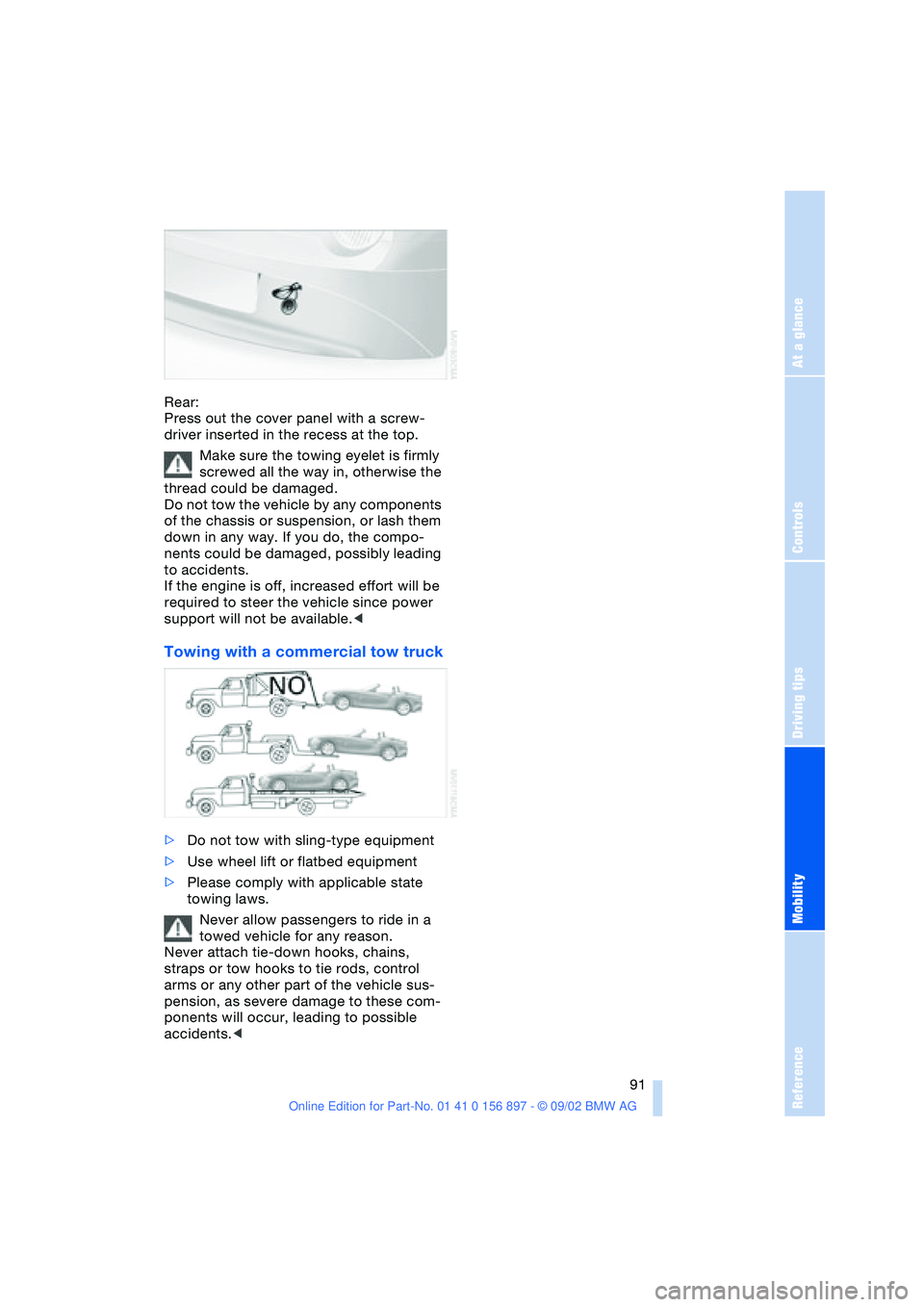
Rear:
Press out the cover panel with a screw-
driver inserted in the recess at the top.
Make sure the towing eyelet is firmly
screwed all the way in, otherwise the
thread could be damaged.
Do not tow the vehicle by any components
of the chassis or suspension, or lash them
down in any way. If you do, the compo-
nents could be damaged, possibly leading
to accidents.
If the engine is off, increased effort will be
required to steer the vehicle since power
support will not be available.<
Towing with a commercial tow truck
>Do not tow with sling-type equipment
>Use wheel lift or flatbed equipment
>Please comply with applicable state
towing laws.
Never allow passengers to ride in a
towed vehicle for any reason.
Never attach tie-down hooks, chains,
straps or tow hooks to tie rods, control
arms or any other part of the vehicle sus-
pension, as severe damage to these com-
ponents will occur, leading to possible
accidents.<
Page 102 of 106

Everything from A - Z
102 Speedometer 13
Sport program
– automatic transmission
with Steptronic 41
– Drivelogic 42
Standing lamps, refer to
Parking lamps 45, 46
Starting problems 89
Starting the engine 38
Steering lock 38
Steering wheel
– adjusting 32
Steptronic 40
Storage compartments 60
– electrical fault 60
– opening manually 60
Storage nets 60
Storage, tires 76
Storing the vehicle, refer to
the Caring for your vehi-
cle brochure
Stroke 94
Switching gears, refer to
Automatic transmission
with Steptronic 40
Symbols 6
Synthetic oils 80
T
Tachometer 47
Tail lamps
– bulb replacement 86
– indicator lamp, defective
bulb 14
Tank capacity 96
Technical data 94
– engine 94
– weight 94
Technical
modifications 7
Telephone preparation 61
Telephone, refer to the
Owner's Manual for the
telephone
Temperature
– air conditioning 56
– automatic climate
control 58
– tires 74Temperature display
– engine coolant 47
– outside temperature 48
– outside temperature in
computer 49
Third brake lamp 87
Tilt alarm sensor 19, 28
– deactivating 28
– remote control 19
Tire change 87
Tire damage 73
Tire inflation pressure 71
– checking 71
Tire pressure monitor 53
Tires
– age 73
– approval 71
– break-in procedures 64
– condition 73
– damage 73
– DOT quality grades 73
– flat tire 75
– inflation pressure 71
– M+S tires 76
– replacement 73
– Run Flat tires 73, 75, 87
– temperature 74
– traction 74
– tread 73
– tread wear 73
– Uniform Tire Quality
Grading 74
– wheel-tire
combination 74
– winter tires 76
Tool kit, refer to Onboard
tool kit 84
Torque 94
Towing 90
Towing eyelet 90
Tow-starting 90
Track width 95
Traction 74
Transmission, refer to
Automatic transmission
with Steptronic 40
Transporting children
safely 34
Tread depth, tires 73
Tread wear 73
Tread wear indicator 73Trip odometer 47
Trunk lid, refer to Luggage
compartment lid 21, 22
Trunk, refer to Luggage
compartment 22
Turn signal indicators 42
– bulb replacement 86
– indicator lamps 14
Turning circle 95
U
Undercoating, refer to the
Caring for your vehicle
brochure
Uniform Tire Quality
Grading 74
Unintentional alarm 28
Unlocking the vehicle 19
Used batteries, refer to
Battery disposal 88
V
Vacuum cleaner, refer to
Cigarette lighter
socket 61
Vehicle
– battery 87
– break-in procedures 64
– data 94
Vehicle Memory 37
Vehicle storage, refer to the
Caring for your vehicle
brochure
Vehicle vacuum cleaner,
refer to Cigarette lighter
socket 61
Ventilation 56, 59
Vents, refer to
Ventilation 56, 59
W
Warning and indicator
lamps 14
Warning triangle 89
Warranty and service 7
Warranty and Service
Guide Booklet 82
Page 103 of 106

At a glance
Controls
Driving tips
Mobility
Reference
103
Washer fluids
– refilling 79
Washer reservoir 79, 96
– filling 79
Washer/wiper system 43
Washing fluids 96
Water on roads
– flooding 65
Wear indicator in tires 73
Weights 94
Wheel change 87
Wheel wrench 87
Wheelbase 95
Wheels and tires 74
Width 95
Wind deflector 26
Window condensation
– removing 56, 58
Windows
– convenience operation 20
– defrosting and removing
condensation 56, 58
– power windows 22
Windshield washer
nozzles 44
Windshield washer
reservoir 79
– filling 96
Windshield wipers 43
– cleaning windshield 43
– intermittent operation 43
– rain sensor 43
– replacing 84
Winter tires 76
– changing 87
– condition 76
– pressure 76
– storage 76
Wipers
– replacing 84
Work in the engine
compartment 77
X
Xenon lamps 85