2003 BMW 540I SEDAN light
[x] Cancel search: lightPage 5 of 187

5n
OverviewControlsMaintenanceRepairsDataIndex
Controls and features
Passenger safety systems:
Airbags59
Transporting children safely62
Vehicle Memory, Key
Memory67
Driving:
Steering/Ignition lock68
Starting the engine68
Switching off the engine70
Parking brake70
Manual transmission71
Automatic transmission72
Automatic transmission with
Steptronic75
Indicator/Headlamp flasher78
Washer/Wiper system/Rain
sensor78
Cruise control80
Everything under control:
Odometer, outside temperature
display82
Tachometer83
Energy control83
Fuel gauge83
Coolant temperature gauge84
Service Interval Display84
Check Control85
Computer88
Multi-Information Display
(MID)89
Digital clock in the MID90
Computer in the MID93
Technology for safety and
driving convenience:
Park Distance Control (PDC)98
Automatic Stability Control plus
Traction (ASC+T)/Dynamic
Stability Control (DSC)99
Self-leveling suspension 101
Tire Pressure Monitor (RDC)101
Lamps:
Parking lamps/Low beams103
Instrument lighting104
High beams/Standing
lamps104
Fog lamps104
Interior lamps105
Reading lamps105
Controlling the climate for
pleasant driving:
Air conditioning106
Automatic climate control109
Roller sun blind114
Parked-car ventilation
system114
Cabin convenience:
BMW Universal Transmitter115
Glove compartment118
Storage compartments118
Cellular phone119
Beverage holder119
Ashtray, front119
Cigarette lighter120
Ashtray, rear120
Loading and transporting
cargo:
Through-loading system121
Ski bag122
sport wagon:
Cargo area125
Roll-up cover125
Partition net125
Storage areas in the luggage
compartment126
Cargo loading128
Roof-mounted luggage rack129
Page 19 of 187
19n
OverviewControlsMaintenanceRepairsDataIndex
Indicator and warning lamps
Technology that monitors itself
The system runs a check on the
warning and indicator lamps marked
by "
l
" each time you switch on the
ignition. They each light up once for dif-
ferent periods of time.
If a fault should occur in one of these
systems, the corresponding lamp does
not go out after the engine is started or
it lights up while the vehicle is moving.
The following section describes how
you should respond.
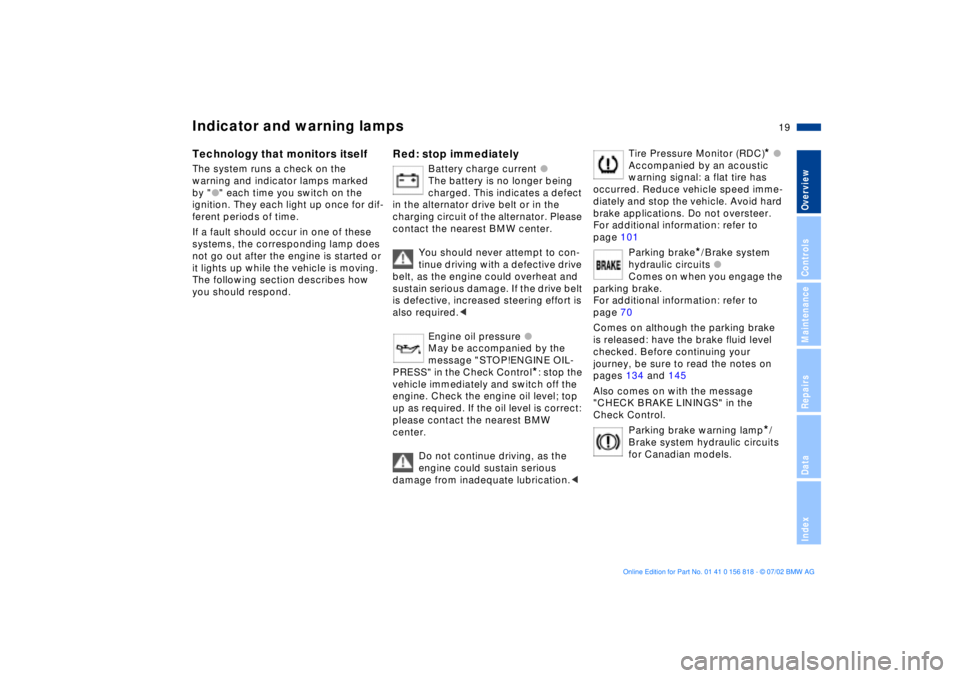
Red: stop immediately
Battery charge current
l
The battery is no longer being
charged. This indicates a defect
in the alternator drive belt or in the
charging circuit of the alternator. Please
contact the nearest BMW center.
You should never attempt to con-
tinue driving with a defective drive
belt, as the engine could overheat and
sustain serious damage. If the drive belt
is defective, increased steering effort is
also required.
<
Engine oil pressure
l
May be accompanied by the
message "STOP!ENGINE OIL-
PRESS" in the Check Control
*
: stop the
vehicle immediately and switch off the
engine. Check the engine oil level; top
up as required. If the oil level is correct:
please contact the nearest BMW
center.
Do not continue driving, as the
engine could sustain serious
damage from inadequate lubrication.
<
Tire Pressure Monitor (RDC)
*
l
Accompanied by an acoustic
warning signal: a flat tire has
occurred. Reduce vehicle speed imme-
diately and stop the vehicle. Avoid hard
brake applications. Do not oversteer.
For additional information: refer to
page 101
Parking brake
*
/Brake system
hydraulic circuits
l
Comes on when you engage the
parking brake.
For additional information: refer to
page 70
Comes on although the parking brake
is released: have the brake fluid level
checked. Before continuing your
journey, be sure to read the notes on
pages 134 and 145
Also comes on with the message
"CHECK BRAKE LININGS" in the
Check Control.
Parking brake warning lamp
*
/
Brake system hydraulic circuits
for Canadian models.
Page 21 of 187
21n
OverviewControlsMaintenanceRepairsDataIndex
Indicator and warning lamps
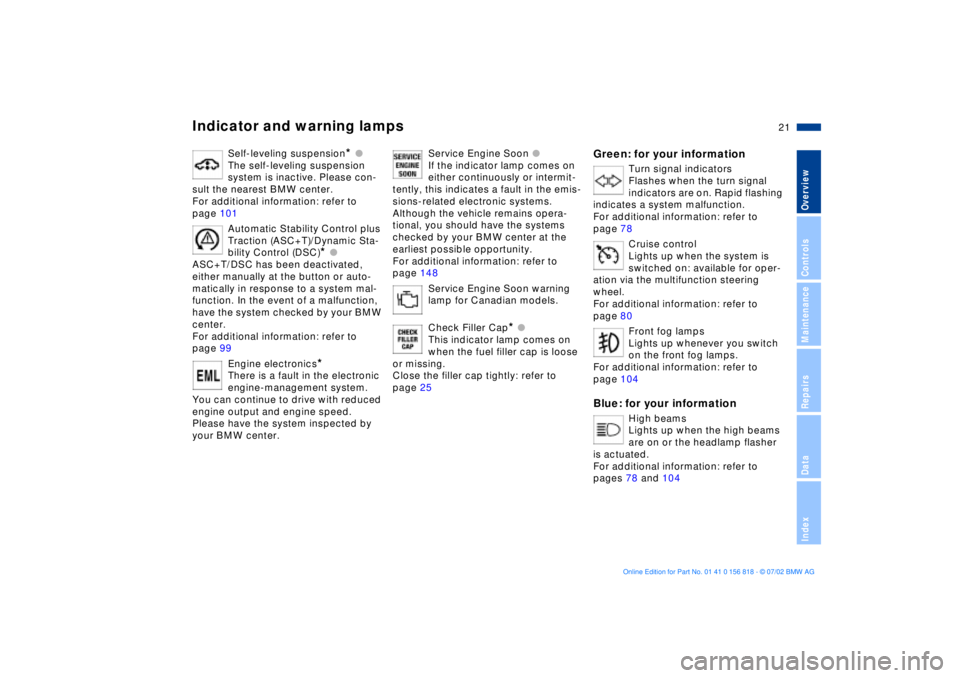
Self-leveling suspension
* l
The self-leveling suspension
system is inactive. Please con-
sult the nearest BMW center.
For additional information: refer to
page 101
Automatic Stability Control plus
Traction (ASC+T)/Dynamic Sta-
bility Control (DSC)
* l
ASC+T/DSC has been deactivated,
either manually at the button or auto-
matically in response to a system mal-
function. In the event of a malfunction,
have the system checked by your BMW
center.
For additional information: refer to
page 99
Engine electronics
*
There is a fault in the electronic
engine-management system.
You can continue to drive with reduced
engine output and engine speed.
Please have the system inspected by
your BMW center.
Service Engine Soon l
If the indicator lamp comes on
either continuously or intermit-
tently, this indicates a fault in the emis-
sions-related electronic systems.
Although the vehicle remains opera-
tional, you should have the systems
checked by your BMW center at the
earliest possible opportunity.
For additional information: refer to
page 148
Service Engine Soon warning
lamp for Canadian models.
Check Filler Cap
* l
This indicator lamp comes on
when the fuel filler cap is loose
or missing.
Close the filler cap tightly: refer to
page 25
Green: for your information
Turn signal indicators
Flashes when the turn signal
indicators are on. Rapid flashing
indicates a system malfunction.
For additional information: refer to
page 78
Cruise control
Lights up when the system is
switched on: available for oper-
ation via the multifunction steering
wheel.
For additional information: refer to
page 80
Front fog lamps
Lights up whenever you switch
on the front fog lamps.
For additional information: refer to
page 104
Blue: for your information
High beams
Lights up when the high beams
are on or the headlamp flasher
is actuated.
For additional information: refer to
pages 78 and 104
Page 34 of 187
34n
Opening and closing Ð via the remote controlThe conceptThe remote control makes opening and
locking the doors of your vehicle very
convenient. Furthermore, it provides
three additional functions which you
can only execute via the remote control:
>To switch on interior lamps, refer to
page 35.
With this function, you can also
"search for" your vehicle, when
parked in an underground garage, for
instance
>To open the luggage compartment
lid/tailgate, refer to page 35.
The luggage compartment lid/tailgate
will open slightly, regardless of
whether it was previously locked or
unlocked
>Panic mode
In case of danger, you can trigger the
alarm.
Whenever you unlock (lock) the vehicle,
you simultaneously deactivate (activate)
the anti-theft system, disarm (arm) the
alarm system and switch the interior
lamps on (off).
You can have a signal set to con-
firm that the vehicle's locks have
engaged securely.<
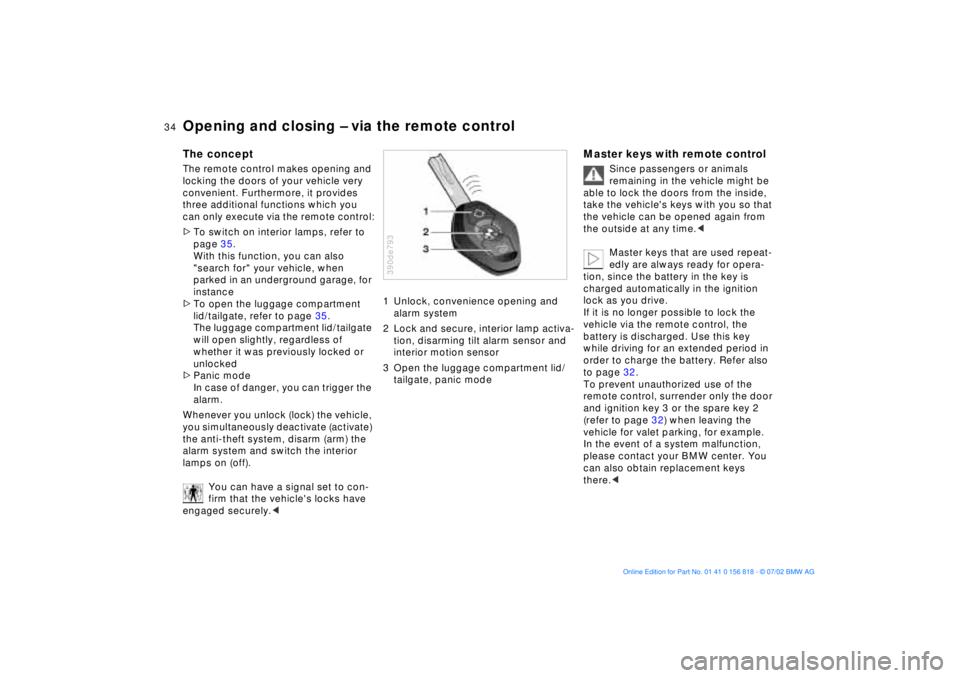
1 Unlock, convenience opening and
alarm system
2 Lock and secure, interior lamp activa-
tion, disarming tilt alarm sensor and
interior motion sensor
3 Open the luggage compartment lid/
tailgate, panic mode390de793
Master keys with remote control
Since passengers or animals
remaining in the vehicle might be
able to lock the doors from the inside,
take the vehicle's keys with you so that
the vehicle can be opened again from
the outside at any time.<
Master keys that are used repeat-
edly are always ready for opera-
tion, since the battery in the key is
charged automatically in the ignition
lock as you drive.
If it is no longer possible to lock the
vehicle via the remote control, the
battery is discharged. Use this key
while driving for an extended period in
order to charge the battery. Refer also
to page 32.
To prevent unauthorized use of the
remote control, surrender only the door
and ignition key 3 or the spare key 2
(refer to page 32) when leaving the
vehicle for valet parking, for example.
In the event of a system malfunction,
please contact your BMW center. You
can also obtain replacement keys
there.<
Page 35 of 187
35n
OverviewControlsMaintenanceRepairsDataIndex
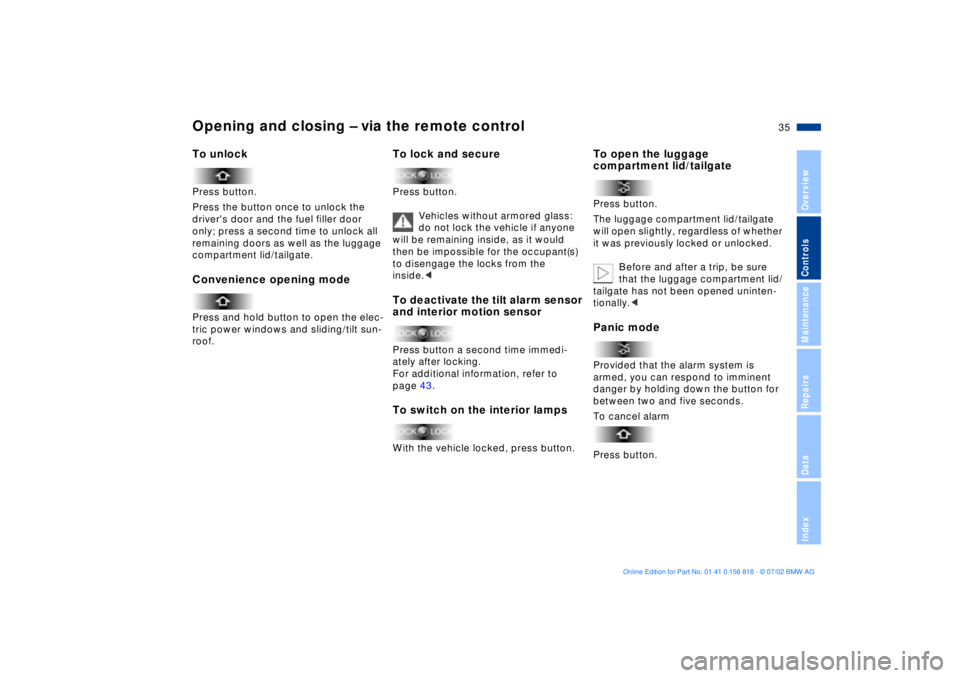
Opening and closing Ð via the remote controlTo unlockPress button.
Press the button once to unlock the
driver's door and the fuel filler door
only; press a second time to unlock all
remaining doors as well as the luggage
compartment lid/tailgate.Convenience opening modePress and hold button to open the elec-
tric power windows and sliding/tilt sun-
roof.
To lock and securePress button.
Vehicles without armored glass:
do not lock the vehicle if anyone
will be remaining inside, as it would
then be impossible for the occupant(s)
to disengage the locks from the
inside.< To deactivate the tilt alarm sensor
and interior motion sensorPress button a second time immedi-
ately after locking.
For additional information, refer to
page 43.To switch on the interior lampsWith the vehicle locked, press button.
To open the luggage
compartment lid/tailgatePress button.
The luggage compartment lid/tailgate
will open slightly, regardless of whether
it was previously locked or unlocked.
Before and after a trip, be sure
that the luggage compartment lid/
tailgate has not been opened uninten-
tionally.< Panic modeProvided that the alarm system is
armed, you can respond to imminent
danger by holding down the button for
between two and five seconds.
To cancel alarm
Press button.
Page 38 of 187
38n
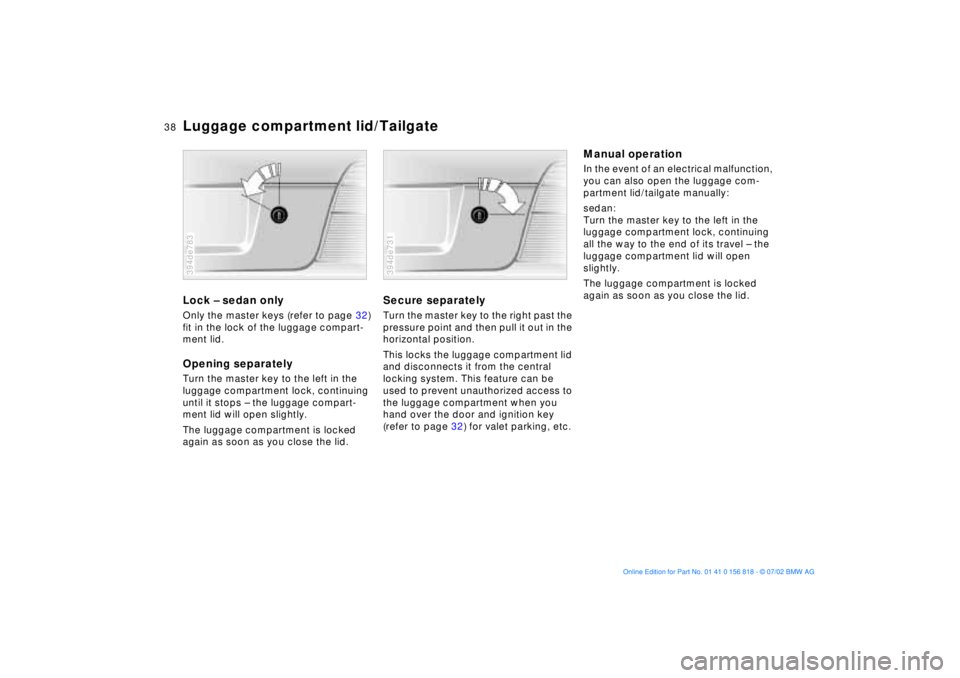
Luggage compartment lid/TailgateLock Ð sedan onlyOnly the master keys (refer to page 32)
fit in the lock of the luggage compart-
ment lid.Opening separatelyTurn the master key to the left in the
luggage compartment lock, continuing
until it stops Ð the luggage compart-
ment lid will open slightly.
The luggage compartment is locked
again as soon as you close the lid.394de783
Secure separatelyTurn the master key to the right past the
pressure point and then pull it out in the
horizontal position.
This locks the luggage compartment lid
and disconnects it from the central
locking system. This feature can be
used to prevent unauthorized access to
the luggage compartment when you
hand over the door and ignition key
(refer to page 32) for valet parking, etc.394de731
Manual operationIn the event of an electrical malfunction,
you can also open the luggage com-
partment lid/tailgate manually:
sedan:
Turn the master key to the left in the
luggage compartment lock, continuing
all the way to the end of its travel Ð the
luggage compartment lid will open
slightly.
The luggage compartment is locked
again as soon as you close the lid.
Page 39 of 187
39n
OverviewControlsMaintenanceRepairsDataIndex
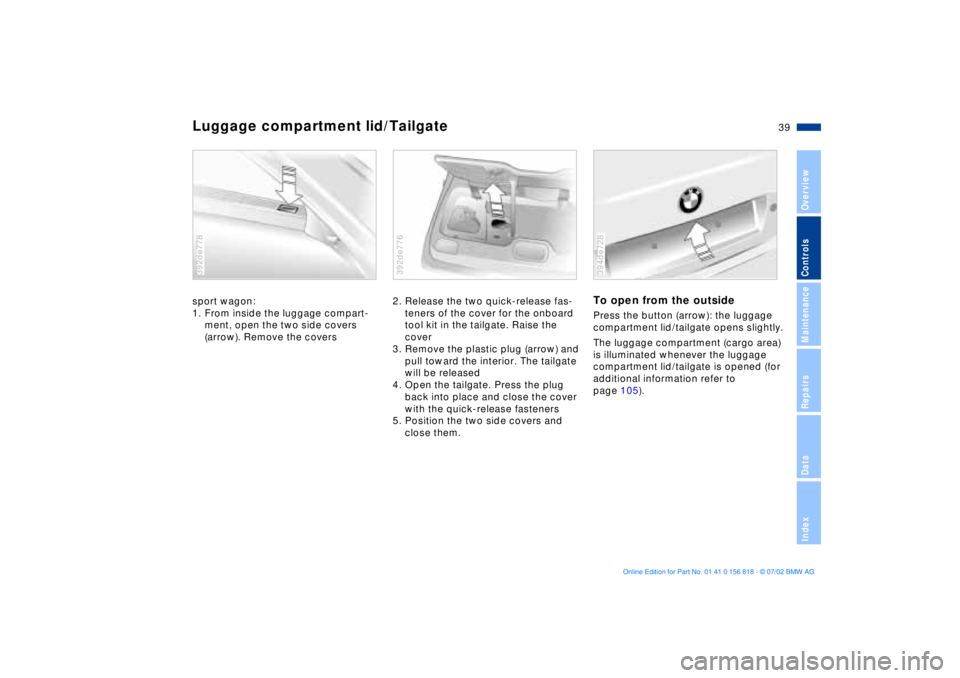
Luggage compartment lid/Tailgatesport wagon:
1. From inside the luggage compart-
ment, open the two side covers
(arrow). Remove the covers392de778
2. Release the two quick-release fas-
teners of the cover for the onboard
tool kit in the tailgate. Raise the
cover
3. Remove the plastic plug (arrow) and
pull toward the interior. The tailgate
will be released
4. Open the tailgate. Press the plug
back into place and close the cover
with the quick-release fasteners
5. Position the two side covers and
close them.392de776
To open from the outsidePress the button (arrow): the luggage
compartment lid/tailgate opens slightly.
The luggage compartment (cargo area)
is illuminated whenever the luggage
compartment lid/tailgate is opened (for
additional information refer to
page 105).394de728
Page 40 of 187
40n
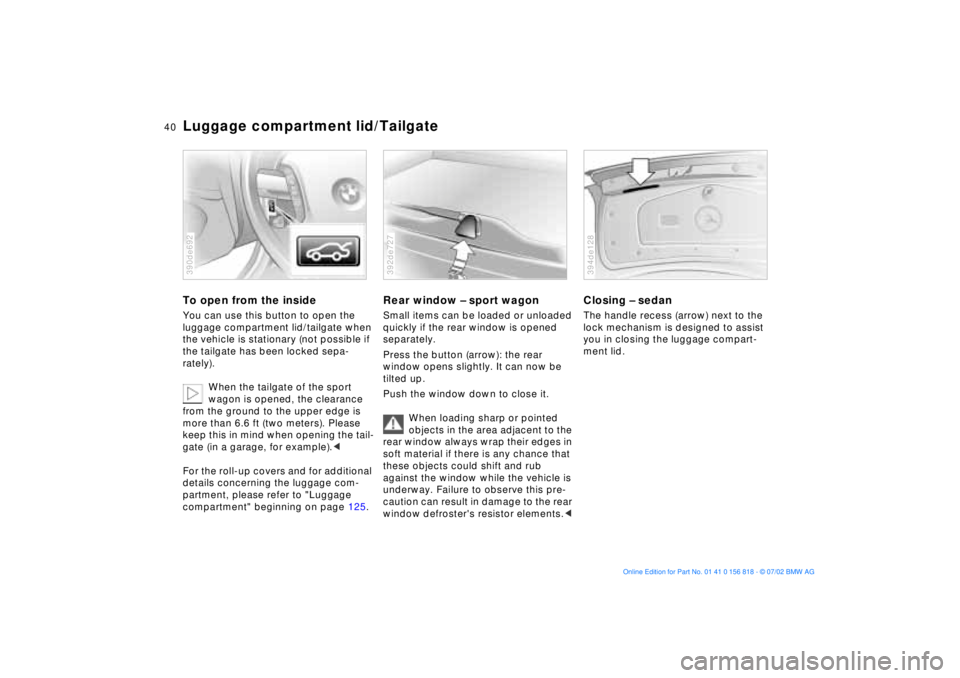
Luggage compartment lid/TailgateTo open from the insideYou can use this button to open the
luggage compartment lid/tailgate when
the vehicle is stationary (not possible if
the tailgate has been locked sepa-
rately).
When the tailgate of the sport
wagon is opened, the clearance
from the ground to the upper edge is
more than 6.6 ft (two meters). Please
keep this in mind when opening the tail-
gate (in a garage, for example).<
For the roll-up covers and for additional
details concerning the luggage com-
partment, please refer to "Luggage
compartment" beginning on page 125.390de692
Rear window Ð sport wagonSmall items can be loaded or unloaded
quickly if the rear window is opened
separately.
Press the button (arrow): the rear
window opens slightly. It can now be
tilted up.
Push the window down to close it.
When loading sharp or pointed
objects in the area adjacent to the
rear window always wrap their edges in
soft material if there is any chance that
these objects could shift and rub
against the window while the vehicle is
underway. Failure to observe this pre-
caution can result in damage to the rear
window defroster's resistor elements.< 392de727
Closing Ð sedanThe handle recess (arrow) next to the
lock mechanism is designed to assist
you in closing the luggage compart-
ment lid.394de128