2003 BMW 540I SEDAN key
[x] Cancel search: keyPage 4 of 187
Contents
© 2002 Bayerische Motoren Werke
Aktiengesellschaft
Munich, Germany
Reprinting, including excerpts, only with the
written consent of BMW AG, Munich.
Order No. 01 41 0 156 818
US English IX/2002
Printed in Germany
Printed on environmentally friendly paper
Ð bleached without chlorine, suitable for recycling.
Notes
Overview
Controls and features
About this Owner's Manual8
Symbols used8
The individual vehicle8
Status at time of printing9
For your own safety9
Symbol on vehicle parts10
Service and Warranty10
Reporting safety defects10Cockpit14
Instrument cluster15
Indicator and warning lamps19
Steering wheel with multifunction
buttons22
Warning triangle23
First-aid kit23
Refueling24
Fuel specifications25
Tire inflation pressure26
Locks and security systems:
Keys32
Central locking system32
Opening and closing Ð via the
door lock33
Opening and closing Ð via the
remote control34
Opening and closing Ð from the
inside37
Luggage compartment lid/
Tailgate38
Rear window40
Luggage compartment42
Alarm system42
Electric power windows44
Sliding/tilt sunroof46
Adjustments:
Sitting safely48
Seats48
Manually-adjusted seat49
Electric power seats50
Head restraints52
BMW active seat52
Safety belts53
Seat, mirror and steering wheel
memory54
Seat heating55
Adjusting steering wheel56
Steering wheel heating56
Mirrors57
Contents
Page 5 of 187
5n
OverviewControlsMaintenanceRepairsDataIndex
Controls and features
Passenger safety systems:
Airbags59
Transporting children safely62
Vehicle Memory, Key
Memory67
Driving:
Steering/Ignition lock68
Starting the engine68
Switching off the engine70
Parking brake70
Manual transmission71
Automatic transmission72
Automatic transmission with
Steptronic75
Indicator/Headlamp flasher78
Washer/Wiper system/Rain
sensor78
Cruise control80
Everything under control:
Odometer, outside temperature
display82
Tachometer83
Energy control83
Fuel gauge83
Coolant temperature gauge84
Service Interval Display84
Check Control85
Computer88
Multi-Information Display
(MID)89
Digital clock in the MID90
Computer in the MID93
Technology for safety and
driving convenience:
Park Distance Control (PDC)98
Automatic Stability Control plus
Traction (ASC+T)/Dynamic
Stability Control (DSC)99
Self-leveling suspension 101
Tire Pressure Monitor (RDC)101
Lamps:
Parking lamps/Low beams103
Instrument lighting104
High beams/Standing
lamps104
Fog lamps104
Interior lamps105
Reading lamps105
Controlling the climate for
pleasant driving:
Air conditioning106
Automatic climate control109
Roller sun blind114
Parked-car ventilation
system114
Cabin convenience:
BMW Universal Transmitter115
Glove compartment118
Storage compartments118
Cellular phone119
Beverage holder119
Ashtray, front119
Cigarette lighter120
Ashtray, rear120
Loading and transporting
cargo:
Through-loading system121
Ski bag122
sport wagon:
Cargo area125
Roll-up cover125
Partition net125
Storage areas in the luggage
compartment126
Cargo loading128
Roof-mounted luggage rack129
Page 8 of 187
8n
About this Owner's Manual
We have made every effort to ensure
that you are able to find what you need
in this Owner's Manual as quickly as
possible. The fastest way to find certain
topics is by using the detailed index at
the end. If you are looking for a brief
initial summary of the essentials, please
turn to the first chapter.
Should you wish to sell your BMW at
some time in the future, please
remember to hand over the Owner's
Manual to the new owner; it is an
important part of the vehicle.
If you have any questions, your BMW
center will be glad to advise you.
Symbols used
Indicates precautions that must
be followed precisely in order to
avoid the possibility of personal injury
and serious damage to the vehicle.
Contains information that will
assist you in gaining the optimum
benefit from your vehicle and enable
you to care more effectively for your
vehicle.
Refers to measures that can be
taken to help protect the environ-
ment.
<
Marks the end of a specific item of
information.
*
Indicates special equipment, country-
specific equipment and optional extras.
t
Identifies index entries that refer
to owner service procedures or topics
on vehicle maintenance.
Identifies systems or components,
which can be activated or adapted
to suit an individual driver's require-
ments ("Vehicle Memory", "Key
Memory"). Refer to page 67.
Activation and adjustments on some of
these systems can be performed at
your BMW center.
The individual vehicle
On buying your BMW, you have
decided in favor of a model with individ-
ualized equipment and features. This
Owner's Manual describes all models
and equipment that BMW offers within
the same group.
We hope you will understand that
equipment and features are included
which you might not have chosen for
your vehicle. You can easily identify any
differences with the aid of the asterisk
*
used to identify all optional extras and
accessories.
If your BMW features equipment which
is not described in this Owner's
Manual, Supplementary Owner's
Manuals are enclosed. We ask you to
read these manuals as well.
Notes
Symbols
Notes
Page 32 of 187
32n
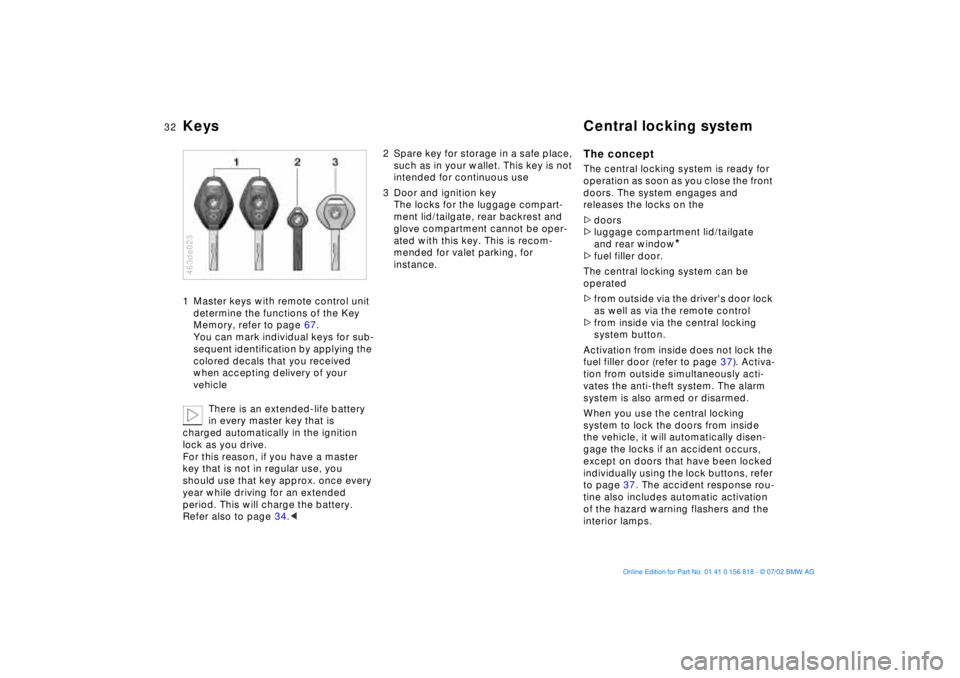
Keys Central locking system1 Master keys with remote control unit
determine the functions of the Key
Memory, refer to page 67.
You can mark individual keys for sub-
sequent identification by applying the
colored decals that you received
when accepting delivery of your
vehicle
There is an extended-life battery
in every master key that is
charged automatically in the ignition
lock as you drive.
For this reason, if you have a master
key that is not in regular use, you
should use that key approx. once every
year while driving for an extended
period. This will charge the battery.
Refer also to page 34.< 463de023
2 Spare key for storage in a safe place,
such as in your wallet. This key is not
intended for continuous use
3 Door and ignition key
The locks for the luggage compart-
ment lid/tailgate, rear backrest and
glove compartment cannot be oper-
ated with this key. This is recom-
mended for valet parking, for
instance.
The conceptThe central locking system is ready for
operation as soon as you close the front
doors. The system engages and
releases the locks on the
>doors
>luggage compartment lid/tailgate
and rear window
*
>fuel filler door.
The central locking system can be
operated
>from outside via the driver's door lock
as well as via the remote control
>from inside via the central locking
system button.
Activation from inside does not lock the
fuel filler door (refer to page 37). Activa-
tion from outside simultaneously acti-
vates the anti-theft system. The alarm
system is also armed or disarmed.
When you use the central locking
system to lock the doors from inside
the vehicle, it will automatically disen-
gage the locks if an accident occurs,
except on doors that have been locked
individually using the lock buttons, refer
to page 37. The accident response rou-
tine also includes automatic activation
of the hazard warning flashers and the
interior lamps.
Page 33 of 187
33n
OverviewControlsMaintenanceRepairsDataIndex
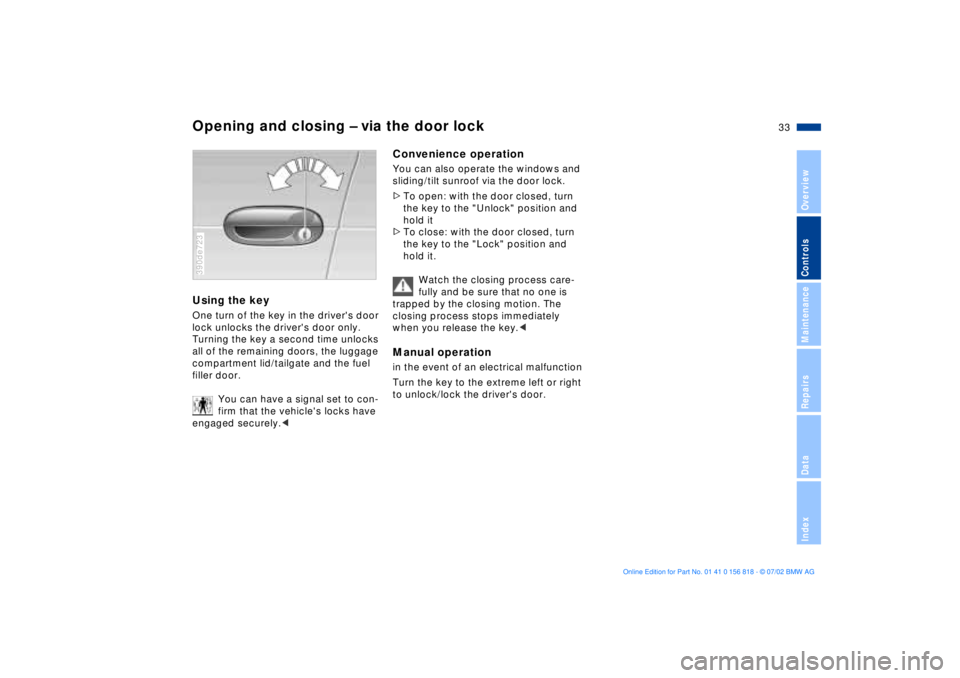
Opening and closing Ð via the door lockUsing the keyOne turn of the key in the driver's door
lock unlocks the driver's door only.
Turning the key a second time unlocks
all of the remaining doors, the luggage
compartment lid/tailgate and the fuel
filler door.
You can have a signal set to con-
firm that the vehicle's locks have
engaged securely.< 390de723
Convenience operationYou can also operate the windows and
sliding/tilt sunroof via the door lock.
>To open: with the door closed, turn
the key to the "Unlock" position and
hold it
>To close: with the door closed, turn
the key to the "Lock" position and
hold it.
Watch the closing process care-
fully and be sure that no one is
trapped by the closing motion. The
closing process stops immediately
when you release the key.< Manual operationin the event of an electrical malfunction
Turn the key to the extreme left or right
to unlock/lock the driver's door.
Page 34 of 187
34n
Opening and closing Ð via the remote controlThe conceptThe remote control makes opening and
locking the doors of your vehicle very
convenient. Furthermore, it provides
three additional functions which you
can only execute via the remote control:
>To switch on interior lamps, refer to
page 35.
With this function, you can also
"search for" your vehicle, when
parked in an underground garage, for
instance
>To open the luggage compartment
lid/tailgate, refer to page 35.
The luggage compartment lid/tailgate
will open slightly, regardless of
whether it was previously locked or
unlocked
>Panic mode
In case of danger, you can trigger the
alarm.
Whenever you unlock (lock) the vehicle,
you simultaneously deactivate (activate)
the anti-theft system, disarm (arm) the
alarm system and switch the interior
lamps on (off).
You can have a signal set to con-
firm that the vehicle's locks have
engaged securely.<
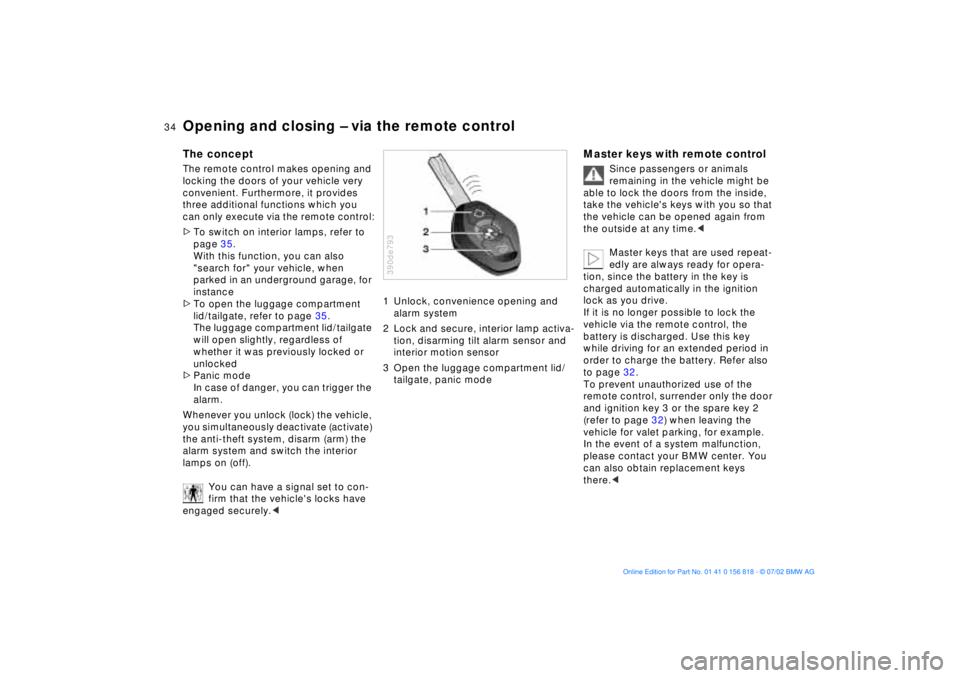
1 Unlock, convenience opening and
alarm system
2 Lock and secure, interior lamp activa-
tion, disarming tilt alarm sensor and
interior motion sensor
3 Open the luggage compartment lid/
tailgate, panic mode390de793
Master keys with remote control
Since passengers or animals
remaining in the vehicle might be
able to lock the doors from the inside,
take the vehicle's keys with you so that
the vehicle can be opened again from
the outside at any time.<
Master keys that are used repeat-
edly are always ready for opera-
tion, since the battery in the key is
charged automatically in the ignition
lock as you drive.
If it is no longer possible to lock the
vehicle via the remote control, the
battery is discharged. Use this key
while driving for an extended period in
order to charge the battery. Refer also
to page 32.
To prevent unauthorized use of the
remote control, surrender only the door
and ignition key 3 or the spare key 2
(refer to page 32) when leaving the
vehicle for valet parking, for example.
In the event of a system malfunction,
please contact your BMW center. You
can also obtain replacement keys
there.<
Page 36 of 187

36n
Opening and closing Ð via the remote controlExternal systemsThe remote control system may be
affected by other units or equipment
operating in the immediate vicinity of
your vehicle.
If this should occur, you can unlock and
lock the vehicle via the door lock with a
master key.
For US owners onlyThe transmitter and receiver units
comply with part 15 of the FCC (Federal
Communication Commission) regula-
tions. Operation is governed by the
following:
FCC ID: LX8EWS
LX8FZVS
LX8FZVE
Compliance statement:
This device complies with part 15 of the
FCC Rules. Operation is subject to the
following two conditions:
>This device may not cause harmful
interference, and
>this device must accept any interfer-
ence received, including interference
that may cause undesired operation.
Any unauthorized modifications to
these devices could void the
user's authority to operate the equip-
ment.<
Page 37 of 187
37n
OverviewControlsMaintenanceRepairsDataIndex
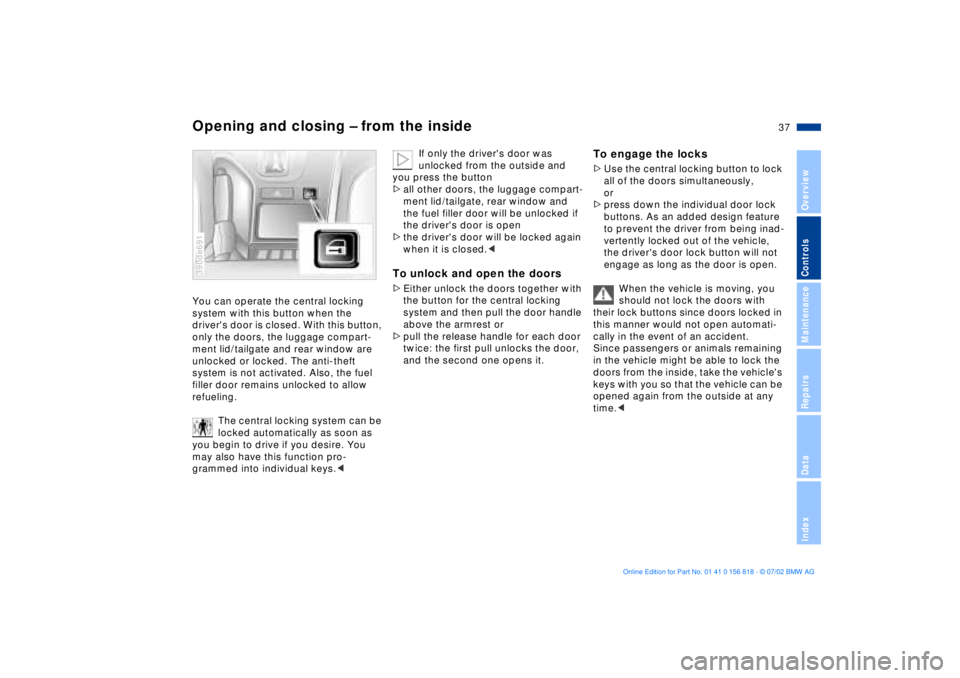
Opening and closing Ð from the insideYou can operate the central locking
system with this button when the
driver's door is closed. With this button,
only the doors, the luggage compart-
ment lid/tailgate and rear window are
unlocked or locked. The anti-theft
system is not activated. Also, the fuel
filler door remains unlocked to allow
refueling.
The central locking system can be
locked automatically as soon as
you begin to drive if you desire. You
may also have this function pro-
grammed into individual keys.< 390de691
If only the driver's door was
unlocked from the outside and
you press the button
>all other doors, the luggage compart-
ment lid/tailgate, rear window and
the fuel filler door will be unlocked if
the driver's door is open
>the driver's door will be locked again
when it is closed.<
To unlock and open the doors>Either unlock the doors together with
the button for the central locking
system and then pull the door handle
above the armrest or
>pull the release handle for each door
twice: the first pull unlocks the door,
and the second one opens it.
To engage the locks>Use the central locking button to lock
all of the doors simultaneously,
or
>press down the individual door lock
buttons. As an added design feature
to prevent the driver from being inad-
vertently locked out of the vehicle,
the driver's door lock button will not
engage as long as the door is open.
When the vehicle is moving, you
should not lock the doors with
their lock buttons since doors locked in
this manner would not open automati-
cally in the event of an accident.
Since passengers or animals remaining
in the vehicle might be able to lock the
doors from the inside, take the vehicle's
keys with you so that the vehicle can be
opened again from the outside at any
time.<