Page 48 of 187

48n
For relaxed and fatigue-free driving you
should select a seating position that
reflects your personal requirements.
Correct seating position combines with
safety belts and airbags to enhance
occupant safety in the event of an acci-
dent. To ensure that the vehicle's safety
systems provide you with optimal pro-
tection, we request that you direct your
careful attention to the following sec-
tion.
For additional information on trans-
porting children, refer to page 62.
Sitting safely with airbags
Always maintain an adequate dis-
tance between yourself and the
airbags. Always hold the steering wheel
by the rim to keep any chance of injury
to hands or arms to an absolute min-
imum should the airbag be deployed.
Never allow any objects, individuals or
animals to obstruct the areas between
passengers and airbags.
Never use the front airbag's cover as a
storage tray or support for objects of
any kind. Never allow front passengers
to rest their feet or legs on the airbag
cover.<
For airbag locations and additional
information on airbags refer to page 59.
Sitting safely with safety belt
Never allow more than one person
to wear a single safety belt. Never
allow infants or small children to ride in
a passenger's lap. Avoid twisting the
belt while routing it firmly across the
pelvis and shoulder, wear it as snugly
against your body as possible. Do not
allow the belt to rest against hard or
fragile objects in your pockets. Do not
route the belt across your neck, or run it
across sharp edges. Avoid wearing
bulky clothing and pull on the lap belt
periodically to retention it over your
shoulders. In the event of a frontal
impact, a loose lap belt could slide over
the hips, leading to abdominal injury. In
addition, the safety belt's restraint
effectiveness is reduced if it is worn
loosely. Expectant mothers should
always wear their safety belts, taking
care to position the lap belt against the
lower hips, where it will not exert pres-
sure against the abdominal area.<
For information on using the safety
belts refer to page 53.
When adjusting your seat, always
observe the following precautions
Never try to adjust your seat while
operating the vehicle. The seat
could respond with an unexpected
movement, and the ensuing loss of
vehicle control could lead to an acci-
dent. Never ride with the backrest
reclined to an extreme horizontal angle
(important for front passengers to
remember), otherwise, there is a risk
that you will slide under the safety belt
in an accident, thus negating the pro-
tection the safety belt provides.
Do not move the seats to the rear when
the vehicle is at an extreme angle (on
garage ramps or steep slopes, for
example). If you do so, the automatic
safety belt height adjustment can be
disengaged.<
Seat adjustment>Manually-adjusted seat, refer to
page 49
>Electric power seats, refer to page 50
>Head restraints, refer to page 52
>BMW active seat, refer to page 52
Sitting safely Seats
Page 49 of 187
49n
OverviewControlsMaintenanceRepairsDataIndex
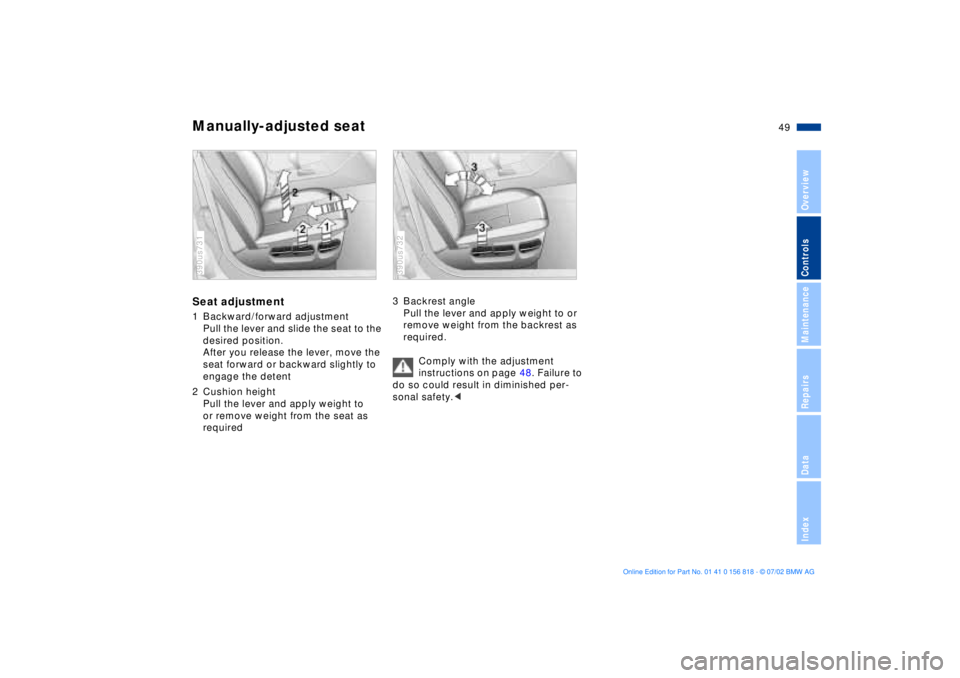
Manually-adjusted seatSeat adjustment1 Backward/forward adjustment
Pull the lever and slide the seat to the
desired position.
After you release the lever, move the
seat forward or backward slightly to
engage the detent
2 Cushion height
Pull the lever and apply weight to
or remove weight from the seat as
required390us731
3 Backrest angle
Pull the lever and apply weight to or
remove weight from the backrest as
required.
Comply with the adjustment
instructions on page 48. Failure to
do so could result in diminished per-
sonal safety.< 390us732
Page 50 of 187
50n
Electric power seats
*
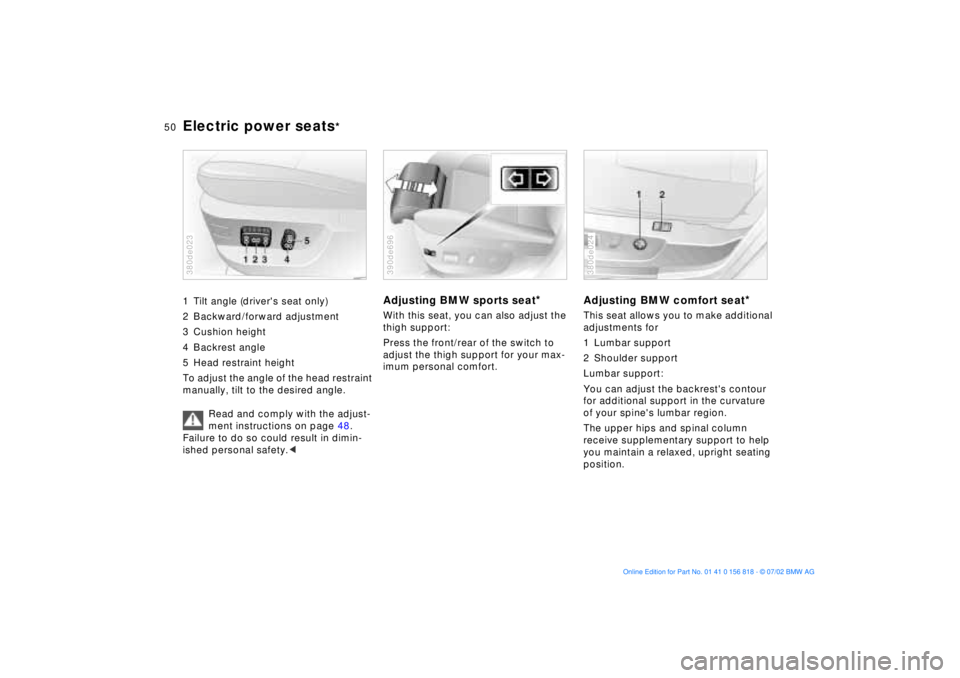
1 Tilt angle (driver's seat only)
2 Backward/forward adjustment
3 Cushion height
4 Backrest angle
5 Head restraint height
To adjust the angle of the head restraint
manually, tilt to the desired angle.
Read and comply with the adjust-
ment instructions on page 48.
Failure to do so could result in dimin-
ished personal safety.< 380de023
Adjusting BMW sports seat
*
With this seat, you can also adjust the
thigh support:
Press the front/rear of the switch to
adjust the thigh support for your max-
imum personal comfort.390de696
Adjusting BMW comfort seat
*
This seat allows you to make additional
adjustments for
1 Lumbar support
2 Shoulder support
Lumbar support:
You can adjust the backrest's contour
for additional support in the curvature
of your spine's lumbar region.
The upper hips and spinal column
receive supplementary support to help
you maintain a relaxed, upright seating
position.380de024
Page 52 of 187
52n
Head restraints BMW active seat*AdjustingTo adjust the height of the front or rear
head restraints, pull up or push down.
For electric height adjustment, refer to
page 50.
To adjust the angle of the front head
restraints, tilt to the desired angle.390de715
Head restraints reduce the risk
of spinal injury in the event of an
accident.
Adjust the head restraint so that its
center is approximately level with your
ears.
Leave the center-rear head restraint in
the fully-lowered position at all times.
Extending it limits its function.<
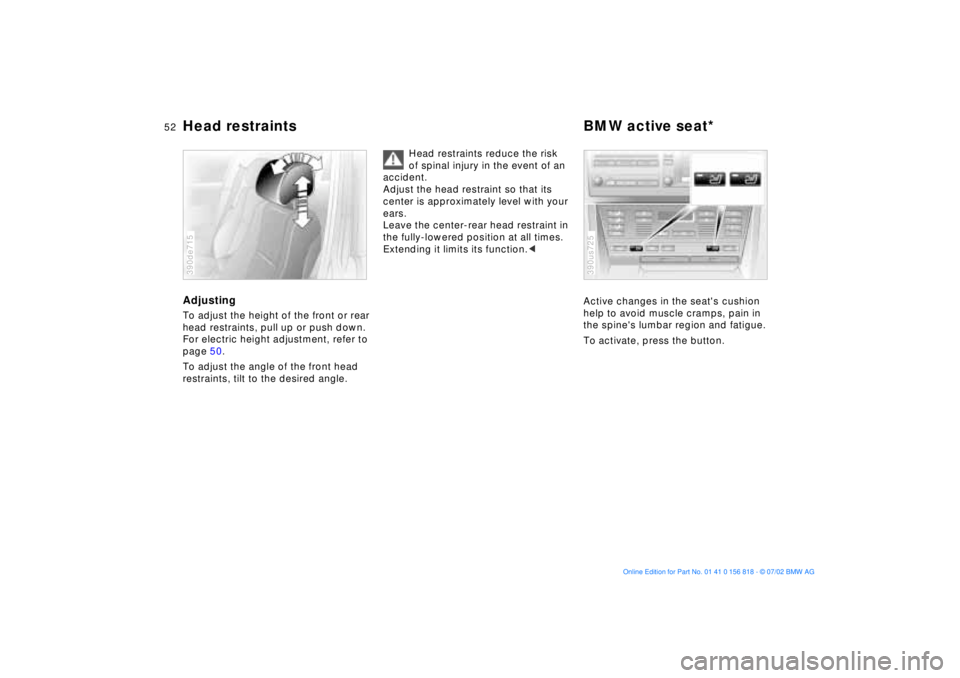
Active changes in the seat's cushion
help to avoid muscle cramps, pain in
the spine's lumbar region and fatigue.
To activate, press the button.390us725
Page 64 of 187
64n
Transporting children safelyOlder children should be tightly secured
with a safety belt, after they have out-
grown a booster seat that is appro-
priate for their age, height and weight.
Younger children should be secured in
an appropriate forward-facing child-
restraint system that has first been
properly secured with a safety belt.
Never install a rearward-facing child-
restraint system in the front passenger
seat.
We strongly urge you to carefully read
and comply with the instructions for
installation and use provided by the
child-restraint's manufacturer whenever
you use such a system.
Be sure that all occupants (of all ages)
remain properly and securely restrained
at all times.<
All rear seating positions in your
vehicle meet the recommendations
of SAE J1819, an industry-recom-
mended practice for securing child-
restraint systems in motor vehicles.
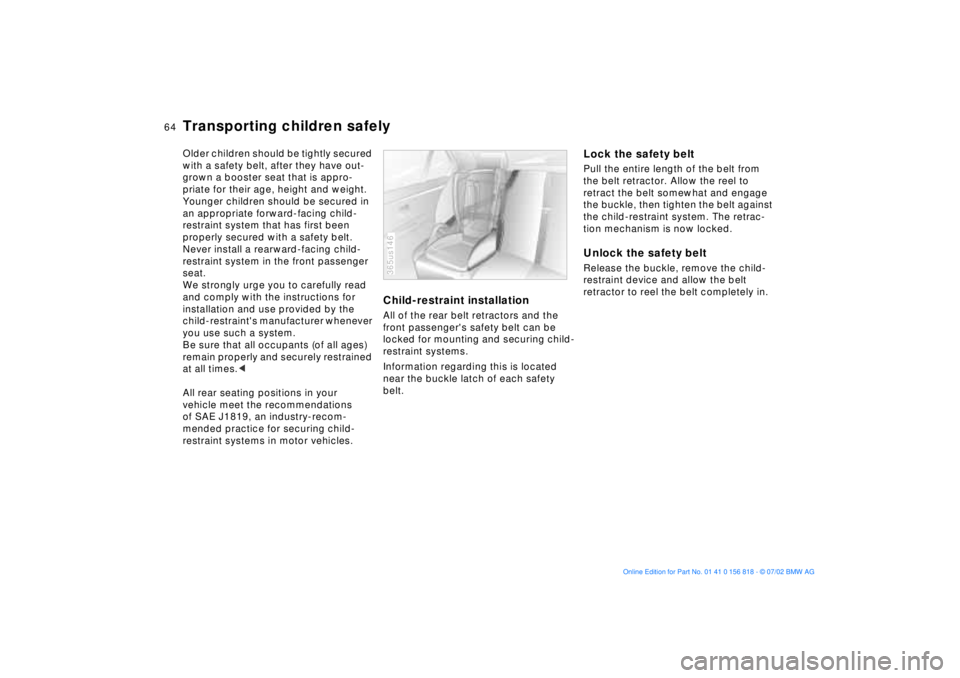
Child-restraint installationAll of the rear belt retractors and the
front passenger's safety belt can be
locked for mounting and securing child-
restraint systems.
Information regarding this is located
near the buckle latch of each safety
belt.365us146
Lock the safety beltPull the entire length of the belt from
the belt retractor. Allow the reel to
retract the belt somewhat and engage
the buckle, then tighten the belt against
the child-restraint system. The retrac-
tion mechanism is now locked.Unlock the safety beltRelease the buckle, remove the child-
restraint device and allow the belt
retractor to reel the belt completely in.
Page 139 of 187
139n
OverviewControlsMaintenanceRepairsDataIndex
HoodTo unlockPull the lever located under the left-
hand side of the instrument panel.
Do not work on your vehicle
without appropriate skills. Failure
to work in an informed, professional
manner when servicing components
and materials constitutes a safety
hazard for vehicle occupants and other
road users. If you are not familiar with
the guidelines, please have the opera-
tions performed by your BMW center.<390de759
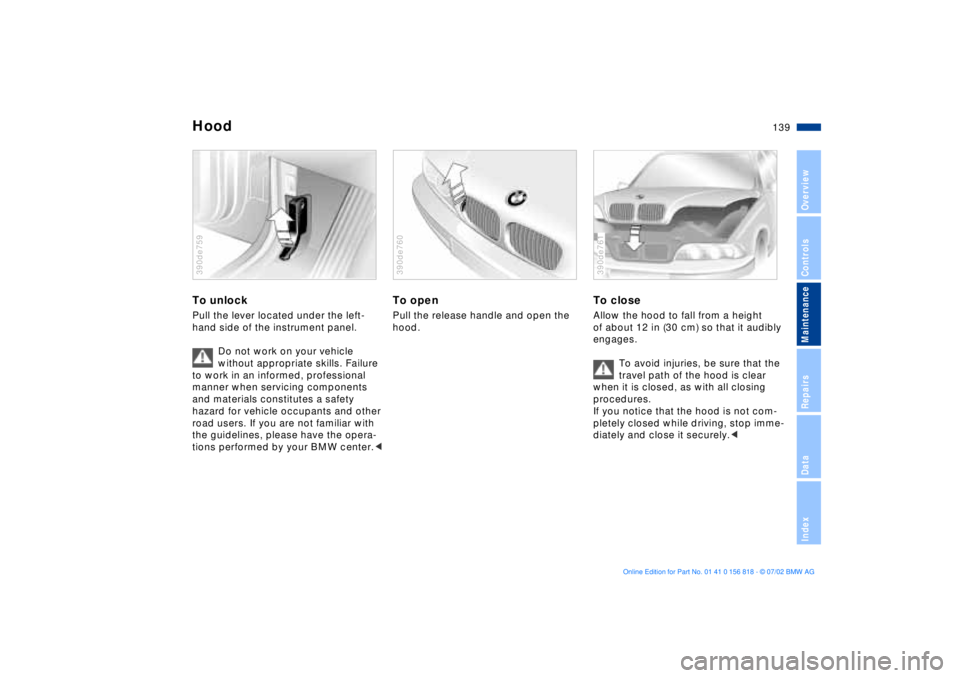
To openPull the release handle and open the
hood.390de760
To closeAllow the hood to fall from a height
of about 12 in (30 cm) so that it audibly
engages.
To avoid injuries, be sure that the
travel path of the hood is clear
when it is closed, as with all closing
procedures.
If you notice that the hood is not com-
pletely closed while driving, stop imme-
diately and close it securely.< 390de761
Page 158 of 187
158n
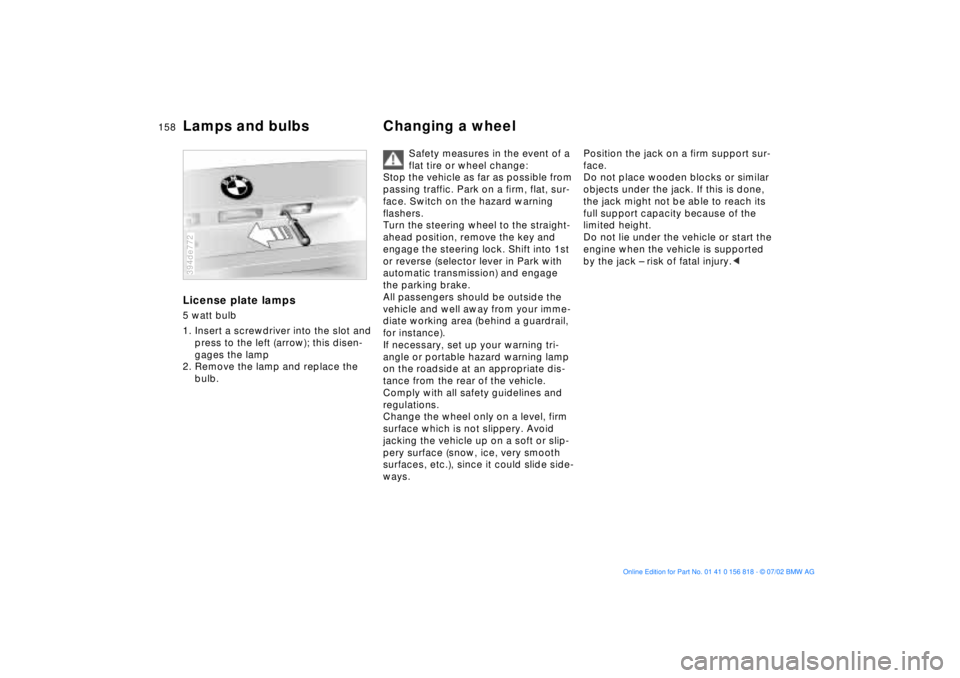
Lamps and bulbs Changing a wheelLicense plate lamps5 watt bulb
1. Insert a screwdriver into the slot and
press to the left (arrow); this disen-
gages the lamp
2. Remove the lamp and replace the
bulb.394de772
Safety measures in the event of a
flat tire or wheel change:
Stop the vehicle as far as possible from
passing traffic. Park on a firm, flat, sur-
face. Switch on the hazard warning
flashers.
Turn the steering wheel to the straight-
ahead position, remove the key and
engage the steering lock. Shift into 1st
or reverse (selector lever in Park with
automatic transmission) and engage
the parking brake.
All passengers should be outside the
vehicle and well away from your imme-
diate working area (behind a guardrail,
for instance).
If necessary, set up your warning tri-
angle or portable hazard warning lamp
on the roadside at an appropriate dis-
tance from the rear of the vehicle.
Comply with all safety guidelines and
regulations.
Change the wheel only on a level, firm
surface which is not slippery. Avoid
jacking the vehicle up on a soft or slip-
pery surface (snow, ice, very smooth
surfaces, etc.), since it could slide side-
ways.
Position the jack on a firm support sur-
face.
Do not place wooden blocks or similar
objects under the jack. If this is done,
the jack might not be able to reach its
full support capacity because of the
limited height.
Do not lie under the vehicle or start the
engine when the vehicle is supported
by the jack Ð risk of fatal injury.<
Page 172 of 187
172n
Dimensions Ð sport wagon
392us724
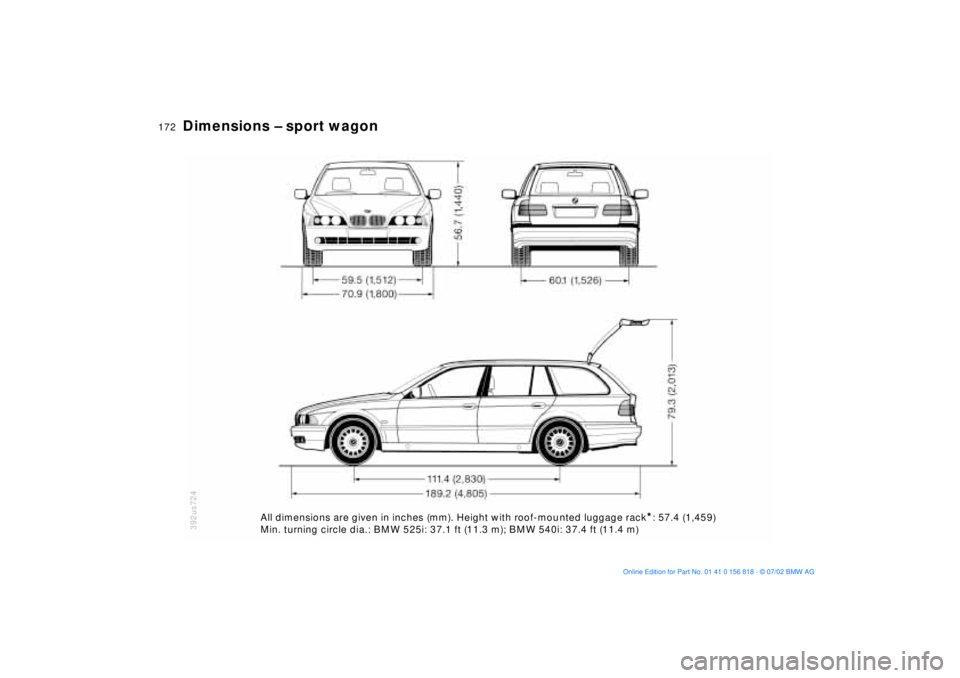
All dimensions are given in inches (mm). Height with roof-mou nted luggage rack
*: 57.4 (1,459)
Min. turning circle dia.: BMW 525i: 37.1 ft (11.3 m); BMW 540i: 37.4 ft (11.4 m)