2003 BMW 540I SEDAN ESP
[x] Cancel search: ESPPage 9 of 187
9n
OverviewControlsMaintenanceRepairsDataIndex
Status at time of printing
BMW pursues a policy of continuous,
ongoing development designed to
ensure that our vehicles continue to
embody the highest quality and safety
standards combined with advanced,
state-of-the-art technology. For this
reason, it is possible that the features
described in this Owner's Manual could
differ from those on your vehicle. Nor
can errors and omissions be entirely
ruled out. We therefore request your
understanding for the fact that we are
unable to recognize any legal claims
based on the data, illustrations or
descriptions in this manual.
For your own safety
Use unleaded gasoline only. Fuels
containing up to and including
10 % ethanol or other oxygenates with
up to 2.8 % oxygen by weight Ð i.e.
15 % MTBE or 3 % methanol plus an
equivalent amount of co-solvent Ð will
not void the applicable warranties
covering defects in materials or work-
manship. Field experience has indi-
cated significant differences in fuel
quality Ð volatility, composition, addi-
tives, etc. among gasolines offered for
sale in the United States and Canada.
The use of poor-quality fuels may result
in driveability, starting and stalling
problems, especially under certain
environmental conditions, such as high
ambient temperature and high altitude.
Should you encounter driveability prob-
lems that you suspect could be related
to the fuel you are using, we recom-
mend that you respond by switching to
a recognized high-quality brand.
Failure to comply with these recom-
mendations may result in unscheduled
maintenance.
Obey pertinent safety rules when you
are handling gasoline.
<
Important safety information!
For your own safety, use genuine
parts and accessories approved by
BMW.
When you purchase accessories tested
and approved by BMW and Original
BMW Parts, you simultaneously acquire
the assurance that they have been thor-
oughly tested by BMW to ensure
optimum performance when installed
on your vehicle.
BMW warrants these parts to be free
from defects in material and workman-
ship.
BMW will not accept any liability for
damages resulting from installation of
parts and accessories not approved by
BMW.
BMW cannot test every product from
other manufacturers to verify if it can be
used on a BMW safely and without risk
to either the vehicle, its operation, or its
occupants.
Original BMW Parts, BMW Accessories
and other products approved by BMW,
together with professional advice on
using these items, are available from all
BMW centers.
The individual vehicle
Status at time of printing
Notes
Page 19 of 187
19n
OverviewControlsMaintenanceRepairsDataIndex
Indicator and warning lamps
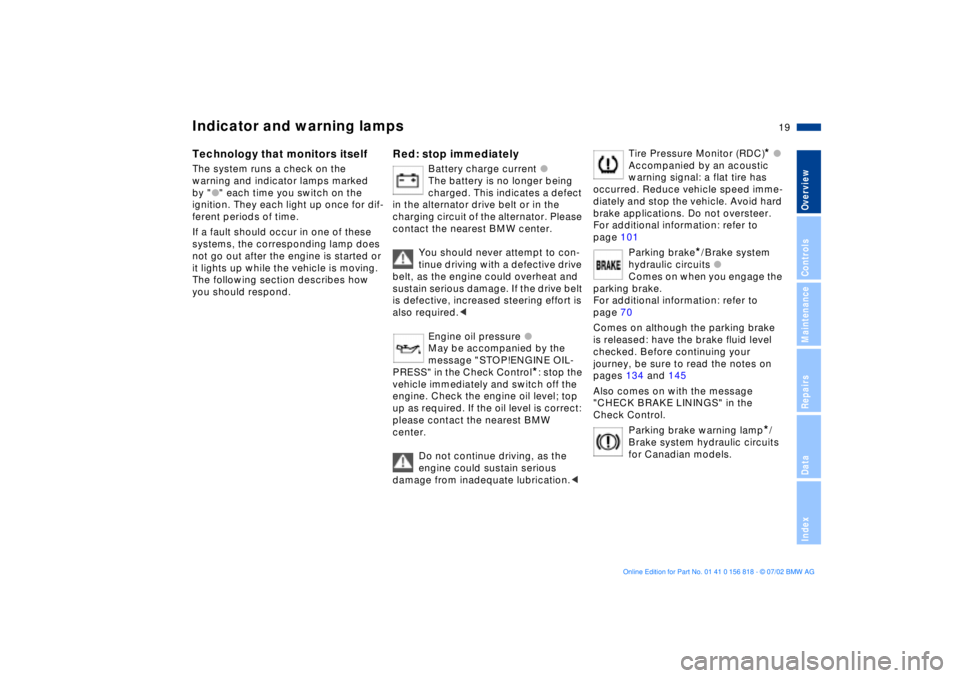
Technology that monitors itself
The system runs a check on the
warning and indicator lamps marked
by "
l
" each time you switch on the
ignition. They each light up once for dif-
ferent periods of time.
If a fault should occur in one of these
systems, the corresponding lamp does
not go out after the engine is started or
it lights up while the vehicle is moving.
The following section describes how
you should respond.
Red: stop immediately
Battery charge current
l
The battery is no longer being
charged. This indicates a defect
in the alternator drive belt or in the
charging circuit of the alternator. Please
contact the nearest BMW center.
You should never attempt to con-
tinue driving with a defective drive
belt, as the engine could overheat and
sustain serious damage. If the drive belt
is defective, increased steering effort is
also required.
<
Engine oil pressure
l
May be accompanied by the
message "STOP!ENGINE OIL-
PRESS" in the Check Control
*
: stop the
vehicle immediately and switch off the
engine. Check the engine oil level; top
up as required. If the oil level is correct:
please contact the nearest BMW
center.
Do not continue driving, as the
engine could sustain serious
damage from inadequate lubrication.
<
Tire Pressure Monitor (RDC)
*
l
Accompanied by an acoustic
warning signal: a flat tire has
occurred. Reduce vehicle speed imme-
diately and stop the vehicle. Avoid hard
brake applications. Do not oversteer.
For additional information: refer to
page 101
Parking brake
*
/Brake system
hydraulic circuits
l
Comes on when you engage the
parking brake.
For additional information: refer to
page 70
Comes on although the parking brake
is released: have the brake fluid level
checked. Before continuing your
journey, be sure to read the notes on
pages 134 and 145
Also comes on with the message
"CHECK BRAKE LININGS" in the
Check Control.
Parking brake warning lamp
*
/
Brake system hydraulic circuits
for Canadian models.
Page 20 of 187
20n
Indicator and warning lamps
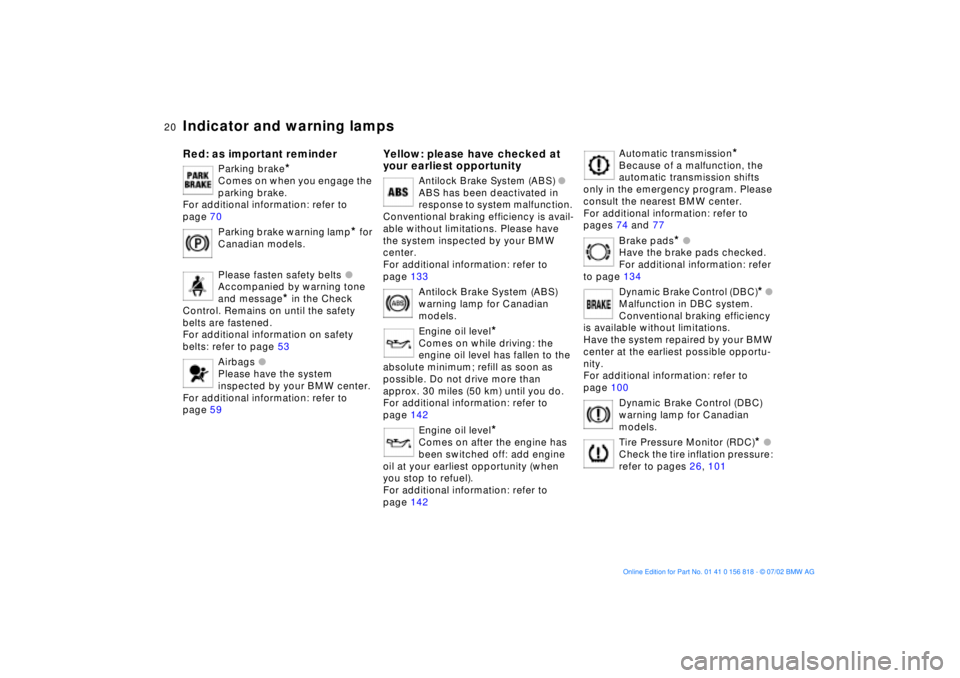
Red: as important reminder
Parking brake
*
Comes on when you engage the
parking brake.
For additional information: refer to
page 70
Parking brake warning lamp
*
for
Canadian models.
Please fasten safety belts
l
Accompanied by warning tone
and message
*
in the Check
Control. Remains on until the safety
belts are fastened.
For additional information on safety
belts: refer to page 53
Airbags
l
Please have the system
inspected by your BMW center.
For additional information: refer to
page 59
Yellow: please have checked at
your earliest opportunity
Antilock Brake System (ABS)
l
ABS has been deactivated in
response to system malfunction.
Conventional braking efficiency is avail-
able without limitations. Please have
the system inspected by your BMW
center.
For additional information: refer to
page 133
Antilock Brake System (ABS)
warning lamp for Canadian
models.
Engine oil level
*
Comes on while driving: the
engine oil level has fallen to the
absolute minimum; refill as soon as
possible. Do not drive more than
approx. 30 miles (50 km) until you do.
For additional information: refer to
page 142
Engine oil level
*
Comes on after the engine has
been switched off: add engine
oil at your earliest opportunity (when
you stop to refuel).
For additional information: refer to
page 142
Automatic transmission
*
Because of a malfunction, the
automatic transmission shifts
only in the emergency program. Please
consult the nearest BMW center.
For additional information: refer to
pages 74 and 77
Brake pads
*
l
Have the brake pads checked.
For additional information: refer
to page 134
Dynamic Brake Control (DBC)
*
l
Malfunction in DBC system.
Conventional braking efficiency
is available without limitations.
Have the system repaired by your BMW
center at the earliest possible opportu-
nity.
For additional information: refer to
page 100
Dynamic Brake Control (DBC)
warning lamp for Canadian
models.
Tire Pressure Monitor (RDC)
*
l
Check the tire inflation pressure:
refer to pages 26, 101
Page 21 of 187
21n
OverviewControlsMaintenanceRepairsDataIndex
Indicator and warning lamps
Self-leveling suspension
* l
The self-leveling suspension
system is inactive. Please con-
sult the nearest BMW center.
For additional information: refer to
page 101
Automatic Stability Control plus
Traction (ASC+T)/Dynamic Sta-
bility Control (DSC)
* l
ASC+T/DSC has been deactivated,
either manually at the button or auto-
matically in response to a system mal-
function. In the event of a malfunction,
have the system checked by your BMW
center.
For additional information: refer to
page 99
Engine electronics
*
There is a fault in the electronic
engine-management system.
You can continue to drive with reduced
engine output and engine speed.
Please have the system inspected by
your BMW center.
Service Engine Soon l
If the indicator lamp comes on
either continuously or intermit-
tently, this indicates a fault in the emis-
sions-related electronic systems.
Although the vehicle remains opera-
tional, you should have the systems
checked by your BMW center at the
earliest possible opportunity.
For additional information: refer to
page 148
Service Engine Soon warning
lamp for Canadian models.
Check Filler Cap
* l
This indicator lamp comes on
when the fuel filler cap is loose
or missing.
Close the filler cap tightly: refer to
page 25
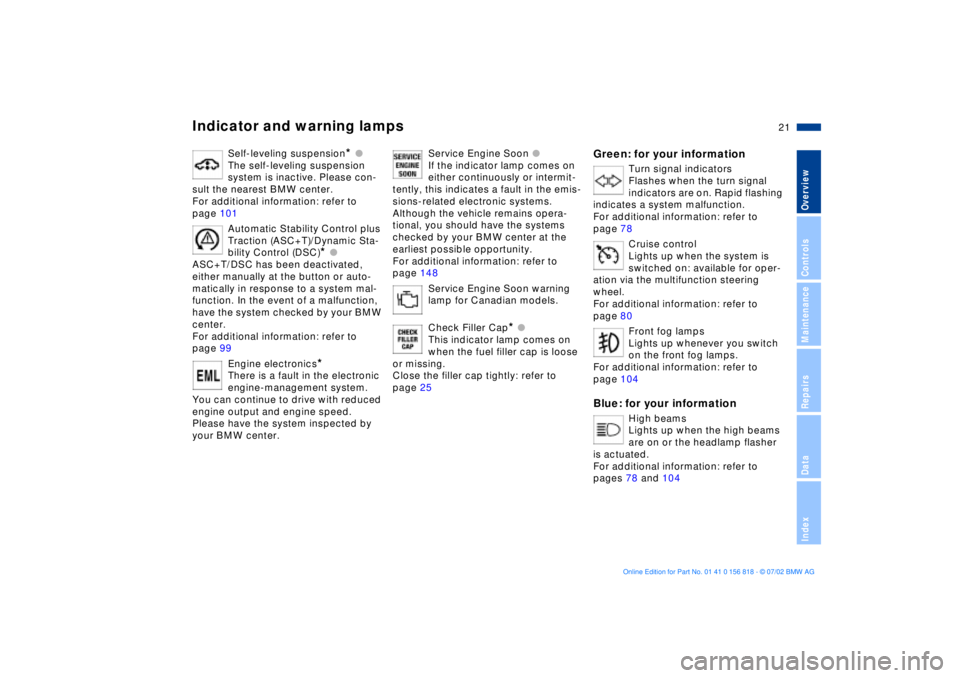
Green: for your information
Turn signal indicators
Flashes when the turn signal
indicators are on. Rapid flashing
indicates a system malfunction.
For additional information: refer to
page 78
Cruise control
Lights up when the system is
switched on: available for oper-
ation via the multifunction steering
wheel.
For additional information: refer to
page 80
Front fog lamps
Lights up whenever you switch
on the front fog lamps.
For additional information: refer to
page 104
Blue: for your information
High beams
Lights up when the high beams
are on or the headlamp flasher
is actuated.
For additional information: refer to
pages 78 and 104
Page 22 of 187
22n
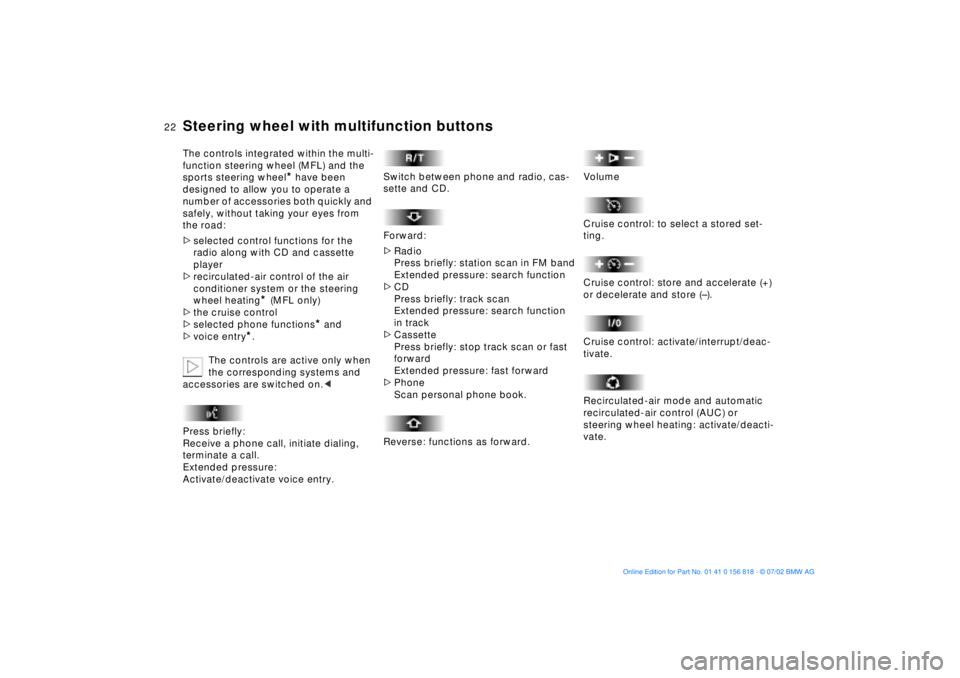
Steering wheel with multifunction buttonsThe controls integrated within the multi-
function steering wheel (MFL) and the
sports steering wheel
* have been
designed to allow you to operate a
number of accessories both quickly and
safely, without taking your eyes from
the road:
>selected control functions for the
radio along with CD and cassette
player
>recirculated-air control of the air
conditioner system or the steering
wheel heating
* (MFL only)
>the cruise control
>selected phone functions
* and
>voice entry
*.
The controls are active only when
the corresponding systems and
accessories are switched on.<
Press briefly:
Receive a phone call, initiate dialing,
terminate a call.
Extended pressure:
Activate/deactivate voice entry.
Switch between phone and radio, cas-
sette and CD.
Forward:
>Radio
Press briefly: station scan in FM band
Extended pressure: search function
>CD
Press briefly: track scan
Extended pressure: search function
in track
>Cassette
Press briefly: stop track scan or fast
forward
Extended pressure: fast forward
>Phone
Scan personal phone book.
Reverse: functions as forward.
Volume
Cruise control: to select a stored set-
ting.
Cruise control: store and accelerate (+)
or decelerate and store (Ð).
Cruise control: activate/interrupt/deac-
tivate.
Recirculated-air mode and automatic
recirculated-air control (AUC) or
steering wheel heating: activate/deacti-
vate.
Page 29 of 187
29n
OverviewControlsMaintenanceRepairsDataIndex
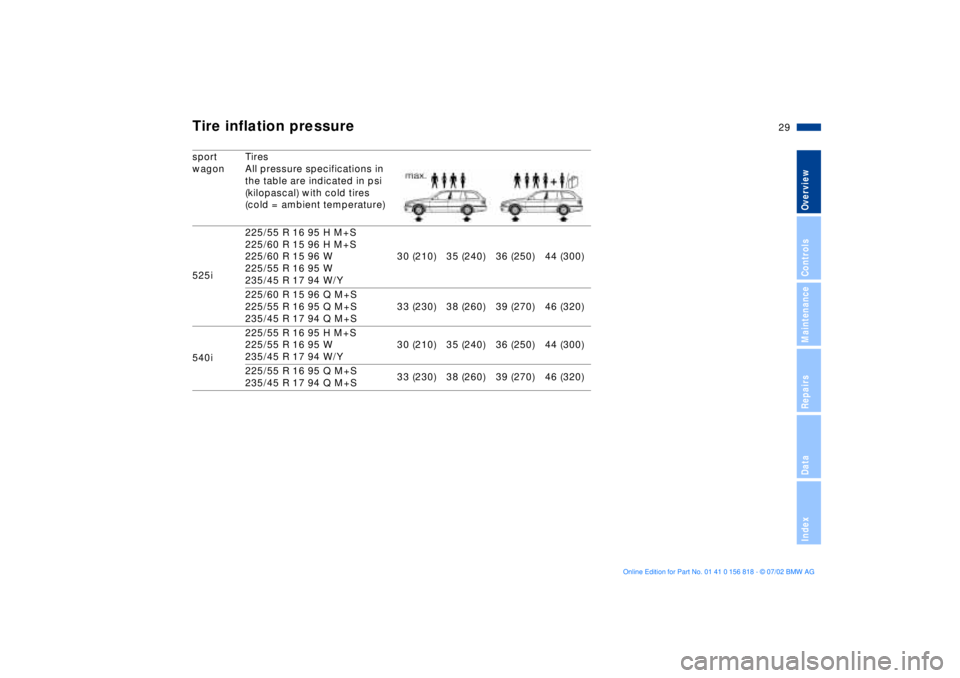
Tire inflation pressuresport
wagonTires
All pressure specifications in
the table are indicated in psi
(kilopascal) with cold tires
(cold = ambient temperature)
525i225/55 R 16 95 H M+S
225/60 R 15 96 H M+S
225/60 R 15 96 W
225/55 R 16 95 W
235/45 R 17 94 W/Y30 (210) 35 (240) 36 (250) 44 (300)
225/60 R 15 96 Q M+S
225/55 R 16 95 Q M+S
235/45 R 17 94 Q M+S33 (230) 38 (260) 39 (270) 46 (320)
540i225/55 R 16 95 H M+S
225/55 R 16 95 W
235/45 R 17 94 W/Y30 (210) 35 (240) 36 (250) 44 (300)
225/55 R 16 95 Q M+S
235/45 R 17 94 Q M+S33 (230) 38 (260) 39 (270) 46 (320)
Page 32 of 187
32n
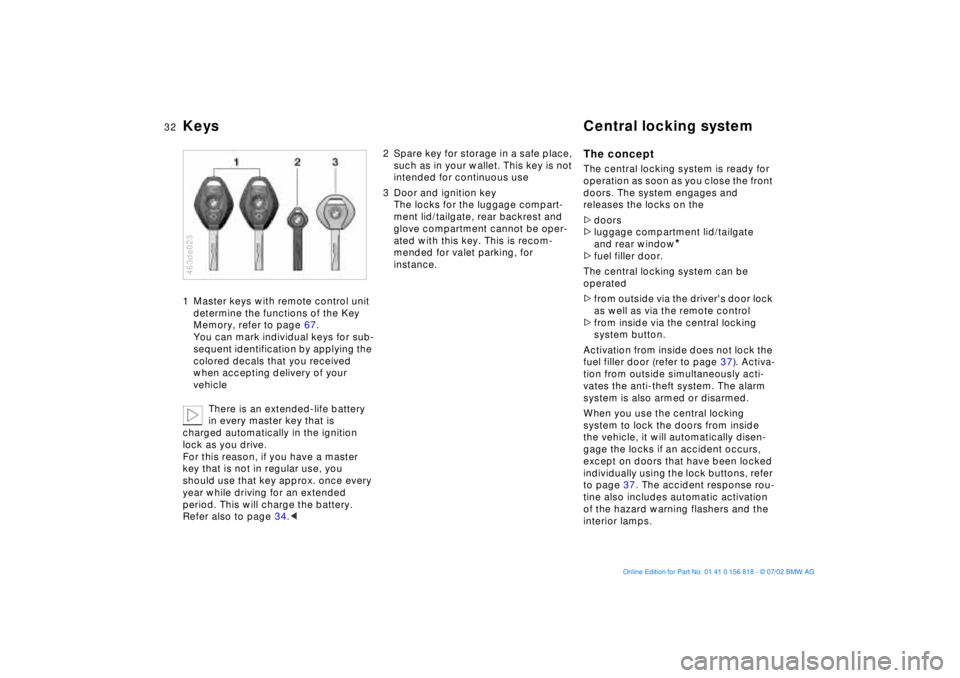
Keys Central locking system1 Master keys with remote control unit
determine the functions of the Key
Memory, refer to page 67.
You can mark individual keys for sub-
sequent identification by applying the
colored decals that you received
when accepting delivery of your
vehicle
There is an extended-life battery
in every master key that is
charged automatically in the ignition
lock as you drive.
For this reason, if you have a master
key that is not in regular use, you
should use that key approx. once every
year while driving for an extended
period. This will charge the battery.
Refer also to page 34.< 463de023
2 Spare key for storage in a safe place,
such as in your wallet. This key is not
intended for continuous use
3 Door and ignition key
The locks for the luggage compart-
ment lid/tailgate, rear backrest and
glove compartment cannot be oper-
ated with this key. This is recom-
mended for valet parking, for
instance.
The conceptThe central locking system is ready for
operation as soon as you close the front
doors. The system engages and
releases the locks on the
>doors
>luggage compartment lid/tailgate
and rear window
*
>fuel filler door.
The central locking system can be
operated
>from outside via the driver's door lock
as well as via the remote control
>from inside via the central locking
system button.
Activation from inside does not lock the
fuel filler door (refer to page 37). Activa-
tion from outside simultaneously acti-
vates the anti-theft system. The alarm
system is also armed or disarmed.
When you use the central locking
system to lock the doors from inside
the vehicle, it will automatically disen-
gage the locks if an accident occurs,
except on doors that have been locked
individually using the lock buttons, refer
to page 37. The accident response rou-
tine also includes automatic activation
of the hazard warning flashers and the
interior lamps.
Page 35 of 187
35n
OverviewControlsMaintenanceRepairsDataIndex
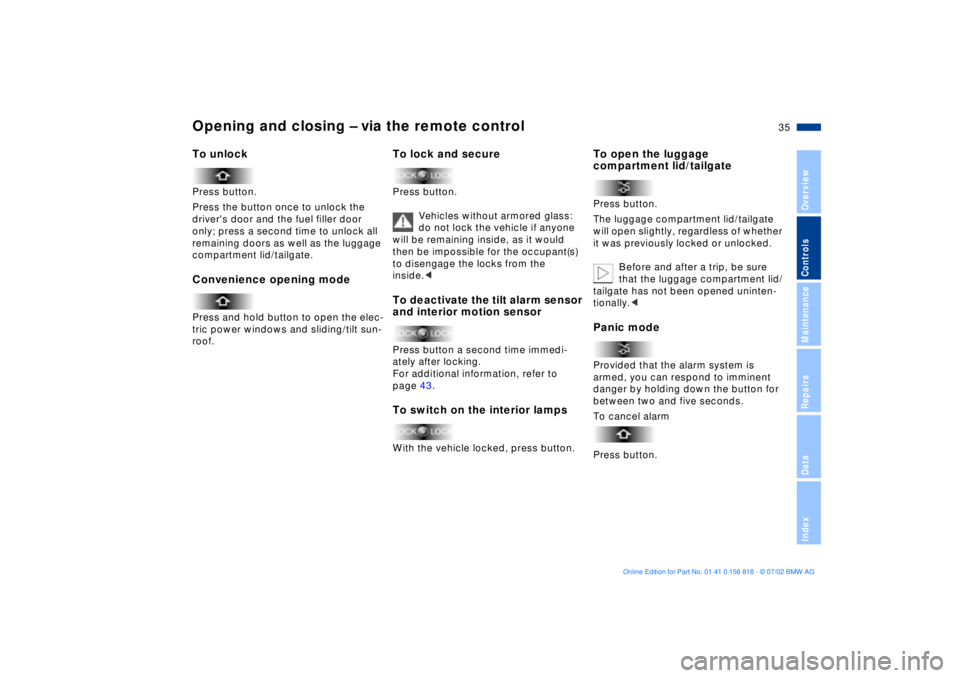
Opening and closing Ð via the remote controlTo unlockPress button.
Press the button once to unlock the
driver's door and the fuel filler door
only; press a second time to unlock all
remaining doors as well as the luggage
compartment lid/tailgate.Convenience opening modePress and hold button to open the elec-
tric power windows and sliding/tilt sun-
roof.
To lock and securePress button.
Vehicles without armored glass:
do not lock the vehicle if anyone
will be remaining inside, as it would
then be impossible for the occupant(s)
to disengage the locks from the
inside.< To deactivate the tilt alarm sensor
and interior motion sensorPress button a second time immedi-
ately after locking.
For additional information, refer to
page 43.To switch on the interior lampsWith the vehicle locked, press button.
To open the luggage
compartment lid/tailgatePress button.
The luggage compartment lid/tailgate
will open slightly, regardless of whether
it was previously locked or unlocked.
Before and after a trip, be sure
that the luggage compartment lid/
tailgate has not been opened uninten-
tionally.< Panic modeProvided that the alarm system is
armed, you can respond to imminent
danger by holding down the button for
between two and five seconds.
To cancel alarm
Press button.