730G8±01
± THEFT DETERRENT & DOOR LOCKTHEFT DETERRENT SYSTEM
73±31
AVENSIS REPAIR MANUAL (RM1018E)
THEFT DETERRENT SYSTEM
ON±VEHICLE INSPECTION
1. OUTLINE OF THEFT DETERRENT SYSTEM
(a) When the theft deterrent system detects that the vehicle is being tampered with, the system sets off
the alarm, causing the horns to sound and the lights to light up or blink in order to alert people around
the vehicle to the theft.
(b) The theft deterrent system has an active arming mode; a disarmed state, an arming preparation state,
an armed state and an alarm sounding state.
(1) Disarmed state:
�The alarm function is not operating.
�The theft deterrent system is not operating.
(2) Arming preparation state:
�The time until the system goes into the armed state.
�The theft deterrent system is not operating.
(3) Armed state:
�The theft deterrent system is operating.
HINT:
If the vehicle remains in a condition that sets off the alarm (any door remains open, engine hood remains
open, ignition switch remains directly connected) after the alarm ends, the alarm will be set off repeatedly
a maximum of 10 times for every one of the above specified conditions.
Alarm time: Approx. 27.5 sec. x 10
(4) Alarm sounding state:
When the theft deterrent system detects that the vehicle is being tampered with while in the
armed state, the system causes the horns to sound and the lights to light up or blink in order to
alert people around the vehicle to the theft.
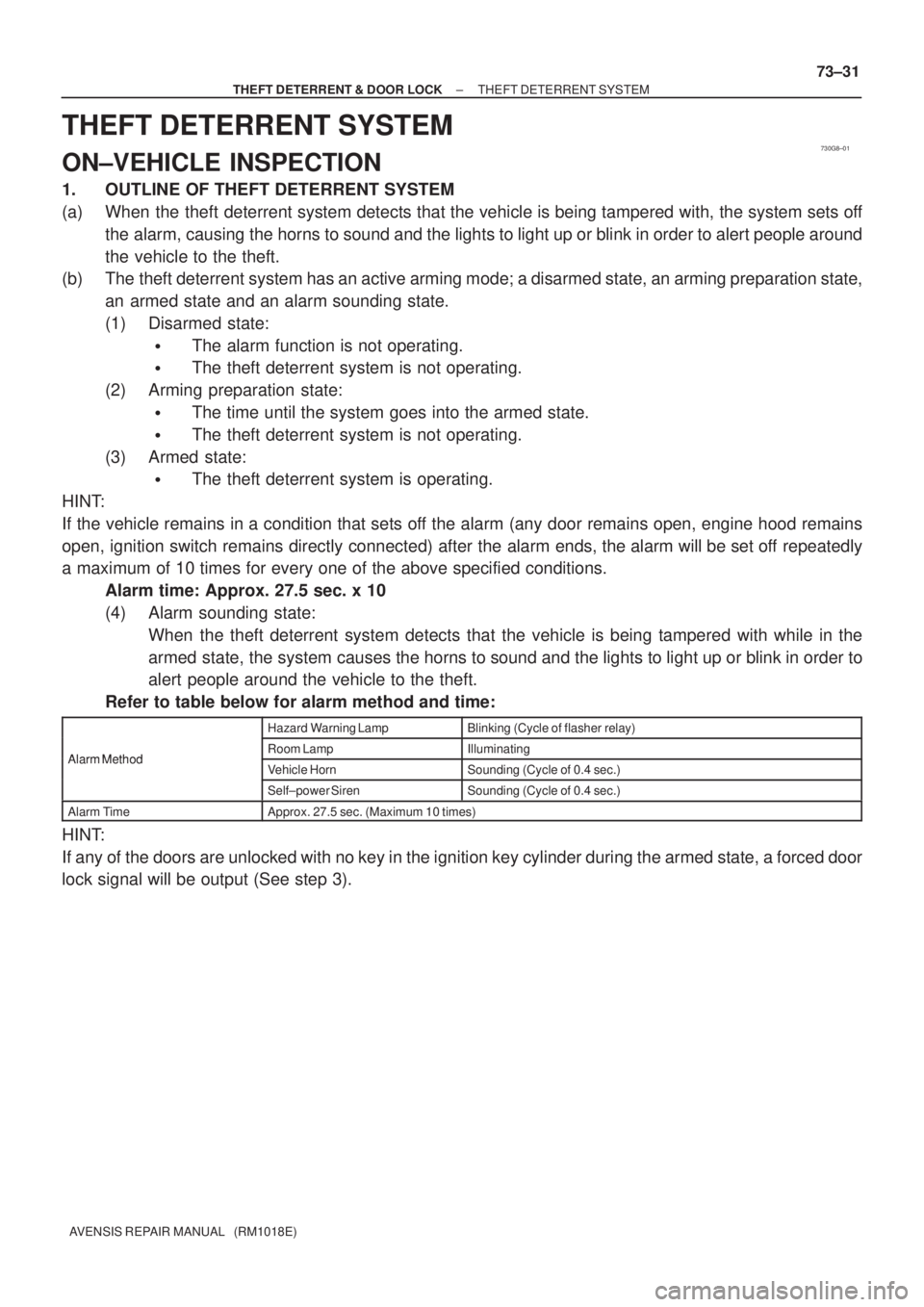
Refer to table below for alarm method and time:
Hazard Warning LampBlinking (Cycle of flasher relay)
Alarm MethodRoom LampIlluminatingAlarm MethodVehicle HornSounding (Cycle of 0.4 sec.)
Self±power SirenSounding (Cycle of 0.4 sec.)
Alarm TimeApprox. 27.5 sec. (Maximum 10 times)
HINT:
If any of the doors are unlocked with no key in the ignition key cylinder during the armed state, a forced door
lock signal will be output (See step 3).
73±34
± THEFT DETERRENT & DOOR LOCKTHEFT DETERRENT SYSTEM
AVENSIS REPAIR MANUAL (RM1018E)
3. FORCED DOOR LOCK CONTROL
(a) The forced door lock control prevents the vehicle from being tampered with. Immediately after a door
is unlocked (alarm starts), the door is forced to lock by a forced door lock signal.
(1) Conditions that force the doors to lock:
When no key is in the ignition key cylinder and 0.4 seconds have elapsed after the previous out-
put of a forced door lock signal, the doors will be forced to lock if any of the following conditions
is present.
�The theft deterrent system is in the armed state of active arming mode.
�All the doors are locked.�Any door is unlocked.
�Any door is unlocked.
HINT:
Only Europe:
Forced door lock control does not operate if any door is unlocked by key.
4. ALARM MEMORY FUNCTION
(a) If the alarm is set off (tampering is detected) while the theft deterrent system is set, the alarm memory
function will record it. Whenever you cancel the theft deterrent system, the alarm memory function
causes the taillights to light up for 2 seconds in order to inform you that the alarm has been set off.
(1) Conditions of the alarm memory function that cause the taillights to light up:
When the theft deterrent system has entered into the alarm sounding state (tampering has been
detected) even once, the taillights will light up for 2 seconds if any of the following conditions is
present.
�Switched to the disarmed state from the armed state.
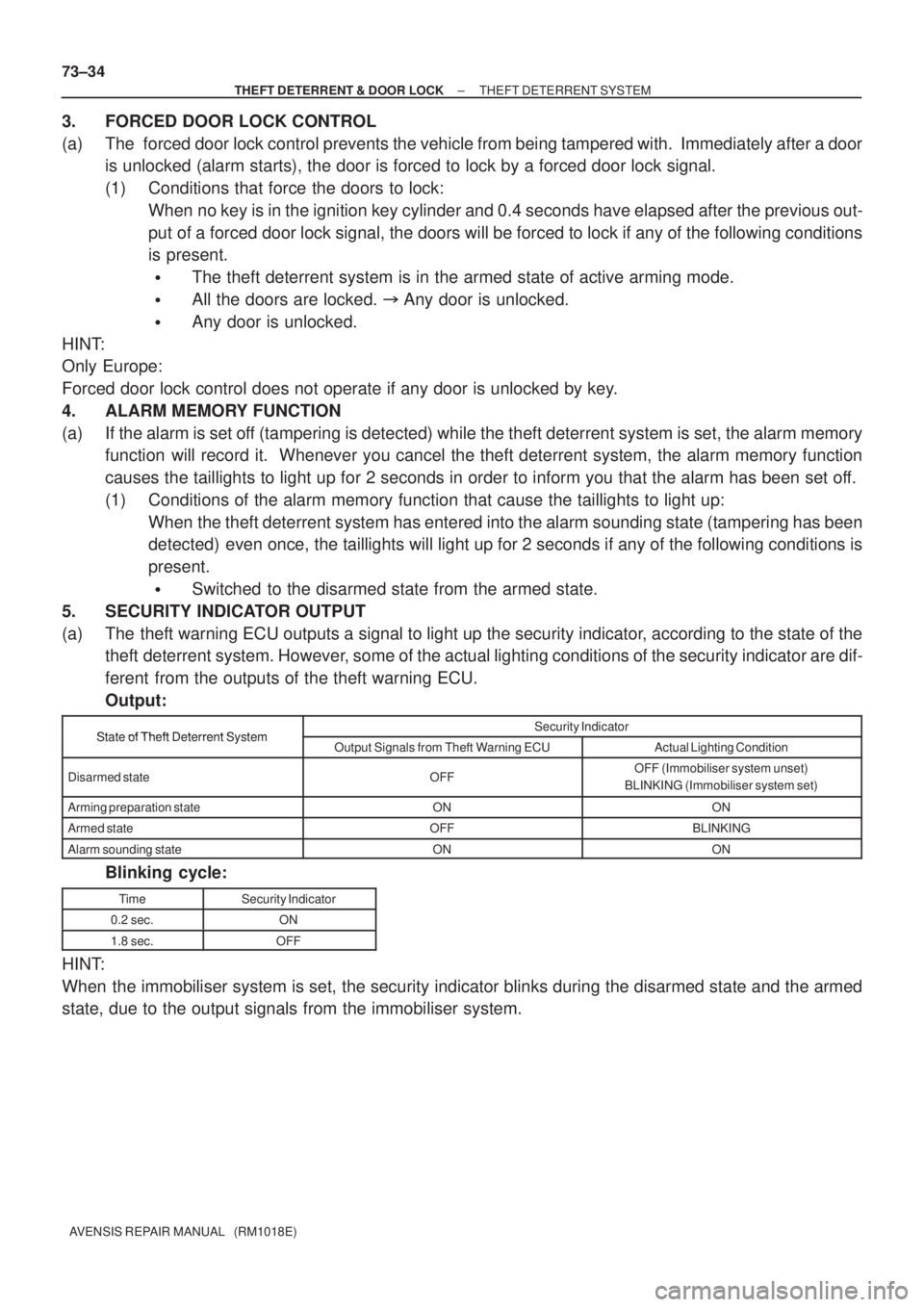
5. SECURITY INDICATOR OUTPUT
(a) The theft warning ECU outputs a signal to light up the security indicator, according to the state of the
theft deterrent system. However, some of the actual lighting conditions of the security indicator are dif-
ferent from the outputs of the theft warning ECU.
Output:
State of Theft Deterrent SystemSecurity IndicatorState of Theft Deterrent SystemOutput Signals from Theft Warning ECUActual Lighting Condition
Disarmed stateOFFOFF (Immobiliser system unset)
BLINKING (Immobiliser system set)
Arming preparation stateONON
Armed stateOFFBLINKING
Alarm sounding stateONON
Blinking cycle:
TimeSecurity Indicator
0.2 sec.ON
1.8 sec.OFF
HINT:
When the immobiliser system is set, the security indicator blinks during the disarmed state and the armed
state, due to the output signals from the immobiliser system.