Page 97 of 1672

TORQUE WRENCH SETTINGS
06-12
Rear suspension
Brakes
TORQUE DESCRIPTION METRIC IMPERIAL
Wheel nuts140 Nm (103 lbf.ft)
Wheel hub to axle 100 Nm (74 lbf.ft)
Damper to axle125 Nm (92 lbf.ft)
SLS height sensor link to radius arm 25 Nm (18 lbf.ft)
Radius arm230 Nm (170 lbf.ft)
Transverse links to pivot housing 155 Nm (114 lbf.ft)
Pivot housing to axle bolts 230 Nm (170 lbf.ft)
Transverse link to chassis 140 Nm (103 lbf.ft)
SLS height sensor 6 Nm (4.4 lbf.ft)
SLS compressor25 Nm (18 lbf.ft)
ACE actuator to short arm 185 Nm (136 lbf.ft)
ACE actuator to long arm 48 Nm (35 lbf.ft)
ACE actuator pipe cap nuts 29 Nm (21 lbf.ft)
Anti-roll bar link - upper 50 Nm (37 lbf.ft)
Anti-roll bar link - lower 100 Nm (74 lbf.ft)
ACE long arm to torsion bar 180 Nm (133 lbf.ft)
TORQUE DESCRIPTION METRIC IMPERIAL
Brake caliper bleed screw 10 Nm (7 lbf.ft)
Brake disc to drive flange 13 Nm (10 lbf.ft)
Caliper bolts - Front 175 Nm (129 lbf.ft)
Caliper bolts - Rear 95 Nm (70 lbf.ft)
Master cylinder to servo 25 Nm (18 lbf.ft)
Master cylinder brake pipe, unions 25 Nm (18 lbf.ft)
Brake caliper pivot bolt 30 Nm (22 lbf.ft)
Vacuum pump8 Nm (6 lbf.ft)
Vacuum pump lubrication pipe union 10 Nm (7 lbf.ft)
Brake caliper guide pin bolts 30 Nm (22 lbf.ft)
Brake caliper banjo bolt 32 Nm (24 lbf.ft)
ABS modulator to mounting bracket nuts 9 Nm (7 lbf.ft)
ABS modulator - 13 mm unions 22 Nm (16 lbf.ft)
ABS modulator - 11 mm union 14 Nm (10 lbf.ft)
Handbrake lever to floor bolts 22 Nm (16 lbf.ft)
Page 102 of 1672

LIFTING AND TOWING
08-1
LIFTING AND TOWING
LIFTING
The following instructions must be carried out before
raising the vehicle off the ground.
lUse a solid level ground surface.
lApply hand brake.
lSelect 'P' (Automatic gearbox) or 1st gear
(Manual gearbox) in main gearbox.
lSelect Low range in transfer gearbox.
To avoid damage occurring to the under body
components of the vehicle the following jacking
procedures must be adhered to.
DO NOT POSITION JACKS OR AXLE STANDS
UNDER THE FOLLOWING COMPONENTS:
lBody structure
lBumpers
lFuel lines
lBrake lines
lFront radius arms
lPanhard rod
lSteering linkage
lRear trailing arms
lFuel tank
lEngine sump
lGearbox bell housing
Vehicle jack
The jack provided with the vehicle is only intended for
use in an emergency, for changing a tyre. DO NOT
use the jack for any other purpose. Refer to Owner's
Handbook for vehicle jack location points and
procedure. Never work under a vehicle supported
solely by the vehicle jack.
Hydraulic jack
A hydraulic jack with a minimum 1500 kg, 3,300 lbs
load capacity must be used. Do not commence
work on the underside of the vehicle until
suitable axle stands have been positioned under
the axle.
WARNING: Always chock the wheels when
jacking. The hand brake acts on the
transmission, not the rear wheels, and may be
ineffective when the wheels are off the ground.Raising and supporting the vehicle
Position cup of hydraulic arm under differential
casing (1).The differential casing is not central to
the axle. Care should be taken when raising the
front road wheels off the ground as the rear axle
has less sway stiffness.
Raise vehicle to enable an axle stand to be installed
under left hand axle tube (2).
Position an axle stand under right hand axle tube (4).
Carefully lower jack until vehicle sits securely on both
axle stands, remove jack.
Alternatively, the axle stands can be positioned
under the chassis longitudinals at the front and/or
rear of the vehicle.
Before commencing work on underside of vehicle re-
check security of vehicle on stands.
WARNING: Always chock the wheels when
jacking. The hand brake acts on the the
transmission, not the rear wheels, and may be
ineffective when the wheels are off the ground.
Page 103 of 1672
LIFTING AND TOWING
08-2
Reverse procedure when removing vehicle from
stands.
Hydraulic ramps
Use only a 'drive on' type ramp which supports a
vehicle by it's own road wheels. If a 'wheel free'
condition is required, use a 'drive on' ramp
incorporating a 'wheel free' system that supports
under axle casings. Alternatively, place vehicle on a
firm, flat floor and support on axle stands.
TOWING
Towing
The vehicle has permanent four wheel drive. The
following towing instructions must be adhered
to:
Towing on 4 wheels with driver
Turn ignition key to position '1' to release steering
lock.
Select neutral in main gearbox and transfer gearbox.
Secure tow rope, chain or cable to towing eye.
Release the handbrake.
The brake servo and power assisted steering
system will not be functional without the engine
running. Greater pedal pressure will be required
to apply the brakes, the steering system will
require greater effort to turn the front road
wheels. The vehicle tow connection should be
used only in normal road conditions, 'snatch'
recovery should be avoided.Suspended tow
To prevent vehicle damage, front or rear
propeller shaft MUST BE removed, dependent
upon which axle is being trailed.
Mark propeller shaft drive flanges at transfer box and
axles with identification lines to enable the propeller
shaft to be refitted in its original position.
Remove the propeller shaft fixings, remove the shaft
from the vehicle.
If the front axle is to be trailed turn ignition key to
position '1' to release steering lock.
The steering wheel and/or linkage must be
secured in a straight ahead position. DO NOT use
the steering lock mechanism for this purpose.
Towing eyes
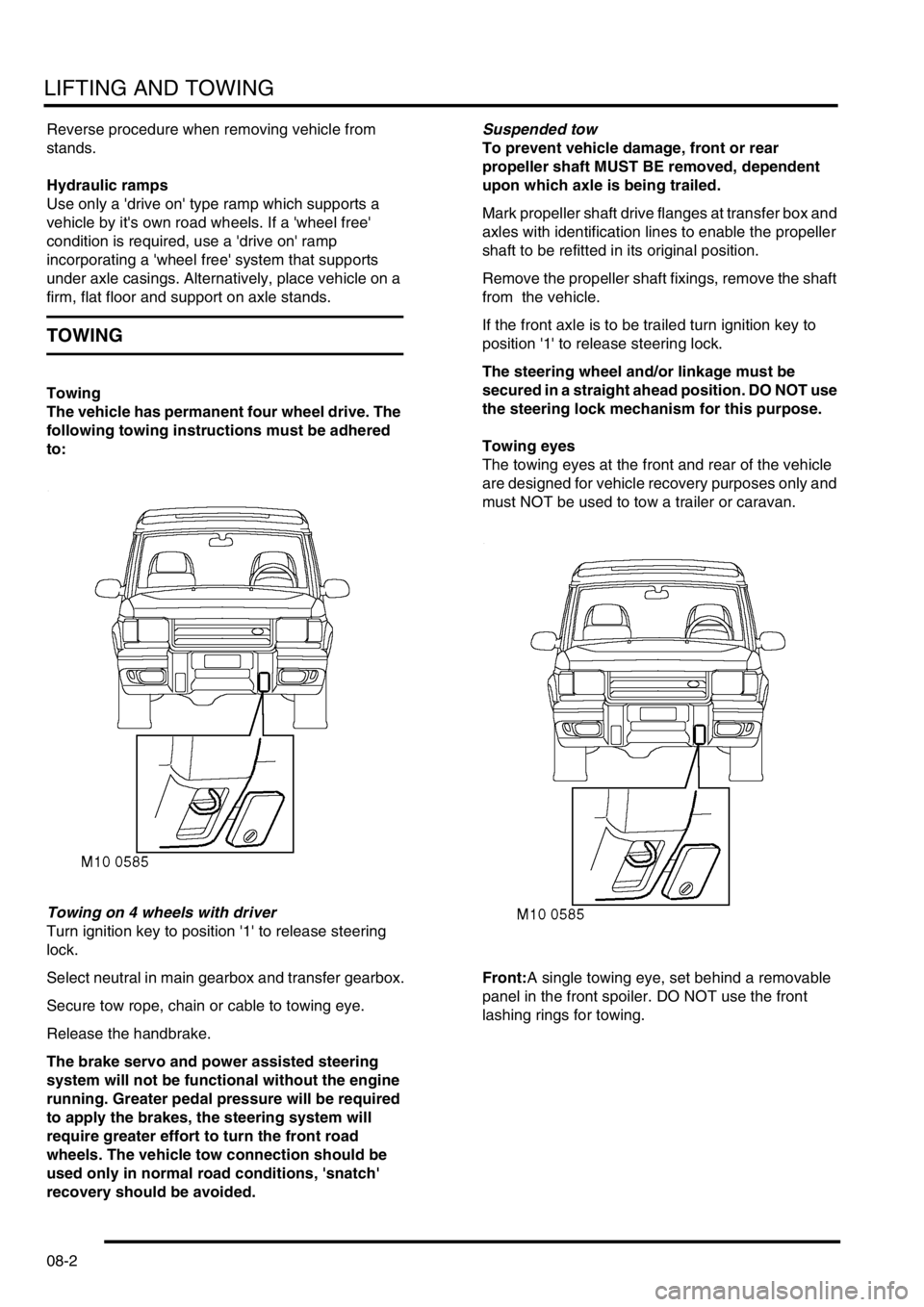
The towing eyes at the front and rear of the vehicle
are designed for vehicle recovery purposes only and
must NOT be used to tow a trailer or caravan.
Front:A single towing eye, set behind a removable
panel in the front spoiler. DO NOT use the front
lashing rings for towing.
Page 104 of 1672
LIFTING AND TOWING
08-3
Rear: A pair of towing eyes at the rear of the vehicle
can be used as lashing rings and for towing another
light vehicle.
TRANSPORTING
Transporting by trailer
Front lashing eyes
Rear lashing eyes
Lashing eyes are provided on the chassis
longitudinals, at the front (behind the front wheels)
and at the rear (behind the rear wheels).
Page 116 of 1672
MAINTENANCE
PROCEDURES 10-7
Road wheels
Remove
1.Mark the wheel to stud relationship to ensure
that the wheels are refitted in the same
position.
2.Loosen wheel nuts. Raise the vehicle to a
wheel-free condition and remove the wheel
nuts.
Tyres
Check
1.Check tyres for compliance with manufacturer's
specification; visually for cuts, lumps, bulges,
uneven tread wear and depth.
2.Check tyre pressures, condition and tread
depth. Measure the tread depth across the
width of the tyre and around the circumference.
Brake pads, discs and calipers
Check
1. Check front and rear brake pads for wear,
ensure all pads are wearing evenly.
2.Check brake discs for signs of cracking,
excessive scoring or oil contamination.
3.Check calipers for signs of fluid leaks.
4.Clean excessive deposits of brake dust from
pads, calipers and disc shields using brake
cleaner.
Road wheel speed sensors
Inspect
Front wheel
Rear wheel
1.Inspect each sensor harness for damage.
Page 117 of 1672
MAINTENANCE
10-8 PROCEDURES
Brake fluid
Replace
1.Replace brake fluid.
+ BRAKES, ADJUSTMENTS, Brake
system bleeding.
Fuel filter - diesel engine
Replace
1.Replace filter element.
+ ENGINE MANAGEMENT SYSTEM -
Td5, REPAIRS, Element - fuel filter.
Fuel filter sedimenter
Drain
1.Position suitable container beneath fuel filter.
2.Disconnect multiplug from sedimenter.
3.Rotate sedimenter anti-clockwise until water
flows from drain tube.
4.Allow to drain until diesel fuel flows from drain
tube.
5.Rotate sedimenter fully clockwise.
6.Connect multiplug.
Road wheels
Refit
1.Apply anti-seize compound to wheel hub
centre.
2.Refit road wheels to original hub position.
Tighten wheel nuts to 140 Nm (103 lbf.ft).
Radiator/Intercooler
Check
1.Visually check radiator/intercooler for external
obstructions, remove debris.
2.Visually check fan blades for damage.
Ambient air Temperature and pressure
sensor
Check
1.Check ambient air temperature and pressure
sensor for damage.
Page 122 of 1672
MAINTENANCE
PROCEDURES 10-13
Check/top-up — Washer reservoir
1.Check fluid level in windscreen washer
reservoir.
2.Clean area around filler cap, remove cap.
3.Top-up if necessary to correct level on reservoir
using recommended fluid.
+ CAPACITIES, FLUIDS AND
LUBRICANTS, Fluids.
4.Fit filler cap.
Steering box
Check
1.Check steering box for fluid leaks.
Adjust
1.Check that there is no backlash in steering box
with road wheels in straight ahead position.
Adjust if required.
+ STEERING, ADJUSTMENTS,
Steering box - check and adjust.
Battery
Check
1.Check battery condition by checking colour of
condition indicator.
lGreen = O.K.
lBlack = Battery requires charging.
lClear/white = New battery required.
Clean
1.Clean and grease battery terminals with
petroleum jelly.
Page 126 of 1672

MAINTENANCE
PROCEDURES 10-17
Automatic gearbox
WARNING: Avoid excessive skin contact with
mineral oil. Mineral oils remove the natural fats
from the skin, leading to dryness, irritation and
dermatitis.
Replace oil filter
1.Replace oil filter.
+ AUTOMATIC GEARBOX - ZF4HP22
- 24, REPAIRS, Filter - oil.
Replace oil
1. Ensure that gearbox is cool. Apply
handbrake and securely chock front and rear
wheels.
2.Place a suitable container beneath gearbox.
3.Clean area around oil filler/level and drain
plugs.
4.Remove oil drain plug, remove and discard
sealing washer.
5.Allow oil to drain.
6.Fit new sealing washer to oil drain plug.
7.Fit automatic gearbox drain plug and tighten to
15 Nm (11 lbf.ft).
8.Remove oil filler/level plug, remove and discard
sealing washer.9.Fill gearbox with recommended oil to bottom of
oil level/filler plug hole.
+ CAPACITIES, FLUIDS AND
LUBRICANTS, Lubrication.
10.Select 'P' (Park).
11.Ensure handbrake is applied.
12.Start engine and allow it to idle.
13.Apply footbrake.
14.Move selector lever through all gear positions,
while continuing to fill the gearbox. Select 'P'
(Park).
15.With engine idling, continue filling gearbox until
a 2 mm bead of oil runs from oil filler/level plug
hole.
16.Fit new sealing washer to automatic gearbox
filler/level plug, fit plug and tighten to 30 Nm (22
l b f . f t ) .
17.Stop engine.
18.Remove all traces of oil from gearbox casing.


