2002 LAND ROVER DISCOVERY LOCK doors
[x] Cancel search: LOCK doorsPage 1132 of 1672
DOORS
REPAIRS 76-1-9
Trim casing - tail door
$% 76.34.09.99
Remove
1.If fitted, remove tail door speaker.
+ IN CAR ENTERTAINMENT,
REPAIRS, Speaker - tail door.
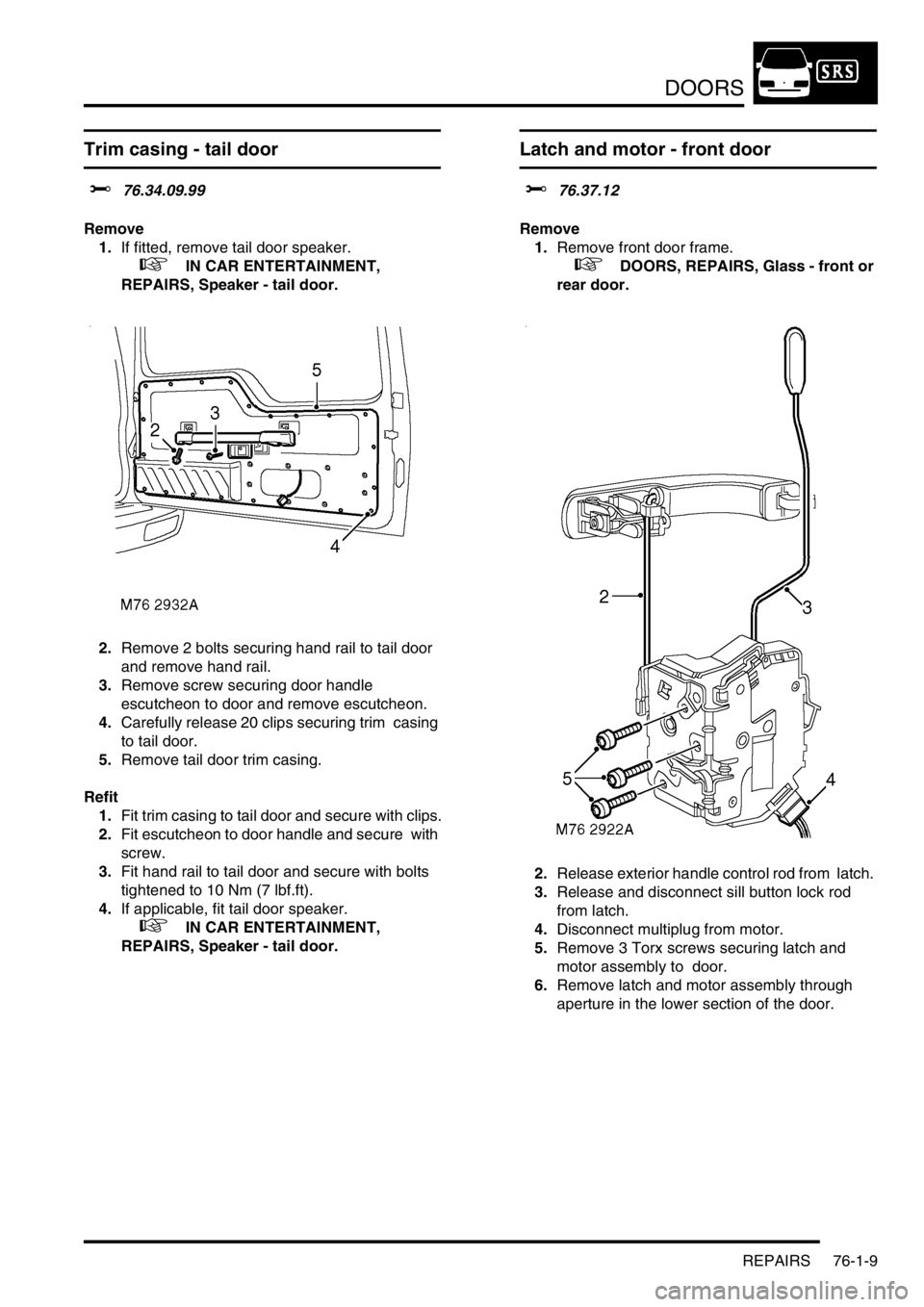
2.Remove 2 bolts securing hand rail to tail door
and remove hand rail.
3.Remove screw securing door handle
escutcheon to door and remove escutcheon.
4.Carefully release 20 clips securing trim casing
to tail door.
5.Remove tail door trim casing.
Refit
1.Fit trim casing to tail door and secure with clips.
2.Fit escutcheon to door handle and secure with
screw.
3.Fit hand rail to tail door and secure with bolts
tightened to 10 Nm (7 lbf.ft).
4.If applicable, fit tail door speaker.
+ IN CAR ENTERTAINMENT,
REPAIRS, Speaker - tail door.
Latch and motor - front door
$% 76.37.12
Remove
1.Remove front door frame.
+ DOORS, REPAIRS, Glass - front or
rear door.
2.Release exterior handle control rod from latch.
3.Release and disconnect sill button lock rod
from latch.
4.Disconnect multiplug from motor.
5.Remove 3 Torx screws securing latch and
motor assembly to door.
6.Remove latch and motor assembly through
aperture in the lower section of the door.
Page 1133 of 1672
DOORS
76-1-10 REPAIRS
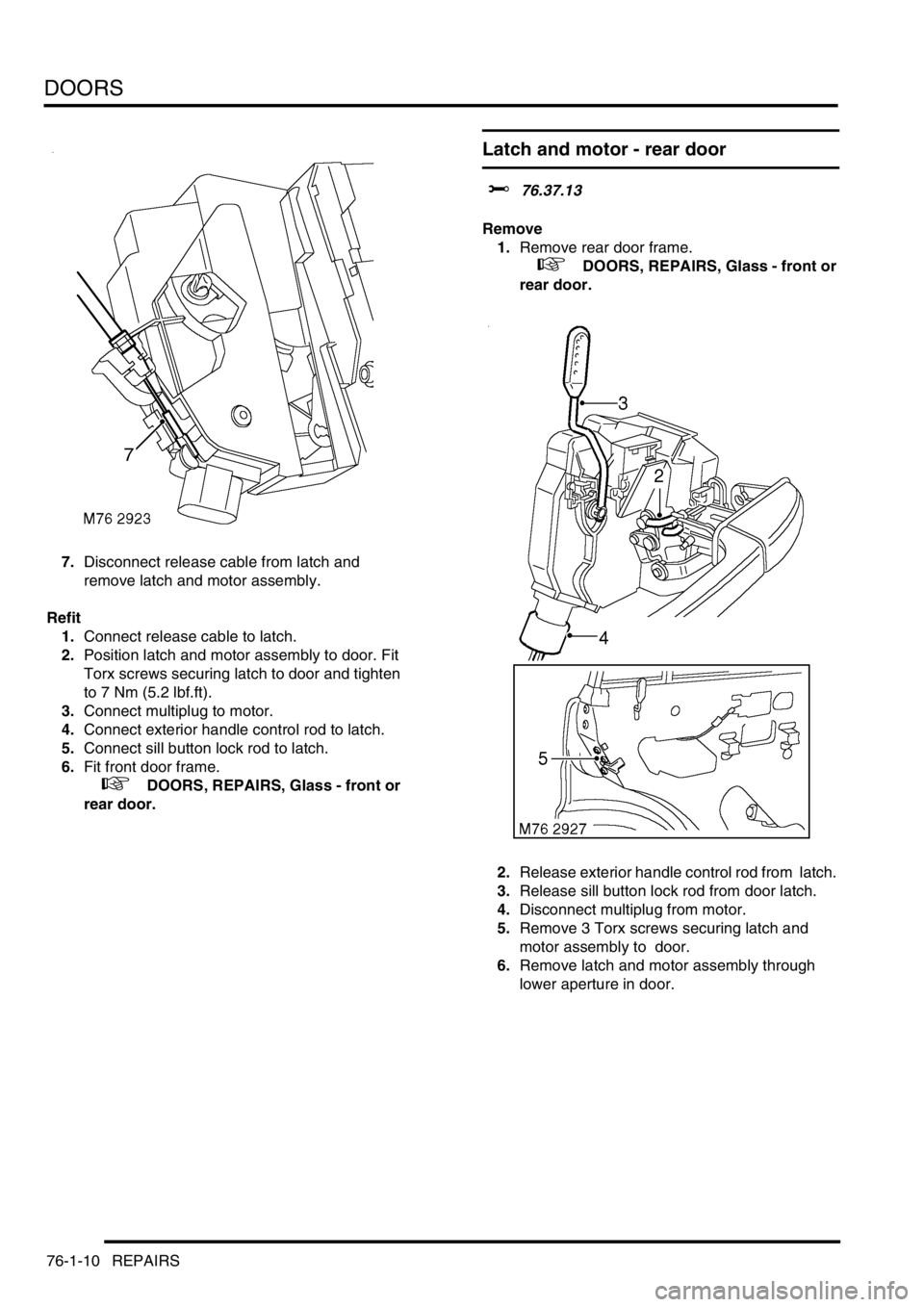
7.Disconnect release cable from latch and
remove latch and motor assembly.
Refit
1.Connect release cable to latch.
2.Position latch and motor assembly to door. Fit
Torx screws securing latch to door and tighten
to 7 Nm (5.2 lbf.ft).
3.Connect multiplug to motor.
4.Connect exterior handle control rod to latch.
5.Connect sill button lock rod to latch.
6.Fit front door frame.
+ DOORS, REPAIRS, Glass - front or
rear door.
Latch and motor - rear door
$% 76.37.13
Remove
1.Remove rear door frame.
+ DOORS, REPAIRS, Glass - front or
rear door.
2.Release exterior handle control rod from latch.
3.Release sill button lock rod from door latch.
4.Disconnect multiplug from motor.
5.Remove 3 Torx screws securing latch and
motor assembly to door.
6.Remove latch and motor assembly through
lower aperture in door.
Page 1134 of 1672
DOORS
REPAIRS 76-1-11
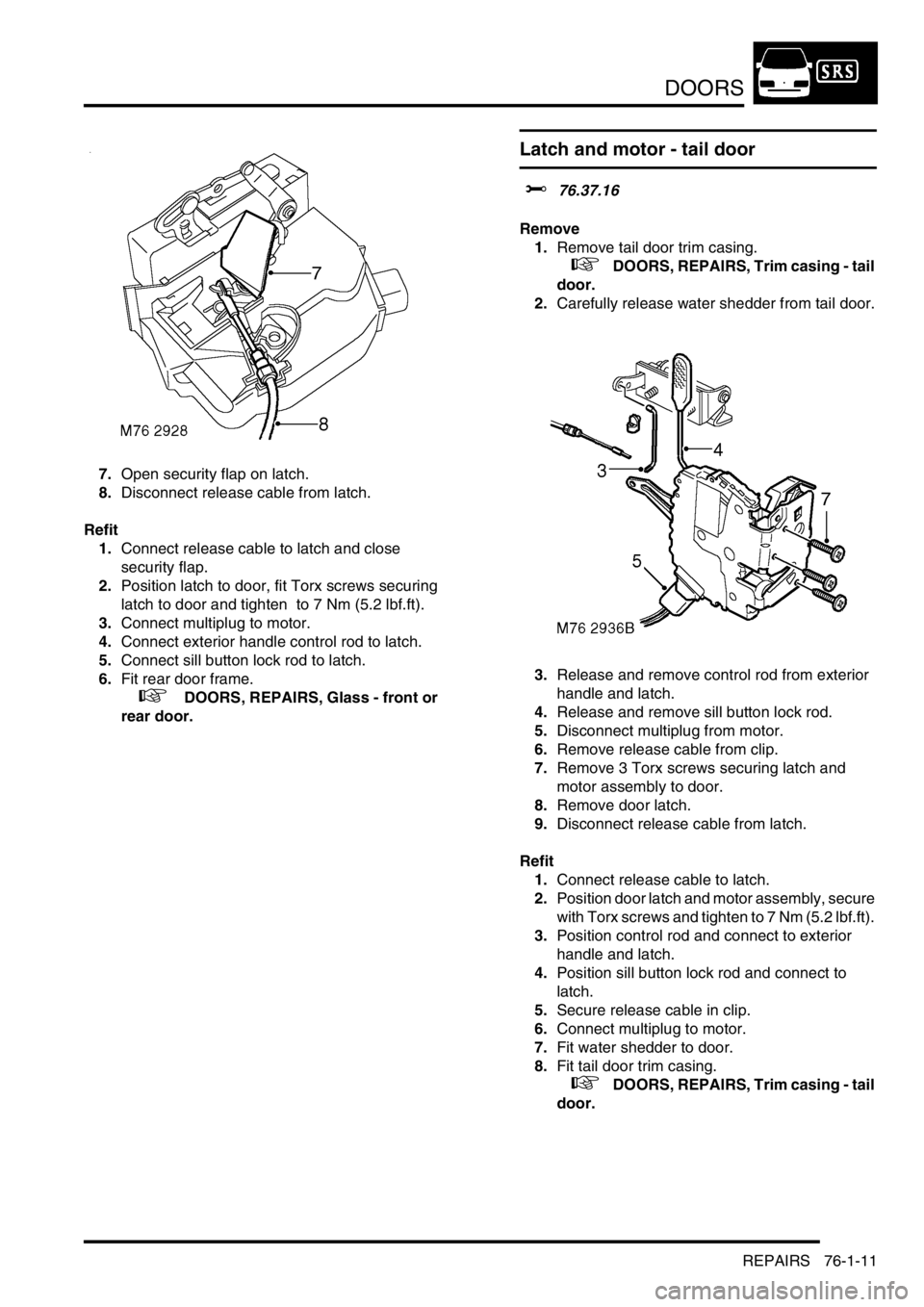
7.Open security flap on latch.
8.Disconnect release cable from latch.
Refit
1.Connect release cable to latch and close
security flap.
2.Position latch to door, fit Torx screws securing
latch to door and tighten to 7 Nm (5.2 lbf.ft).
3.Connect multiplug to motor.
4.Connect exterior handle control rod to latch.
5.Connect sill button lock rod to latch.
6.Fit rear door frame.
+ DOORS, REPAIRS, Glass - front or
rear door.
Latch and motor - tail door
$% 76.37.16
Remove
1.Remove tail door trim casing.
+ DOORS, REPAIRS, Trim casing - tail
door.
2.Carefully release water shedder from tail door.
3.Release and remove control rod from exterior
handle and latch.
4.Release and remove sill button lock rod.
5.Disconnect multiplug from motor.
6.Remove release cable from clip.
7.Remove 3 Torx screws securing latch and
motor assembly to door.
8.Remove door latch.
9.Disconnect release cable from latch.
Refit
1.Connect release cable to latch.
2.Position door latch and motor assembly, secure
with Torx screws and tighten to 7 Nm (5.2 lbf.ft).
3.Position control rod and connect to exterior
handle and latch.
4.Position sill button lock rod and connect to
latch.
5.Secure release cable in clip.
6.Connect multiplug to motor.
7.Fit water shedder to door.
8.Fit tail door trim casing.
+ DOORS, REPAIRS, Trim casing - tail
door.
Page 1289 of 1672

PANEL REPAIRS
77-2-40 REPAIRS
13.Fit front door striker to B/C post, fit Torx bolts
and tighten to 26 Nm (19 lbf.ft).
14.Fit rear door.
+ DOORS, REPAIRS, Door - rear.
15.Connect leads/multiplug to alternator.
16.Connect battery leads, negative lead last.
Panel body side assembly
Remove
1.Disconnect both battery leads, negative lead
first.
2.Disconnect leads/multiplug from alternator.
3.Remove loadspace side trim casing.
+ INTERIOR TRIM COMPONENTS,
REPAIRS, Trim casing - side - loadspace.
4.Remove head lining rear trim finisher.
5.Remove rear head rests, if fitted.
6.Remove body side rear glass.
+ SCREENS, REPAIRS, Glass - body
side - rear.
7.Remove rear bumper assembly.
+ EXTERIOR FITTINGS, REPAIRS,
Bumper assembly - rear - up to 03MY.
8.Remove rear bumper finisher.
9.Remove rear wheel arch liner.
+ EXTERIOR FITTINGS, REPAIRS,
Liner - wheel arch - rear.
10.Remove mud flap.
11.Remove tread plate from rear door aperture.
12.Remove rear door aperture seal.
13.Remove rear door striker from 'D' post.
14.Remove 'D' post outer trim finisher.
15.Remove wheel arch trim finisher.
16.Remove side drip rail finisher.
17. RH side: Remove tail door.
18. LH side: Remove tail door striker and setting
block from 'E' post.
19.Remove tail door tread plate.
20.Remove loadspace carpet retainer.
21.Remove tail door aperture seal.
22.Remove tail lamp.
+ LIGHTING, REPAIRS, Lamp - tail.
23. RH side: Remove fuel filler flap.
24. RH side: Remove fuel filler tube.
+ FUEL DELIVERY SYSTEM - V8,
REPAIRS, Filler tube - fuel.
25.Remove aerial amplifier.
26.Remove relevant wiring from body side area.
Page 1329 of 1672
CORROSION PREVENTION AND SEALING
77-4-14 SEALING
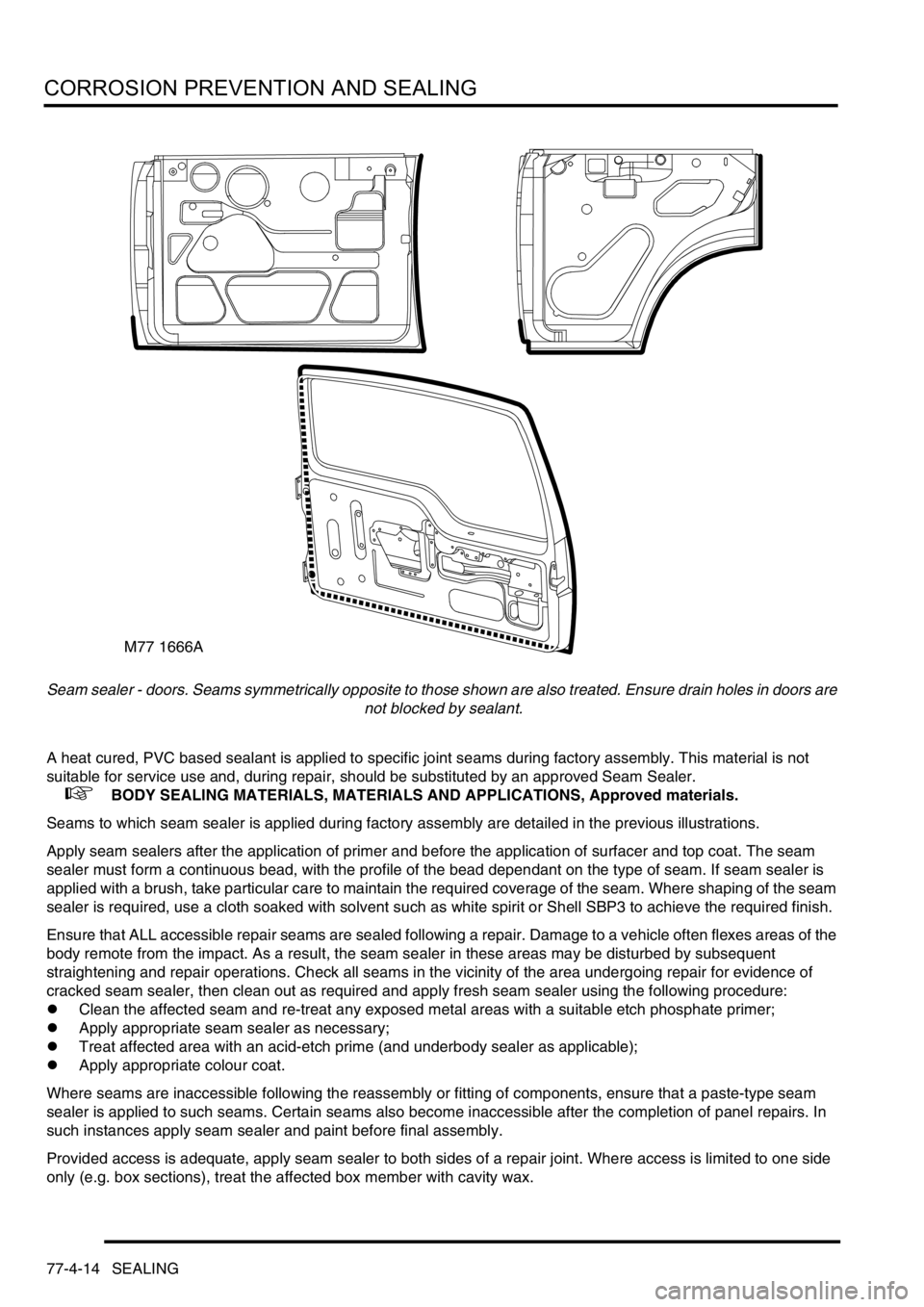
Seam sealer - doors. Seams symmetrically opposite to those shown are also treated. Ensure drain holes in doors are
not blocked by sealant.
A heat cured, PVC based sealant is applied to specific joint seams during factory assembly. This material is not
suitable for service use and, during repair, should be substituted by an approved Seam Sealer.
+ BODY SEALING MATERIALS, MATERIALS AND APPLICATIONS, Approved materials.
Seams to which seam sealer is applied during factory assembly are detailed in the previous illustrations.
Apply seam sealers after the application of primer and before the application of surfacer and top coat. The seam
sealer must form a continuous bead, with the profile of the bead dependant on the type of seam. If seam sealer is
applied with a brush, take particular care to maintain the required coverage of the seam. Where shaping of the seam
sealer is required, use a cloth soaked with solvent such as white spirit or Shell SBP3 to achieve the required finish.
Ensure that ALL accessible repair seams are sealed following a repair. Damage to a vehicle often flexes areas of the
body remote from the impact. As a result, the seam sealer in these areas may be disturbed by subsequent
straightening and repair operations. Check all seams in the vicinity of the area undergoing repair for evidence of
cracked seam sealer, then clean out as required and apply fresh seam sealer using the following procedure:
lClean the affected seam and re-treat any exposed metal areas with a suitable etch phosphate primer;
lApply appropriate seam sealer as necessary;
lTreat affected area with an acid-etch prime (and underbody sealer as applicable);
lApply appropriate colour coat.
Where seams are inaccessible following the reassembly or fitting of components, ensure that a paste-type seam
sealer is applied to such seams. Certain seams also become inaccessible after the completion of panel repairs. In
such instances apply seam sealer and paint before final assembly.
Provided access is adequate, apply seam sealer to both sides of a repair joint. Where access is limited to one side
only (e.g. box sections), treat the affected box member with cavity wax.
M77 1666A
Page 1471 of 1672

BODY CONTROL UNIT
86-3-2 DESCRIPTION AND OPERATION
Power supply
Battery supply to the BCU and the IDM is provided through a 10 A fuse located in the engine compartment fuse box.
The BCU unit receives an ignition switched power supply (ignition switch position II) input via a 10 A fuse in the
passenger compartment fuse box.
The BCU receives a signal when the ignition switch is turned to the crank position, it then supplies an earth path to
the starter relay coil, to enable the crank operation by supplying power through the starter relay contacts to the starter
motor.
Battery voltage is monitored and BCU operation will function normally between 8 and 18 volts. Between 5.7 and 8
volts the BCU is in the 'under volts' state. The status of the battery is used to determine which outputs may be driven.
If a voltage supply above 18 volts is experienced, outputs will not normally be driven except for those functions which
are required during cranking (robust immobilisation, antenna coil, crank enable relay and feed to gear position switch
contacts W, X, Y, Z). In the over voltage state the vehicle can be driven, but all other functions are disabled and
outputs are switched off (power windows, heated screen, direction indicators etc.).
All functions are disabled on power up until communications between the BCU and IDM have been established. If
communications cannot be established, operation will commence with degraded functionality.
Battery supply to the IDM is provided through the inertia switch and a 10 A fuse in the engine compartment fuse box.
If the inertia switch contacts are closed battery voltage is available at the IDM; if the inertia switch contacts are open
there is no battery supply to the IDM. The supply condition of the IDM is signalled to the BCU via the serial bus. If the
inertia switch is operated (contacts open) the change in state is detected by the BCU which unlocks the doors if the
ignition switch is in position II and the alarm is not set.
The BCU is earthed through a hard-wire connection.
Inputs and outputs
The BCU and IDM process inputs and provide the necessary outputs for control and operation of the vehicle's 'body'
systems.
BCU inputs
The BCU processes signals received from the following components:
lDoor latch switches.
lDriver's door key lock/ unlock switches.
lBonnet activated security system.
lVolumetric sensors.
lCentral Door Locking (CDL) switches.
lRemote transmitter (via receiver unit).
lInertia fuel cut-off switch.
lIgnition switch.
lFuel flap release switch.
The input voltages (V
in) for BCU digital signals are defined as follows:
lLogic 1 when V
in ≥ 6V.
lLogic 0 when V
in ≤ 2V.
BCU input voltages between 2 and 6 volts are indeterminate and cannot be guaranteed.
Analogue input voltages are measured as a ratio with respect to battery voltage.
Page 1473 of 1672
BODY CONTROL UNIT
86-3-4 DESCRIPTION AND OPERATION
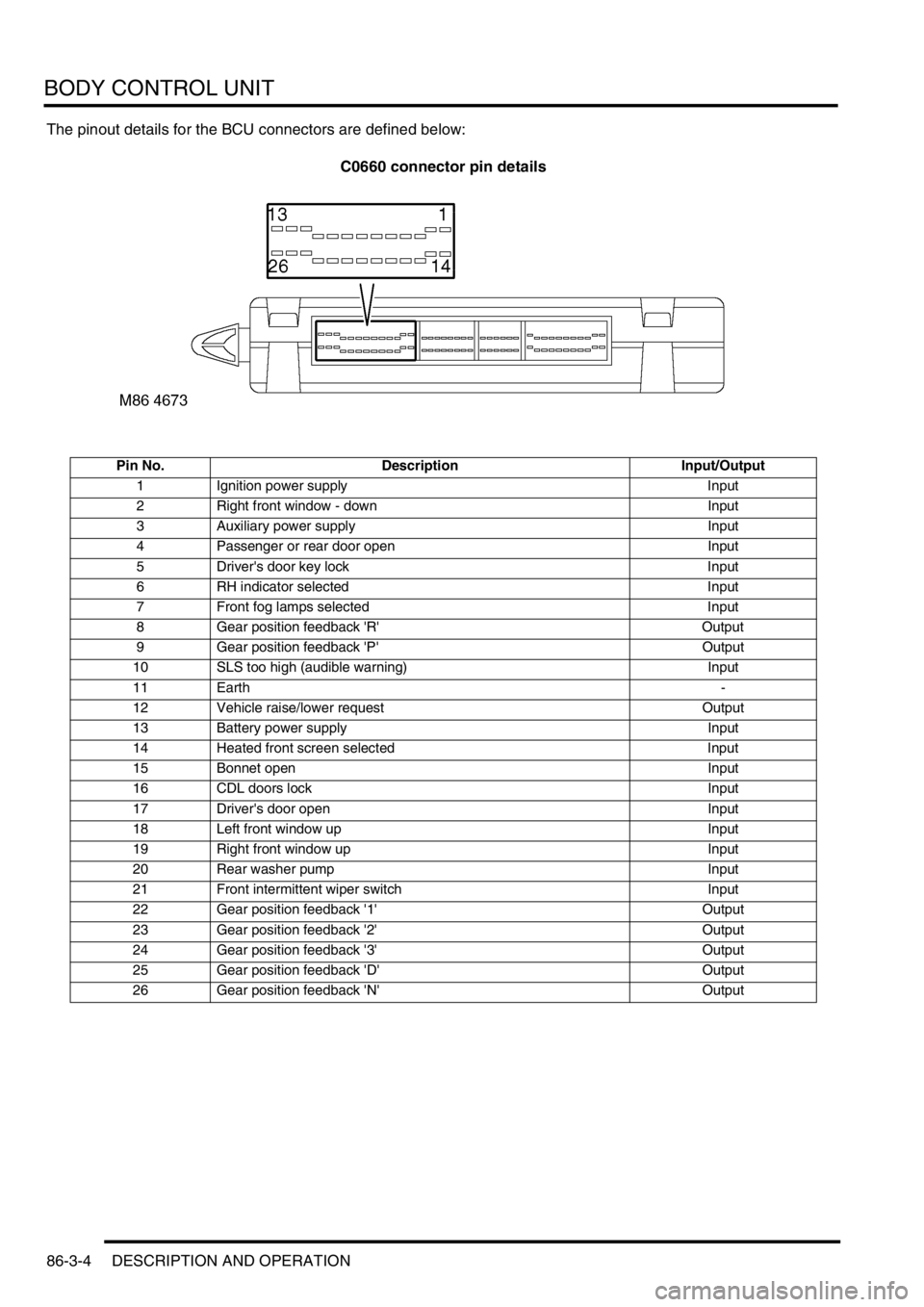
The pinout details for the BCU connectors are defined below:
C0660 connector pin details
Pin No. Description Input/Output
1 Ignition power supply Input
2 Right front window - down Input
3 Auxiliary power supply Input
4 Passenger or rear door open Input
5 Driver's door key lock Input
6 RH indicator selected Input
7 Front fog lamps selected Input
8 Gear position feedback 'R' Output
9 Gear position feedback 'P' Output
10 SLS too high (audible warning) Input
11 Earth-
12 Vehicle raise/lower request Output
13 Battery power supply Input
14 Heated front screen selected Input
15 Bonnet open Input
16 CDL doors lock Input
17 Driver's door open Input
18 Left front window up Input
19 Right front window up Input
20 Rear washer pump Input
21 Front intermittent wiper switch Input
22 Gear position feedback '1' Output
23 Gear position feedback '2' Output
24 Gear position feedback '3' Output
25 Gear position feedback 'D' Output
26 Gear position feedback 'N' Output
Page 1475 of 1672
BODY CONTROL UNIT
86-3-6 DESCRIPTION AND OPERATION
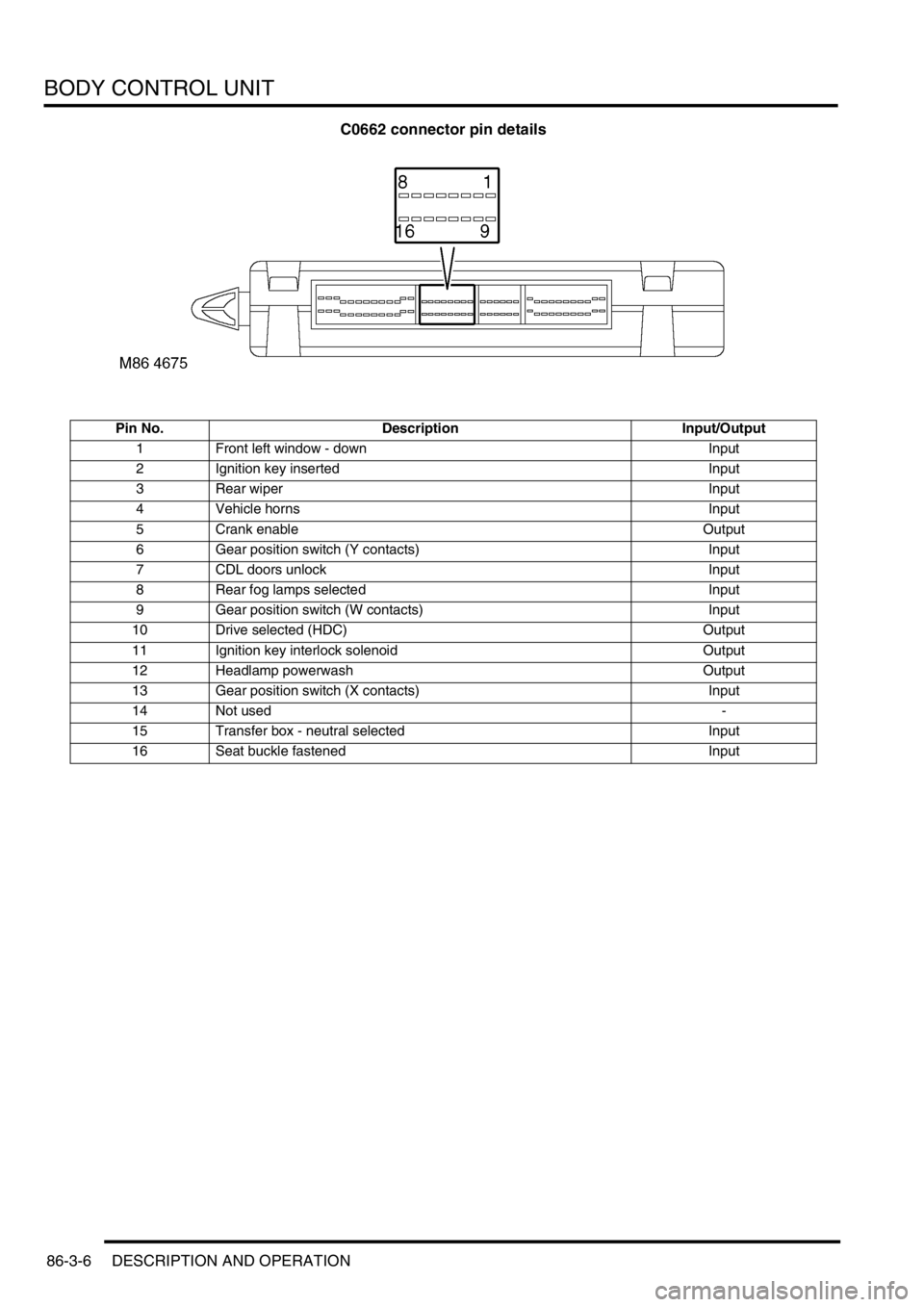
C0662 connector pin details
Pin No. Description Input/Output
1 Front left window - down Input
2 Ignition key inserted Input
3 Rear wiper Input
4 Vehicle horns Input
5 Crank enable Output
6 Gear position switch (Y contacts) Input
7 CDL doors unlock Input
8 Rear fog lamps selected Input
9 Gear position switch (W contacts) Input
10 Drive selected (HDC) Output
11 Ignition key interlock solenoid Output
12 Headlamp powerwash Output
13 Gear position switch (X contacts) Input
14 Not used-
15 Transfer box - neutral selected Input
16 Seat buckle fastened Input